Showing posts with label superfluidity. Show all posts

Tuesday, April 22, 2025

Superfluid phase discovered in molecular hydrogen for the first time since it was theoretically predicted in 1972

Amazing stuff!

"An international team led by chemists ... has reported strong experimental evidence for a superfluid phase in molecular hydrogen at 0.4 K.
This phase, theoretically predicted in 1972, had only been observed in helium and ultracold atomic gases until now, and never in molecules. The work could give scientists a better understanding of quantum phase transitions and collective phenomena. More speculatively, it could advance the field of hydrogen storage and transportation. ...

Previously, superfluidity had been observed in helium (3He and 4He) and in clusters of ultracold atoms known as Bose-Einstein condensates. In principle, molecular hydrogen (H2), which is the simplest and lightest of all molecules, should also become superfluid at ultracold temperatures. Like 4He, H2 is a boson, so it is theoretically capable of condensing into a superfluid phase. The problem is that it is only predicted to enter this superfluid state at a temperature between 1 and 2 K, which is lower than its freezing point of 13.8 K. ...

To keep their molecular hydrogen liquid below its freezing point ... confined small clusters of hydrogen molecules inside helium nanodroplets at 0.4 K. They then embedded a methane molecule in the hydrogen cluster and observed its rotation with laser spectroscopy. ..."

From the abstract:
"Molecular hydrogen (H2) has long been predicted to exhibit superfluidity—a state of zero viscosity—at extremely low temperatures. However, its existence remains under debate despite several experimental reports.
In this study, we investigated the infrared transitions of methane embedded in clusters of parahydrogen molecules at 0.4 K using high-resolution helium nanodroplet spectroscopy.
Our results revealed fully quantized rotational states of methane with minimal interference from surrounding H2 molecules, enabling precise determination of the rotational constant for each hydrogen cluster. The cluster-size dependence of the determined rotational constant aligns with behavior predicted by path-integral Monte Carlo simulations, indicating that more than 60% of the hydrogen molecules in the clusters participate in quantum bosonic exchanges, a characteristic feature of superfluidity.
This work provides strong experimental evidence for the existence of a superfluid phase of molecular hydrogen at 0.4 K, representing a major step forward in understanding quantum behaviors in molecular systems."

Superfluid phase spotted in molecular hydrogen for the first time – Physics World


Experimental apparatus and laser used by researchers at the University of British Columbia, RIKEN and Kanazawa University to demonstrate superfluidity in hydrogen


Friday, November 08, 2024

Quantum vortices confirm superfluidity in supersolid

Amazing (exotic) stuff! That is quite a super headline!

"Supersolids are a new form of quantum matter that has only recently been demonstrated. The state of matter can be produced artificially in ultracold, dipolar quantum gases. A team ... has now demonstrated a missing hallmark of superfluidity, namely the existence of quantized vortices as a system's response to rotation. They have observed tiny quantum vortices in the supersolid, which also behave differently than previously assumed. ...

Yet, more than 50 years ago, physicists predicted that quantum mechanics allows such a state, where a collection of indistinguishable particles can simultaneously exhibit seemingly contradictory properties. ...

Now, in a major breakthrough, quantized vortices have finally been observed in a rotating two-dimensional supersolid, providing the long-awaited confirmation of irrotational superfluid flow into a supersolid and marking a critical step forward in the study of modulated quantum matter. ..."

From the abstract:
"Supersolids are states of matter that spontaneously break two continuous symmetries: translational invariance owing to the appearance of a crystal structure and phase invariance owing to phase locking of single-particle wavefunctions, responsible for superfluid phenomena. Although originally predicted to be present in solid helium, ultracold quantum gases provided a first platform to observe supersolids, with particular success coming from dipolar atoms. Phase locking in dipolar supersolids has been investigated through, for example, measurements of the phase coherence and gapless Goldstone modes, but quantized vortices, a hydrodynamic fingerprint of superfluidity, have not yet been observed. Here, with the prerequisite pieces at our disposal, namely a method to generate vortices in dipolar gases and supersolids with two-dimensional crystalline order, we report on the theoretical investigation and experimental observation of vortices in the supersolid phase (SSP). Our work reveals a fundamental difference in vortex seeding dynamics between unmodulated and modulated quantum fluids. This opens the door to study the hydrodynamic properties of exotic quantum systems with numerous spontaneously broken symmetries, in disparate domains such as quantum crystals and neutron stars."

Quantum vortices confirm superfluidity in supersolid


Simulation of quantum vortices superimposed with experimental data.


Saturday, August 31, 2024

Physicists successfully observe Kibble–Zurek scaling in an atomic Fermi superfluid

Amazing stuff! Almost super exotic physics! 😊

"The Kibble–Zurek (KZ) mechanism is a theoretical framework introduced by physicists Tom Kibble and Wojciech Zurek. This framework essentially describes the formation of topological defects while systems undergo non-equilibrium phase transitions.
Researchers ... recently observed KZ scaling in a homogeneous and strongly interacting Fermi gas as it was transitioning into a superfluid. ...
While KZ scaling is applicable to a wide range of systems, including superfluids, ferroelectrics, superconductors, ion traps and Rydberg atom arrays, so far it has primarily been observed in some of these systems. The main objective of the study by Lee and his colleagues was to observe KZ scaling in a Fermi superfluid, which has so far proved particularly challenging. ..."

From the abstract:
"The Kibble–Zurek mechanism is a theoretical framework that describes the formation and scaling of topological defects in symmetry-breaking phase transitions. It was originally conceptualized for superfluid helium. The theory predicts that the number of quantum vortices should scale as a power law with the rate at which the system passes through the lambda transition, but demonstrating this effect has been elusive in experiments using superfluid systems. Here, we report the observation of Kibble–Zurek scaling in a homogeneous, strongly interacting Fermi gas undergoing a superfluid phase transition. We investigate the superfluid transition using temperature and interaction strength as two distinct control parameters. The microscopic physics of condensate formation is markedly different for the two quench parameters, as shown by the two orders of magnitude difference in the condensate formation timescale. However, regardless of the thermodynamic direction in which the system passes through a phase transition, the Kibble–Zurek exponent is identically observed to be about 0.68, in good agreement with theoretical predictions. This work experimentally demonstrates the theoretical proposal laid out for liquid helium, which is in the same universality class as strongly interacting Fermi gases."

Physicists successfully observe Kibble–Zurek scaling in an atomic Fermi superfluid


Time-of-flight image of an atomic cloud of 6Li, where the dark density depletions are quantum vortices


Tuesday, February 13, 2024

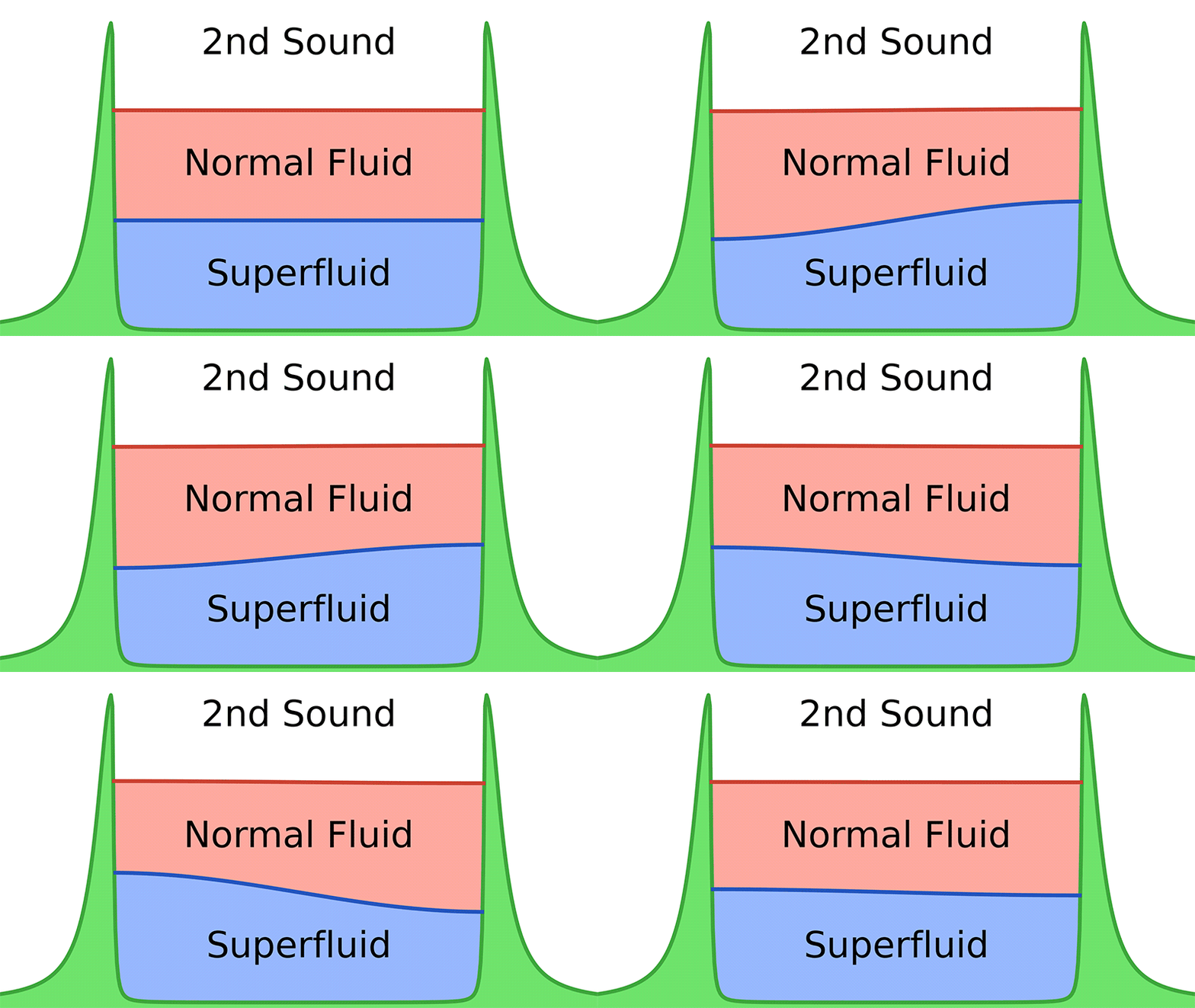
MIT physicists capture the first sounds of a second sound of heat “sloshing” in a superfluid made of fermions

Amazing stuff!

"... But in rare states of matter, heat can behave as a wave, moving back and forth somewhat like a sound wave that bounces from one end of a room to the other. In fact, this wave-like heat is what physicists call “second sound". ...
Under certain conditions, however, fermions can be made to strongly interact and pair up. In this coupled state, fermions can flow in unconventional ways. For their latest experiments, the team employs fermionic lithium-6 atoms, which are trapped and cooled to nanokelvin temperatures. ...
Since a fluid transitions into a superfluid at a certain critical, ultracold temperature, the MIT team reasoned that the two types of fluid should also transport heat differently: In normal fluids, heat should dissipate as usual, whereas in a superfluid, it could move as a wave, similarly to sound.
Second sound is the hallmark of superfluidity, but in ultracold gases so far you could only see it in this faint reflection of the density ripples that go along with it,” ... “The character of the heat wave could not be proven before.” ..."

From the abstract:
"Heat transport is a fundamental property of all physical systems and can serve as a fingerprint identifying different states of matter. In a normal liquid a hot spot diffuses while in a superfluid heat propagates as a wave called second sound. Despite its importance for understanding quantum materials, direct imaging of heat transport is challenging, and one usually resorts to detecting secondary effects, such as changes in density or pressure. Here we establish thermography of a strongly interacting atomic Fermi gas, a paradigmatic system whose properties relate to strongly correlated electrons, nuclear matter and neutron stars. Just as the color of a glowing metal reveals its temperature, the radiofrequency spectrum of the interacting Fermi gas provides spatially resolved thermometry with sub-nanokelvin resolution. The superfluid phase transition is directly observed as the sudden change from thermal diffusion to second sound propagation, and is accompanied by a peak in the second sound diffusivity. The method yields the full heat and density response of the strongly interacting Fermi gas, and therefore all defining properties of Landau’s two-fluid hydrodynamics. Our measurements serve as a benchmark for theories of transport in strongly interacting fermionic matter."

MIT physicists capture the first sounds of heat “sloshing” in a superfluid | MIT News | Massachusetts Institute of Technology The results will expand scientists’ understanding of heat flow in superconductors and neutron stars.