Showing posts with label smart devices. Show all posts

Tuesday, May 19, 2026

South Korea's LetinAR is building optics behind AI glasses

Good news!

"... Over the past few years, Big Tech has been quietly (and not so quietly) placing its bets. 
Meta has been selling AI-enabled Ray-Ban glasses since 2023,
Google is building Android XR, and Apple is expected to enter the market.
Last week, Samsung was reportedly set to unveil its first AI-capable smart glasses, co-designed with Gentle Monster, at a Galaxy Unpacked event in London 
this July. China’s Huawei, Alibaba, Xiaomi, and others are all moving too.

The numbers reflect the momentum. Global AI glasses shipments surged to 8.7 million units in 2025, up more than 300% from the prior year, and analysts project that figure will cross 15 million this year, per Omdia.

Suppliers and component makers of AI-powered smart glasses are also positioning themselves for what comes next. One of the companies, a South Korean startup called LetinAR, has spent the last decade building the optical technology that could make all of this actually wearable. ...

The LG Electronics-backed startup just secured $18.5 million ...

LetinAR doesn’t make the glasses. It makes the part that makes the glasses work. The optical module, the tiny lens component that projects images into your field of vision, is what determines whether a pair of smart glasses feels like a sci-fi headset or something you’d actually wear to work ... 
It has to be light, thin, and power-efficient, while still delivering a sharp, clear image. Getting all of that right in a single component, small enough to fit inside a normal-looking frame, is the central engineering challenge of the entire industry. That’s what LetinAR is building. ...

PinTILT sidesteps that trade-off ... By focusing only on the light that can actually enter the eye and carefully engineering the angle of each tiny element inside the lens, LetinAR claims it can produce a brighter image in a thinner, lighter form factor, using less power. ..."

South Korea's LetinAR is building optics behind AI glasses | TechCrunch


Wednesday, May 13, 2026

The obsession with school smartphone policies coninoues and it is narrowly focused on distraction. How stupid!

Here is another such study! How relevant is it how often a student checks his/her smartphone!

It is high time to integrate smartphones into school curricula!!! Banning is stupid!

Again this study also resorts to the totally antiquated term "cell phone" as if we are still living in the 1970s/1980s!

"A new RAND study finds that stricter school cell phone policies are associated with less student phone use in class, but even the most restrictive policies don’t completely stop students from checking their phones.

The study draws on survey data from the RAND American Youth Panel, a nationally representative panel of middle and high school students. Cell phone policies and how those policies are enforced vary widely among schools, so this approach provides a clearer picture of how those differences relate to student behavior. ..."

How School Cell Phone Policy Strictness Shapes Student Phone Use: Selected Findings from the American Youth Panel | RAND

Saturday, April 18, 2026

FBI says these apps downloaded from smartphone app storefronts let China suck up your personal data

I think this is plausible! These storefronts surely are valuable targets for espionnage.

Unlike the article below, I don't think these apps are limited to typical, popular Chinese apps like Temu, TikTok, Tencent etc. Any popular App could be affected.

"Centralized smartphone app storefronts, like Apple’s App Store for iPhone and the Google Play Store for Android, make apps feel like they all come from the same safe place online, but the developers behind these apps are spread out all over the world. This month, the FBI brought attention to international developers, warning that installing apps built by foreign nations could pose a major threat to user privacy and security. ..."

FBI says these apps let China suck up your personal data (behind paywall)

Tuesday, December 02, 2025

Samsung launches its first tri-fold smartphone to test consumer appetite

I have my doubts about this new product even though Samsung is an excellent smartphone maker!

I think, I will wait for the four-fold phone! Caution: satire!

According to Google search: "The first tri-fold smartphone, the Huawei Mate XT, was introduced in China on September 20, 2024. Samsung followed with its Galaxy Z TriFold, which was announced on December 1, 2025"

Samsung launches its first tri-fold smartphone to test consumer appetite - Nikkei Asia


Thursday, September 18, 2025

Tuesday, August 12, 2025

Does it make sense to ban smartphones or their use by children from schools?

Not really! Prohibition rarely if ever works! Banning is a sign of cluelessness!

It is one thing to ban drugs, alcohol, and guns from schools, but smartphones?

There should be smarter ways to integrate smartphones, or other smart devices or even AI into curriculum of schools to benefit the students and their learning!

"A fast-growing network of American parents is seeking to curb the influence of smartphones and social media on their children’s health—and they are starting with schools.  

Bans and “bell-to-bell” policies: Much parent-led advocacy so far has focused on making schools smartphone-free environments. Once highly unpopular, such bans are quickly gaining traction:
74% of U.S. adults now support preventing students from using their phones during class, while 44% support all-day bans, per a Pew Research Center study from July.

37 states and D.C. have passed laws limiting classroom phone use, with about half passing all-day bans. ..."

Global Health NOW: U.S. FDA’s Slipshod Protection for Generics; Sierra Leone’s ‘Red Zone’; and The Push for Phone-Free Schools

Sunday, July 13, 2025

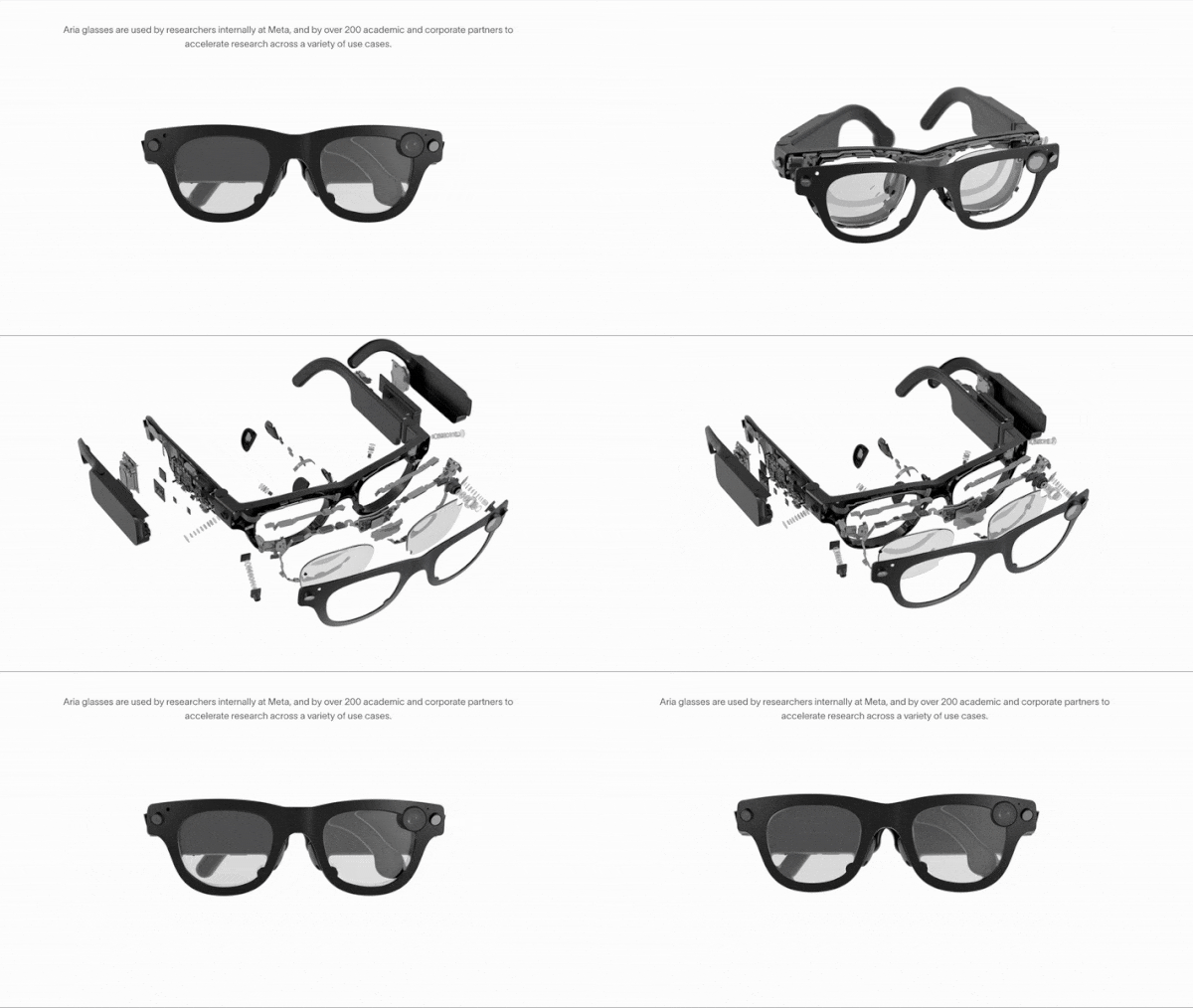
Meta’s new Aria Gen 2 Sensor-Packed Glasses

Very impressive, but will it be too cumbersome and heavy (75 grams)?

"Meta revealed new details about its latest Aria eyeglasses, which aim to give AI models a streaming, multisensory, human perspective.

What’s new: Meta described its Aria Gen 2 smart-glasses platform in a blog post that focuses on capabilities relevant to research in augmented reality, “embodied AI” such as robot training, and “contextual AI” for personal use. Units will be available to researchers later this year. Meanwhile, you can apply for access to Aria Generation 1 and download open source datasets, models, tools, 3D objects, and evals.

How it works: Aria Generation 2 packs an impressive variety of technologies into a package the shape of a pair of glasses and the weight of an egg (around 75 grams), with battery life of 6 to 8 hours. A suite of sensors enables the unit, in real time, to interpret user activity (including hand motions), surroundings, location, and interactions with nearby compatible devices. A privacy switch lets users disable data collection.

A Qualcomm SD835 chip with 4GB RAM and 128GB storage processes input and output on the device itself. Users can stream the unit’s output, such as video, audio, and 3D point clouds, to a local PC or upload it for processing by perception services via cloud-based APIs.

The unit includes five cameras: An RGB camera captures the user’s point of view. Two more help track the user’s visual attention based on gaze direction per eye, vergence point, pupil diameters, and blinking. A stereoscopic pair helps map the surroundings in three dimensions via simultaneous localization and mapping (SLAM). In addition, an ambient light sensor helps control camera exposure. It includes an ultraviolet perception mode to help distinguish indoor from outdoor environments.

Seven microphones help to monitor surrounding sounds and their locations. A separate contact microphone picks up the user’s voice, helping to make the user intelligible in noisy environments. A pair of open-ear speakers reproduces sounds.

Other sensors include two motion-sensing inertial measurement units (IMUs), a barometer, and a magnetometer to help track the unit’s motion and orientation; global navigation satellite receiver to help track its location; and a photoplethysmography (PPG) sensor to detect the user’s heart rate. Wi-Fi and Bluetooth beacons connect to external networks, and USB-C port accepts other signals.

A common clock calibrates and time-stamps most sensor readings with nanosecond resolution to synchronize with external devices including nearby Aria units. ..."

Amazon’s $100 Billion Bet, Meta’s Sensor-Packed Glasses, Anthropic’s Reason-Free Reasoning, Google’s Extreme Weather Prediction


Wednesday, July 09, 2025

Fitness App Trap: World Leaders Exposed by Strava with Palki Sharma

Very recommendable! A serious security issue! When bodyguards of VIPs upload their Strava data, the enemy learns the whereabouts and movements!