Showing posts with label radioactive decay. Show all posts

Friday, August 28, 2026

Using airborne sensors for Gamma rays to predict tree die-offs in Australia

Amazing stuff! Good news!

"... In a new study, they present a surprising new tool: gamma rays. Beneath the surface of the parched forests lies thick, granite-rich bedrock, which gradually breaks down and leaves potassium-40-rich minerals in the surrounding soils. Potassium-40 produces gamma rays as it decays—and over millions of years of weathering, the researchers reasoned that the gamma-ray signal should be stronger where soils were shallow and full of potassium-40. Shallow soils in turn mean that tree roots have less room to stretch out for water during drought.

Gamma-ray measurements of three forested areas spanning 400 to 900 square kilometers overlapped neatly with the [conventional] electrical measurements.
In fact, gamma rays were a better predictor of tree mortality than the go-to explanations of the slope of the land or the proximity of trees to streams. The technique could be applied throughout the globe, since one-third of Earth’s ice-free land boasts similar kinds of bedrock and weathered soils. ..."

"... The method revealed that all die-off spots had soils 12 meters deep or less, which made it harder for tree roots to stretch out and access water. But it was incredibly labor intensive, requiring the team to lay electrodes across the forest floor. ...

Still, some applications have already begun: Mining companies operating in the same Western Australian forests have been flying gamma ray sensors to understand the surface geology, but are now considering how much soil should be restored after their operations cease ..."

"... Using airborne sensors, the research team measured gamma rays produced by the natural decay of potassium-40, a naturally occurring radioactive isotope found in rocks and soils. In the highly weathered landscapes of south-west Western Australia, potassium has largely been leached from the soil over millions of years, meaning stronger potassium signals often indicate that bedrock is closer to the surface. ..."

From the abstract:
"Extreme drought and heat are driving forest die-off globally, yet regional-scale mapping of subsurface water storage capacity, governing forest vulnerability, remains a major challenge.
Here, we demonstrate that airborne gamma-ray spectrometry (GRS) of potassium (40K) decay provides a powerful proxy for subsurface constraints on water availability.
In southwestern Australia, we found that spatial patterns of forest die-off during an extreme 2023–2024 drought-heat event were strongly predicted by surficial 40K concentrations.
While GRS measures the upper ∼30 cm of soil
plot-scale electrical resistivity tomography suggests that elevated 40K signals shallow granite or gneiss bedrock, to depths reaching several tens of meters due to leaching of mobile elements, remnant bedrock minerals, erosional thinning of regolith and biological nutrient recycling from K-rich saprolite.
Airborne GRS can map forest vulnerability across highly leached landscapes, which cover one-third of Earth's ice-free land surface. This enables targeted adaptive management of forests for future drought-heat intensification."

ScienceAdviser


Scientists use natural radiation to predict which forests are most vulnerable to drought (original news release) "What do bananas and drought-stressed forests have in common? According to new research led by the Department of Biodiversity, Conservation and Attractions (DBCA) in collaboration with Murdoch University, both contain potassium and a tiny amount of naturally occurring radiation that can reveal important clues about the world around us."


Fig. 1 The forests of southwestern Australia occur on highly leached soils and experienced die-off during a record-breaking drought and heat event in 2023–2024.(a), (b)Study region in southwestern Australia; ...
(c) historical (from 1923) and recent 18-month cumulative rainfall ;
(d) 30-day running mean temperatures; and a 
 (e) global map of strongly leached soils, similar to those in this study, with the potential for gamma rays to signal drought vulnerability.


Thursday, April 16, 2026

New laser method gives insight into radioactive atomic nuclei size and shape of Actinides

Amazing stuff!

"... They have developed a new analysis method using a pulsed laser, based on an Optical Parametric Oscillator (OPO). This laser technology can achieve wavelengths and colours that conventional laser systems struggle to produce with sufficient intensity and wavelength precision.

The laser pulses are directed at the atoms, revealing small changes in energy in the wavelengths that are absorbed. ... 

The results of the study can be used to refine theoretical models of atoms and atomic nuclei, making it easier to identify new possible elements and isotopes in future experiments. ..."

New laser method gives insight into radioactive atomic nuclei

New laser method gives insight into radioactive atomic nuclei (original news release) "By directing pulses of laser light at atoms, researchers can study how radioactive elements decay in a matter of seconds. The method is described in a new thesis from the University of Gothenburg, which shows that the atomic nuclei of the elements neptunium and fermium are shaped like rugby balls."


Shapes of an atomic nucleus. The nucleus is always prolate-shaped for fermium-255, but it can vary, for the same element, depending on how many neutrons the nucleus has.


Friday, January 02, 2026

Did natural radioactivity help with habitability on Earth during the time of the primordial soup?

Amazing stuff!

"Habitability gets funky on worlds outside our own. While plants use sunlight for energy and animals, in turn, use plants, life in the subsurface oceans of icy moons has to find another way. New research suggests that primordial life could take advantage of radioactively decaying elements in rocks.

Typically, planetary scientists have thought that hydrothermal vents on Jupiter’s fourth-largest moon, Europa, spurred the rocky reactions needed to generate free energy for life in the form of movable electrons. ...

A team has theorized that trace radioactive elements in rocks, such as uranium-238 and phosphorus-40, might dissolve into the water over time, decaying and releasing heat. That heat could split apart water molecules, generating hydrogen and oxygen ions with available electrons—and thus energy for life. ..."

From the abstract:
"Europa and other icy ocean worlds have long been considered prime targets for astrobiology. Their potential for habitability has generally been thought to depend on chemical disequilibria produced by ongoing water-rock interaction. However, recent studies have raised questions about whether such interactions are currently active on Europa (Byrne et al. 2024, Austin et al. 2025). In addition to the ocean, the presence of liquid water bodies within the ice shell—so-called perched lakes--has been suggested (Schmidt et al. 2011). The latter represents another potential environment for future astrobiological exploration. Both of these environments where liquid water is present at Europa, but water-rock interaction may not currently be active, motivate consideration of alternative mechanisms for sustaining chemical energy sources.
We examine a novel mechanism in which the decay of radioactive isotopes (e.g., ⁴⁰K, 235U, ²³⁸U) drives liquid water radiolysis, generating local chemical disequilibria that could support microbial metabolism.
Our modeling shows that even low concentrations of these isotopes can produce both significant oxidants and reductants in aqueous environments without active water-rock interaction.
Depending on the salinity, these redox gradients could support approximately 1,000 microbial cells per liter under conditions similar to those inferred for Enceladus’s ocean, and up to 20,000 cells per liter at salinities comparable to terrestrial seawater. These values fall within the range of previous estimates for Europa’s ocean (~ 100-100,000 cells per liter, Hand+2017) and the equivalent biomass would be approximately 1023 - 1026 cells, comparable to the biomass of roughly 1,000-1,000,000 blue whales.
The decay of ⁴⁰K also leads to the production of ⁴⁰Ar, which could be detected by Europa Clipper’s MASPEX.
This mechanism offers a new perspective on the potential habitability of icy ocean worlds that may lack active water-rock interaction, i.e. Titan, Ganymede, and the Uranian moons."

ScienceAdviser

Life in Europa’s ocean could feed on rocks’ radioactive decay "After series of bleak findings, theory sparks hope for alternative energy source within Jupiter’s intriguing moon"

Thursday, October 02, 2025

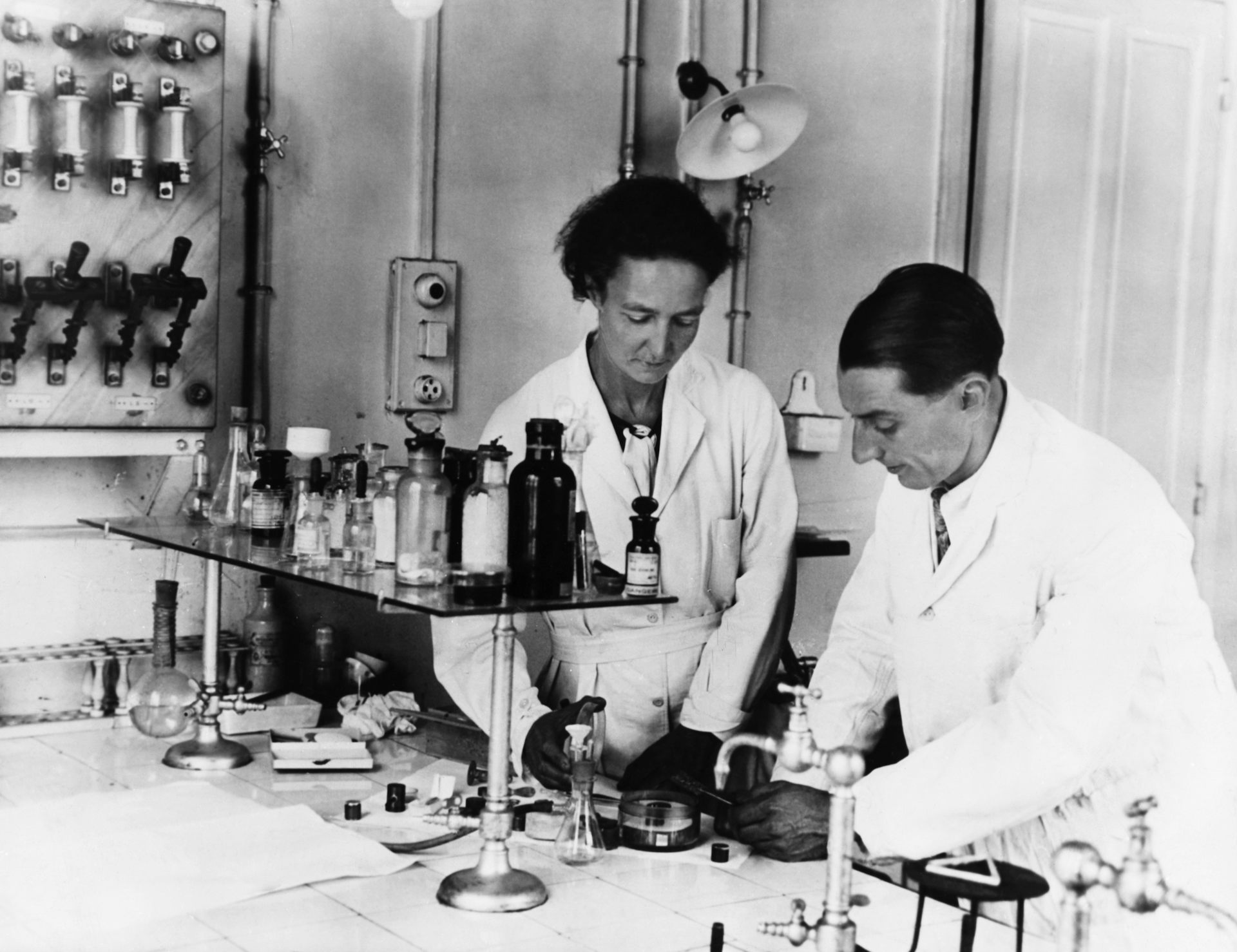
Meet Irene Curie, the Nobel-winning atomic physicist who together with her husband discovered artificial radioactivity

Very recommendable! The many similarities between Marie Curie & Pierre Curie and Irene Curie &  Frederic Joliot are stunning!

She was homeschooled!

"The adage goes “like mother like daughter,” and in the case of Irene Joliot-Curie, truer words were never spoken. She was the daughter of two Nobel Prize laureates, Marie Curie and Pierre Curie, and was herself awarded the Nobel Prize in chemistry in 1935 together with her husband, Frederic Joliot.

While her parents received the prize for the discovery of natural radioactivity, Irene’s prize was for the synthesis of artificial radioactivity. This discovery changed many fields of science and many aspects of our everyday lives. Artificial radioactivity is used today in medicine, agriculture, energy production, food sterilization, industrial quality control and more. ...

World War I started in 1914, when Irene was only 17, and she interrupted her studies to help her mother find fragments of bombs in wounded soldiers using portable X-ray machines. She soon became an expert in these wartime radiology techniques, and on top of performing the measurements herself, she also spent time training nurses to use the X-ray machines.

After the war, Irene went back to her studies in her mother’s lab at the Radium Institute. This is where she met fellow researcher Frederic Joliot, whom she later married. The two worked together on many projects, which led them to their major breakthrough in 1934. ..."

Meet Irene Curie, the Nobel-winning atomic physicist who changed the course of modern cancer treatment


Irene and Frederic Joliot-Curie shared the Nobel Prize in 1935. 


"In Irene and Frederic’s experiments, an isotope of aluminum was hit with an alpha particle (two neutrons and two protons bound together). The collision resulted in two protons and a neutron from the alpha particle binding to the aluminum, making it an isotope of phosphorus, which decayed, releasing a particle called a positron." 


"Scientists graph the known isotopes in the chart of nuclei. They have discovered roughly 3,000 radioisotopes (shown with cyan boxes) and predict the existence of another 4,000 radioisotopes (shown with gray boxes)."


Sunday, February 18, 2024

Chernobyl mutant wolves appear to have developed some type of resistance to cancer

Amazing stuff! Like pathogens train the immune system ...

"... The Chernobyl disaster occurred on April 26, 1986, in the then Soviet Union. It stands as one of the most catastrophic nuclear accidents in history. ...
Overall, the researchers found that the wolves are exposed to up to 11.28 millirem of radiation every day. That’s kind of like taking a chest X-ray every day — over 6 times the normal safe limit for humans. But what was more intriguing is how the wolves responded to radiation. ...
... found that the immune systems of the wolves had adapted to change. In fact, researchers found some of the markers that cancer patients undergoing radiation treatment also exhibit — suggesting that the wolves’ immune systems are taking steps to fight the radiation. ... Some parts of the wolves’ genetic information seemed to be remarkably resilient to increased cancer risk. ..."

"... No, they don’t glow in the dark.
Gray wolves have flourished in the exclusion zone. Their population density is estimated to be 7x greater within the CZE than in surrounding reserves. Unlike comic book depictions, these wolves don’t glow in the dark. In fact, they are indistinguishable from their European counterparts.  ..."

The research has not yet been published.

Chernobyl mutant wolves appear to have developed some type of resistance to cancer In the radioactive exclusion zone of Chernobyl the immune systems of wild wolves have undergone striking adaptation.

Taking back Chernobyl (Project website)

Cara Love researching the wolves around Chernobyl


Wednesday, October 11, 2023

Radioaktive Belastung: Der strahlende Makel chinesischer Windräder

Tolle Schlagzeile! Saubere Energie und umweltfreundlich soll es sein! Wer es glaubt wird selig!

Habe hier (in Englisch) kürzlich über den zunehmenden Müll durch abgenutzte Windmühlen berichtet.

Radioaktive Belastung: Der strahlende Makel chinesischer Windräder In den Magneten von Windrädern ist jede Menge Neodym verbaut, durch dessen Abbau Radioaktivität freigesetzt wird. Eine kritische Lebenszyklus-Analyse deutscher Radioökologen.

Sunday, July 12, 2020

More evidence for a ‘fifth force’ found in radioactive decay measurements

Amazing stuff, but not yet confirmed!

"Anomalies in the radioactive decay of beryllium-8 and helium-4 point to the existence of a new force of nature. That is the conclusion of a group of theorists in the US, who have scrutinized data from experiments carried out by nuclear physicists in Hungary over the past five years."