Showing posts with label quantum computing. Show all posts

Wednesday, August 19, 2026

IBM Connects Its First Modular Cryogenic Systems in Milestone Toward Fault-Tolerant Quantum Computing

Good Big Blue news! From punch card mainframe to quantum computing! What a business story!

"
• New cryogenic quantum fridges designed to link hundreds of quantum chips.
Cooled to below 15 millikelvin, more than 180 times colder than deep space, the build out marks a step forward in the engineering required for future quantum computers.
• Advances IBM’s quantum roadmap to deliver the world’s first fault-tolerant quantum computer in 2029.
...

it has successfully joined and cooled down two cryogenic modules into a single environment. The new architecture is designed to scale into the modular, shared, and ultra-cold system required to link hundreds of quantum chips into a more powerful quantum computer capable of solving large problems. Its deployment is a milestone on IBM's path to delivering IBM Quantum Starling in 2029, which is expected to be the world's first fault-tolerant quantum computer and will integrate advances across error correction, processor design, decoding, and systems engineering. ...

IBM’s plans for Starling were introduced last year with a new error correction code that dramatically reduces the physical resources required for fault tolerance. Since then, the company’s progression has remained on course, including the demonstration of core hardware components and breakthroughs in efficient error-correction decoding. ..."

IBM Connects Its First Modular Cryogenic Systems in Milestone Toward Fault-Tolerant Quantum Computing


A cryogenic quantum fridge?


IBM Nostalgia, one of the first Personal Computers from 1984 (Source)


Monday, August 03, 2026

Quantum computers Modeling the chemistry of fusion reactor material

Good news! Is this just incremental progress or a major step forward?

"Quantum is aiding in the race to realize fusion energy by taking a step toward making the fuel for a fusion reactor. New work ... uses quantum computing to model molten salt—salt in a liquid phase. When wrapped around a fusion reaction like a blanket, molten salt could produce a rare fuel necessary to sustain that reaction: tritium.

The chemistry involved in extracting tritium from the molten salt is so complex that researchers have not been able to accurately model it using classical compute methods, and molten salt experiments are difficult and expensive, requiring immense energy and specialized equipment. Oak Ridge National Laboratory, Cleveland Clinic, and IBM showed how hybrid quantum-AI methods could yield better results, speeding the pace of fusion research. ..."

From the abstract:
"Molten salts such as FLiBe (2LiF--BeF2) are leading blanket materials for breeding and recovering tritium in fusion reactors.
Predicting tritium speciation requires accurate electronic ground-state energies for representative molten-salt clusters, a demanding task for correlated electronic-structure methods.
Here we report the first application of heterogeneous quantum--classical computing to tritium binding in FLiBe. Clusters drawn from ab initio molecular dynamics are partitioned by an embedded-wavefunction (EWF) method into atom-centered fragments, and the largest fragments are solved on IBM quantum hardware using extended sample-based quantum diagonalization (ext-SQD).
Across nine clusters, the heterogeneous quantum--classical workflow reproduces fragment ground-state energies with agreement to full configuration interaction within 0.7~kcal/mol and a mean absolute deviation of 0.3~kcal/mol.
In contrast, fragmented and unfragmented conformational energy differences and tritium binding energies differ by 12~kcal/mol and 110~kcal/mol on average, respectively, identifying fragment construction rather than fragment solution as the dominant source of algorithmic bias.
To the best of our knowledge, this is the first such demonstration for a charged ionic system and in particular an inorganic molten salt, where electrostatic and polarization effects make the accurate treatment of electronic correlation particularly challenging.
These results also identify areas of future research towards an accurate and scalable quantum--classical workflow to compute free-energy estimates of tritium speciation in fusion blankets."

Modeling the chemistry of fusion reactor material | IBM Quantum Computing Blog "Researchers used quantum-centric supercomputing to simulate molten salts, in an early step toward solving a key problem in fusion power."


Thursday, April 16, 2026

First complete genome loaded onto a quantum computer

Amazing stuff!

"Since the landmark decoding of the human genome in the early 2000s, DNA sequencing has exploded. Traditional computers have struggled to keep pace with the deluge of data and soaring processing demands, creating a bottleneck in scientists’ capacity to mine the myriad variations in DNA for biological insights—and a push for alternative solutions.

Now, one option, quantum computing, may be a step closer to helping. In an announcement last week, researchers say they have for the first time encoded a complete, albeit small, genome, that of the hepatitis D virus, into a quantum computer, proving in principle these weird machines could one day aid genomics research. ...

The approach may hold promise for studying the immense genetic variation found in humans and other organisms. Although geneticists have long relied on reference genomes represented by single linear sequences, they’re increasingly turning to “pangenomes,” which capture many possible DNA or RNA sequences within a species by branching into alternative versions. Pangenomes are seen as key to personalized medicine and understanding pathogen evolution, for example, but they’re computationally complex. ..."

"... The breakthrough comes from a collaboration between the Wellcome Sanger Institute and the Universities of Oxford, Cambridge and Melbourne, with Kyiv Academic University as an additional partner. The genome was loaded onto an IBM quantum computer, powered by the company’s latest 156-qubit Heron processor. ...

The goal of the Quantum Pangenomics project within Q4Bio was to perform a range of genomic processing tasks for the most complex and variable genomes and sequences – a task that can go beyond the capabilities of current classical computers, including the use of artificial intelligence. These tasks include assembling genomes and pangenomes from DNA sequence data, as well as mapping DNA fragments into reference genomes, which is key for studying genetic variation.

A pangenome is a collection of genome sequences from many individuals of the same species and they are particularly challenging to analyse using classical computing methods.2 Rather than representing a single reference genome, pangenomes capture the genetic diversity across many populations, which provides a more complete view of genetic variation. However, analysing multiple genomes at once dramatically increases computational complexity: as more genomes are incorporated into a pangenome, the burden on classical tools grows rapidly. ..."

First complete genome loaded onto a quantum computer | Science | AAAS "Researchers encode the tiny hepatitis D virus in an early step toward “quantum genomics”"

Genome loaded onto a quantum computer in world first (original news release) "Sanger Institute team and their collaborators have successfully loaded the Hepatitis D viral genome on a quantum computer "

Sunday, February 22, 2026

Triplet superconductivity—physicists may have found the missing link for quantum computers

Amazing stuff!

Google search: "Triplet superconductivity is an exotic, rarely observed state of matter where electrons pair up with parallel spins (spin triplet S=1), in contrast to conventional "singlet" superconductors (spin S=0) where spins are antiparallel."

"... "Triplet superconductors make a number of unusual physical phenomena possible. These phenomena have important applications in quantum technology and spintronics," said Linder.

More detailed information about these applications:

The reason triplet superconductors can transfer spin without energy loss is that the superconducting particles now carry spin with them.
Triplet superconductors can also be used to create a very exotic type of particle called a "Majorana particle."
A Majorana particle is its own antiparticle. Therefore, it can perform calculations in a quantum computer in a stable way. ...

Conventional superconductors are so-called "singlet superconductors." In simple terms, this means that the superconducting particles do not have spin.
In triplet superconductors, however, the superconducting particles have spin. ...

"The fact that triplet superconductors have spin has an important consequence. We can now transport not only electrical currents but also spin currents with absolutely zero resistance," ...."

From the abstract:
"NbRe is a noncentrosymmetric superconductor that has been proposed as a candidate for intrinsic spin-triplet pairing. However, a conclusive demonstration of triplet pairing in NbRe is yet to be found. To probe the presence of spin-triplet Cooper pairs, we fabricated Py/NbRe/Py trilayers capped with an antiferromagnetic layer.
Magnetic and electrical measurements reveal an inverse spin-valve effect, which could indicate equal-spin-triplet superconductivity. The minimal sample structure and the lack of ad hoc engineered interfaces clearly associate our observation to intrinsic triplet correlations of NbRe. The availability of NbRe in thin-film form and the simplicity of the heterostructure highlight its potential as a scalable platform for superconducting spintronics."

Triplet superconductivity—physicists may have found the missing link for quantum computers


Wednesday, December 03, 2025

Scientists achieve breakthrough on quantum signaling at room temperature

Good news!

"In brief
  • Researchers developed a room-temperature quantum communication device, removing the need for super-cooling and enhancing practical applications.
  • The device utilizes twisted light from molybdenum diselenide to entangle photons and electrons, stabilizing quantum states for effective communication.
  • Researchers are refining the device to achieve greater quantum performance, aiming to eventually miniaturize quantum systems for embedding in everyday devices.
Present-day quantum computers are big, expensive, and impractical, operating at temperatures near -459 degrees Fahrenheit, or “absolute zero.” In a new paper, however, materials scientists at Stanford University introduce a new nanoscale optical device that works at room temperature to entangle the spin of photons (particles of light) and electrons to achieve quantum communication – an approach that uses the laws of quantum physics to transmit and process data. The technology could usher in a new era of low-cost, low-energy quantum components able to communicate over great distances. ..."

From the abstract:
"Transition metal dichalcogenides possess valley pseudospin, enabling coupling between photon spin and electron spin for classical and quantum information processing. However, rapid valley-dephasing processes have impeded the development of scalable, high-performance valleytronic devices operating at room temperature.
Here we demonstrate that a chiral resonant metasurface can enable room-temperature valley-selective emission in MoSe2 monolayers independent of excitation polarization. This platform provides circular eigen-polarization states with a high quality factor (Q-factor) and strong chiral near-field enhancement. The fabricated Si chiral metasurfaces exhibit chiroptical resonances with Q-factors up to 450 at visible wavelengths.
We reveal degrees of circular polarization (DOP) reaching a record high of 0.5 at room temperature. Our measurements show that the high DOP can be attributed to the significantly increased chiroptical local density of states, which enhances valley-specific radiative transition rates by a factor of ~13. Our work could facilitate the development of ultracompact chiral classical and quantum light sources."

Scientists achieve breakthrough on quantum signaling | Stanford Report "A tiny device that entangles light and electrons without super-cooling could revolutionize quantum tech in cryptography, computing, and AI."


The nanoscale optical device works at room temperature to entangle the spin of photons and electrons to achieve quantum communication.


Sunday, November 23, 2025

Ten-ion system brings us a step closer to large-scale qubit registers

Good news!

"Researchers in Austria have entangled matter-based qubits with photonic qubits in a ten-ion system. The technique is scalable to larger ion-qubit registers, paving the way for the creation of larger and more complex quantum networks. ..."

"... To make such a network possible, so-called quantum network nodes — that can store quantum information and share it via light particles – are needed. In their latest work, the ... team ... demonstrated such a node using a string of ten calcium ions in a prototype quantum computer. By carefully adjusting electric fields, the ions were moved one by one into an optical cavity. There, a finely tuned laser pulse triggered the emission of a single photon whose polarization was entangled with the ion’s state. ..."

From the abstract:
"Establishing networks of quantum processors offers a path to scalable quantum computing and applications in communication and sensing. This requires first developing efficient interfaces between photons and multiqubit registers.
In this Letter, we show how to entangle each individual matter qubit in a register of ten to a separate traveling photon. The qubits are encoded in a string of cotrapped atomic ions.
By switching the trap confinement, ions are brought one at a time into the waist of an optical cavity and emit a photon via a laser-driven cavity-mediated Raman transition.
The result is a train of photonic qubits, each near-maximally entangled by their polarization with a different ion qubit in the string. An average ion-photon Bell state fidelity of 92% is achieved, for an average probability for detecting each single photon of 9%.
The technique is directly scalable to larger ion-qubit registers and opens up the near-term possibility of entangling distributed networks of trapped-ion quantum processors, sensing arrays, and clocks."

Ten-ion system brings us a step closer to large-scale qubit registers – Physics World

Pow­er­ful nodes for quan­tum net­works (original news release) "Researchers at the University of Innsbruck have created a system in which individual qubits — stored in trapped calcium ions — are each entangled with separate photons. Demonstrating this method for a register of up to 10 qubits, the team has shown an easily scalable approach that opens new possibilities for linking quantum computers and quantum sensors."


One by one, each ion-qubit is moved into an optical cavity, where mirrors efficiently collect the photons emitted by the ion-qubit. Each photon emerges entangled with its ion-qubit, forming a deep quantum link.


Saturday, November 22, 2025

IBM and Cisco Announce Plans to Build a Network of Large-Scale, Fault-Tolerant Quantum Computers and quantum computing Internet

Amazing how this once famous network gear/device maker (Cisco Systems) and pioneer of local area networks (LANs) has transformed!

"- New collaboration plans to unite strengths of both leaders to design a connected network of large-scale, fault-tolerant quantum computers, targeted by early 2030s
- Companies plan to deliver an initial demonstration of multiple networked quantum computers within five years
- Distributed quantum network could lay groundwork towards quantum computing internet defined by quantum computers, sensors, and communication in the late 2030s
...."

IBM and Cisco Announce Plans to Build a Network of Large-Scale, Fault-Tolerant Quantum Computers


Sunday, November 16, 2025

How quantum computers can aid the search for room-temperature superconductors

Good news! Amazing stuff!

"For the first time, a quantum computer has successfully measured pairing correlations (quantum signals that show electrons teaming up in pairs), which is essential to helping scientists find one of the holy grails of physics—superconductors that work at room temperature. ..."

"... In our work, we've simulated three different regimes of the Fermi-Hubbard model and successfully measured non-zero superconducting pairing correlations — a first for any quantum computing platform.

We began by preparing a low-energy state of the model at half-filling — a standard benchmark for testing quantum simulations. Then, using simulated laser pulses or electric fields, we perturbed the system and observed how it responded.

After these perturbations, we measured a notable increase in the so-called “eta” pairing correlations, a mathematical signature of superconducting behavior. These results prove that our computers can help us understand light-induced superconductivity ... Helios offers a new level of control and insight. By tuning every aspect of the simulation — from pulse shape, to field strength, to lattice geometry — researchers can explore scenarios that are completely inaccessible to real materials or analog simulators. ..."

From the abstract:
"The Fermi-Hubbard model is the starting point for the simulation of many strongly correlated materials, including high-temperature superconductors, whose modelling is a key motivation for the construction of quantum simulation and computing devices.
However, the detection of superconducting pairing correlations has so far remained out of reach, both because of their off-diagonal character-which makes them inaccessible to local density measurements-and because of the difficulty of preparing superconducting states.
Here, we report measurement of significant pairing correlations in three different regimes of Fermi-Hubbard models simulated on Quantinuumś Helios trapped-ion quantum computer. Specifically, we measure non-equilibrium pairing induced by an electromagnetic field in the half-filled square lattice model, d-wave pairing in an approximate ground state of the checkerboard Hubbard model at."

How quantum computers can aid the search for room-temperature superconductors

Helios Delivers Quantum Advantage with Real-World Impact (original news release) "A breakthrough in room-temperature superconductivity simulation opens doors to transformative technologies"


Figure 1: A rendering of the Quantinuum Helios system deployed at a customer site. 


Saturday, November 15, 2025

Inside IBM’s MIND-BLOWING Quantum computer

Recommendable! From mainframe to one of the first commercial PC (personal computer) to quantum computing! An amazing transformation of IBM over 6-7 decades!

Sunday, October 12, 2025

Scientists finally prove that a quantum computer can unconditionally outperform classical computers

Good news!

"A quantum computer has demonstrated that it can solve a problem more efficiently than a conventional computer. This achievement comes from being able to unlock a vast memory resource that classical computing cannot match. ...

They constructed a complicated mathematical task designed to test this memory advantage. Their experiment was like a game between two parts of the quantum system referred to as Alice and Bob. Alice's task was to create a quantum state and send it in a message to Bob, who had to measure it to figure out what it was. The goal was to build a process so accurate that Bob could predict the state before Alice finished preparing the message.

The researchers optimized this process over 10,000 independent trials, and their analysis revealed that a classical computer would need at least 62 bits of memory to complete the task with the same success rate. The quantum device performed it using only 12 qubits. ..."

From the abstract:
"A longstanding goal in quantum information science is to demonstrate quantum computations that cannot be feasibly reproduced on a classical computer. Such demonstrations mark major milestones: they showcase fine control over quantum systems and are prerequisites for useful quantum computation.
To date, quantum advantage has been demonstrated, for example, through violations of Bell inequalities and sampling-based quantum supremacy experiments. However, both forms of advantage come with important caveats: Bell tests are not computationally difficult tasks, and the classical hardness of sampling experiments relies on unproven complexity-theoretic assumptions.
Here we demonstrate an unconditional quantum advantage in information resources required for a computational task, realized on Quantinuum's H1-1 trapped-ion quantum computer operating at a median two-qubit partial-entangler fidelity of 99.941(7)%.
We construct a task for which the most space-efficient classical algorithm provably requires between 62 and 382 bits of memory, and solve it using only 12 qubits.
Our result provides the most direct evidence yet that currently existing quantum processors can generate and manipulate entangled states of sufficient complexity to access the exponentiality of Hilbert space.
This form of quantum advantage -- which we call quantum information supremacy -- represents a new benchmark in quantum computing, one that does not rely on unproven conjectures."

Scientists finally prove that a quantum computer can unconditionally outperform classical computers


Saturday, September 27, 2025

Physicists demonstrate 3,000 quantum-bit system capable of continuous operation

Good news! Very impressive (resulted in three papers)! This could be a breakthrough! We are getting there!

When will I get my hands on the first personal quantum computer like the IBM PC way back then when I was a very young adult?

I just blogged here a few days ago about another, very recent breakthrough in quantum computing (also mentioned in the article below), a 6,100-qubit system by Caltech!

"One often-repeated example illustrates the mind-boggling potential of quantum computing: A machine with 300 quantum bits could simultaneously store more information than the number of particles in the known universe.

Now process this: Harvard scientists just unveiled a system that was 10 times bigger and the first quantum machine able to operate continuously without restarting. ...

the team demonstrated a system of more than 3,000 quantum bits (or qubits) that could run for more than two hours, surmounting a series of technical challenges and representing a significant step toward building the super computers, which could revolutionize science, medicine, finance, and other fields. ...

In the new study, the team devised a system to continually and rapidly resupply qubits using “optical lattice conveyor belts” (laser waves that transport atoms) and “optical tweezers” (laser beams that grab individual atoms and arrange them into grid-like arrays). The system can reload up to 300,000 atoms per second. ... “That really is solving this fundamental bottleneck of atom loss.” ... Over two hours, more than 50 million atoms had cycled through the system. ...

The new study advances a fast-developing frontier of research. In fact, this week a team from Caltech published a 6,100-qubit system, but it could only run for less than 13 seconds. ...

The approach allows the connectivity of the processor to be changed during the process of computation. In contrast, most existing computer chips — like the ones in your cellphone or desktop — have fixed connectivity. ..."

From the abstract (1):
"Neutral atoms are a promising platform for quantum science, enabling advances in areas ranging from quantum simulations and computation to metrology, atomic clocks and quantum networking.
While atom losses typically limit these systems to a pulsed mode, continuous operation could significantly enhance cycle rates, remove bottlenecks in metrology, and enable deep-circuit quantum evolution through quantum error correction.
Here we demonstrate an experimental architecture for high-rate reloading and continuous operation of a large-scale atom array system while realizing coherent storage and manipulation of quantum information.
Our approach utilizes a series of two optical lattice conveyor belts to transport atom reservoirs into the science region, where atoms are repeatedly extracted into optical tweezers without affecting the coherence of qubits stored nearby. 
Using a reloading rate of 300,000 atoms in tweezers per second, we create over 30,000 initialized qubits per second, which we leverage to assemble and maintain an array of over 3,000 atoms for more than two hours.
Furthermore, we demonstrate persistent refilling of the array with atomic qubits in either a spin-polarized or a coherent superposition state while preserving the quantum state of stored qubits.
Our results pave the way for realization of large-scale continuously operated atomic clocks, sensors, and fault-tolerant quantum computers."

From the abstract (2):
"Fast, reliable logical operations are essential for realizing useful quantum computers. By redundantly encoding logical qubits into many physical qubits and using syndrome measurements to detect and correct errors, we can achieve low logical error rates.
However, for many practical quantum error correction codes such as the surface code, owing to syndrome measurement errors, standard constructions require multiple extraction rounds—of the order of the code distance d—for fault-tolerant computation, particularly considering fault-tolerant state preparation. 
Here we show that logical operations can be performed fault-tolerantly with only a constant number of extraction rounds for a broad class of quantum error correction codes, including the surface code with magic state inputs and feedforward, to achieve ‘transversal algorithmic fault tolerance’.
Through the combination of transversal operations and new strategies for correlated decoding, despite only having access to partial syndrome information, we prove that the deviation from the ideal logical measurement distribution can be made exponentially small in the distance, even if the instantaneous quantum state cannot be made close to a logical codeword because of measurement errors.
We supplement this proof with circuit-level simulations in a range of relevant settings, demonstrating the fault tolerance and competitive performance of our approach.
Our work sheds new light on the theory of quantum fault tolerance and has the potential to reduce the space–time cost of practical fault-tolerant quantum computation by over an order of magnitude."

From the abstract (3):
"Quantum simulations of many-body systems are among the most promising applications of quantum computers.
In particular, models based on strongly correlated fermions are central to our understanding of quantum chemistry and materials problems, and can lead to exotic, topological phases of matter.
However, owing to the non-local nature of fermions, such models are challenging to simulate with qubit devices.
Here we realize a digital quantum simulation architecture for two-dimensional fermionic systems based on reconfigurable atom arrays.
We utilize a fermion-to-qubit mapping based on Kitaev’s model on a honeycomb lattice, in which fermionic statistics are encoded using long-range entangled states. We prepare these states efficiently using measurement and feedforward, realize subsequent fermionic evolution through Floquet engineering with tunable entangling gates interspersed with atom rearrangement, and improve results with built-in error detection.
Leveraging this fermion description of the Kitaev spin model, we efficiently prepare topological states across its complex phase diagram and verify the non-Abelian spin-liquid phase3 by evaluating an odd Chern number.
We further explore this two-dimensional fermion system by realizing tunable dynamics and directly probing fermion exchange statistics.
Finally, we simulate strong interactions and study the dynamics of the Fermi–Hubbard model on a square lattice.
These results pave the way for digital quantum simulations of complex fermionic systems for materials science, chemistry and high-energy physics."

Clearing significant hurdle to quantum computing — Harvard Gazette "Harvard physicists working to develop game-changing tech demonstrate 3,000 quantum-bit system capable of continuous operation"


Thursday, September 25, 2025

Caltech Team Sets Record with 6,100-Qubit Array

Good news! This is an older paper!

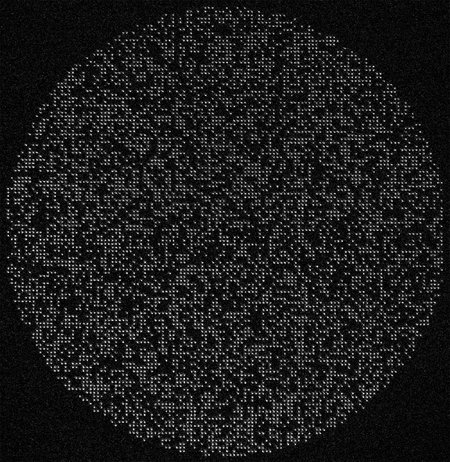
"... physicists have created the largest qubit array ever assembled: 6,100 neutral-atom qubits trapped in a grid by lasers. Previous arrays of this kind contained only hundreds of qubits.

This milestone comes amid a rapidly growing race to scale up quantum computers. There are several approaches in development, including those based on superconducting circuits, trapped ions, and neutral atoms, as used in the new study. ...

"We can now see a pathway to large error-corrected quantum computers. The building blocks are in place." ..."

From the abstract:
"Optical tweezer arrays have transformed atomic and molecular physics, now forming the backbone for a range of leading experiments in quantum computing simulation, and metrology.
Typical experiments trap tens to hundreds of atomic qubits, and recently systems with around one thousand atoms were realized without defining qubits or demonstrating coherent control.
However, scaling to thousands of atomic qubits with long coherence times, low-loss, and high-fidelity imaging is an outstanding challenge and critical for progress in quantum science, particularly towards quantum error correction.
Here, we experimentally realize an array of optical tweezers trapping over 6,100 neutral atoms in around 12,000 sites, simultaneously surpassing state-of-the-art performance for several metrics that underpin the success of the platform. Specifically, while scaling to such a large number of atoms, we demonstrate a coherence time of 12.6(1) seconds, a record for hyperfine qubits in an optical tweezer array.
We show room-temperature trapping lifetimes of  ~ 23 minutes, enabling record-high imaging survival of 99.98952(1)% with an imaging fidelity of over 99.99%. We present a plan for zone-based quantum computing and demonstrate necessary coherence-preserving qubit transport and pick-up/drop-off operations on large spatial scales, characterized through interleaved randomized benchmarking. Our results, along with recent developments, indicate that universal quantum computing and quantum error correction with thousands to tens of thousands of physical qubits could be a near-term prospect."

Caltech Team Sets Record with 6,100-Qubit Array - www.caltech.edu


A tweezer array with 6100 highly coherent atomic qubits (preprint first published 3/18/2024, but recently updated. Open access)


This image shows 6,100 cesium atoms trapped by highly focused laser beams called optical tweezers. The width of the circle is about one millimeter.


Wednesday, September 03, 2025

New MIT report captures state of quantum computing

Good news!

"Quantum technologies are evolving from theoretical concepts into tangible
technologies with commercial promise. Their rapid progress is capturing
global attention and suggests we stand on the cusp of a second quantum
revolution. While the first quantum revolution gave us the rules of the
quantum world and applied them to create groundbreaking technologies
such as semiconductors, lasers, MRI machines and atomic clocks,
the second quantum revolution, by contrast, focuses on controlling and
engineering quantum systems directly—such as using qubits for computing
or entangled photons for communication. ..."

"... Insights from the “Quantum Index Report 2025” include the following:
  • Quantum processor performance is improving, with the U. S. leading the field. Two-dozen manufacturers are now commercially offering more than 40 quantum processing units (QPUs), which are the processing hardware for a quantum computer. This is an indicator that the technology is becoming more accessible to business. While there have been impressive advancements in performance, QPUs do not yet meet the requirements for running large-scale commercial applications such as chemical simulations or cryptanalysis.
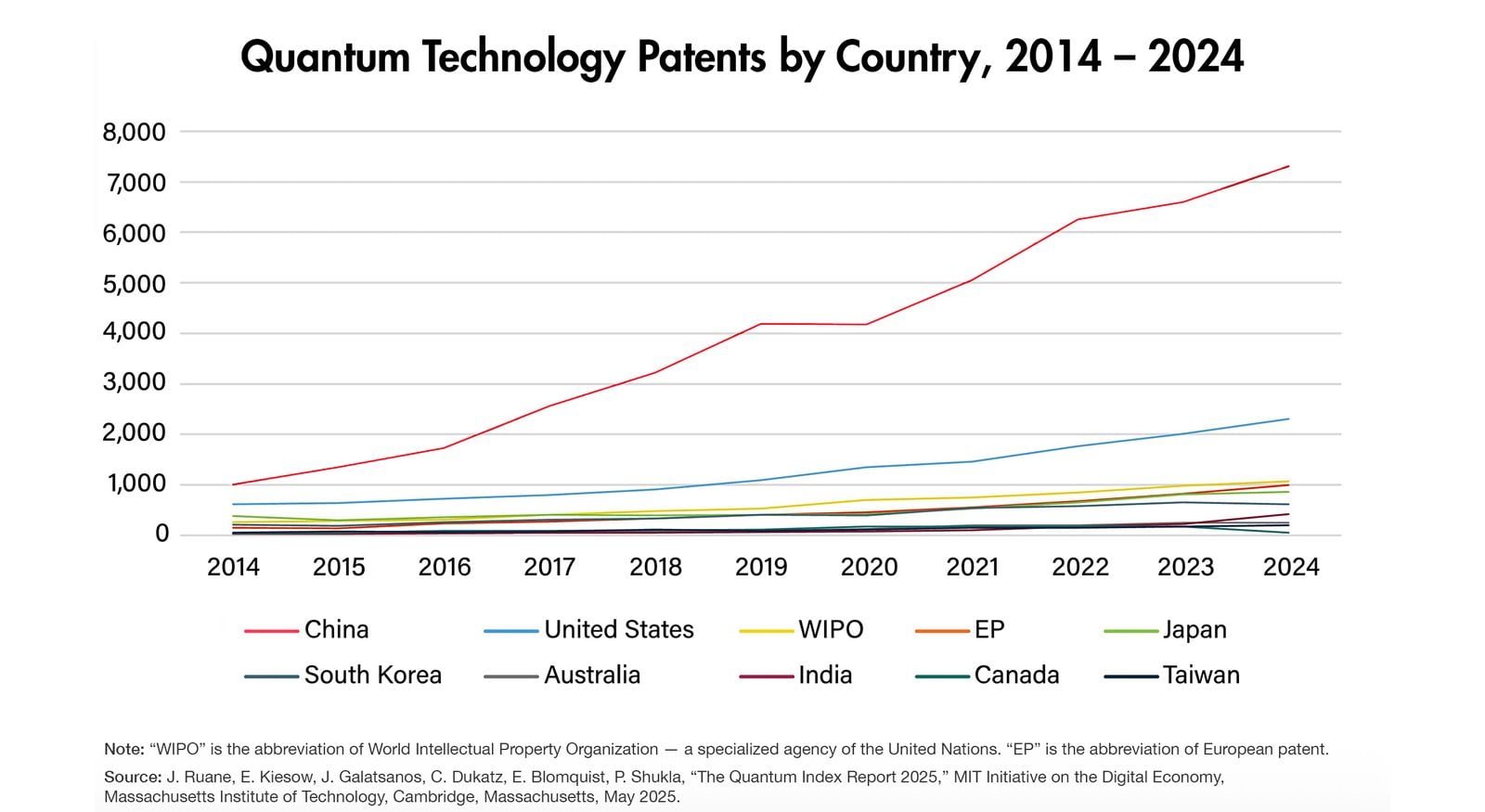
  • Quantum technology patents are soaring, with the total number increasing fivefold from 2014 to 2024. Corporations and universities are spearheading innovation efforts, accounting for 91% of the patents filed, with corporations holding 54% and universities 37%. China held 60% of quantum patents as of 2024, followed by the U.S. and Japan.
  • Venture capital funding for quantum technology reached a new high point in 2024. Quantum computing firms received the most funding ($1.6 billion in publicly announced investments), followed by quantum software companies at $621 million. The researchers note that quantum received less than 1% of total venture capital funding worldwide.
  • Businesses are buzzing over quantum computing. The report tracks how often the technology was mentioned across more than 50,000 corporate communication vehicles, including press releases and earnings calls, from 2022 to 2024. There was a significant uptick in mentions each quarter in 2024, with the frequency outpacing that of previous years by a substantial margin. The researchers said that this positively correlates with the maturing of the quantum market and the growing presence of quantum technology in mainstream business discourse.  
  • Quantum skills and training are growing in importance as companies begin to focus on workforce development. The demand for quantum skills has nearly tripled since 2018, according to the report. In response, universities are establishing quantum hubs and standing up programs that connect business leaders with researchers.
..."

New MIT report captures state of quantum computing | MIT Sloan


Too bad, following chart is outdated. Why MIT did not bother to update this chart is strange! Look at India! Surprisingly, Israel is not higher up in the list. Quantity is not quality!


Saturday, August 23, 2025

Scientists program cells to create biological qubit in multidisciplinary research

Good news!

"... Now, researchers ... have turned a protein found in living cells into a functioning quantum bit (qubit), the foundation of quantum technologies. The protein qubit can be used as a quantum sensor capable of detecting minute changes and ultimately offering unprecedented insight into biological processes. ..."

From the abstract:
"Quantum bits (qubits) are two-level quantum systems that support initialization, readout and coherent control. Optically addressable spin qubits form the foundation of an emerging generation of nanoscale sensors. The engineering of these qubits has mainly focused on solid-state systems.
However, fluorescent proteins, rather than exogenous fluorescent probes, have become the gold standard for in vivo microscopy because of their genetic encodability. Although fluorescent proteins possess a metastable triplet state10, they have not been investigated as qubits.
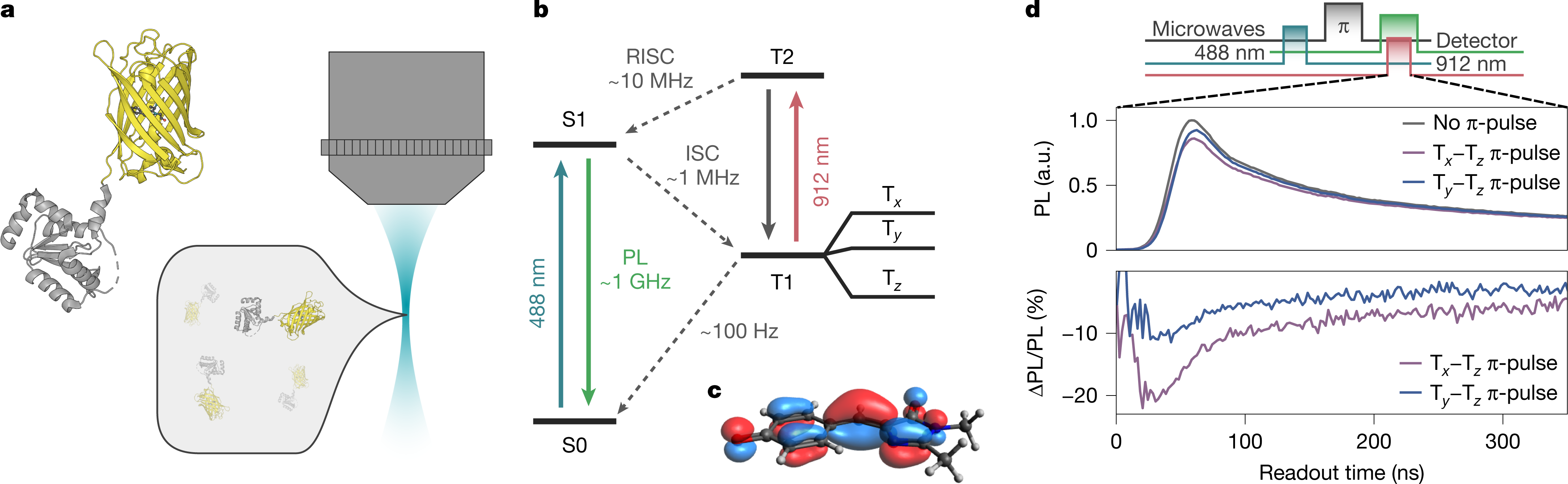
Here we realize an optically addressable spin qubit in enhanced yellow fluorescent protein. A near-infrared laser pulse enables triggered readout of the triplet state with up to 20% spin contrast.
Using coherent microwave control of the enhanced-yellow-fluorescent-protein spin at liquid-nitrogen temperatures, we measure a (16 ± 2) μs coherence time under Carr–Purcell–Meiboom–Gill decoupling.
We express the qubit in mammalian cells, maintaining contrast and coherent control despite the complex intracellular environment.
Finally, we demonstrate optically detected magnetic resonance in bacterial cells at room temperature with contrast up to 8%.
Our results introduce fluorescent proteins as a powerful qubit platform that paves the way for applications in the life sciences, such as nanoscale field sensing and spin-based imaging modalities."

Scientists program cells to create biological qubit in multidisciplinary research

Scientists program cells to create biological qubit in multidisciplinary breakthrough (original news release) "Researchers have designed protein qubits that can be produced by cells naturally, opening possibilities for precision measurements of tissues, single cells, or even individual molecules."


Fig. 1: Photophysics of EYFP proteins and OADF readout scheme.