Showing posts with label Ancient Greece. Show all posts

Saturday, August 01, 2026

Trade, Trust, and Civilisation: The Hidden Economic Message of Nolan’s 'Odyssey'

Very recommendable! I blogged here about the movie recently.

"That question lies at the heart of Johan Norberg’s recent book Peak Human, which argues that societies rise not simply because of military strength or exceptional rulers, but because they develop the institutions that make cooperation, innovation, and voluntary exchange possible. Historians once explained the fate of civilisations primarily through battles, conquests, and empires. Increasingly, however, scholarship has shifted its attention towards less dramatic but ultimately more decisive forces: secure property rights, political stability, trust between strangers, economic freedom, and the peaceful exchange of goods and ideas. Armies may conquer kingdoms, but commerce is what allows civilisations to endure."
Note: If correctly described in the article below, then it appears Johan Norberg regurgitates what August Friedrich von Hayek has said many times before in his writings. Maybe the author of this article below is not aware of this.

"Nolan’s emphasis on trade is therefore far from accidental. Archaeology has revealed that the eastern Mediterranean during the Late Bronze Age was home to one of the most sophisticated commercial systems the world had yet seen. Rather than a collection of isolated kingdoms, it formed a remarkably integrated economic network linking Egypt, Anatolia, the Levant, Cyprus, mainland Greece, and beyond. Copper, tin, wine, olive oil, timber, textiles, ivory, glass, spices, and precious metals travelled enormous distances through interconnected markets.

The most remarkable evidence for this commercial world emerged almost by accident in 1982, when a diver discovered the wreck of a merchant ship off the southern coast of modern-day Turkey. The Uluburun shipwreck, dating from the fourteenth century BC, contained more than ten tonnes of Cypriot copper, almost a tonne of tin, African ivory, Baltic amber, Mesopotamian glass, Mycenaean pottery, and gold jewellery. No primitive economy could have organised such a logistical operation. Long before the Industrial Revolution, an extensive international trading system already connected societies separated by thousands of kilometres.

Commerce alone, however, was not enough. These networks depended upon institutions of cooperation. The Amarna Letters reveal rulers addressing one another as “brothers,” exchanging gifts, negotiating alliances, and maintaining permanent diplomatic contacts.
Greek society reflected the same logic through xenia—the sacred obligation to offer hospitality to strangers. In a world where long-distance trade depended on trust between people who had never met, such norms were not merely moral ideals; they were essential economic institutions. ..."

Trade, Trust, and Civilisation: The Hidden Economic Message of Nolan’s 'Odyssey' (Unfortunately, no author name is provided as if written anonymously) "A fragile web of trust and voluntary exchange holds societies together"

Friday, July 24, 2026

On Homer’s The Odyssey movie 2026

I did not yet watch the movie!

Lot's of criticism has been published so far about this movie claiming it is woke, infested with/motivated by DEI ideology etc.

If this movie can inspire many viewers to become more interested in the fascinating history of Ancient Greece, its philosophers (e.g. Socrates), stories, wisdom and achievements etc., then this would be really great!

Monday, April 06, 2026

Thirty previously unpublished verses by Empedocles discovered on a papyrus from Cairo

Good news!

"A 2,000-year-old papyrus fragment, discovered in the archives of the French Institute of Oriental Archaeology in Cairo, reveals 30 previously unpublished verses by Empedocles, a pre-Socratic philosopher of the fifth century BCE. This discovery offers researchers direct access to a body of thought previously known only through quotations from later authors. The very first edition, translation, and commentary on these verses are published in the book "L'Empédocle du Caire," ... 

a papyrologist ... identified papyrus P. Fouad inv. 218 as an unknown fragment of the "Physica," the poem by the philosopher Empedocles of Agrigentum. ...

The text that has come to light deals with the theory of particle effluvia and sensory perceptions, particularly vision. Analysis of the text has revealed unexpected connections, including the probable direct source of a passage by Plutarch (2nd century), as well as a dialogue by Plato and a text by Theophrastus, a disciple of Aristotle, both from the 4th century BCE. Unnoticed echoes of Empedocles have also been detected in the comic poet Aristophanes and in the Latin philosopher Lucretius. The study further suggests that Empedocles could be regarded as a precursor of the atomist philosophers, foremost among whom is Democritus of Abdera. ..."

Thirty previously unpublished verses by Empedocles discovered on a papyrus from Cairo

Thirty previously unpublished verses by Empedocles discovered on a papyrus from Cairo (original news release) "A two-thousand-year-old papyrus fragment, discovered in the archives of the French Institute of Oriental Archaeology in Cairo, reveals thirty previously unpublished verses by Empedocles, a pre-Socratic philosopher of the 5th century BCE. This discovery offers researchers direct access to a body of thought previously known only through quotations from later authors. The very first edition, translation and commentary on these verses are published in the book L'Empédocle du Caire ..."


Monday, August 25, 2025

'A woman should cast off her shame together with her clothes': What women in ancient times really thought about sex

Little is known!

Caution, the article is very eurocentric (more accurately very Ancient Greece centric)!

Well, Lesbians have been very familiar with some of this for at least the past 50 or more years. The poet Sappho of the Greek island of Lesbos was well known by Lesbians back then.

'A woman should cast off her shame together with her clothes': What women in ancient times really thought about sex

Saturday, August 16, 2025

Pilot breaks altitude record for solar-powered plane, crossing paths with commercial airliner, his team says

Amazing stuff!

The Greek myth of Icarus and Daedalus comes to mind!

"Swiss adventurer Raphael Domjan flew his SolarStratos plane to 31,237 feet over Switzerland, breaking the 15-year-old altitude record for a solar-powered aircraft."

"Swiss pilot Raphael Domjan beat the altitude record for a solar-powered electric plane in a flight that took him soaring to 9,521 meters, or 31,237 feet ...

The SolarStratos plane made the landmark flight from Sion airport in southwest Switzerland on Tuesday, taking advantage of warm air thermals to go beyond the record that has stood for 15 years.

The certified altitude record for a solar plane stands at 9,235 meters, or 30,298 feet. ..."

Pilot breaks altitude record for solar-powered plane, crossing paths with commercial airliner, his team says - CBS News

Credits: The Flyover


Solar-powered plane SolarStratos piloted by Swiss pilot Raphael Domjan is seen taking off at the Sion airport, on Aug. 8, 2025


Raphael Domjan


Thursday, July 10, 2025

The Ancient Roots of Western Self-Criticism

Recommendable! 

It is very curious why this article omitted to mention Socrates (470 – 399 BC). It was he who stated “The only true wisdom is in knowing you know nothing.” Such humbleness and humility. It was him who refused the opportunity to escape from his death sentence by drinking the poison. He obeyed the law although he knew it was flawed!

The Ancient Roots of Western Self-Criticism "The West’s enduring success is rooted in its awareness of its own faults and constant striving to be better."

Socrates
undefined

Wednesday, October 16, 2024

Unearthed papyrus contains lost scenes from two of Euripides’ plays, one of the most significant new finds in Greek literature in this century

Good news!

"For centuries, questions have loomed about two of Euripides’ lesser-known tragedies, “Ino” and “Polyidus,” with only a smattering of text fragments and plot summaries available to offer glimpses into their narratives.

Now, in a groundbreaking find, two Harvard alumni have identified and worked to decipher 97 lines from these plays on a papyrus from the third century A.D. ...

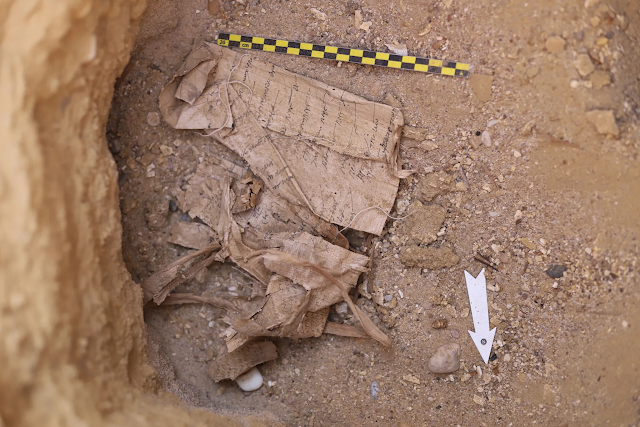
The papyrus was discovered in 2022 in a burial shaft at the ancient necropolis of Philadelphia, Egypt, by a team from the Egyptian Ministry of Antiquities. ..."

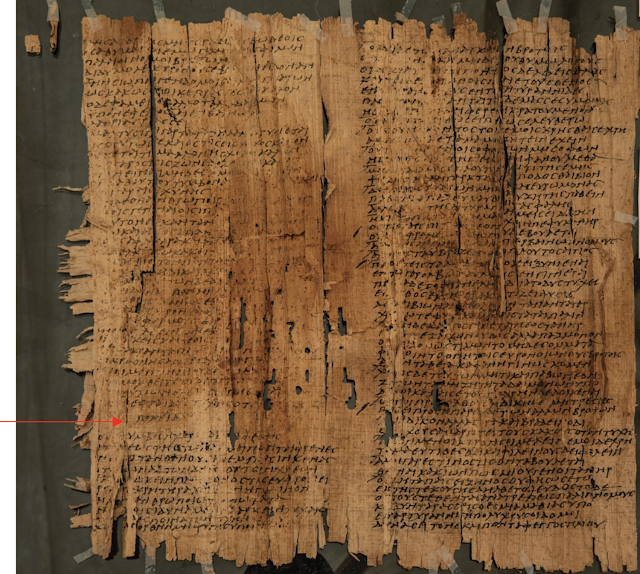
"The Euripidean text dates to the 3rd century CE. It is written on the back of a land survey from the late 2nd century CE or early 3rd century CE.

It contains an excerpt from Ino in the first column and an excerpt from Polyidos in the first and second columns. The title “Of Polyidos” (indicated by the red arrow) separates the two excerpts. ..."

Unearthed papyrus contains lost scenes from Euripides’ plays — Harvard Gazette "Alums help identify, decipher ‘one of the most significant new finds in Greek literature in this century’"

The Papyrus

The papyrus as it was uncovered at the ancient necropolis.
The red arrow separates the two texts