Showing posts with label cosmology. Show all posts

Thursday, August 27, 2026

Gamma-ray signal could be long awaited evidence for WIMPs. Really!

Amazing stuff, but possibly wimpish!

Notice Big Bang, Dark matter & energy are perhaps some of the least plausible explanations/theories of our cosmos/universe/physics. E.g. what came before the Big Bang? Nothing?

Notice again how a popular science article deviates from the actually published research article. The abstract of the paper makes no mentioning of WIMPS. A case of journalistic sensationalism? Some skepsis is perhaps in order.

"Dark matter is known to make up roughly 85% of all mass in the universe, as evidenced by the way galaxies spin and how galaxy clusters are held together under gravity. Yet despite decades of searching, physicists have never managed to detect the elusive substance directly.

In new research ... claims to have spotted a strong gamma-ray signal coming from a group of galaxy clusters, which could be among the most compelling evidence yet for a leading dark matter candidate known as WIMPs.

Elusive particles

WIMPs, or weakly interacting massive particles, are hypothetical particles that barely interact with normal matter or light but would still exert a gravitational pull. ..."

From the abstract:
"As the largest gravitationally bound objects in the Universe, galaxy clusters have provided the first piece of evidence for the presence of dark matter and may be suitable targets for indirect dark matter searches.
Among various signals, the GeV-TeV 𝛾-ray line has been taken as the smoking-gun signal of the dark matter annihilation and decay, since no known astrophysical or physical process(es) could generate such a peculiar spectrum.
With 15.5 years of Fermi-LAT P8R3 publicly available data, we search for the 𝛾-ray line emission in the directions of 13 massive galaxy clusters at redshifts 𝑧 ≤0.028 with an unbinned likelihood analysis.
A 𝛾-ray line signal at  ∼43.2  GeV has a net test statistic (TS) value of  ≈30 if we take into account only the data in the directions of the Virgo, Fornax, and Ophiuchus clusters, three massive clusters with the highest J-factors expected to generate the dark matter annihilation signal.
The signal still presents when the data of 10 other nearby massive clusters are also included, though the TS value decreases to  ≈21, likely because of their lower signal-to-noise ratios.
The absence of this signal in the inner Galaxy disfavors both the instrumental effect and the canonical dark matter annihilation interpretation, and a more sophisticated dark matter model or very peculiar astrophysical scenario might be needed.
This 𝛾-ray line signal, if intrinsic, could be unambiguously verified by the Very Large Area 𝛾-ray Space Telescope in its first two years of performance."

Gamma-ray signal could be long awaited evidence for WIMPs


Evidence for a ∼43 GeV γ-ray line signal in a stacking analysis of the Virgo, Fornax, and Ophiuchus Galaxy clusters (preprint, open access, first published July 2024, but last updated July 2026)

Tuesday, August 18, 2026

Astronomers discover a brand-new type of astrophysical object: A black hole star

Amazing stuff!

"Astronomers ... have spotted an extremely bright red spot in the early universe. The object resembles an enormous star, spanning the size of our solar system. But it also is putting out 100 billion times more energy than any known star can physically produce. In fact, such energies are closer to what a black hole might generate.

The curious combination suggests that the red spot is an entirely new type of astrophysical source. The astronomers are calling it a “black hole star.” ..."

From the abstract:
"The physical processes that led to the formation of billion-solar-mass black holes within the first 700 million years of cosmic time, a period known as cosmic dawn, remain a puzzle.
Several theoretical scenarios have been proposed to seed and rapidly grow black holes, but direct observations of these mechanisms remain elusive.
Here we present a source 660 million years after the Big Bang that exhibits singular properties: among the largest hydrogen Balmer breaks reported at any redshift, broad multi-peaked Hβ emission, and Balmer line absorption in several transitions.
We model this source as an enshrouded black hole in which the Balmer break and absorption features are a result of extremely dense, turbulent gas forming a dust-free envelope around a supermassive black hole.
This source may provide evidence of an early black hole embedded in dense gas—a theoretical configuration proposed to rapidly grow black holes by super-Eddington accretion.
Radiation from the black hole seems to dominate almost all observed light, leaving limited room for contribution from its host galaxy. If the source merged with its brighter neighbour, it would resemble the recently discovered ‘little red dots’ with perplexing spectral energy distributions.
The redness of the black hole is due to gas, not dust, and scattering, not kinematics, gives rise to the complex line shapes and luminosities—black hole masses of these sources may therefore be overestimated by orders of magnitude."

Astronomers discover a brand-new type of astrophysical object: A black hole star | MIT News | Massachusetts Institute of Technology "The mashup of a black hole and an enormous star has never been seen before and could explain the mysterious little red dots often found in deep-space images."


Fig. 1: JWST imaging and spectroscopy of MoM-BH*-1.


Tuesday, April 07, 2026

Gravitational lensing could break the Hubble tension

Amazing stuff!

"How do you measure the distance to far off cosmic objects? That question is key to calculating the speed of the universe’s expansion and hence understanding its evolution and eventual fate. The rate of cosmic expansion, known as the Hubble constant, is so important for cosmologists that the disagreement among researchers over its value has its own name: the Hubble tension.
Astronomers measure it one way, using stars or supernovae with predictable brightness. Cosmologists have another way, studying ripples in the echo of the Big Bang and winding the clock forward to today. The two techniques have become increasingly precise, but they steadfastly disagree with each other.

A third method is needed to break the deadlock . That may come through the magic of gravitational lensing, which can cause a supernova—a star exploding at the end of its life—to appear to explode again and again. If a supernova is situated behind a large mass, such as a galaxy or cluster of galaxies, then as its light passes by the mass, its gravity bends the light along different paths, producing multiple images that show the explosion at different times when viewed from Earth. Using the time delays and path lengths, researchers can calculate the distance to the supernova and so calculate the Hubble constant.

Only a handful of such lensed supernovae have been found so far, but several upcoming survey telescopes, including the Vera C. Rubin Observatory, are expected to find them by the dozen and, hopefully, to ease the Hubble tension."

"... The idea goes back to the early 1960s, when gravitational lenses had only been theorized. But Sjur Refsdal, a graduate student at the University of Oslo, suggested a way to calculate how such a lens would bend light, using the same geometric tools used to model the paths of light through a glass lens. His thesis evaluators weren’t convinced—until he got the result published in the Monthly Notices of the Royal Astronomical Society in 1964. In the same issue, Refsdal also proposed a way to put his technique to work. He suggested time-delayed images of a lensed supernova could offer a handle on the Hubble constant."

ScienceAdviser


A foreground galaxy (center) acts as a lens to produce four images of a background supernova in 2014. The supernova is dubbed SN Refsdal in honor of Sjur Refsdal, who predicted this effect 50 years earlier.


Saturday, January 03, 2026

Cosmic Paradox Reveals the Awful Consequence of an Observer-Free Universe

Amazing stuff!

"When one applies the powerful tools of quantum gravity to an entire universe—not just black holes—a glaring paradox appears: in certain “observer-free” models of a closed cosmos, the universe seems to admit only a single possible quantum state. This conclusion, first raised by Juan Maldacena, Carl P. Feinberg Professor in the School of Natural Sciences, and several collaborators in the School—including Member Ahmed Almheiri; Raghu Mahajan, Member (2019–20) and Visitor (2017–19); and Ying Zhao, Member (2018–21)—challenges one of physics’s deepest ideals: the hope of an objective, observer-independent description of the universe.  ..."

"... But almost 30 years ago, a landmark paper ..., showed that difficult string theory calculations could sometimes be sidestepped and carried out using familiar concepts from particle physics instead. The catch is that this approach only works if the universe has an unusual “anti-de Sitter” geometry. An anti-de Sitter universe has a boundary, often illustrated to resemble a tin can. Remarkably, everything that happens inside the can, from colliding particles to spinning black holes, is revealed by shadows on the can’s outer boundary. It’s as if the 3D universe inside were equivalent to an image on a flat screen, a concept physicists call holography. ...

The problem is that we don’t live in an anti-de Sitter tin-can cosmos. The nature of the universe’s expansion implies that it has no boundary. No matter how far you travel, you will never hit an edge. ...

In 2024, ... began to work on the problem of how to put an observer into a closed universe. ... thought of the observer as introducing a new kind of boundary: not the edge of the universe, but the boundary of the observer themself. When you consider a classical observer inside a closed universe, all the complexity of the world  returns, Zhao and her collaborators showed.

The ... paper came out at the beginning of 2025, around the same time that another group came forward with a similar idea.  ...

If the idea holds up, using the subjective nature of the observer as a way to account for the complexity of the universe would represent a paradigm shift in physics. Physicists typically seek a view from nowhere, a stand-alone description of nature. ..."

Cosmic Paradox Reveals the Awful Consequence of an Observer-Free Universe | In the Media | Institute for Advanced Study

Cosmic Paradox Reveals the Awful Consequence of an Observer-Free Universe "Encouraged by successes in understanding black holes, theoretical physicists are applying what they’ve learned to whole universes. What they’re finding has them questioning fundamental assumptions about how physics ought to be done."


Sunday, August 24, 2025

The shape of the universe revealed through algebraic geometry

Amazing stuff! The theory of the nature of everything in the universe is forthcoming!

"How can the behavior of elementary particles and the structure of the entire universe be described using the same mathematical concepts? This question is at the heart of recent work ...

To the point:
  • Bridging mathematics and physics: The study explores how algebraic and one of the key players in the flourishing field of positive geometry unify physics from subatomic particles to galaxies.
  • Beyond Feynman diagrams: Positive geometry offers a complementary perspective to traditional quantum field theory methods - providing a geometric framework for describing particle interactions alongside Feynman diagrams.
  • From particle collisions to the big bang: Tools from algebraic geometry, D-module theory, and combinatorics drive this interdisciplinary progress - helping to decode the fundamental structures of particle interactions and the universe’s earliest states.
...
In their article, the authors explore how algebraic structures and geometric shapes can help us understand phenomena ranging from particle collisions ... to the large-scale architecture of the cosmos. Their research is centered around algebraic geometry. Their recent undertakings also connect to a field called positive geometry – an interdisciplinary and novel subject in mathematics driven by new ideas in particle physics and cosmology. This field was inspired by the geometrical concept of positive geometry which expands the standard Feynman diagram approach in particle physics by representing interactions as volumes of high-dimensional geometric objects, such as the amplituhedron, as introduced by the theoretical physicists Nima Arkani-Hamed and Jaroslav Trnka in 2013. It carries a rich combinatorial structure and offers an alternative, potentially simpler way to compute scattering amplitudes, from which one can derive probabilities of scattering events. ...

In cosmology, scientists are using the faint light of the cosmic microwave background and the distribution of galaxies to infer what shaped the early universe. Similar mathematical tools are now being applied. For instance, cosmological polytopes, which are themselves positive geometries, can represent correlations in the universe's first light and help reconstruct the physical laws that governed the birth of the cosmos.

A Geometry for the Universe

The article highlights that positive geometry is not a niche mathematical curiosity but a potential unifying language for form branches of theoretical physics. These geometric frameworks naturally encode the transfer of information between physical systems, for example, by mapping concrete, sensory-based concepts to abstract structures, a process that mirrors how humans metaphorically understand the world. ..."

From the abstract:
"In recent years, the intersection of algebra, geometry, and combinatorics with particle physics and cosmology has led to significant advances.
Central to this progress is the twofold formulation of the study of particle interactions and observables in the universe: on the one hand, Feynman’s approach reduces to the study of intricate integrals; on the other hand, one encounters the study of positive geometries.
This article introduces key developments, mathematical tools, and the connections that drive progress at the frontier between algebraic geometry, the theory of $D$-modules, combinatorics, and physics. All these threads contribute to shaping the flourishing field of positive geometry, which aims to establish a unifying mathematical language for describing phenomena in cosmology and particle physics. ..."

The shape of the universe revealed through algebraic geometry


N.B. Schwinger parameters like swinging parameters


Saturday, April 26, 2025

'Hidden galaxies' could be smoking gun in universe riddle

Amazing stuff!

Unfortunately, the reporting about these hidden galaxies is obscure if not amateurish, possibly due to early stage research.

"Astronomers have peered back in time to find what looks like a population of "hidden" galaxies that could hold the key to unlocking some of the universe's secrets. If their existence is confirmed it would "effectively break current models of galaxy numbers and evolution." The possible galaxies may also provide the missing piece of the puzzle for the energy generation in the universe in infrared light.

That's because their combined light would be enough to top-up the energy budget of the universe to the maximum we observe, effectively accounting for all remaining energy emissions at these long wavelengths.

Possible evidence of the galaxies' existence was detected on the deepest ever image of the universe at long far-infrared wavelengths, which features almost 2,000 distant galaxies ...

"What we found was possible evidence of a completely new, undiscovered population of faint galaxies hidden in the blur of the image, too faint to be detected by conventional methods in the original analysis. ...
"

Credits: 'Hidden galaxies' could be smoking gun in universe riddle


The final SPIRE Dark Field image map created by combining the Blue (250 micrometres), Green (350 micrometres) and Red (500 micrometres) SPIRE camera channels together, each channel stacking a total of 141 individual images on top of each other. The blobs on the image are all individual galaxies or groups of galaxies. However, the image is so crowded that there is almost no empty space with the faintest galaxies merging into the background light in the map.


Sunday, December 22, 2024

Webb telescope's largest study of universe expansion confirms challenge to cosmic theory

Amazing stuff!

"New observations from the James Webb Space Telescope suggest that a new feature in the universe—not a flaw in telescope measurements—may be behind the decadelong mystery of why the universe is expanding faster today than it did in its infancy billions of years ago.

The new data confirms Hubble Space Telescope measurements of distances between nearby stars and galaxies, offering a crucial cross-check to address the mismatch in measurements of the universe's mysterious expansion. Known as the Hubble tension, the discrepancy remains unexplained even by the best cosmology models. ...

"The discrepancy between the observed expansion rate of the universe and the predictions of the standard model suggests that our understanding of the universe may be incomplete," said Nobel laureate and lead author Adam Riess, a Bloomberg ...

Observations from both telescopes aligned closely, revealing that Hubble's measurements are accurate and ruling out an inaccuracy large enough to attribute the tension to an error by Hubble. ...

While the standard model yields a Hubble constant of about 67-68 kilometers per second per megaparsec, measurements based on telescope observations regularly give a higher value of 70 to 76, with a mean of 73 km/s/Mpc. This mismatch has perplexed cosmologists for more than a decade because a 5-6 km/s/Mpc difference is too large to be explained simply by flaws in measurement or observational technique. ...

Since Webb's new data rules out significant biases in Hubble's measurements, the Hubble tension may stem from unknown factors or gaps in cosmologists' understanding of physics yet to be discovered, Riess' team reports. ..."

From the abstract:
"We cross-check the Hubble Space Telescope (HST) Cepheid/Type Ia supernova (SN Ia) distance ladder, which yields the most precise local H0, against early James Webb Space Telescope (JWST) subsamples (∼1/4 of the HST sample) from SH0ES and CCHP, calibrated only with NGC 4258. We find HST Cepheid distances agree well (∼1σ) with all combinations of methods, samples, and telescopes. The comparisons explicitly include the measurement uncertainty of each method in NGC 4258, an oft-neglected but dominant term. Mean differences are ∼0.03 mag, far smaller than the 0.18 mag "Hubble tension." Combining all measures produces the strongest constraint yet on the linearity of HST Cepheid distances, 0.994 ±0.010, ruling out distance-dependent bias or offset as the source of the tension at ∼7σ. However, current JWST subsamples produce large sampling differences in H0 whose size and direction we can directly estimate from the full HST set. We show that ΔH0 ∼ 2.5 km s−1 Mpc−1 between the CCHP JWST program and the full HST sample is entirely consistent with differences in sample selection. We combine all JWST samples into a new distance-limited set of 16 SNe Ia at D ≤ 25 Mpc. Using JWST Cepheids, JAGB, and tip of the red giant branch, we find 73.4 ± 2.1, 72.2 ± 2.2, and 72.1 ± 2.2 km s−1 Mpc−1, respectively. Explicitly accounting for common supernovae, the three-method JWST result is H0 = 72.6 ± 2.0, similar to H0 = 72.8 expected from HST Cepheids in the same galaxies. The small JWST sample trivially lowers the Hubble tension significance due to small-sample statistics and is not yet competitive with the HST set (42 SNe Ia and 4 anchors), which yields 73.2 ± 0.9. Still, the joint JWST sample provides important cross-checks that the HST data pass."

Webb telescope's largest study of universe expansion confirms challenge to cosmic theory | Hub "The findings offer a crucial cross-check for previous Hubble Space Telescope measurements of the universe's mysterious expansion"


Figure 4. Anchors and SN Ia hosts selected to cross-check HST and JWST distances from the full HST sample of four anchors and 42 SNe Ia.


Thursday, September 26, 2024

What If The Universe DID NOT Start With The Big Bang? with Matt O'Dowd

Very recommendable! I have blogged here several times on my doubts about the Big Bang theory. What came before the Big Bang?

Penrose diagram


Saturday, September 14, 2024

Early dark energy could resolve cosmology’s two biggest puzzles

Dark matter/energy were in the news again recently! See also my blog post here about dark matter.

What is the difference between speculation and science?

The so called Big Bang is another one of those speculations!

"A new study ... proposes that a mysterious force known as early dark energy could solve two of the biggest puzzles in cosmology and fill in some major gaps in our understanding of how the early universe evolved.

One puzzle in question is the “Hubble tension,” which refers to a mismatch in measurements of how fast the universe is expanding. The other involves observations of numerous early, bright galaxies that existed at a time when the early universe should have been much less populated.

Now, the MIT team has found that both puzzles could be resolved if the early universe had one extra, fleeting ingredient: early dark energy. Dark energy is an unknown form of energy that physicists suspect is driving the expansion of the universe today. Early dark energy is a similar, hypothetical phenomenon that may have made only a brief appearance, influencing the expansion of the universe in its first moments before disappearing entirely. ..."

From the abstract (abstract contains images):
"JWST has revealed a large population of UV-bright galaxies at [] 
 and possibly overly massive galaxies at ⁠[], challenging standard galaxy formation models in the ΛCDM cosmology. We use an empirical galaxy formation model to explore the potential of alleviating these tensions through an Early Dark Energy (EDE) model, originally proposed to solve the Hubble tension. Our benchmark model demonstrates excellent agreement with the UV luminosity functions (UVLFs) at in both ΛCDM and EDE cosmologies. In the EDE cosmology, the UVLF measurements at  based on spectroscopically confirmed galaxies (eight galaxies at ⁠) exhibit no tension with the benchmark model. Photometric constraints at  can be fully explained within EDE via either moderately increased star-formation efficiencies (⁠ at ⁠) or enhanced UV variabilities (⁠ mag at ⁠) that are within the scatter of hydrodynamical simulation predictions. A similar agreement is difficult to achieve in CDM, especially at ⁠, where the required 
 exceeds the maximum value seen in simulations. Furthermore, the implausibly large cosmic stellar mass densities inferred from some JWST observations are no longer in tension with cosmology when the EDE is considered. Our findings highlight EDE as an intriguing unified solution to a fundamental problem in cosmology and the recent tensions raised by JWST observations. Data at the highest redshifts reached by JWST will be crucial for differentiating modified galaxy formation physics from new cosmological physics."

Study: Early dark energy could resolve cosmology’s two biggest puzzles | MIT News | Massachusetts Institute of Technology "In the universe’s first billion years, this brief and mysterious force could have produced more bright galaxies than theory predicts."

Early galaxies and early dark energy: a unified solution to the hubble tension and puzzles of massive bright galaxies revealed by JWST (open access)


Early dark energy could have triggered the formation of numerous bright galaxies, very early in the universe, a new study finds. The mysterious unknown force could have caused early seeds of galaxies (depicted at left) to sprout many more bright galaxies (at right) than theory predicts.


Saturday, January 13, 2024

A Big Cosmological Mystery - two unexpected, newly discovered ultra large structures in close proximity

Amazing stuff! It appears, the latest research has not yet been published in a journal or as preprint.

I blogged here yesterday about a BBC report of this discovery.

"The Big Ring on the Sky is 9.2 billion light-years from Earth. It has a diameter of about 1.3 billion light-years, and a circumference of about four billion light-years. ...
It is the second ultra-large structure discovered by University of Central Lancashire (UCLan) PhD student Alexia Lopez who, two years ago, also discovered the Giant Arc on the Sky. Remarkably, the Big Ring and the Giant Arc, which is 3.3 billion light-years across, are in the same cosmological neighbourhood – they are seen at the same distance, at the same cosmic time, and are only 12 degrees apart on the sky. ...
Identifying two extraordinary ultra-large structures in such close configuration raises the possibility that together they form an even more extraordinary cosmological system. ..."

A Big Cosmological Mystery - UCLan Discovery of a second ultra-large structure in distant space further challenges what we understand about the universe

Wednesday, February 09, 2022

The Largest Suite of Cosmic Simulations for AI Training Is Now Free to Download; Already Spurring Discoveries

Good news! Many of the advances of AI & machine learning over the past two decades were driven by the emergence and availability of better, large and larger datasets!

"Totaling 4,233 universe simulations, millions of galaxies and 350 terabytes of data, a new release from the CAMELS project is a treasure trove for cosmologists. CAMELS — which stands for Cosmology and Astrophysics with MachinE Learning Simulations — aims to use those simulations to train artificial intelligence models to decipher the universe’s properties.
Scientists are already using the data, which is free to download, to power new research ..."

The Largest Suite of Cosmic Simulations for AI Training Is Now Free to Download; Already Spurring Discoveries The CAMELS project uses machine learning and thousands of simulations to extract secrets from the cosmos


Sunday, June 13, 2021

Giant Arc of galaxies 3 billion light-years long may challenge standard model of cosmology

Amazing stuff! More and more recent observations are challenging the Big Bang theory!

In my opinion, the Big Bang theory is one of the most implausible major scientific theories that still survives to this day! I have previously speculated here that if there was indeed a Big Bang as they say, then the universe is perhaps only an aquarium built by God or by super intelligent beings.

"... If it is real, the Giant Arc would join a growing group of large-scale structures in the universe that, taken together, would break the standard model of cosmology. This model assumes that when you look at large enough volumes of space — above about 1 billion light-years — matter is distributed evenly. The Giant Arc appears about three times as long as that theoretical threshold. It joins other structures with similarly superlative names, like the Sloan Great Wall, the Giant Gamma-Ray Burst Ring and the Huge Large Quasar Group. ..."

Here is the entire abstract of this discovery:
"We present the discovery of the Giant Arc, a large-scale structure marked by MgII absorbers spanning approximately 1 Gpc in length and 100 Mpc in width (present epoch values), at a redshift of z ~ 0.8. The structure forms a highly symmetric arc in the plane of the sky, but shows more intricate structuring along the redshift axis, with a depth of ~ 340 Mpc. Two different statistical analyses show the Giant Arc to be significant at > 4 sigma. We discuss the implications for the Giant Arc in context with other known large structures for the fundamental assumption of homogeneity in cosmology."

An arc of galaxies 3 billion light-years long may challenge cosmology | Science News The discovery is a “big deal” if true, but still needs to be confirmed

Here is the link to the oral session to the 238th Meeting of the American Astronomical Society where the Giant Arc was presented:

Wednesday, December 23, 2020

Is the universe an aquarium?

This just a wild speculation! However, it would nicely explain the otherwise incredible Big Bang theory! 

What lies beyond the universe? What came before the universe?

If the universe is like an aquarium, who created it? Then humans are most likely not the only intelligent creatures within or without of the aquarium.

Sunday, July 05, 2020

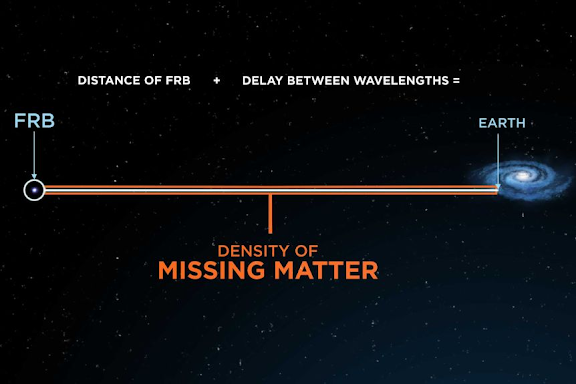
Astronomers find 'missing matter', solving decades-long mystery of outer space

Amazing stuff! Has the puzzle over Dark Matter/Energy been resolved? I get it that the intergalactic matter is very thinly dispersed (sparse) and very difficult to measure, but why did it take so long and why were speculations/hypotheses over intergalactic matter not more well known? 

Even pure logic would have suggested that this missing matter might to be found in intergalactic space. Or was the Dark Matter/Energy speculation so much more popular and captivating that it drowned out other, more bland sounding theories.

"After an intergalactic search lasting more than two decades, an Australian-led team of scientists say they have finally found the universe's "missing matter", solving a mystery that has long stumped astronomers.
Since the mid-90s, scientists have been trying to locate half of the universe's ordinary matter. ... "It's been a true embarrassment that we haven't been able to find it," said Professor Xavier Prochaska, an astronomer from the University of California, Santa Cruz. ...
That was until they started to measure fast radio bursts — brief flashes of intense energy found racing across the universe — and discovered the missing matter hiding in the cold dispersed gas between galaxies."

"More than three-quarters of the baryonic content of the Universe resides in a highly diffuse state that is difficult to detect, with only a small fraction directly observed in galaxies and galaxy clusters ... Censuses of the nearby Universe have used absorption line spectroscopy to observe the ‘invisible’ baryons, but these measurements rely on large and uncertain corrections and are insensitive to most of the Universe’s volume and probably most of its mass."

Astronomers find 'missing matter', solving decades-long mystery of outer space - ABC News

Here is the underlying research paper:
A census of baryons in the Universe from localized fast radio bursts