Showing posts with label light pollution. Show all posts

Wednesday, September 23, 2026

Light pollution’s ‘transformation of night’ requires prompt action. Really!

Another one of those perennial topics of environmentalists for several decades! If I am not mistaken, this topic light pollution has been extensively covered since the 1960s or so.

There is even now a new book about this subject!

How do you become a professor at Cornell U? Write a book about long worn out subjects like light pollution?

According to Google Scholar this professor has a lifetime citation count of 1491! This is very low!
 
Light pollution’s ‘transformation of night’ requires prompt action | Cornell Chronicle


The author Professor Sara B. Pritchard


Tuesday, May 05, 2026

Light pollution in urban areas could be making allergies worse and longer

Recommendable!

"... Now, a study finds, flashy billboards, streetlights and bright buildings are extending pollen season in cities.

Indeed, that season can now run two months longer there than in rural areas. ...

Pollen season starts around 20 days earlier in cities than in rural areas ... It also ends 20 to 30 days later. ..."

From the abstract:
"Artificial light at night (ALAN), a growing environmental stressor in urban ecosystems, disrupts natural light–dark cycles and alters plant phenological events such as leaf-out and flowering. However, the extent to which ALAN influences airborne pollen season timing and exacerbates allergy-related health risks remains largely understudied.
This study investigates how ALAN influences the timing and duration of the airborne pollen season across the Northeastern United States from 2012 to 2023 and the consequences of allergenic pollen exposure. Using daily pollen concentrations from the National Allergy Bureau, ALAN data from the Visible Infrared Imaging Radiometer Suite product, and gridded Daymet climate data, we derived three key pollen season metrics: start of season, end of season, and season length, and examined their relationship with environmental conditions.
We found that higher ALAN exposure was significantly associated with an earlier start of pollen season, a later end of season, and a longer pollen season length, after controlling for temperature and precipitation.
ALAN’s impact on the end of the season is larger than on the start of the season. ALAN sites experienced more days and higher severity for allergenic pollen exposure, relative to sites with minimal or no ALAN exposure. These results underscore the potential of ALAN to exacerbate allergy-related disease burdens, calling for its integration into urban environmental public health and planning strategies."

Got pollen allergies? Light pollution might make them worse "In the Northeast’s brightest cities, pollen season was two months longer than in rural areas"


Fig. 3.Proportion of days in the pollen season under four exposure severity levels for “No ALAN” and “ALAN” conditions.


Friday, August 22, 2025

Light pollution makes birds sing longer. Really!

More light pollution please! So I can hear more bird singing e.g. in the morning! Caution: satire!

I don't think light pollution in urban areas has become much worse of the past several decades. If so, then birds have adapted to urban light pollution for decades without much fanfare and notice! What is the fuss about?

"If you’re an avid birdwatcher, then you’ll know that most of our feathered friends stick to a fairly predictable schedule: a burst of vocal activity early in the morning, known as the “dawn chorus,” followed by some more singing throughout the day and at dusk. But according to new research, birds living in areas with lots of artificial light are staying awake much longer than usual.

To find out how light pollution—which now affects 23% of the Earth’s surface—impacts avian activity, scientists analyzed millions of bird calls from more than 500 species around the world. The data, collected as part of a global citizen science project called BirdWeather, revealed that birds in light-polluted urban areas are waking earlier and settling down later than their rural counterparts. “We were shocked by our findings,” study co-author Brent ..."

"Birds that are active during the day sing later into the night in places with significant light pollution, according to research by a Southern Illinois University Carbondale professor and his colleague. ..."

From the editor's summary and abstract:
"Editor’s summary
Light pollution has become ubiquitous across much of the planet. This situation has the potential [???] to widely affect a variety of species because most living organisms have evolved to respond, in one way or another, to the circadian light-dark cycle. Pease et al. looked at the influence of light pollution on activity patterns in more than 500 species of birds globally. They found that birds were generally vocal for nearly an hour longer in the presence of light pollution. Furthermore, birds that are more exposed, or entrained, to light were more affected, such as those with large eyes and open nests. ...

Abstract
Light pollution disrupts light–dark cues that organisms use as timetables for life. Although studies—typically focusing on individual species—have documented earlier morning onset of bird vocalization in light-polluted landscapes, a synthesis of light pollution effects across species, space, and season is lacking. We used a global acoustic dataset of more than 60 million detections, representing 583 diurnal bird species, to synthesize effects of light pollution on avian vocalization.
On average, light pollution prolonged vocal activity by 50 min. Light pollution responses were strongest for species with large eyes, open nests, migratory habits, and large ranges and during the breeding season.
Prolonged activity may confer negative, neutral, or positive fitness effects; documenting these fitness effects and curbing light pollution are challenges for 21st-century conservation."

ScienceAdviser


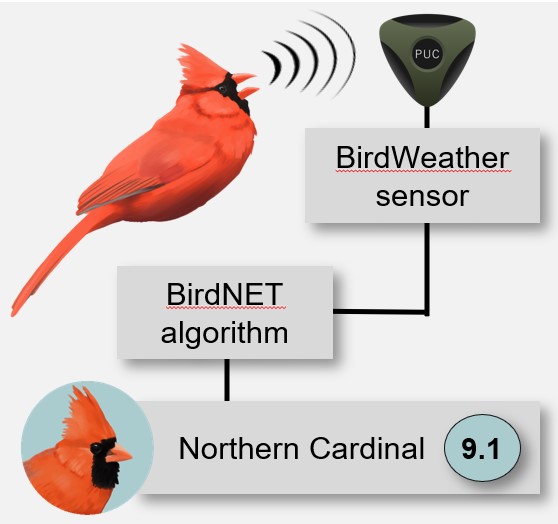
"BirdWeather, which makes sophisticated recording devices with Wi-Fi, GPS and sensors connected to the BirdNET database and its machine learning from the Cornell Lab of Ornithology and the Chemnitz University of Technology. BirdWeather’s dashboard provided a better visualization of what bird species were in the area."


Sunday, June 22, 2025

A new ultra-black paint for satellites Could Help Fight Light Pollution. Really!

I bet this is wishful thinking and it ignores that all satellites block the view  on space!

Like putting lipstick on a pig. Each satellite still blocks earthbound astronomical observatories. This measure only seems to take care of the light streaks emanating from passing satellites.

According to Google Search:
  1. "As of May 2025, there are approximately 11,700 active satellites orbiting Earth.". These are only active satellites. There are probably hundreds or even thousands of inactive/old satellites in orbit and tons of satellite debris.
  2. "In the next five years, it is expected that tens of thousands of new satellites will be launched into Earth orbit, with estimates ranging from 58,000 to 70,000. This surge is largely driven by the deployment of large satellite constellations for internet access, like SpaceX's Starlink." 
We may have to put more astronomical observatories in earth orbit too!

"“A new type of super-black, highly resistant satellite paint promises an affordable fix to the satellite light pollution problem that has marred astronomical research since the recent advent of low-Earth-orbit megaconstellations…

The new coating is based on a proprietary blend of carbon black, a soot-like form of carbon, mixed with special binders that make the paint resistant against the harsh conditions in near-Earth space. In tests, the new coating outperformed other similar paints currently on the market not just in terms of its light absorption ability but also durability in space, Clifford said…"

Painting Satellites Vantablack Could Help Fight Light Pollution - Human Progress

Coating satellites with super-dark Vantablack paint could help fight light pollution crisis "Light streaks caused by passing satellites mar images taken by the world's most expensive telescopes. The problem is set to get worse."


An animation that shows 57,000 planned satellites being deployed around Earth through 2029 (Source)