Showing posts with label heliophysics. Show all posts

Tuesday, September 15, 2026

An experiment that recreates coronal mass ejections in the lab

Amazing stuff!

"Some of the most iconic images of the Sun have captured the explosive force of coronal mass ejections (CMEs), in which huge clouds of magnetized plasma erupt from the solar atmosphere. But CMEs have only rarely been sighted on other stars, a discrepancy that has puzzled astrophysicists for many years.
Now an international research team has devised an experiment that recreates these stellar eruptions in the lab, providing clear evidence that CMEs can be suppressed by strong magnetic fields. The same experimental approach could also be used to investigate the role that magnetic confinement plays in other stellar activity. ..."

"... The current study ... combines astrophysical simulations, high-energy laser-plasma experiments, and advanced 3D plasma numerical modelling. The results show that strong magnetic fields of active stars can completely suppress CMEs before they escape into space. “The unique combination of theory, laboratory tests, and numerical simulations provides the first experimental evidence supporting a long-standing prediction that stellar magnetic fields can confine these large-scale eruptions.” ..."

From the abstract:
"Solar coronal mass ejections (CMEs) are routinely observed, but as of yet there exist few convincing detections of stellar CMEs. A reason for this could be that the stronger magnetic fields of these stars, compared to that of our Sun, would prevent CME to form and escape.
Here we combined astrophysical simulations, measurements of scaled high-energy laser-driven plasma flows, and 3D magnetohydrodynamic modeling to test this hypothesis.
Simulations show that, in a 100 G stellar dipole field, low-plasma CMEs become magnetically confined.
In the laboratory, a laser-produced plasma stream scaled to stellar CME conditions propagates freely at low applied magnetic fields (approximately 30 G stellar equivalent), but becomes unstable and halts entirely when the field is increased to  (i.e., a 100 G equivalent).
Analytical estimates and numerical simulations suggest that the sudden disruption of the flow is induced by a kink instability. Even though the laboratory environment does not fully reproduce the complex magnetic flux-rope topology of CMEs, these results provide the first laboratory-scale evidence that strong stellar magnetic fields can fully suppress CME propagation, offering a physical explanation for their lack in stellar observations and highlighting the role of magnetic confinement in stellar evolution and exoplanet space weather."

Physics - Lab-Based Plasmas Shed Light on Stellar Mystery "Using high-power lasers to drive highly magnetized plasmas, researchers have probed the stellar processes that control coronal mass ejections."


Computer simulation of a coronal mass ejection for a star (green) with a strong magnetic field (lines). The eruption is confined by the magnetic field and thus does not escape the star.


Thursday, August 27, 2026

How the sun's galactic journey shapes Earth's climate

Amazing stuff! How does the temporal dynamics of the heliosphere (shrinking/expanding) influence climate on Earth while our solar system travels through the Milky Way?

Notice the researchers limit the frequency of such disturbances to "every couple of million years", while I would propose it may happen more often.
If I am not mistaken, we still know very little about the trajectory of our solar system traversing the interstellar space within the Milky Way galaxy. For example, the researchers investigated only the extreme event when the heliosphere shrank so much that the Earth was no longer protected by heliosphere anymore.

Notice Merav Opher (the author of the paper below) has extensively written about the influence of the heliosphere on paleoclimate on Earth for several years (see e.g. her webpage on this subject).

I have been arguing here on blog for some years that the climate (e.g. long warming and cooling periods) on Earth may significantly be influenced by our solar system traveling or its trajectory through the Milky Way galaxy.

"... In new research ... trace the trajectory of the heliosphere, the massive bubble created by our sun that envelops our solar system, as it moved through our galaxy and influenced Earth's climate along the way. ...

Our heliosphere orbits around the center of our galaxy, the Milky Way. Throughout the sun's 4.6-billion-year existence, our heliosphere has traversed various regions within our galaxy. In a paper ..., researchers ... used computer modeling to reverse-engineer the path of the heliosphere through our galaxy, revealing that the environments it passed through may have triggered changes on Earth. ...

ran simulations that showed the sun has encountered frigid expanses of gas and dust at least three times in the past few million years. In these instances, massive interstellar "cold clouds" pushed against the heliosphere to such an extent that it shrank to smaller than Earth's orbit, stranding our planet outside the sun's protective shield. 

These exposures—approximately 2–3 million years, 6–7 million years and 13–14 million years ago—would have exposed Earth's atmosphere to different surroundings. The simulation results match geologic evidence: Elements prevalent in interstellar dust appear in deep-sea sediment core samples, Antarctic snow and lunar samples from these periods.

These heliosphere collapse events may also explain ancient climatic patterns on Earth. In the simulations, when Earth's atmosphere was exposed to a cold, dense galactic hydrogen cloud, water vapor content increased and upper-atmospheric dynamics shifted, ultimately altering conditions at the surface. In summary, our heliosphere's trips through colder regions in our galaxy may be a key factor in driving some of Earth's ancient climate changes, including possible ice ages. ..."

From the abstract:
"This article reviews today's open issues, frontiers of research, and advances in our understanding of the heliosphere throughout the Sun's last 10 million years. Today's heliosphere, the cocoon formed by the solar wind as it moves through the Galaxy, engulfs all the planets extending in the nose direction to ∼120 astronomical units (AU).
  • ▪  The Sun moves at 19 pc/Myr and has traversed many different structures in the interstellar medium that affect the heliosphere, at times collapsing it to sub-astronomical-unit scales. These periods of collapse introduce climate and radiation changes in Earth's environment.
  • ▪  The frequency of such encounters could be as often as every couple of million years, making it a major external disturbance to the development of life on Earth.
  • ▪  Stepwise shifts in past global climate, seen in deep-sea sediment cores, indicate intervals of more rapid cooling at 13–14 Mya, 6–7 Mya, and 2–3 Mya, for which the driving mechanisms are subject to ongoing debate. Such cooling events might be triggered by heliosphere collapse."

How the sun's galactic journey and superflare-filled youth shaped Earth's climate


Fig. 1 Schematic of the heliosphere. Several elements that form the heliosphere are noted (see also the definitions in the margins throughout this article). The width of the sector region is expected to vary with the solar cycle.


Figure 3 
(a) The heliosphere of today is immersed in a warm ISM ...
(b) The heliosphere of the past after the Sun encountered dense cold clouds ... that compressed the heliosphere to sub-astronomical-unit scales
Abbreviation: AU, astronomical unit; ISM, interstellar medium.


Saturday, August 22, 2026

The Wolf Solar Grand Minimum roughly between 1270 and 1350 CE and of other grand solar minimums and grand solar cycles

Here is another reason why the global warming is a hoax and why climate change is a religion! 

Anthropocene greenhouse gases is an obscene explanation! What has probably more influence on climate on Earth when comparing trace gases and varying solar activity? Varying solar activity!

Let's not forget that the world population also increased tremendously over the past several centuries from about 1 billion around 1800 AD/CE to now about 9 billion (aka as the Population Bomb since 1968). Of course, so many humans and their activities largely concentrated in urban areas contribute to warming (e.g. urban heat island effect). However, world population growth might be at an inflection point.

Much more likely are variations in solar activity and solar cycles over short and long term periods that cause warming and cooling periods on Earth than trace gases in the atmosphere! We know for a long time about the 11 year solar activity cycle, but most likely there are other, yet to be discovered cycles like the grand solar cycle.

Grand solar minimums is the missing link I was looking for to possibly explain changes of extended warming to cooling climate periods.

Thanks to the incessant daily climate change demagoguery, the effect of solar activity on Earth climate is heavily suppressed, avoided and omitted! 

"The Wolf Solar Minimum is a grand solar minimum—a prolonged period of sharply reduced sunspot activity and magnetic output on the Sun—that lasted roughly from 1270 to 1350." (Google Search)

This Wolf Solar Minimum roughly coincides with the end of the Medieval Warm Period from about 950 AD/CE to 1250 AD/CE (not medieval climate anomaly) or it falls between the MWP and the Little Ice Age from about 1400 AD/CE to 1850 AD/CE. Or in other words, we are currently in another, modern warm period!

"Major historical grand solar minima identified in solar physics include the following:
Homeric minimum: ~750 BC – 400 BC
Oort minimum: 1040 – 1080
Wolf minimum: 1280 – 1350
Spörer Minimum: 1450 – 1550
Maunder Minimum: 1645 – 1715
Dalton Minimum: 1790 – 1820
Modern Minimum: 2020 – 2053" (Google Search)

From the abstract (1):
"In this editorial I will demonstrate with newly discovered solar activity proxy-magnetic field that the Sun has entered into the modern Grand Solar Minimum (2020–2053) that will lead to a significant reduction of solar magnetic field and activity like during Maunder minimum leading to noticeable reduction of terrestrial temperature. ..."

From the abstract (2):
"Recent progress in undersatanding a role of the solar background magnetic field in defining solar activity is presented using eigen vectors derived with Principle Compnent Analysis.
This approach revealed a presence of not only 11 year solar cycles but also of grand solar cycles with duration of 330-380 years.
We demonstrated that these grand cycles are formed by the interferences of two magnetic waves produced by solar dynamo with dipole magnetic field in two layers of the solar interior with close but not equal frequencies.
These grand cycles are always separated by grand solar minima (GSMs) similar to Maunder minimum type, with the modern GSM started in 2020 and to last until 2053.
This GSM leads to a reduction of solar irradiance by about 0.22% from the modern level and a decrease of the average terrestrial temperature by about 1.0C in the cycle 26.
The reduction of a terrestrial temperature can have important implications for different parts of the planet on growing vegetation, agriculture, food supplies and heating needs in both Northern and Southern hemispheres."

Modern Grand Solar Minimum will lead to terrestrial cooling (1, open access)

Modern grand solar minimum and its impact on the terrestrial environment (2, open access?)


Figure 3. Solar activity (summary) curve restored for 1200–3300 AD


Figure 4.
Top plot: restored total solar irradiance from 1600 until 2014 [Notice the dip around 1812 AD. This when Napoleon tried and failed to conquer Moscow due to an extremely cold winter.]
Bottom plot: Central England temperatures (CET) recorded continuously since 1658. Blue areas are reoccurring cool periods; red areas are warm periods. All times of solar minima were coincident with cool periods in central England.


Wednesday, August 05, 2026

Sun Revealed In Stunning Clarity With Record-Breaking New Images

Update of 8/6/2026: "Telescope captures sun's surface in sharpest detail ever Researchers using the Daniel K. Inouye Solar Telescope in Hawaii have captured the highest-resolution images yet of the sun's outer shell. The images reveal feathery and rippling patterns caused by magnetized plasma ..." IEEE USA Smartbrief

Amazing stuff! We still know so little about the sun! What if the solar activity and cycles of the sun is the main cause of global warming/climate change?

(721) Sun Revealed In Stunning Clarity With Record-Breaking New Images | WION originals - YouTube


Gallery Images from the Inouye


Wednesday, January 21, 2026

Spectacular northern aurora lights as far south as New Mexico

Amazing stuff!

"A severe geomagnetic storm sparked northern lights as far south as New Mexico after a coronal mass ejection from the sun struck Earth on Jan. 19."

Wednesday, January 21, 2026 - Join The Flyover

Severe G4 geomagnetic storm sparks jaw-dropping northern lights worldwide "A fast CME slammed into Earth on Jan. 19, unleashing hours of intense auroral activity and lighting up skies far beyond the poles."


Northern lights above Portsall, France.


Northern lights captured from Deming, New Mexico, on Jan. 19


Monday, September 22, 2025

NASA scientists say solar winds and magnetic activity have intensified since 2008 (so has Global Warming?)

What if long lasting fluctuations/cycles of solar activity are the main cause of the Global Warming/Climate Change?

Maybe the well known 11-year sunspot cycle (known and tracked since about  1600 CE) is not the only cycle there is!

Fact is that we still know very little about the sun!

"NASA scientists say solar winds and magnetic activity have intensified since 2008, defying expectations and raising the odds of more solar storms that could disrupt satellites, power grids, and communications on Earth."

"The sun has become more and more active over the last 16 years, in a turn that surprised scientists and could affect space weather and technology on Earth, NASA announced ..."

From the abstract:
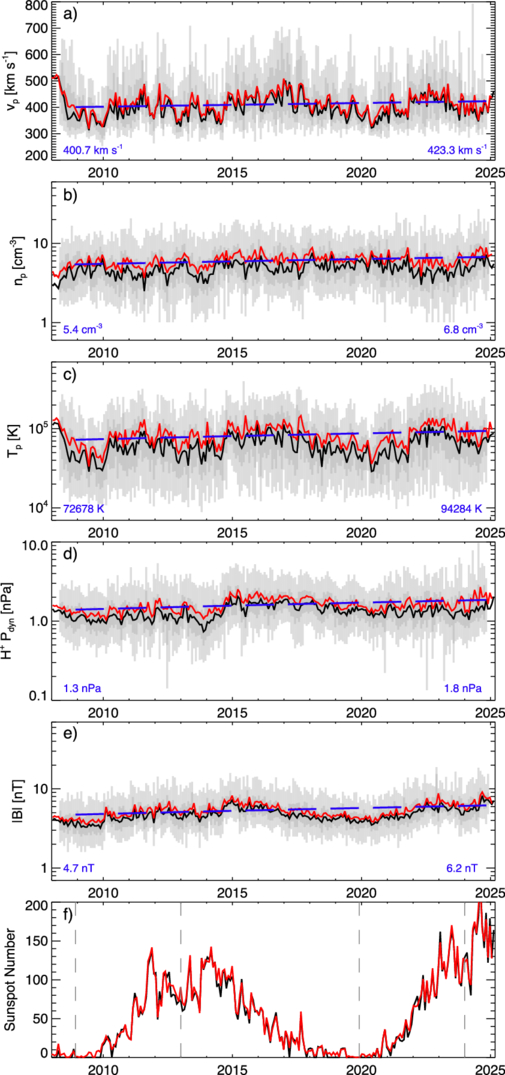
"Over the course of two decades until 2008, the solar wind became significantly weaker with a constant declining trend in many important solar wind parameters, and solar cycle 24 being the weakest on record since the start of the space age. Here we show that since 2008, the Sun has reversed this long-term weakening trend with a steady increase in various solar wind proton parameters observed at 1 au.
Furthermore, comparison of values from a fitted trend to data between 2008 and 2025 show the following increases in solar wind proton parameters: speed (~6%), density (~26%), temperature (~29%), thermal pressure (~45%), mass flux (~27%), momentum flux or dynamic pressure (~34%), energy flux (~40%), interplanetary magnetic field magnitude (~31%), and the radial component of the magnetic field (~33%).
This has important implications on long-term solar trends, implying that the exceptional weakness of solar cycle 24 was most likely a recent outlier and that the Sun is not entering a modern era Maunder/Dalton-like minimum phase in its solar variation, but is instead recovering from a ~20 yr decline. Presently, the trending average solar wind dynamic pressure of ~1.9 nPa in the current solar cycle, however, is still lower than the recorded ~2.4 nPa at the end of the 20th century.
Continuous future measurements will reveal whether this increase will continue in upcoming solar cycles or whether these parameters will remain stable."

Thursday, September 18, 2025 - Join The Flyover


NASA Analysis Shows Sun’s Activity Ramping Up (original news release) "It looked like the Sun was heading toward a historic lull in activity. That trend flipped in 2008, according to new research."


Figure 1. Solar wind measurements of various parameters measured at 1 au since 2008. The measurements are averaged over a complete solar rotation and show mean (red), median (black), 5%–95% ranges (light gray), and 25%–75% ranges (dark gray), and blue shows a fitted trend from the start of 2008 onward (see the text for details). The blue numbers show the values at the start (left) and end (right) of the fitted trend. From top to bottom are 
(a) proton speed, 
(b) proton density, 
(c) proton temperature,
(d) proton dynamic pressure, (e) magnetic field magnitude, and 
(f) sunspot number. ...


Saturday, September 13, 2025

The Race to the Sun's Surface

Very recommendable! Almost a suspense movie!

We still know shockingly little about the sun and its varying if not periodic solar activity. What if the sun is one of the dominant factors determining climate change on earth?  There is a strong, but possibly wrong, presumption (inductive bias) that the output of the sun is like a constant!


Tuesday, August 26, 2025

The Inouye Solar Telescope Delivers Record-Breaking Images of Solar Flare, Coronal Loops

Amazing stuff!

What little we still know about our star! What if the sun is responsible for most of climate change on earth and not the spurious life essential trace gas CO2?

"On August 8, 2024, the U.S. National Science Foundation (NSF) Daniel K. Inouye Solar Telescope captured the sharpest-ever images of a solar flare at the H-alpha wavelength (656.28 nm), revealing dark coronal loop strands in unprecedented detail. The observations, made during the decay phase of an X1.3-class flare, measured loop widths averaging 48.2 km, with some even half as narrow.
By using the Inouye Solar Telescope to isolate light at the H-alpha wavelength, emitted by hydrogen atoms, solar physicists can identify fine structures in the lower solar atmosphere too small to observe in the past—offering a potential breakthrough in determining the fundamental scale of coronal loops and advancing solar flare modeling. By improving researchers’ ability to model solar flares, these observations will also improve forecasting for space weather events that are hazardous to satellites, power grids, and communications on Earth. ..."

The NSF Inouye Solar Telescope Delivers Record-Breaking Images of Solar Flare, Coronal Loops - NSO - National Solar Observatory


"A high-resolution image of the flare from the Inouye Solar Telescope, taken on August 8, 2024, at 20:12 UT. The image is about 4 Earth-diameters on each side. Labels of the different relevant regions of the image are added for clarity: flare ribbons (bright areas of energy release in the dense lower solar atmosphere) and an arcade of coronal loops (arcs of plasma outlining magnetic field lines that transport energy from the corona to the flare ribbons)."


Thursday, August 21, 2025

Solar probe confirms decades-old theory about the Sun’s magnetic reconnection

Amazing stuff!

We still know shockingly little about the sun and its varying if not periodic solar activity. What if the sun is one of the dominant factors determining climate change on earth?

"... Data captured by NASA’s Parker Solar Probe has confirmed that the Sun’s magnetic field lines break to reconnect in a new configuration, releasing large amounts of energy. ..."

"New research ... has confirmed decades-old theoretical models about magnetic reconnection, the process that releases stored magnetic energy to drive solar flares, coronal mass ejections and other space weather phenomena. The data was captured by NASA’s Parker Solar Probe (PSP), which is the only spacecraft to have flown through the Sun’s upper atmosphere. 

Magnetic reconnection occurs when magnetic field lines in plasma sever and reconnect in a new configuration, releasing large amounts of stored energy. On the Sun, this energy release often results in solar activity that can affect technology on Earth, a phenomenon known as space weather. 
Modeling solar magnetic reconnection accurately may help predict coronal mass ejections, solar flares and other space weather events that can impact satellites, communication systems and even power grids on Earth. ..."

From the abstract:
"Magnetic reconnection is a fundamental process within highly conductive plasmas. Oppositely oriented field lines are reconfigured, releasing stored magnetic energy. It plays a vital role in shaping the dynamics of the solar corona and provides one of the main mechanisms for releasing the stored energy that powers solar eruptions. Reconnection at the Sun has been studied using remote-sensing observations, but the Parker Solar Probe (PSP) now permits in situ sampling of reconnection-related plasma in the corona.
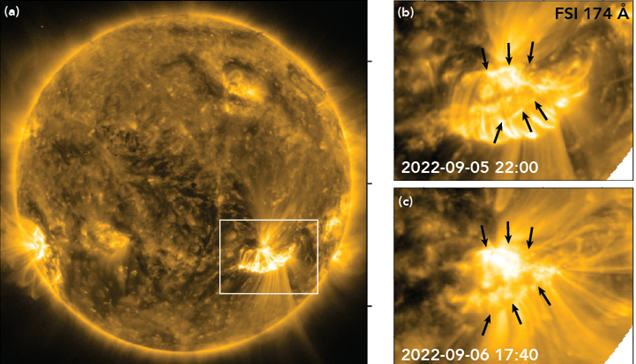
Here we report on a PSP fly-through of a reconnecting current sheet in the corona during a major solar eruption on 5–6 September 2022. We find that even 24 h after the flare peak, PSP detected the reconnection exhaust, indicating continuing fast reconnection, which we confirmed using remote-sensing observations made by the Solar Orbiter.
This reconnection persisted much longer than typical timescales of a few minutes to hours. Plasma parameters measured by PSP within the reconnection region match numerical simulations.
These new observations provide a key bridge between theory and measurements of plasmas in the solar atmosphere, laboratory experiments and astrophysical systems, generating new constraints required for the refinement of models and for the strengthening of their links to observations at many scales."

Solar probe confirms decades-old theory about the Sun’s magnetic reconnection

SwRI-led work confirms decades-old theoretical models about solar reconnection "Research helps fill crucial observation gaps about process that drives solar flares, coronal mass ejections"


Coronal Mass Ejection Source


Saturday, August 09, 2025

European Space Agency - spacecraft Proba-3’s first artificial solar eclipse

Amazing stuff! Stunning images. I believe, this important event was little reported about!

We still now so little about our star, the Sun! Global Warming is a hoax and Climate Change is a religion. Just maybe fluctuations in solar activity is warming and cooling our planet.

"Today [6/16/2025], the European Space Agency’s Proba-3 mission unveils its first images of the Sun’s outer atmosphere – the solar corona. The mission’s two satellites, able to fly as a single spacecraft thanks to a suite of onboard positioning technologies, have succeeded in creating their first ‘artificial total solar eclipse’ in orbit. The resulting coronal images demonstrate the potential of formation flying technologies, while delivering invaluable scientific data that will improve our understanding of the Sun and its enigmatic atmosphere. ...

This March, Proba-3 achieved what no other mission has before – its two spacecraft, the Coronagraph and the Occulter, flew 150 metres apart in perfect formation for several hours without any control from the ground. ...

The Sun's fiery corona reaches temperatures above a million degrees Celsius, much hotter than the surface beneath it. This counterintuitive temperature difference has long been a topic in the scientific community.

Proba-3’s ASPIICS is tackling this mystery by studying the corona very close to the Sun’s surface. It can also see more detail, detecting fainter features than traditional coronagraphs thanks to a drastic reduction in how much ‘stray’ light reaches the detector. ..."

ESA - Proba-3’s first artificial solar eclipse


Proba-3 Occulter eclipsing Sun for Coronagraph spacecraft


Solar corona viewed by Proba-3’s ASPIICS


Thursday, July 10, 2025

The Closest Images Ever Taken of the Sun’s Atmosphere

Recommendable! We still know very little about our sun! What if the solar activity fluctuates and determines climate on earth? You can trash the so called greenhouse gas superstitions immediately!

Tuesday, June 24, 2025

Listen to the sounds of the Sun like never before

Amazing stuff! What if the fluctuations of solar activity are the main cause of climate change on earth? I bet it is the case! We still know very little about the sun!

Wednesday, June 11, 2025

Our first ever look at Sun's south poles 〰️🌞

Recommendable! We still know so little about the sun! It is shocking! What if the sun is mostly responsible for climate change on earth?

Wednesday, December 25, 2024

Astronomers trying to discover if the Sun could produce catastrophic superflares

Amazing stuff! We still know so little about our sun and its solar activity and cycles!

What if fluctuating solar activity explains most of global warming and climate change?

"But interesting, and somewhat scary, new research, has now revealed that superflares occur roughly once per 100 years in other stars like our Sun elsewhere in the universe. ..."

From the editor's summary and abstract:
"Editor’s summary
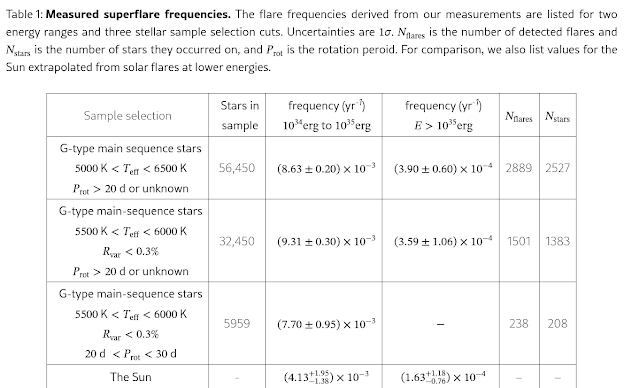
Solar flares are bright, transient, multiwavelength emissions from active regions on the Sun. The most intense directly observed solar flares release energies of about 1032 erg. It is unclear whether the Sun can produce more intense flares than that or how often they might occur. Vasilyev et al. investigated brightness measurements of 56,000 Sun-like stars observed by the Kepler space telescope. They identified almost 3000 bright stellar flares with energies of about 1034 to 1035 erg, which are called superflares. The occurrence rate is about one superflare per star per century. If the Sun behaves like the stars in this sample, then it could produce superflares at a similar rate. ...
Abstract
Stellar superflares are energetic outbursts of electromagnetic radiation that are similar to solar flares but release more energy, up to 1036 erg on main-sequence stars. It is unknown whether the Sun can generate superflares and, if so, how often they might occur. We used photometry from the Kepler space observatory to investigate superflares on other stars with Sun-like fundamental parameters. We identified 2889 superflares on 2527 Sun-like stars, out of 56,450 observed. This detection rate indicates that superflares with energies >1034 erg occur roughly once per century on stars with Sun-like temperature and variability. The resulting stellar superflare frequency-energy distribution is consistent with an extrapolation of the Sun’s flare distribution to higher energies, so we suggest that both are generated by the same physical mechanism."

Astronomers trying to discover if the Sun could produce catastrophic superflares


Saturday, November 09, 2024

How has the Sun’s energy changed over the last 45 years? No consensus among scientists

We still know very little about the sun! E.g. how does the the sun's energy output fluctuate over time.

What if the sun is the dominant source of warming and/or cooling periods on Earth, which is very likely!

This study reveals e.g. how inconsistent or how difficult to interpret 45 years just satellite data are.

Remember global warming is a hoax and climate change is a religion! 

"... The team behind this new paper were shocked at how many completely different plausible composites could be generated from the available satellite data as provided by the satellite mission science teams. ..."

From the abstract:
"Several total solar irradiance (TSI) satellite missions have been carried out since 1978. None of these missions have lasted more than one to two solar cycles (SCs), and each mission implies a slightly different absolute TSI baseline. Nonetheless, several satellite composites have been developed by compositing satellite data from different missions to form an almost continuous daily record for the satellite era. However, disconcertingly, each mission has implied slightly different changes in TSI between consecutive solar minima and solar maxima. Some groups have developed adjustments to individual missions that have substantially reduced these differences. Others prefer to use the original data published by the satellite science teams. Some TSI composites average together conflicting records, while others prioritize specific records over others. Here, we compare four existing composites to 17 new alternative series based on the available satellite data. These 21 TSI series are statistically sorted into six groups of three to four series each. We found that the six groups suggest different intercycle trends between solar minima. We compare the groups to eight daily resolved solar proxy-based TSI reconstructions and to daily sunspot numbers. Excellent agreement is obtained over one to two SCs, but significant differences are observed over longer timescales for each group. Therefore, we have assembled all these time series (old and new) into a large and new TSI data set for use by the scientific community. Versions scaled to 1 au (for studying solar variability) or in situ values at Earth (for studying solar/terrestrial interactions) are provided at daily, monthly, and yearly resolutions."

How has the Sun’s energy changed over the last 45 years? - Clintel


Using common statistical techniques, these 21 composites were sorted into 6 main composite groups – labelled “A” to “F”, as seen in the chart below:


Figure 1. Original daily satellite TSI data as provided by the satellite mission teams at 1 au used to generate and update the composites.


Thursday, June 20, 2024

Will The Sun’s Magnetic Field Flip This Year? with Matt O'Dowd

Very recommendable! I bet fluctuating sun activity has much more do with climate on earth than CO2! Fact is we still know very little about solar activity and how it influences the earth.


Wednesday, May 29, 2024

The origin of the sun’s magnetic field could lie close to its surface

We still know so little about our sun! What if the sun and its fluctuating solar activity is actually one of the main drivers of climate change on earth not the heavily propagandized so called anthropogenic green house gases? Global Warming is a hoax and Climate Change is a religion!

What if e.g. there are more, yet unknown sun cycles, than the well known 11 year sun spot cycle?

"The sun’s surface is a brilliant display of sunspots and flares driven by the solar magnetic field, which is internally generated through a process called dynamo action. Astrophysicists have assumed that the sun’s field is generated deep within the star. But an MIT study finds that the sun’s activity may be shaped by a much shallower process. ..."

From the abstract:
"The magnetic dynamo cycle of the Sun features a distinct pattern: a propagating region of sunspot emergence appears around 30° latitude and vanishes near the equator every 11 years. Moreover, longitudinal flows called torsional oscillations closely shadow sunspot migration, undoubtedly sharing a common cause. Contrary to theories suggesting deep origins of these phenomena, helioseismology pinpoints low-latitude torsional oscillations to the outer 5–10% of the Sun, the near-surface shear layer. Within this zone, inwardly increasing differential rotation coupled with a poloidal magnetic field strongly implicates the magneto-rotational instability, prominent in accretion-disk theory and observed in laboratory experiments. Together, these two facts prompt the general question: whether the solar dynamo is possibly a near-surface instability. Here we report strong affirmative evidence in stark contrast to traditional models focusing on the deeper tachocline. Simple analytic estimates show that the near-surface magneto-rotational instability better explains the spatiotemporal scales of the torsional oscillations and inferred subsurface magnetic field amplitudes. State-of-the-art numerical simulations corroborate these estimates and reproduce hemispherical magnetic current helicity laws. The dynamo resulting from a well-understood near-surface phenomenon improves prospects for accurate predictions of full magnetic cycles and space weather, affecting the electromagnetic infrastructure of Earth."
 
The origin of the sun’s magnetic field could lie close to its surface | MIT News | Massachusetts Institute of Technology Sunspots and flares could be a product of a shallow magnetic field, according to surprising new findings that may help scientists predict space weather.

The solar dynamo begins near the surface (open access)


Fig. 1: Measured internal solar rotation profiles.