Showing posts with label organic chemistry. Show all posts

Monday, June 08, 2026

Chemists design impact-resistant plastics for shoe soles, tires and other products

Amazing stuff! In my next life I'll become a chemist! 😊 

What about more bounce and springiness for soles?

"With help from a novel cross-linking molecule, MIT chemists have shown they can substantially improve the ballistic impact resistance of common polymers, including polystyrene and a type of rubber used to make shoe soles. ...

To make the polymer more resistant to sudden impact, the MIT team added weak bonds scattered throughout the material as cross-links, which allows the material to dissipate energy much more effectively under deformations. When struck by a projectile, these weak bonds selectively break at the site of impact to open up pathways for enhanced energy absorption.

The researchers found that this approach can also fortify styrene-butadiene-styrene rubber, and they are now investigating whether it will also work for other types of polymers such as latex or the rubber that is used to make tires.  ..."

From the abstract:
"Mechanical failure is a marked limitation for plastics used in structural, protective and coating applications. In particular, perforation under high-rate deformation is difficult to mitigate through conventional molecular design.
Cross-linking is widely used to improve the thermal and chemical stability of polymers, yet under mechanical deformation, it typically renders materials more brittle, limiting impact resistance and functional lifetime. Overcoming this fundamental trade-off between stability and toughness remains a central challenge. Here we demonstrate that embedding a small fraction of force-sensitive mechanophores as cross-links into common polymers fundamentally reverses this trade-off, producing materials with substantially enhanced ballistic energy dissipation.
At strain rates exceeding 107 s−1, we show that mechanophore-cross-linked networks absorb up to about 115% more energy than conventional thermosets and surpass even their uncross-linked thermoplastic counterparts.
We attribute this behaviour to a force- and adiabatic-heating-driven local thermoset-to-thermoplastic transition, in which selective mechanophore scission facilitates viscoplastic deformation at the impact site while preserving network integrity in the surrounding regions.
We demonstrate the generality of this strategy in both glassy polystyrene and rubbery styrene–butadiene–styrene triblock copolymers.
These results establish mechanophore cross-linking as a design principle for converting commodity polymers into impact-resilient materials and open directions at the intersection of polymer mechanochemistry and extreme-strain-rate material behaviour."

MIT chemists design impact-resistant plastics | MIT News | Massachusetts Institute of Technology "Introducing weaker bonds into polystyrene and rubber helps these materials dissipate energy, making them more resistant to destructive forces."


Saturday, October 25, 2025

New molecular strategy achieves complete synthesis of anti-MRSA natural product (new antibiotics)

Good news! Amazing stuff! With machine learning & AI this will only get better!

Interesting: Most of the researchers involved in this study are from the Shanghai University of Traditional Chinese Medicine.

"Spiroaspertrione A is a complex polycyclic compound naturally produced by the fungus Aspergillus sp. TJ23. First isolated in 2017, it quickly drew scientific attention for its promising ability to combat drug-resistant bacteria and restore their sensitivity to existing antibiotics.

Scientists have now found a way to carry out the total synthesis of the molecule in 16 steps, starting from a chiral pool building block called (+)-enoxolone that costs less than one euro per gram. ..."

From the editor's summary and abstract:
"Editor’s summary
Spiroaspertrione A is a complex, polycyclic fungal natural product that has garnered interest in antibiotics research. Huang et al. now report a total synthesis of the compound in its natural stereoconfiguration starting from readily available precursors.
Key steps included a Diels-Alder reaction to set the compound’s characteristic spiro stereocenter, as well as a divinylcyclopropane rearrangement to establish an additional out-of-plane ring. The synthesis required 16 steps from a reported precursor and proceeded in an overall yield of 2.3%. ...

Abstract
The rise of multidrug-resistant pathogens poses a major threat to global health, with methicillin-resistant Staphylococcus aureus (MRSA) among the most challenging. One promising approach to overcoming resistance is using small molecules that resensitize MRSA to existing drugs.
Here, we report the enantioselective total synthesis of one such promising candidate, (−)-spiroaspertrione A, a complex meroterpenoid of the andiconin family. This natural product has long eluded synthesis because of its densely functionalized polycyclic backbone.
Our route features a stereoselective Diels-Alder cycloaddition, followed by a key divinylcyclopropane rearrangement forming the spirobicyclo[3.2.2]nonane core, which proved to be reversible and was further investigated by density functional theory calculations. Strategic late-stage functionalization of the compact cage architecture enabled access to the natural product and provided evidence for a plausible biosynthetic relationship with (−)-aspermerodione."

New molecular strategy achieves complete synthesis of anti-MRSA natural product


A new 16-step process enables total synthesis of (−)-spiroaspertrione A from a known intermediate.


Friday, August 15, 2025

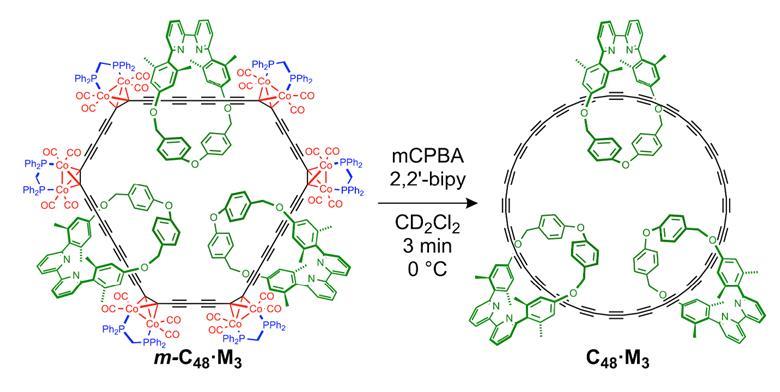
Stable carbon ring C48 molecule can be studied in solution for the first time

Amazing stuff! The magic of the carbon atom!

From the editor's summary and abstract:
"Editor’s summary
The discovery of C60 and related three-dimensional fullerenes introduced a molecular class of carbon allotropes more discrete than diamond and graphite. Recently, scanning probe microscopy has enabled the synthesis of two-dimensional molecular carbon rings, but these could only be assembled one by one on surfaces. Gao et al. now report a method to prepare macroscopic quantities of a ring comprising 48 carbons in solution phase. The key was to protect the backbone by threading it through three macrocycles during preparation of the precursor.  ...

Abstract
Cyclo[N]carbons, molecular rings consisting solely of N carbon atoms, have previously been studied in the gas phase and on surfaces at cryogenic temperatures, but they are generally considered too reactive to be studied under ambient laboratory conditions.
In this study, we report the synthesis of a cyclo[48]carbon catenane, in which the C48 ring is protected by being threaded through three other macrocycles. This cyclo[48]carbon [4]catenane is stable enough for spectroscopic characterization in solution at room temperature. Its mass spectrum displays the expected molecular ions; its 13C nuclear magnetic resonance spectrum gives a single resonance for all 48 sp1 carbon atoms at 72.9 parts per million; and its Raman spectrum shows an intense peak at 1890 inverse centimeters, similar to linear polyynes."

Stable carbon ring molecule created by Oxford chemists can be studied in solution for the first time | Chemistry World


Friday, June 27, 2025

Designer Microbes (E. coli) Make Painkillers (paracetamol) from Plastic Waste like PET

Good news! Amazing stuff! Bacteria can do it all! Next time you pop a painkiller ... 😊

Alert: Plastophobia is a serious disorder. Please seek immediate medical help! (Caution: satire)


"... For the past decade, ... a synthetic biologist at the University of Edinburgh, has been working on engineering microbes to produce diverse chemicals from sustainable sources. He has created bacterial factories that pump out nylon precursors using paper waste and vanilla flavor compounds from discarded plastic. Now, ... his team have designed bacteria that convert plastic waste into the widely used analgesic paracetamol.3 Published in Nature Chemistry, the technique has a negligible carbon footprint and introduces a new potential use for recycled plastic. ..."

"... A team of scientists ... used genetically reprogrammed E. coli, a harmless bacterium, to transform a molecule derived from PET known as terephthalic acid into the active ingredient of paracetamol. Researchers used a fermentation process, similar to the one used in brewing beer, to accelerate the conversion from industrial PET waste into paracetamol in less than 24 hours. The new technique was carried out at room temperature and created virtually no carbon emissions, proving that paracetamol can be produced sustainably. Further development is needed before it can be produced at commercial levels, the team says. Some 90 per cent of the product made from reacting terephthalic acid with genetically reprogrammed E. coli was paracetamol. ..."

From the abstract:
"Nature has evolved an exquisite yet limited set of chemical reactions that underpin the function of all living organisms. By contrast, the field of synthetic organic chemistry can access reactivity not observed in nature, and integration of these abiotic reactions within living systems offers an elegant solution to the sustainable synthesis of many industrial chemicals from renewable feedstocks.
Here we report a biocompatible Lossen rearrangement that is catalysed by phosphate in the bacterium Escherichia coli for the transformation of activated acyl hydroxamates to primary amine-containing metabolites in living cells.
Through auxotroph rescue, we demonstrate how this new-to-nature reaction can be used to control microbial growth and chemistry by generating the essential metabolite para-aminobenzoic acid.
The Lossen rearrangement substrate can also be synthesized from polyethylene terephthalate and applied to whole-cell biocatalytic reactions and fermentations generating industrial small molecules (including the drug paracetamol), paving the way for a general strategy to bioremediate and upcycle plastic waste in native and engineered biological systems."

Designer Microbes Make Painkillers from Plastic Waste | The Scientist "Engineered bacteria turned recycled plastic into paracetamol, a common analgesic, offering a fossil-free route to pharmaceuticals."

Microbes transform plastic waste into paracetamol (original news release) "Paracetamol production could be revolutionised by the discovery that a common bacterium can turn everyday plastic waste into the painkiller, a study reveals."

Everyday painkiller made from plastic — by E. coli "Study highlights potential for sustainable synthesis of paracetamol."


Graphical abstract


Fig. 1: Aniline synthesis from carboxylic acids in vitro and in vivo.


Fig. 3: Substrate synthesis from PET plastic waste for bioremediation.


Friday, March 21, 2025

Engineered bacteria produce ‘nylon’ for the first time

Amazing stuff! This could be a breakthrough!

"Polymers produced by bacteria might one day replace one of the most widely used fossil-fuel-based plastics: nylon. No natural enzymes produce this type of polymer, so researchers tweaked enzyme-coding genes from a variety of bacteria and inserted them into Escherichia coli. These genes then encoded several new-to-nature enzymes that could link up chains of molecules to create polymers, creating a bioplastic called poly(ester amide), or PEA. There are many hurdles to overcome before this laboratory experiment can be translated into a product: the PEA polymers have to be purified before they can be used, and the process is currently more expensive than the fossil-fuel route."

"Researchers have genetically engineered microbes to produce a strong, flexible plastic similar to nylon for the first time.

Bacteria have been used to generate polyesters such as polyhydroxyalkanoates (PHAs) in the past, but nylon-like plastics such as those used in clothing and shoe manufacturing have been difficult to create ...

Testing revealed that one type of PEA had physical, thermal and mechanical properties comparable to those of polyethylene, one of the most widely used commercial plastics. ..."

From the abstract:
"The development of biobased polymers to substitute their current petroleum-based counterparts is crucial for fostering a sustainable plastic industry.
Here we report the biosynthesis and characterization of a group of biopolymers, poly(ester amide)s (PEAs), in Escherichia coli. PEAs are biosynthesized by constructing a new-to-nature amino acid polymerization pathway, comprising amino acid activation by β-alanine CoA transferase and subsequent polymerization of amino acyl-CoA by polyhydroxyalkanoate synthase.
The engineered E. coli strains harboring this pathway are capable of biosynthesizing various PEAs, each incorporating different amino acid monomers in varying fractions.
Examination of the physical, thermal and mechanical properties reveals a dependence of molecular weight on the type of polyhydroxyalkanoate synthase, a decrease in melting temperature and crystallinity as the 3-aminopropionate monomer fraction increases and enhanced elongation at break compared to its polyester analog. The engineered bacterial system will prove beneficial for the biobased production of various PEAs using renewable resources."

Nature Briefing: Translational Research

Strong, flexible ‘nylon’ made by engineered bacteria for the first time "The bioplastic was malleable, but is more expensive to produce than are plastics made from fossil fuels."


Graphical abstract


Monday, March 17, 2025

Scientists break down various kinds of plastic using a simple, inexpensive catalyst and air

Good news!

I have blogged here several times before that there are multiple ways to process and recycle plastic trash!

Alert: Plastophobia is a serious disorder. Please seek immediate medical help! (Caution: satire)

"Harnessing moisture from air, ... chemists have developed a simple new method for breaking down plastic waste.

The non-toxic, environmentally friendly, solvent-free process first uses an inexpensive catalyst to break apart the bonds in polyethylene terephthalate (PET), the most common plastic in the polyester family. Then, the researchers merely expose the broken pieces to ambient air. Leveraging the trace amounts of moisture in air, the broken-down PET is converted into monomers—the crucial building blocks for plastics. ..."

From the abstract:
"Here, we describe the solventless catalytic deconstruction of polyethylene-terephthalate (PET) under an aerobic atmosphere, mediated by an earth-abundant, low-cost activated carbon (AC)-supported single-site molybdenum-dioxo catalyst (AC/MoO2). Catalytic amounts of AC/MoO2 selectively convert waste PET into its monomer, terephthalic acid (TPA), within 4 h at 265 °C with yields as high as 94% under 1 atm air. Pure crystalline TPA product sublimes from the reaction hot zone, crystallizing on the reactor cold zone, thus avoiding the need for separation and purification steps. This process does not employ any hazardous/toxic reducing agents or solvents, and the catalyst can be recycled multiple times without loss of activity, rendering this process highly atom-efficient. According to computational and experimental mechanistic studies, the AC/MoO2 catalyst mediates a thermoneutral metal-catalyzed β-scission step, followed by an exothermic step that converts the vinyl benzoate intermediate to TPA and acetaldehyde using trace amounts of moisture in the air. The formation of gaseous acetaldehyde makes the isolation of TPA from the reaction mixture facile and industrially favorable, especially since solvents are unnecessary.
The present methodology is also extended to the deconstruction of other frequently used polyester plastics, polybutylene terephthalate (PBT), polyethylene naphthalate (PEN), and polyethylene furanoate (PEF), and operates equally well with post-consumer waste products.
Notably, this process is also compatible with plastic mixtures of polyesters with polyolefins, polyamides, and polycarbonates, leading to the selective conversion of each polyester to the corresponding monomer, leaving the residual polymer unchanged and polyester-free."

Scientists break down plastic using a simple, inexpensive catalyst and air


Monday, November 04, 2024

Chemists just broke a 100-year-old rule and say it's time to rewrite the textbooks

Some rules can be broken! Sometimes it takes longer!

"A new study by UCLA organic chemists shows how to create several types of molecules that violate Bredt’s rule, known as anti-Bredt olefins (ABOs). Many modern textbooks and online resources describe ABOs as being “too unstable to form” or “forbidden”. The research provides chemists with practical methods to synthesize and utilize ABOs in reactions, 100 years after “Bredt’s Rule” originated. ...
Key takeaways
  • According to Bredt’s rule, double bonds cannot exist at certain positions on organic molecules if the molecule’s geometry deviates too far from what we learn in textbooks.
  • This rule has constrained chemists for a century.
  • A new paper in Science shows how to make molecules that violate Bredt’s rule, allowing chemists to find practical ways to make and use them in reactions.
..."

From the editor's summary and abstract:
"Editor’s summary
One hundred years ago, Julius Bredt published an observation that certain molecules that constrained several adjacent carbon centers in a particular nonplanar arrangement could not form double bonds between them. These hypothetical double bonds became known as “anti-Bredt” olefins, and the doctrine that they were inaccessible remains widespread even with the occasional hint to the contrary. McDermott et al. now report a general strategy to prepare these olefins as fleeting intermediates that can be captured in cycloaddition reactions. The protocol relies on the driving force of silicon-fluorine bond formation from a precursor, which is akin to approaches used to access strained aromatics. ...
Structured Abstract
INTRODUCTION
The π-bonds in unsaturated organic molecules are typically associated with having well-defined geometries that are conserved across diverse structural contexts. Nonetheless, these geometries can be distorted, leading to heightened reactivity of the π-bond. Although π-bond–containing compounds with bent geometries are well utilized in synthetic chemistry, the corresponding leveraging of π-bond–containing compounds that display twisting or pyramidalization remains underdeveloped. One of the most notorious classes of π-bond–containing compounds that feature twisting and pyramidalization are anti-Bredt olefins (ABOs), which conventional wisdom maintains are difficult or impossible to access. We sought to realize a solution to the long-standing problem of synthesizing and manipulating ABOs.
RATIONALE
The study of ABOs began at the dawn of the 20th century with Julius Bredt’s derivatization studies of the camphane and pinane ring systems. These studies eventually led to Bredt’s 1924 conclusion that a carbon-carbon double bond could not arise from the branching positions of the carbon bridge, which is now known as “Bredt’s rule” in the context of strained systems. Despite Bredt’s conclusion, many endeavors toward generating ABOs transiently have been made over the past century. These studies support the existence of ABOs but also suggest that ABOs are often unstable and prone to decomposition. ABOs are still often considered inaccessible synthetic intermediates per modern resources. A solution to the long-standing problem of accessing and intercepting ABOs would challenge Bredt’s rule, provide a new entryway to access substituted bridged bicycles, and highlight the potential of strategically leveraging geometrically distorted alkenes for use in chemical synthesis.
RESULTS
Inspired by the Kobayashi approach toward benzyne and its successful application to other strained intermediates, we evaluated silyl (pseudo)halide precursors to a number of different ABOs. Treatment of these precursors with a fluoride source, such as Bu4NF or CsF/Bu4NBr, in the presence of a suitable trapping agent, led to cycloadducts indicative of an ABO being generated in situ and undergoing trapping. This strategy was applied to several bicyclic ring systems, such as [3.2.1], [2.2.2], and [2.2.1] ABOs. In all cases, we evaluated the geometric distortion associated with the ABO π-bond using density functional theory computations, showing that the alkenes of ABOs indeed display twisting and pyramidalization. In the context of a [2.2.1] ABO, we show that this geometrically distorted structure could be used in a variety of trapping experiments, including (4+2), (2+2), (3+2), and (5+2) cycloadditions. These trapping experiments show that ABOs can provide access to structurally complex products, including those that bear functional handles poised for further manipulation.
Computational studies were performed to better understand the high reactivity of ABOs, with a focus on the [2.2.1] bicyclic structure. These studies support the notion that ABOs have distinctly olefinic character and react in a concerted asynchronous cycloaddition with dienes such as anthracene. Stereochemical studies on the [2.2.2] bicyclic system show that point chirality present in a precursor can be transmitted to deliver point chirality in a cycloadduct by way of an axially chiral intermediate. This provides experimental support for the olefinic character present in ABOs.
CONCLUSION
These studies show that highly strained ABOs can be made and intercepted in situ, thus providing a solution to the long-standing problem of ABO generation and trapping. Additionally, our findings highlight the potential of strategically leveraging the heightened reactivity of geometrically distorted alkenes for broad use in synthesis."

Chemists just broke a 100-year-old rule and say it's time to rewrite the textbooks


Summary of Bredt’s original findings from the early 1900s and the establishment of Bredt’s rule (left). Examples of ABOs synthesized in this study, all of which were validated through trapping experiments (right, top). Transfer of point chirality in a precursor to point chirality in the product by way of an axially chiral intermediate provides experimental evidence for the intermediacy of the twisted [2.2.2] ABO (right, bottom). Me, methyl; DMF, N,N′-dimethylformamide; ee, enantiomeric excess.