Showing posts with label exoplanet. Show all posts

Saturday, May 16, 2026

Astronomer, analyzing old satellite date with the help of AI may have just discovered over 10,000 more explanet candidates than previously known

Good news! We are not alone!

"Astronomers using AI found more than 10,000 possible new planets beyond our solar system in old NASA satellite data, a haul that could double the known exoplanet count if confirmed."

From the abstract:
"The T16 project has produced a uniformly detrended and systematics-corrected set of 83,717,159 TESS Cycle 1 full-frame image (FFI) light curves for stars observed by TESS in its primary mission down to T = 16 mag, enabling sensitive transit searches beyond the official TESS pipelines.
While most existing TESS planet searches focus on relatively bright targets, planet occurrence rates suggest that a substantial number of planets should exist around fainter stars. We therefore use the T16 light curves to conduct a semiautomated search for transiting exoplanets across the full Cycle 1 FFI sample, resulting in 11,554 planet candidates orbiting stars down to the 16th magnitude in the TESS band, with orbital periods between 0.5 and 27 days.
Of these, 10,091 are new planet candidates, and 411 are single-transit events, for which we do not attempt to determine orbital parameters. The remaining 1052 candidates are previously known TESS candidates.
We validate our pipeline through Magellan/Planet Finder Spectrograph radial-velocity follow-up measurements on one of our candidate hosts, TIC 183374187, a metal-poor thick-disk star, confirming the signal as a newly identified hot Jupiter, which we call TIC 183374187 b.
This detection demonstrates our pipeline’s ability to identify real, previously undiscovered, transiting planets.
Overall, this work shows that large-scale, machine learning–assisted transit searches of TESS FFIs can significantly expand the census of transiting planet candidates, in particular around faint stars, providing a rich target set for future validation and follow-up efforts. Our findings more than double the number of known TESS exoplanet candidates."

Thursday, May 14, 2026 - Join The Flyover


Figure 3. Left: example of automated off-center source detection. This example shows an off-center residual, indicating a blend as the source of the measured variability. The checkered pattern at the source position is consistent with Poisson noise or imperfect image subtraction due to the brightness of the source. Right: localized, on-center residual, indicating that the variability is due to the target.


Wednesday, July 09, 2025

Desert lichen's remarkable UV resistance could inspire new sunscreens and suggests life is possible on high-radiation exoplanets

Amazing stuff! Extraterrestrial life?

"High-intensity ultraviolet radiation has been found to pose little trouble for a soil-dwelling lichen in the Mojave Desert. After three months of exposure to powerful UVC, the lichen still retained its photosynthetic function and cellular viability thanks to chemical shielding by its secondary metabolites. Compounds derived from these lichens could find UV-blocking applications in cosmetics, materials and agriculture and, according to researchers, provide evidence that exoplanets bombarded by intense UV light are not necessarily hostile to photosynthetic organisms. ...

To investigate, his team continually irradiated Clavascidium lacinulatum, a black desert lichen, for 90 days with 254nm UVC light at 55W/m². Despite receiving a cumulative dose of over 400,000kJ/m², the lichen showed only modest declines in photosynthetic quantum yield and retained approximately 65% viable algal photobiont cells. In comparison, when Deinococcus radiodurans, the most radiation-resistant bacteria ever found, was exposed to the same conditions, it died in under a minute. ...

The chemical basis of the lichen’s resistance lies in its UV-opaque cortex, a structural layer enriched with phenolic lichen acids. These complex aromatic metabolites serve as natural photostabilisers. The researchers identified one such compound with a tentative molecular formula of C₁₀H₁₄N₂O₅. ..."

"... the new research demonstrated that lichen found in the Mojave Desert survived for 3 months under levels of solar radiation previously considered lethal. The common lichen, Clavascidium lacinulatum, was injured, but able to recover and replicate. The results show that photosynthetic life may be possible on planets exposed to intense solar radiation. ..."

From the abstract:
"Many of the recently discovered Earth-like exoplanets are hosted by M and F stars, stars that emit intense UVC, especially during a flare. We studied whether such planets are nevertheless habitable by irradiating a desert lichen, Clavascidium lacinulatum, with 254-nm 55 W/m2 UVC nonstop for 3 months in the laboratory.
Only 50% of its algal photobiont cells were inactivated. To put this in perspective, we used the same setup to challenge the photobiont cells but grown in pure culture, and Deinococcus radiodurans, the most radiation-resistant bacterium on Earth. Entire monolayers of hundreds of cells were inactivated in just 60 s.
Further studies indicated that the cortex of the lichen was rendered UVC-opaque by deposits of phenolic secondary metabolites in its interstices. The lichen was injured only because, while most photochemical reactive oxygen species were quenched, photochemical ozone was not. We conclude that UVC-intense exoplanets are not necessarily uninhabitable to photosynthetic organisms."

Desert lichen's remarkable UV resistance could inspire new sunscreens and suggests life is possible on high-radiation exoplanets | Chemistry World

Desert Lichen Offers New Evidence for the Possibility of Life on Other Planets (original news release) "Lichen from the Mojave Desert can survive, and replicate, under levels of extreme solar radiation found on Earth-like planets in other solar systems."

UVC-Intense Exoplanets May Not Be Uninhabitable: Evidence from a Desert Lichen (open access)


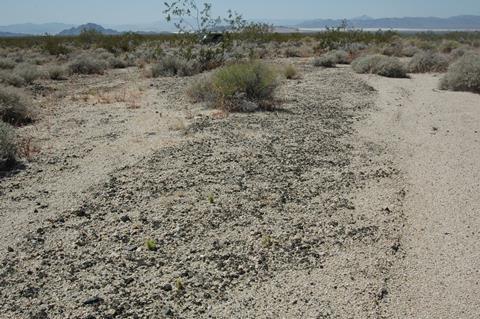
The Mojave Desert in the south-western US, where the soil-dwelling lichen was found
Mojave desert

Wednesday, January 31, 2024

Hubble Space Telescope Detects Water Vapor in Smallest Exoplanet to Date only 97 light years away

Good news! Amazing stuff!

"At around twice Earth's diameter, planet GJ 9827d orbits a red dwarf star 97 light-years away in the constellation Pisces, NASA and the European Space Agency (ESA) said in statements on Thursday. [1/25/2024] ..."

"... At only approximately twice Earth's diameter, the planet GJ 9827d could be an example of potential planets with water-rich atmospheres elsewhere in our galaxy.

"This would be the first time that we can directly show through an atmospheric detection, that these planets with water-rich atmospheres can actually exist around other stars,"  ...
Because the planet is as hot as Venus, at 800 degrees Fahrenheit, it definitely would be an inhospitable, steamy world if the atmosphere were predominantly water vapor. ..."

From the abstract:
"Recent work on the characterization of small exoplanets has allowed us to accumulate growing evidence that sub-Neptunes with radii greater than ∼2.5 R⊕ often host H2/He-dominated atmospheres both from measurements of their low bulk densities and from direct detections of their low mean molecular mass atmospheres. However, the smaller sub-Neptunes in the 1.5–2.2 R⊕ size regime are much less understood and often have bulk densities that can be explained either by the H2/He-rich scenario or by a volatile-dominated composition known as the "water world" scenario. Here we report the detection of water vapor in the transmission spectrum of the 1.96 ± 0.08 R⊕ sub-Neptune GJ 9827 d obtained with the Hubble Space Telescope (HST). We observe 11 HST Wide Field Camera 3 transits of GJ 9827 d and find an absorption feature at 1.4 μm in its transit spectrum, which is best explained (at 3.39σ) by the presence of water in GJ 9827 d's atmosphere. We further show that this feature cannot be caused by unocculted starspots during the transits by combining an analysis of the K2 photometry and transit light source effect retrievals. We reveal that the water absorption feature can be similarly well explained by a small amount of water vapor in a cloudy H2/He atmosphere or a water vapor envelope on GJ 9827 d. Given that recent studies have inferred an important mass-loss rate (>0.5 M⊕ Gyr−1) for GJ 9827 d, making it unlikely to retain a H-dominated envelope, our findings highlight GJ 9827 d as a promising water world candidate that could host a volatile-dominated atmosphere. This water detection also makes GJ 9827 d the smallest exoplanet with an atmospheric molecular detection to date."

'Landmark Discovery': Hubble Detects Water Vapor in Smallest Exoplanet to Date : ScienceAlert


Friday, September 15, 2023

For the first time Methane and carbon dioxide found in atmosphere of habitable-zone exoplanet

We are not alone!

Uh, there is CO2 on this exoplanet! Should we be concerned about climate change? Maybe we have to rescue our brothers and sisters on this exoplanet? (Caution: Satire)

"The results are consistent with an ocean-covered surface underneath a hydrogen-rich atmosphere. The discovery provides a glimpse into a planet unlike anything else in our Solar System, and raises interesting prospects about potentially habitable worlds elsewhere in the Universe.
K2-18 b — which is 8.6 times as massive as Earth — orbits the cool dwarf star K2-18 in the habitable zone and lies 110 light years from Earth in the constellation of Leo. A first insight into the atmosphere of  K2-18 b came from observations with the Hubble Space Telescope but the atmospheric composition has been a subject of debate. The same researchers studied K2-18 b in 2020 and 2021, and identified it as belonging to a new class of habitable exoplanets called ‘Hycean’ worlds which could accelerate the search for life elsewhere. This prompted them to take a more detailed look with JWST, Hubble’s successor. ..."

From the abstract:
"The search for habitable environments and biomarkers in exoplanetary atmospheres is the holy grail of exoplanet science. The detection of atmospheric signatures of habitable Earth-like exoplanets is challenging due to their small planet-star size contrast and thin atmospheres with high mean molecular weight. Recently, a new class of habitable exoplanets, called Hycean worlds, has been proposed, defined as temperate ocean-covered worlds with H2-rich atmospheres. Their large sizes and extended atmospheres, compared to rocky planets of the same mass, make Hycean worlds significantly more accessible to atmospheric spectroscopy with the JWST. Here we report a transmission spectrum of the candidate Hycean world, K2-18 b, observed with the JWST NIRISS and NIRSpec instruments in the 0.9-5.2 μm range. The spectrum reveals strong detections of methane (CH4) and carbon dioxide (CO2) at 5σ and 3σ confidence, respectively, with high volume mixing ratios of ~1% each in a H2-rich atmosphere. The abundant CH4 and CO2 along with the non-detection of ammonia (NH3) are consistent with chemical predictions for an ocean under a temperate H2-rich atmosphere on K2-18 b. The spectrum also suggests potential signs of dimethyl sulfide (DMS), which has been predicted to be an observable biomarker in Hycean worlds, motivating considerations of possible biological activity on the planet. The detection of CH4 resolves the long-standing missing methane problem for temperate exoplanets and the degeneracy in the atmospheric composition of K2-18 b from previous observations. We discuss possible implications of the findings, open questions, and future observations to explore this new regime in the search for life elsewhere."

Methane and carbon dioxide found in atmosphere of habitable-zone exoplanet An international team of astronomers led by the University of Cambridge has used data from the NASA/ESA/CSA James Webb Space Telescope to discover methane and carbon dioxide in the atmosphere of K2-18 b, an exoplanet in the ‘Goldilocks zone’. This is the first time that carbon-based molecules have been discovered in the atmosphere of an exoplanet in the habitable zone.


Thursday, April 20, 2023

Astronomers directly image massive exoplanet in radically new way only 132 light-years away in our Milky Way galaxy

Amazing stuff! We are not alone!

"For ages, astronomers have been intrigued by the notion of uncovering exoplanets – planets outside our Solar System. Thus far, astronomers have found over 5,300 of them with new discoveries coming in at an astounding rate. ...
The outcome was the discovery of HIP 99770 b, located some 132 light-years away. This planet is more than 15 times the mass of Jupiter and orbits a star almost twice as massive as the Sun. ..."

"In a breakthrough discovery, the Subaru Telescope’s powerful extreme adaptive optics system has imaged a massive benchmark gas giant planet around the nearby, bright star HIP 99770. The object, HIP 99770 b, is the first extrasolar planet jointly discovered by direct imaging and the new method of indirect detection, precision astrometry. This new approach for finding imageable planets simultaneously measures their mass, orbits, and even their atmosphere. It prefigures the way that we will someday identify and characterize an Earth twin around a nearby star. ..."

"Astrometry guides imaging detection
Direct imaging of exoplanets is challenging because of the glare of the much brighter host star. The technique has detected only small numbers of gas giant exoplanets on wide orbits. Astrometry, the precise measurements of stellar positions, could potentially identify stars being pulled by the gravity of a nearby planet. Currie et al. used astrometry to identify a candidate host star, which they then studied with direct imaging. They found an object with the right properties to explain the astrometry signal and interpreted it as an exoplanet of about 14 Jupiter masses. The detection shows how astrometry can help to detect and characterize directly imaged exoplanets."

From the abstract:
"Direct imaging of gas giant exoplanets provides information on their atmospheres and the architectures of planetary systems. However, few planets have been detected in blind surveys with direct imaging. Using astrometry from the Gaia and Hipparcos spacecraft, we identified dynamical evidence for a gas giant planet around the nearby star HIP 99770. We confirmed the detection of this planet with direct imaging using the Subaru Coronagraphic Extreme Adaptive Optics instrument. The planet, HIP 99770 b, orbits 17 astronomical units from its host star, receiving an amount of light similar to that reaching Jupiter. Its dynamical mass is 13.9 to 16.1 Jupiter masses. The planet-to-star mass ratio [(7 to 8) × 10−3] is similar to that of other directly imaged planets. The planet’s atmospheric spectrum indicates an older, less cloudy analog of the previously imaged exoplanets around HR 8799."

Astronomers directly image massive exoplanet in radically new way Star-mapping data and direct imaging could lead to even more exoplanet discoveries.

Tuesday, April 18, 2023

Earth-like exoplanets may be much more common within our Milky Way galaxy than previously thought

We are not alone! Why would God only create one planet earth?

"Key takeaways
  • ... scientists ... challenge the theory that Earth’s water came from asteroids and comets colliding with our planet.
  • The scientists identified a process through which “homemade” water can be easily produced on planets throughout our galaxy.
  • The study reveals that planets like Earth might not just be common — but inevitable. ..."
From the abstract:
"Earth’s water, intrinsic oxidation state and metal core density are fundamental chemical features of our planet. Studies of exoplanets provide a useful context for elucidating the source of these chemical traits. Planet formation and evolution models demonstrate that rocky exoplanets commonly formed with hydrogen-rich envelopes that were lost over time. These findings suggest that Earth may also have formed from bodies with hydrogen-rich primary atmospheres. Here we use a self-consistent thermodynamic model to show that Earth’s water, core density and overall oxidation state can all be sourced to equilibrium between hydrogen-rich primary atmospheres and underlying magma oceans in its progenitor planetary embryos. Water is produced from dry starting materials resembling enstatite chondrites as oxygen from magma oceans reacts with hydrogen. Hydrogen derived from the atmosphere enters the magma ocean and eventually the metal core at equilibrium, causing metal density deficits matching that of Earth. Oxidation of the silicate rocks from solar-like to Earth-like oxygen fugacities also ensues as silicon, along with hydrogen and oxygen, alloys with iron in the cores. Reaction with hydrogen atmospheres and metal–silicate equilibrium thus provides a simple explanation for fundamental features of Earth’s geochemistry that is consistent with rocky planet formation across the Galaxy."

Earth-like exoplanets may be much more common than previously thought A new study led by UCLA scientists on how water forms on young exoplanets with hydrogen atmospheres and molten oceans of magma suggests that Earth-like planets may not be as uncommon as once thought and that the presence of water on such planets may be almost inevitable.

Earth-like planets may be an inevitability A UCLA-led study provides insights into how water might be formed by planets across the galaxy

Sunday, January 22, 2023

How Do Rocky Planets like super earths Really Form in our Milky Way galaxy

Recommendable!

"A new theory for how rocky planets form could explain the origin of so-called "super-Earths"—a class of exoplanets a few times more massive than the Earth that are the most abundant type of planet in the galaxy.
Further, it could explain why super-Earths within a single planetary system often wind up looking strangely similar in size, as though each system were only capable of producing a single kind of planet. ...
In our solar system, there are two distinct types of planets: the smaller rocky inner planets closest to the sun and the outer larger water- and hydrogen-rich gas giants that are farther from the sun. In an earlier study ... this dichotomy led ... to suggest that planet formation in our solar system occurred in two distinct rings in the protoplanetary disk: an inner one where the small rocky planets formed and an outer one for the more massive icy planets (two of which—Jupiter and Saturn—later grew into gas giants). ..."

From the abstract:
"The formation of super-Earths, the most abundant planets in the Galaxy, remains elusive. These planets have masses that typically exceed that of the Earth by a factor of a few, appear to be predominantly rocky, although often surrounded by H/He atmospheres, and frequently occur in multiples. Moreover, planets that encircle the same star tend to have similar masses and radii, whereas those belonging to different systems exhibit remarkable overall diversity. Here we advance a theoretical picture for rocky planet formation that satisfies the aforementioned constraints: building upon recent work, which has demonstrated that planetesimals can form rapidly at discrete locations in the disk, we propose that super-Earths originate inside rings of silicate-rich planetesimals at approximately ~1 au. Within the context of this picture, we show that planets grow primarily through pairwise collisions among rocky planetesimals until they achieve terminal masses that are regulated by isolation and orbital migration. We quantify our model with numerical simulations and demonstrate that our synthetic planetary systems bear a close resemblance to compact, multi-resonant progenitors of the observed population of short-period extrasolar planets."

How Do Rocky Planets Really Form? | www.caltech.edu Scientists unveil a unified theory for rocky planet formation


Wednesday, November 23, 2022

Webb telescope shows exoplanet atmosphere including clouds as never seen before

Amazing stuff!

"... The telescope’s array of highly sensitive instruments was trained on the atmosphere of a “hot Saturn” – a planet about as massive as Saturn orbiting a star some 700 light-years away – known as WASP-39 b. While Webb and other space telescopes, including Hubble and Spitzer, previously have revealed isolated ingredients of this broiling planet’s atmosphere, the new readings provide a full menu of atoms, molecules and even signs of active chemistry and clouds. ...
The suite of discoveries is detailed in a set of five new scientific papers which have not yet been published. Among the unprecedented revelations is the first detection in an exoplanet atmosphere of sulfur dioxide, a molecule produced from chemical reactions triggered by high-energy light from the planet’s parent star. ...
 “This is the first time we see concrete evidence of photochemistry – chemical reactions initialized by energetic stellar light – on exoplanets,” ...
Other atmospheric constituents detected by the Webb telescope include sodium, potassium and water vapor ...
Capturing such a broad spectrum of WASP-39 b’s atmosphere was a scientific tour de force, as an international team numbering in the hundreds independently analyzed data from four of the Webb telescope’s finely calibrated instrument modes. ..."

Webb telescope shows exoplanet atmosphere as never seen before | Cornell Chronicle

Monday, November 09, 2020

More than three billion Milky Way’s sun-like stars could be home to Earth-like planets

We are not alone!

"Nearly 4,300 exoplanets have been discovered by astronomers, and it’s quite obvious now our galaxy is filled with them. ...
When applied to current estimates of 4.1 billion sun-like stars in the [Milky Way] galaxy, their model suggests there are at minimum 300 million with at least one habitable planet. ... Even less conservative predictions suggest it could be over 3.6 billion [sun-like stars]. ..."

Half the Milky Way’s sun-like stars could be home to Earth-like planets | MIT Technology Review A new study of exoplanet data suggests there are at least 300 million potentially habitable planets orbiting stars like the sun, and likely way more.

Here is the respective research article:

From reading the abstract of this paper you would never guess what the MIT Technology Review wrote about it. The paper is 43 pages long, not even the results chapter reflects what MIT TR wrote about it. However, I only briefly perused the paper.

Wednesday, May 06, 2020

Yeast thriving in hydrogen hints at possibility of life on exoplanets

Amazing stuff! We are not alone!

Yeast thriving in hydrogen hints at possibility of life on exoplanets | Research | Chemistry World: First demonstration of non-adapted microorganisms growing in 100% H2 shows that life could exist even under seemingly hostile conditions

Planets with hydrogen-rich atmospheres could harbor life | Science News Lab experiments show that yeast and E. coli survive and reproduce in hydrogen-rich conditions


Friday, January 31, 2020

NESSI Emerges as New Tool for Exoplanet Atmospheres

The search for and research on exoplanets goes on!
We are not alone!

News | NESSI Emerges as New Tool for Exoplanet Atmospheres: The infrared instrument at Palomar Observatory's Hale Telescope holds the promise of deepening our understanding of planets beyond our Sun.

Wednesday, January 09, 2019

Exoplanets: We Are Not Alone?

Posted: 6/17/2012 Updated: 1/9/2019, 7/2/2016, 7/24/2015, 4/12/2015, 4/9/2015, 2/28/2015, 10/17/2014

Update of 1/9/2019

Just read this article about latest research on so called Fast Radio Bursts that were first discovered in 2007: Bevy of mysterious fast radio bursts spotted by Canadian telescope Bounty includes second known example of a repeating burst. If a wild speculation is allowed for a very brief moment, are these perhaps signals from aliens? Let’s stay tuned to what scientists may discover in the future.

Here are two older articles, I had not included so far:

Something went wrong, so I had to republish this almost lost blog post!

Update Of 7/2/2016

To cite:
“NASA’s Cassini spacecraft, currently orbiting Saturn, has made intriguing observations of icy jets spewing from a suspected underground liquid ocean … Enceladus has over 90 geysers that spew plumes of salty water vapor, organic compounds and ice particles from the underground ocean into the air. ”

Update 7/24/2015

This week we received news like this Earth's Closest Cousin Discovered Among New Pile of Planets Called Kepler 452b, the world is a bit bigger than Earth and could have a surface suitable for water and life. We read here: “Called Kepler 452b, the planet orbits a 6 billion-year-old sunlike star about 1,400 light-years away. Kepler 452b is about 60 percent larger than Earth, and perhaps five times as massive. With a year lasting 385 days, it sits in the region around its star where temperatures are just right for maintaining liquid water on a world’s surface. … A new haul of 500 planet candidates announced Thursday brings Kepler’s total catalog of possible planets to 4,696. Twelve of those are smaller than two Earth-widths, and nine orbit stars that are similar in size and temperature to the sun. More than 1,000 Kepler planets have been confirmed—and that’s just in one tiny piece of sky.”

Update 4/12/15

Just watched this very recommendable PBS Nova documentary “Alien Planets Revealed”.

Update (3)


I quote from the above article: “This discovery, made with the Atacama Large Millimeter/submillimeter Array (ALMA), reveals that the protoplanetary disk surrounding the million-year-old star MWC 480 is brimming with methyl cyanide (CH3CN), a complex carbon-based molecule. Both this molecule and its simpler cousin hydrogen cyanide (HCN) were found in the cold outer reaches of the star's newly formed disk, in a region that astronomers believe is analogous to our own Kuiper Belt - the realm of icy planetesimals and comets beyond Neptune.” (emphasis added)

Update (2)

Just read the abstract of “Untangling dips and pulses in starlight” (Unfortunately, you have to sign in to read even the abstract. What a stupidity!)

So I quote here freely from the above abstract:
“The menagerie of known exoplanets continues to grow with Kepler data. The NASA spacecraft has monitored stars for brightness dips due to planetary transits, enabling Campante et al. to find five rocky planets orbiting the K star Kepler-444—all between Mercury and Venus in size. Kepler's precise photometry also allowed the team to measure the star's asteroseismic pulsations. A comparison of those values with stellar evolution models revealed an age of 11.2 ± 1.0 billion years, or 80% as old as the universe itself. A planetary system this old (over twice the age of Earth) demonstrates the wide time frame in which Earth-sized planets have existed and helps astronomers discern the earliest times of planet formation.”

An Update

Recently, I came across this article in the Neue Zuericher Zeitung titled “Potenzial von Exoplaneten untersucht” (German language) published on 9/19/2013.

This article focuses on so called habitable zones and its lifetime. Habitable zones are defined as the distance from the star that allows for human like life or where water is liquid. I am afraid this is an artificially narrow focus, because life on other planets may be quite different from our own. To assume that life on other planets in the universe is similar to our own is heroic.

Encouraging Recent Developments
Exoplanet stands for extrasolar planet. Almost 800 of them have been identified by now (June 2012). In our Milky Way Galaxy alone, there are an estimated 160 billion exoplanets. The first confirmed detection of several terrestrial-mass planets occurred in 1992. Given these mind boggling numbers, how unique is planet earth?
May I Speculate About Extraterrestrial Life
I usually do not speculate, but I will make an exception here. Extra terrestrial life was something very remote to me to think about, but the confirmed discovery of exoplanets changes my cognition.
Some kind of extraterrestrial life will likely be discovered in space, it is only a matter of time. Probably, these forms of life are maybe quite different from life on earth.
Most likely there is even intelligent life out there. If so, how will we be able to communicate with these beings? I bet we will find a way. Perhaps, they are already trying to communicate with us, but we are yet too primitive to understand. How advanced are they? Are they peaceful? What do they know about us? Have they already visited us?
Extraterrestrial Life And Faith
Do these intelligent beings believe in something like religion or do they have some kind of faith? If yes, do they believe in something like god? If yes, what are the similarities or differences? Would Christians accept these beings as children of god or being made in the image of god? Was Jesus the only son of god? Will religious differences rather divide or unite us?

In the meantime (10/17/2014), astronomer David Weintraub has written a book about this subject titled “Religions and Extraterrestrial Life: How Will We Deal with It?” (See a review here). According to the review, the astronomer argues among other things that Asian religions like Buddhism can easier accommodate the existence of extraterrestrial life and that e.g. Judaism is kind of neutral.

Saturday, February 09, 2013

Aliens Only 13 Light Years Away?


Science In The News


On of the biggest science news this week (ending 2/8/2013) that “in our galaxy, the closest Earth-like planet could be just 13 light-years away.” Once humans travel at or near the speed of light this is like a weekend trip. Details here and here (German language).

Life Much Older Than Ours?

Since this study focused only on red stars in our galaxy it concluded “… red dwarf stars live much longer than Sun-like stars, this discovery raises the interesting possibility that life on such a planet would be much older and more evolved than life on Earth.” How about that?

Sunday, June 17, 2012

Exoplanets: We Are Not Alone?

Posted: 6/17/2012 Updated: 7/2/2016, 7/24/2015, 4/12/2015, 4/9/2015, 2/28/2015, 10/17/2014

Update Of 7/2/2016

To cite:
“NASA’s Cassini spacecraft, currently orbiting Saturn, has made intriguing observations of icy jets spewing from a suspected underground liquid ocean … Enceladus has over 90 geysers that spew plumes of salty water vapor, organic compounds and ice particles from the underground ocean into the air. ”

Update 7/24/2015

This week we received news like this Earth's Closest Cousin Discovered Among New Pile of Planets Called Kepler 452b, the world is a bit bigger than Earth and could have a surface suitable for water and life. We read here: “Called Kepler 452b, the planet orbits a 6 billion-year-old sunlike star about 1,400 light-years away. Kepler 452b is about 60 percent larger than Earth, and perhaps five times as massive. With a year lasting 385 days, it sits in the region around its star where temperatures are just right for maintaining liquid water on a world’s surface. … A new haul of 500 planet candidates announced Thursday brings Kepler’s total catalog of possible planets to 4,696. Twelve of those are smaller than two Earth-widths, and nine orbit stars that are similar in size and temperature to the sun. More than 1,000 Kepler planets have been confirmed—and that’s just in one tiny piece of sky.”

Update 4/12/15

Just watched this very recommendable PBS Nova documentary “Alien Planets Revealed”.

Update (3)


I quote from the above article: “This discovery, made with the Atacama Large Millimeter/submillimeter Array (ALMA), reveals that the protoplanetary disk surrounding the million-year-old star MWC 480 is brimming with methyl cyanide (CH3CN), a complex carbon-based molecule. Both this molecule and its simpler cousin hydrogen cyanide (HCN) were found in the cold outer reaches of the star's newly formed disk, in a region that astronomers believe is analogous to our own Kuiper Belt - the realm of icy planetesimals and comets beyond Neptune.” (emphasis added)

Update (2)

Just read the abstract of “Untangling dips and pulses in starlight” (Unfortunately, you have to sign in to read even the abstract. What a stupidity!)

So I quote here freely from the above abstract:
“The menagerie of known exoplanets continues to grow with Kepler data. The NASA spacecraft has monitored stars for brightness dips due to planetary transits, enabling Campante et al. to find five rocky planets orbiting the K star Kepler-444—all between Mercury and Venus in size. Kepler's precise photometry also allowed the team to measure the star's asteroseismic pulsations. A comparison of those values with stellar evolution models revealed an age of 11.2 ± 1.0 billion years, or 80% as old as the universe itself. A planetary system this old (over twice the age of Earth) demonstrates the wide time frame in which Earth-sized planets have existed and helps astronomers discern the earliest times of planet formation.”

An Update

Recently, I came across this article in the Neue Zuericher Zeitung titled “Potenzial von Exoplaneten untersucht” (German language) published on 9/19/2013.

This article focuses on so called habitable zones and its lifetime. Habitable zones are defined as the distance from the star that allows for human like life or where water is liquid. I am afraid this is an artificially narrow focus, because life on other planets may be quite different from our own. To assume that life on other planets in the universe is similar to our own is heroic.

Encouraging Recent Developments
Exoplanet stands for extrasolar planet. Almost 800 of them have been identified by now (June 2012). In our Milky Way Galaxy alone, there are an estimated 160 billion exoplanets. The first confirmed detection of several terrestrial-mass planets occurred in 1992. Given these mind boggling numbers, how unique is planet earth?
May I Speculate About Extraterrestrial Life
I usually do not speculate, but I will make an exception here. Extra terrestrial life was something very remote to me to think about, but the confirmed discovery of exoplanets changes my cognition.
Some kind of extraterrestrial life will likely be discovered in space, it is only a matter of time. Probably, these forms of life are maybe quite different from life on earth.
Most likely there is even intelligent life out there. If so, how will we be able to communicate with these beings? I bet we will find a way. Perhaps, they are already trying to communicate with us, but we are yet too primitive to understand. How advanced are they? Are they peaceful? What do they know about us? Have they already visited us?
Extraterrestrial Life And Faith
Do these intelligent beings believe in something like religion or do they have some kind of faith? If yes, do they believe in something like god? If yes, what are the similarities or differences? Would Christians accept these beings as children of god or being made in the image of god? Was Jesus the only son of god? Will religious differences rather divide or unite us?

In the meantime (10/17/2014), astronomer David Weintraub has written a book about this subject titled “Religions and Extraterrestrial Life: How Will We Deal with It?” (See a review here). According to the review, the astronomer argues among other things that Asian religions like Buddhism can easier accommodate the existence of extraterrestial life and that e.g. Judaism is kind of neutral.