Amazing stuff! Extraterrestrial life?
"High-intensity ultraviolet radiation has been found to pose little trouble for a soil-dwelling lichen in the Mojave Desert. After three months of exposure to powerful UVC, the lichen still retained its photosynthetic function and cellular viability thanks to chemical shielding by its secondary metabolites. Compounds derived from these lichens could find UV-blocking applications in cosmetics, materials and agriculture and, according to researchers, provide evidence that exoplanets bombarded by intense UV light are not necessarily hostile to photosynthetic organisms. ...
To investigate, his team continually irradiated Clavascidium lacinulatum, a black desert lichen, for 90 days with 254nm UVC light at 55W/m². Despite receiving a cumulative dose of over 400,000kJ/m², the lichen showed only modest declines in photosynthetic quantum yield and retained approximately 65% viable algal photobiont cells. In comparison, when Deinococcus radiodurans, the most radiation-resistant bacteria ever found, was exposed to the same conditions, it died in under a minute. ...
The chemical basis of the lichen’s resistance lies in its UV-opaque cortex, a structural layer enriched with phenolic lichen acids. These complex aromatic metabolites serve as natural photostabilisers. The researchers identified one such compound with a tentative molecular formula of C₁₀H₁₄N₂O₅. ..."
"... the new research demonstrated that lichen found in the Mojave Desert survived for 3 months under levels of solar radiation previously considered lethal. The common lichen, Clavascidium lacinulatum, was injured, but able to recover and replicate. The results show that photosynthetic life may be possible on planets exposed to intense solar radiation. ..."
From the abstract:
"Many of the recently discovered Earth-like exoplanets are hosted by M and F stars, stars that emit intense UVC, especially during a flare. We studied whether such planets are nevertheless habitable by irradiating a desert lichen, Clavascidium lacinulatum, with 254-nm 55 W/m2 UVC nonstop for 3 months in the laboratory.
Only 50% of its algal photobiont cells were inactivated. To put this in perspective, we used the same setup to challenge the photobiont cells but grown in pure culture, and Deinococcus radiodurans, the most radiation-resistant bacterium on Earth. Entire monolayers of hundreds of cells were inactivated in just 60 s.
Further studies indicated that the cortex of the lichen was rendered UVC-opaque by deposits of phenolic secondary metabolites in its interstices. The lichen was injured only because, while most photochemical reactive oxygen species were quenched, photochemical ozone was not. We conclude that UVC-intense exoplanets are not necessarily uninhabitable to photosynthetic organisms."
Desert Lichen Offers New Evidence for the Possibility of Life on Other Planets (original news release) "Lichen from the Mojave Desert can survive, and replicate, under levels of extreme solar radiation found on Earth-like planets in other solar systems."
UVC-Intense Exoplanets May Not Be Uninhabitable: Evidence from a Desert Lichen (open access)
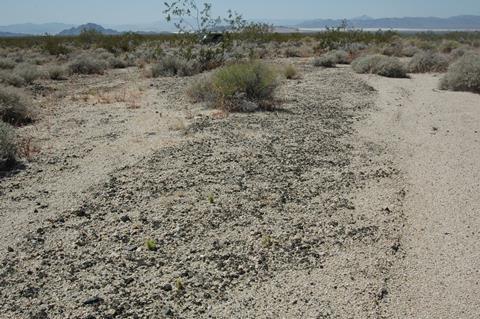
The Mojave Desert in the south-western US, where the soil-dwelling lichen was found

No comments:
Post a Comment