Showing posts with label analgesics. Show all posts

Wednesday, August 26, 2026

Concrete structural evidence that ketamine has opioidic tendencies

Amazing stuff!

"Research has provided concrete structural evidence that ketamine has opioidic tendencies.
Until recently, ketamine’s pain-reducing and sedatory abilities have been predominantly put down to its ability to block the N-methyl-D-aspartate receptors (NMDAR) in the brain.
While studies have suggested some relationship between ketamine and the opioid pathway, until now, no study has visualized ketamine activating opioid receptors. Looking at how NMDAR and opioid receptor signalling works together to drive ketamine's therapeutic effects could help guide the next generation of drugs ..."

From the abstract:
"Ketamine offers rapid relief for treatment-resistant depression and severe pain in the clinic, providing immediate benefits that traditional medications often fail to deliver.
While its antagonistic action at the N-methyl-D-aspartate receptor (NMDAR) is a key mechanism, ketamine’s dual nature as both a promising treatment and a drug with abuse potential suggests its therapeutic effects extend beyond NMDAR inhibition.
Here we provide structural evidence of human opioid receptors bound to ketamine and its parent analog phencyclidine (PCP), supporting that both ligands can directly bind and activate opioid receptors.
The structures, together with site-directed mutagenesis and structure–activity relationship studies, identify key motifs involved in ketamine and PCP recognition and efficacy modulation.
Furthermore, we determine the structure of the ligand-free state of human κ opioid receptor, revealing molecular details before ligand engagement.
Compared to PCP, ketamine displays more notable binding dynamics in the orthosteric site that may contribute to its unique pharmacology at opioid receptors. Our findings highlight the importance of including opioid receptors to fully understand ketamine’s versatility in clinical settings."

Nature Briefing: Translational Research


Fig. 1: Cryo-EM structures of human opioid receptors bound to ketamine and PCP.


Fig. 3: Unique pharmacology of 3-OH-PCP.


Sunday, January 11, 2026

An easier approach to recreate the powerful nerve-blocking molecule saxitoxin found in shellfish

Good news!

"Chemists have long been fascinated and frustrated by saxitoxin: a molecule that causes temporary paralysis by blocking the electrical signals that nerve cells (neurons) use to activate muscle, and which accumulates in shellfish like clams, oysters and scallops. ...

Now [early Dec 2025], scientists ... report a streamlined approach to synthesize saxitoxin and related molecules (known as analogs) in the lab. They combined a synthetic chemical route with an engineered enzyme to make the molecule in less than 10 steps, compared to 11–21 in earlier approaches.
Reducing the total step count is a major advance in synthesis because each step typically lowers yield while increasing cost and time; a shorter route can deliver much more material with far fewer resources. ...

Published in Nature, the research team’s tactic relies on two methods.
The first is radical cross-coupling: a technique that uses highly reactive molecular fragments, called radicals, to form bonds that are difficult or even impossible to create with traditional reactions.
The second method is biocatalysis, where enzymes—proteins that speed up reactions—carry out chemical steps that would otherwise be difficult. ..."

From the abstract:
"Saxitoxin (STX, 1), a potent neurotoxin from shellfish, first isolated in 1957, offers immense pharmaceutical potential owing to its interaction with voltage-gated sodium channels, which are ubiquitously present in all excitable cells of the central and peripheral nervous system.
Hundreds of studies towards its synthesis have been disclosed so far, yet a fully modular and scalable approach to the family remains elusive.
Here we show how a tactical combination of radical retrosynthesis, biocatalysis and C–H functionalization logic can be used to solve this problem, resulting in a scalable approach to the STX family in fewer than ten steps, including the first total synthesis of neosaxitoxin (neoSTX), a hydroxylated naturally occurring STX analogue previously under clinical investigation.
The modular nature of the synthesis enables access to diverse analogues that were previously inaccessible and have now been evaluated through electrophysiological assays for biological activity."

An easier approach to recreate the powerful nerve-blocking molecule found in shellfish | Scripps Research "A Scripps Research-led study resolves the challenge of synthesizing saxitoxin, paving the way for new possibilities in pain management."


Tuesday, September 23, 2025

President Trump Links Autism With Tylenol use by pregnant women

That a US President mentions a single, specific drug in public statements like this is already a little unusual!

President Trump forgot to mention the safer alternatives for Tylenol available to pregnant women!

Even the lefty Johns Hopkins Bloomberg School of Public Health admits "An Environmental Health article in August that analyzed 46 previous studies found 27 had significant links between prenatal acetaminophen use and neurodevelopmental disorders.". 

However, these lefties could not resist to qualify their admission by dubiously stating "However, study co-author Ann Bauer, a University of Massachusetts epidemiologist, told NPR the U.S. government “may be jumping the gun,” adding: “I think those of us in the research community would like to see stronger evidence [???].”" How much stronger evidence do people suffering from Trump Derangement Syndrome need for a warning of pregnant women?

From the abstract:
"Background
Acetaminophen is the most commonly used over-the-counter pain and fever medication taken during pregnancy, with > 50% of pregnant women using acetaminophen worldwide. Numerous well-designed studies have indicated that pregnant mothers exposed to acetaminophen have children diagnosed with neurodevelopmental disorders (NDDs), including autism spectrum disorder (ASD) and attention-deficit/hyperactivity disorder (ADHD), at higher rates than children of pregnant mothers who were not exposed to acetaminophen.

Methods
We applied the Navigation Guide methodology to the scientific literature to comprehensively and objectively examine the association between prenatal acetaminophen exposure and NDDs and related symptomology in offspring. We conducted a systematic PubMed search through February 25, 2025, using predefined inclusion criteria and rated studies based on risk of bias and strength of evidence. Due to substantial heterogeneity, we opted for a qualitative synthesis, consistent with the Navigation Guide’s focus on environmental health evidence.

Results
We identified 46 studies for inclusion in our analysis. Of these, 27 studies reported positive associations (significant links to NDDs), 9 showed null associations (no significant link), and 4 indicated negative associations (protective effects). Higher-quality studies were more likely to show positive associations. Overall, the majority of the studies reported positive associations of prenatal acetaminophen use with ADHD, ASD, or NDDs in offspring, with risk-of-bias and strength-of-evidence ratings informing the overall synthesis.

Conclusions
Our analyses using the Navigation Guide thus support evidence consistent with an association between acetaminophen exposure during pregnancy and increased incidence of NDDs. Appropriate and immediate steps should be taken to advise pregnant women to limit acetaminophen consumption to protect their offspring’s neurodevelopment."

Global Health NOW: Trump Links Autism With Tylenol; Russia’s Infected Troops; and ‘Nicotine-Free’ Vapes Not Free of Health Concerns

Monday, September 08, 2025

Powerful new oral painkiller ADRIANA shows promise in ending opioid dependence

Good news!

"Japanese scientists have developed ADRIANA, a non-opioid painkiller that could provide powerful relief without the dangers of addiction. With successful trials already completed, large U.S. studies are now underway, raising hopes for a safer future in pain treatment. ...

The research team was first inspired by substances that mimic noradrenaline, which is released in life-threatening situations andactivates α2A-adrenoceptors to suppress pain. However, these pose a high risk of cardiovascular instability. After observing noradrenaline levels and α2B-adrenoceptors, the team hypothesized that selectively blocking α2B-adrenoceptors could elevate noradrenaline levels, leading to activation of α2A-adrenoceptors and resulting in pain relief without causing cardiovascular instability.

To identify selective inhibitors of α2B-adrenoceptors and measure the activity of individual α2-adrenoceptor subtypes, the researchers employed a novel technology known as the TGFα shedding assay and conducted compound screening leading to their discovery of the world's first selective α2B-adrenoceptor antagonist.

After success in administering the compound to mice and conducting non-clinical studies to assess its safety, physician-led clinical trials were conducted at Kyoto University Hospital. Both the Phase I trial in healthy volunteers and the Phase II trial in patients with postoperative pain following lung cancer surgery yielded highly promising results. ..."

From the significance and abstract:
"Significance
Control of pain is a global social health issue because severe pain strongly affects patients’ quality of life. Although opioids are the strongest painkillers, continuous use of opioids often leads to addiction with numerous adverse effects, including respiratory depression, constipation, and hyperalgesia.
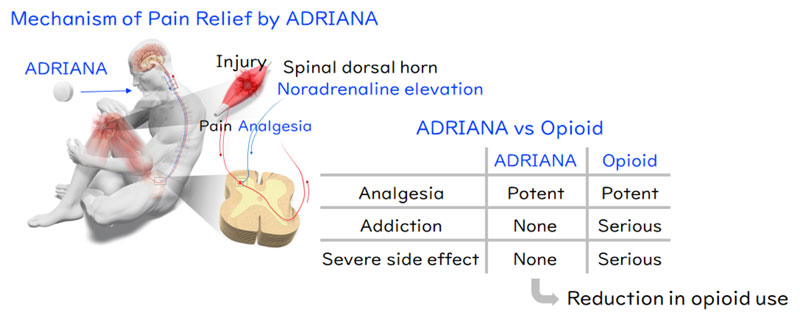
An emerging alternative to opioid-based analgesics is dexmedetomidine, an α2-adrenergic receptor agonist. We found that administration of an α2B-specific antagonist, adrenergic inducer of analgesia (ADRIANA), induced noradrenaline release in the spinal dorsal horn and suppressed pain through an α2A-dependent pathway without causing hemodynamic instability. ADRIANA did not cause addiction or any behavioral change in mice and monkeys. A phase I/II clinical trial of the ADRIANA oral tablet is underway to test its effectiveness in reducing postoperative pain.

Abstract
Noradrenaline is a major monoaminergic neurotransmitter involved in pain modulation through an α2A-adrenergic receptor. Hence, α2-adrenergic agonists such as clonidine and dexmedetomidine exhibit analgesic and opioid-sparing effects. However, their use is restricted to hospital settings due to potential risks of acute hypertension/hypotension and bradycardia.
Here, we report that (Z)-1-(3-ethyl-5-fluorobenzo[d] thiazol-2(3H)-ylidene)propan-2-one [adrenergic inducer of analgesia (ADRIANA)], a newly identified α2B subtype-specific antagonist, specifically promotes noradrenaline release in the murine spinal dorsal horn and produces analgesic effects by stimulating the α2A-dependent pain inhibitory pathway.
Orally administered ADRIANA has potent analgesic effects in several nociceptive pain models of mice and nonhuman primates without cardiovascular effects.
Mice with genetic loss of the α2B adrenoceptor showed normal responses to mechanical pain, but the analgesic effect of ADRIANA was not significantly detected.
These findings reveal that the α2B adrenoceptor is a promising target for nonopioid analgesics through the activation of the α2A-dependent descending pathway."


A new alternative to opioids (original news release)


Credits: Global Health NOW: Ebola Outbreak Tests Shaky Global Health Ground; Burkina Faso’s Gene-Drive Reversal; and Cuts Undermine Quest for Autism’s Cause


Mechanism of pain relief by ADRIANA


Thursday, September 04, 2025

Towards a better understanding of opioid tolerance, pain sensitivity and dependence

Good news! Are we getting closer to strong painkillers without or with less negative side effects like addiction, tolerance etc.?

"Opioids are among the most effective painkillers on the market, and for many people, they’re indispensable. But their effectiveness tends to decrease over time, meaning people have to take higher doses to feel relief. Even worse, people can end up more sensitive to pain than they were before, setting the stage for dependence or addiction. Now, researchers have uncovered a key mechanism behind these effects—and with it, a potential target for preventing them.

Opioids work by activating μ-opioid receptors in sensory neurons, especially those that connect to the central nervous system. There, opioids essentially shut off pain sensations by tamping down on pain signaling.

But the drugs can also activate pathways that do the opposite—particularly via a protein called Gαq. When researchers inhibited this protein or reduced the amount of it in the spinal cords of mice, the animals didn’t develop a tolerance to morphine nor increase their sensitivity to pain. And, as a bonus, the effectiveness of the drug increased. ..."

From the editor's summary and abstract:
"Editor’s summary
Although opioids block nociceptive signaling, their prolonged use increases pain sensitivity and promotes analgesic tolerance. These adverse effects involve the activation of NMDA-type glutamate receptors (NMDARs) and the metabotropic glutamate receptor mGluR5 in sensory neuron terminals in the spinal cord. Jin et al. found that morphine treatment increased the coupling of mGluR5 to Gαq in the spinal cords of rodents and that Gαq was required for morphine-induced increases in NMDAR phosphorylation and synaptic trafficking. Inhibition or knockdown of Gαq reduced morphine-induced hyperalgesia and analgesic tolerance. Thus, Gαq might be targeted to improve the analgesic effects of these drugs while reducing the need for dose escalation. ... 

Abstract
Opioids relieve pain by activating μ-opioid receptors (MORs), which inhibit communication between pain-sensing neurons (nociceptors) and the spinal cord. However, prolonged opioid use can paradoxically lead to increased pain sensitivity (hyperalgesia) and reduced analgesic efficacy (tolerance), partly because of the activation of NMDA-type glutamate receptors (NMDARs) at the central terminals of primary sensory neurons in the spinal cord.
Here, we identified a critical role for the G protein Gαq in this paradox. Pharmacological inhibition of Gαq in rats reversed morphine-induced increases in NMDAR phosphorylation, synaptic trafficking, and activity at sensory neuron terminals and reduced morphine-induced excitatory nociceptive input to spinal dorsal horn neurons. Morphine enhanced Gαq coupling specifically to metabotropic glutamate receptor 5 (mGluR5) dimers in the spinal cord.
Furthermore, targeted knockdown of Gαq in dorsal root ganglion neurons in mice normalized NMDAR-related changes and prevented NMDAR-mediated synaptic potentiation triggered by MOR activation.
In addition, either pharmacological or genetic disruption of Gαq signaling enhanced morphine’s analgesic effects while reducing hyperalgesia and tolerance. These findings reveal that Gαq signaling contributes to opioid-induced NMDAR hyperactivity at nociceptor central terminals by promoting MOR-mGluR5 cross-talk. Targeting this pathway may improve the safety and efficacy of opioid-based pain management."

ScienceAdviser


Fig. 4. Inhibiting Gαq activity at the spinal cord level reduces morphine treatment–induced hyperalgesia and tolerance.


Sunday, August 31, 2025

Common painkillers like Advil and Tylenol supercharge antibiotic resistance

Bad news!

"Painkillers ... — ibuprofen and acetaminophen — may be quietly accelerating one of the world’s greatest health crises: antibiotic resistance. Researchers discovered that these drugs not only fuel bacterial resistance on their own but make it far worse when combined with antibiotics. The findings are especially troubling for aged care settings, where residents commonly take multiple medications, creating perfect conditions for resistant bacteria to thrive. ..."

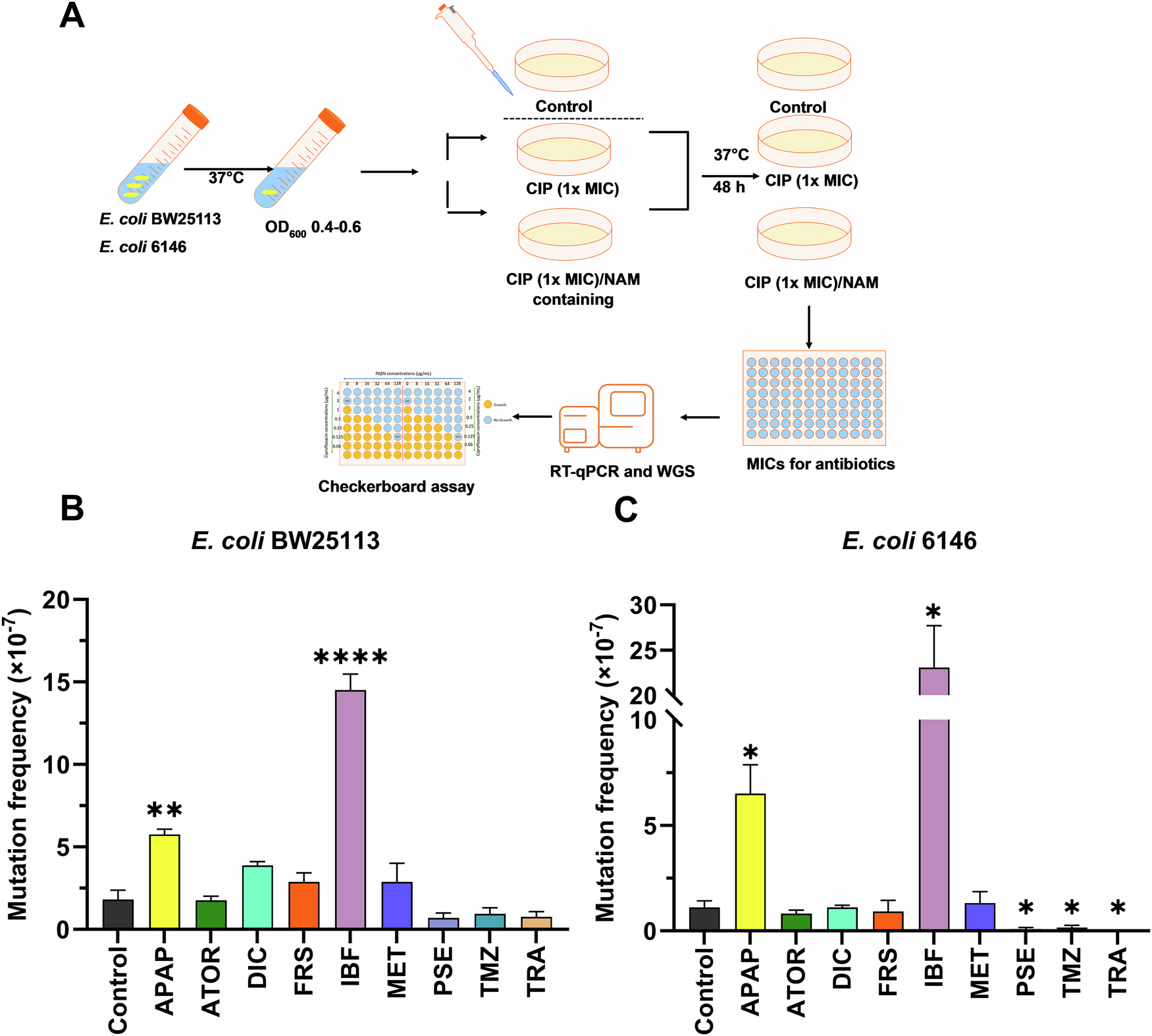
"... Assessing the interaction of non-antibiotic medications, the broad-spectrum antibiotic ciprofloxacin, and Escherichia coli (E. coli) – a common bacteria that causes gut and urinary tract infections ­­– researchers found that ibuprofen and paracetamol significantly increased bacterial mutations, making E. coli highly resistant to the antibiotic. ..."

From the abstract:
"Antimicrobial resistance (AMR) poses a global threat to public health. While antibiotic overuse is a primary driver, emerging evidence suggests that non-antibiotic medications (NAMs) may also contribute. This concern is particularly relevant in residential aged care facilities (RACFs), where both NAMs and antibiotics are frequently used. We investigated whether nine commonly used NAMs in RACFs, including ibuprofen, diclofenac, acetaminophen, furosemide, metformin, atorvastatin, tramadol, temazepam, and pseudoephedrine at gut-relevant concentrations, enhance ciprofloxacin-induced mutagenesis in Escherichia coli. Our findings showed that ibuprofen and acetaminophen significantly increased mutation frequency and conferred high-level ciprofloxacin resistance. Whole-genome sequencing identified mutations in GyrA, MarR, and AcrR, with the latter two correlated with overexpression of AcrAB-TolC drug efflux pump. Co-exposure to two NAMs further elevated mutation rates and ciprofloxacin resistance levels. This study underscored the overlooked role of NAMs in driving AMR and highlighted the need to reassess polypharmacy risks in aged care settings."

Common painkillers like Advil and Tylenol supercharge antibiotic resistance | ScienceDaily


Fig. 2: Mutation frequencies following exposure to ciprofloxacin and NAMs [non-antibiotic medications].


Wednesday, August 13, 2025

A parasitic worm can suppress pain signals in the human body

Amazing stuff!

"A parasitic worm can suppress pain signals in the human body, allowing it to invade without triggering the immune system, per new research published in The Journal of Immunology; the findings about the worm, Schistosoma mansoni, and its tactics for blocking neural pathways could lead to breakthroughs in pain management."

"... New research, ... discovered that a parasitic worm suppresses neurons in the skin to evade detection. The researchers suggest that the worm likely evolved this mechanism to enhance its own survival, and that the discovery of the molecules responsible for the suppression could aid in the development of new painkillers. ..."

From the abstract:
"Immunity against skin-invasive pathogens requires mechanisms that rapidly detect, repel, or immobilize the infectious agent. While bacteria often cause painful cutaneous reactions, host skin invasion by the human parasitic helminth Schistosoma mansoni often goes unnoticed.
This study interrogated whether pain-sensing skin afferents marked by expression of the ion channel Transient Receptor Potential Vanilloid 1 (TRPV1) contributed to the detection and initiation of skin immunity against S. mansoni.
Data show that percutaneous S. mansoni infection significantly reduced thermal pain sensitivity evoked by TRPV1+ neurons. Consistently, isolated skin sensory neurons from infected mice had significantly reduced calcium influx and neuropeptide release in response to the TRPV1 agonist capsaicin compared to neurons from naïve controls.
Using gain- and loss-of-function approaches to test whether TRPV1+ neurons initiate host-protective responses revealed that TRPV1+ neurons limit S. mansoni skin entry and migration into the pulmonary tract. Moreover, TRPV1+ neurons were both necessary and sufficient to promote proliferation and cytokine production from dermal γδ T cells and CD4+ T helper cells, as well as to enhance neutrophil and monocyte recruitment to the skin.
Taken together, this work suggests that S. mansoni may have evolved to manipulate TRPV1+ neuron activation as a countermeasure to limit IL-17-mediated inflammation, facilitating systemic dissemination and chronic parasitism."

Global Health NOW: Renewed Outrage Over FGM in The Gambia; Burma’s Junta Restricts ART Access; and South Sudan’s Fragile Psychological Care System


Graphical abstract


Wednesday, April 09, 2025

Imaging reveals psilocybin's neurological mechanisms in the brain that enable the psychedelic compound’s long-lasting effects

Good news! When will we finally be able to separate pain killing and other beneficial effects from becoming addicted and/or to hallucinate!

"... researchers have identified a pair of key neurological mechanisms in the brain – a cell type and receptor – that enable the psychedelic compound’s long-lasting effects.

Targeting the pyramidal tract neurons and their specific serotonin 5-HT2A receptor in the medial frontal cortex could enable pharmaceuticals to deliver psilocybin’s mood-altering benefits while suppressing the perceptual hallucinatory trip. ...

Using two-photon microscopy on transgenic mice, the researchers targeted the two largest populations of primary cells in the brain: 
pyramidal tract (PT) neurons and 
intratelencephalic (IT) neurons.

Inactivating the IT neurons, which are responsible for high-order cortical-cortical communication, did not change the behavioral effects of the psilocybin. ...

silenced the PT neurons, the drug was essentially ineffective – proof that this cell type and its pathway, which extends from the frontal cortex down into the midbrain and brainstem – is essential to psilocybin’s effects.

Equally important is the PT neurons’ 5-HT2A receptor, which has previously been shown to play an important role in humans experiencing acute, short-term hallucinatory trips. When the researchers knocked out the receptors, psilocybin’s positive behavioral effects disappeared. None of their manipulations affected the acute effects. ..."

From the abstract:
"Psilocybin is a serotonergic psychedelic with therapeutic potential for treating mental illnesses. At the cellular level, psychedelics induce structural neural plasticity, exemplified by the drug-evoked growth and remodeling of dendritic spines in cortical pyramidal cells.
A key question is how these cellular modifications map onto cell-type-specific circuits to produce the psychedelics’ behavioral actions.
Here we use in vivo optical imaging, chemogenetic perturbation and cell-type-specific electrophysiology to investigate the impact of psilocybin on the two main types of pyramidal cells in the mouse medial frontal cortex.
We find that a single dose of psilocybin increases the density of dendritic spines in both the subcortical-projecting, pyramidal tract (PT) and intratelencephalic (IT) cell types.
Behaviorally, silencing the PT neurons eliminates psilocybin’s ability to ameliorate stress-related phenotypes, whereas silencing IT neurons has no detectable effect. In PT neurons only, psilocybin boosts synaptic calcium transients and elevates firing rates acutely after administration.
Targeted knockout of 5-HT2A receptors abolishes psilocybin’s effects on stress-related behaviour and structural plasticity. Collectively, these results identify that a pyramidal cell type and the 5-HT2A receptor in the medial frontal cortex have essential roles in psilocybin’s long-term drug action."

Hitting the target: Imaging reveals psilocybin’s neural odyssey | Cornell Chronicle

The neurons that mediate a psychedelic’s long-term antidepressive effects (research briefing; no public access) "Psilocybin, a classic psychedelic, has therapeutic potential for psychiatric disorders. A specific brain circuit and receptor have now been found to be required for psilocybin’s long-term effects on neural plasticity and depression-related behaviour."


Fig. 1 Psilocybin induces structural plasticity in both PT and IT types of frontal cortical pyramidal neurons


Saturday, March 15, 2025

Compound mimics cannabis for pain relief without the side effects: Mouse study points to effective opioid alternative

Good news! Are we coming closer to effective painkillers without addiction?

"... "The custom-designed compound we created attaches to pain-reducing receptors in the body but, by design, it can't reach the brain. This means the compound avoids psychoactive side effects such as mood changes and isn't addictive because it doesn't act on the brain's reward center." ...

designed a cannabinoid molecule with a positive charge, preventing it from crossing the blood-brain barrier into the brain while allowing the molecule to engage CB1 receptors elsewhere in the body.

By modifying the molecule such that it only binds to pain-sensing nerve cells outside of the brain, the researchers achieved pain relief without mind-altering side effects. ..."

"... In this study, the modified compound offered prolonged pain relief – the animals showed no signs of developing tolerance despite twice-daily treatments with the compound over the course of nine days. This is a promising sign that the molecule could be used as a non addictive drug for relief of chronic pain, which requires continued treatment over time. ..."

From the abstract:
"The current opioid overdose epidemic highlights the urgent need to develop safer and more effective treatments for chronic pain. Cannabinoid receptor type 1 (CB1) is a promising non-opioid target for pain relief, but its clinical use has been limited by centrally mediated psychoactivity and tolerance. We overcame both issues by designing peripherally restricted CB1 agonists that minimize arrestin recruitment. We achieved these goals by computationally designing positively charged derivatives of the potent CB1 agonist MDMB-Fubinaca. We designed these ligands to occupy a cryptic pocket identified through molecular dynamics simulations—an extended binding pocket that opens rarely and leads to the conserved signalling residue D2.50. We used structure determination, pharmacological assays and molecular dynamics simulations to verify the binding modes of these ligands and to determine the molecular mechanism by which they achieve this dampening of arrestin recruitment.
Our lead ligand, VIP36, is highly peripherally restricted and demonstrates notable efficacy in three mouse pain models, with 100-fold dose separation between analgesic efficacy and centrally mediated side effects. VIP36 exerts analgesic efficacy through peripheral CB1 receptors and shows limited analgesic tolerance. These results show how targeting a cryptic pocket in a G-protein-coupled receptor can lead to enhanced peripheral selectivity, biased signalling, desired in vivo pharmacology and reduced adverse effects. This has substantial implications for chronic pain treatment but could also revolutionize the design of drugs targeting other G-protein-coupled receptors."

Compound mimics cannabis for pain relief without the side effects: Mouse study points to effective opioid alternative

Compound harnesses cannabis’ pain-relieving properties without side effects (original news release) "Mouse study points to an effective alternative to opioids"


The compound is illustrated here in cyan, nestled within a protein (green and purple) involved in sensing pain.


Wednesday, January 22, 2025

First New class of painkiller for moderate and severe acute pain heads for approval in decades and it's opioid-free

Good news! Are we finally getting away from opioids as a severe painkiller?

Again, the excessive precautionary principle prevents unnecessarily the  speedy approval of new drugs! Maybe President Trump should do something about it as well!

"The first new class of pain medication to market in decades could be approved by the US Food and Drug Administration by the end of [January]. Suzetrigine, from Vertex Pharmaceuticals, stops pain by blocking certain receptors in the peripheral nervous system rather than acting in the brain. Clinical trials showed that it works, but they were too short to rule out side effects from long-term use. A success for suzetrigine could renew funding interest in the development of new, non-opioid painkillers, a notoriously challenging field that has struggled to make headway in recent years."

"The FDA is weighing the regulatory fate of Vertex’s small-molecule suzetrigine, an inhibitor of voltage-gated sodium channel 1.8 (NaV1.8), for moderate to severe acute pain. A decision is due by 30 January. If approved, the oral drug will be the first new class of pain medication to market in decades ...

Success for Vertex could also bolster interest in related pain-associated NaVs. These ion channels have a key role in pain, helping to conduct electrical signals known as action potentials in peripheral pain-sensing nerves, also known as nociceptors. ...

“This is the first medicine that is specifically designed to only affect pain,”  ..."

Nature Briefing: Translational Research

NaV1.8 inhibitor poised to provide opioid-free pain relief "Vertex’s first-in-class suzetrigine could soon usher in a new class of analgesic."

Sunday, November 17, 2024

New non-addictive painkiller precisely targets sites of chronic pain and does not induce tolerance

Good news! We have been waiting for it for decades! Is this finally the breakthrough!

"Researchers have developed a non-addictive painkiller that remains inactive until it reaches sites of chronic pain. Instead of dulling the nerves that send the pain signals like other analgesics, this new pain pill directly addresses the underlying cause. Its makers are currently working towards testing the compound in human trials.

Different from other medications, a prodrug remains inactive until it encounters a specific circumstance in the body that activates it. ..."

"... The mechanism of action for the targeted prodrug involves activation of the active drug by a chemical reaction with reactive oxygen species such as hydrogen peroxide, which are present in much higher amounts at sites of pain than the rest of the body. ...

The prodrug was tested in both chemical and preclinical models and found to provide localised relief of sciatic nerve injuries, as well as other models of chronic pain featuring oxidative stress like osteoarthritis, chemotherapy-induced peripheral neuropathy and diabetic neuropathy. ...

“This showed us that the compound did not induce a tolerance, which is a major limiting factor to powerful painkillers like morphine,” ..."

From the abstract:
"Treatment of diseases of oxidative stress through activation of the antioxidant nuclear factor E2-related factor 2 (NRF2) is limited by systemic side effects. We chemically functionalize the NRF2 activator monomethyl fumarate to require Baeyer–Villiger oxidation for release of the active drug at sites of oxidative stress. This prodrug reverses chronic pain in mice with reduced side effects and could be applied to other disorders of oxidative stress."

New painkiller precisely targets sites of chronic pain

Researchers discover localised pain relief using known chemical reaction (original news release) "A team of international researchers including those from the University of Adelaide have taken a well-known chemical reaction as the basis of a new generation of targeted pain relief medication."


Fig. 1: Pathological peroxides are required for compound 1c to activate NRF2 in vitro.


Thursday, September 05, 2024

More progress in investigating the neural basis of opioid pain relief

Good news!

"... a team characterizes a neural circuit ...

Activating this network of neurons in the brainstem was enough to dull the pain of mice standing on a heated plate while blocking them from firing removed morphine's analgesic effect. “The findings provide the tools for targeting specific neural circuits to achieve effective pain relief with fewer side effects, potentially identifying targets for nonopioid pain management and the treatment of chronic pain conditions ...

In a statement, the researchers say they hope to further investigate the neural basis of opioid pain relief, particularly why it tends to decrease with long-term use, to aid in the development of truly effective relief for people experiencing severe, lasting pain."

From the abstract of the perspective:
"... Opioid drugs have diverse effects owing to the wide distribution of opioid receptors in the central and peripheral nervous systems, as well as in the gut. Consequently, understanding the neural circuits that mediate their analgesic effects has the potential to improve pain control while eliciting fewer side effects. ... report a population of excitatory neurons in the mouse brainstem that contribute to morphine’s ability to block the transmission of painful or injurious stimuli by sensory neurons (analgesia). Activation of this brainstem population mimicked morphine-induced analgesia, whereas inhibition reversed morphine-induced mechanical analgesia. Selectively targeting relevant neural circuits could potentially enable pain relief without the need for opioid administration."

From the editor's summary and abstract:
"Editor’s summary
It has been known for decades that a brainstem area called the rostral ventromedial medulla is important for opioid-induced analgesia, but the neural substrates underlying this phenomenon have remained elusive. Through the application of mouse genetics and the manipulation of neuron activity with engineered viruses, Fatt et al. discovered that a single type of excitatory neuron located in this brain region confers morphine antinociception ... These neurons project to the spinal cord, where, through monosynaptic connectivity, they activate a defined inhibitory spinal neuron type that gates pain signaling in the ascending pain pathway. Inhibition of either the excitatory neurons in the rostral ventromedial medulla or the inhibitory neurons in the spinal cord was found to abolish all of the analgesic effects of systemically administered morphine.
Structured Abstract
...
RATIONALE
... rostral ventromedial medulla (RVM), which is the last relay nucleus of a descending nerve pathway that collects information from several areas of the brain and modulates pain by increasing or decreasing incoming pain signaling in the spinal cord. ...
RESULTS
We used several recent technological advances, including the dual activity–dependent approaches ArcTRAP and CANE, single-nucleus RNA sequencing, computational analyses, monosynaptic tracing, and behavioral assays of neuronal activity. We found that the RVM consists of multiple molecular types of γ-aminobutyric acid–mediated (GABAergic) neurons as well as a few types of glutamatergic and serotonergic neurons. Among these, morphine activated a select set of neurons, which together formed a “morphine ensemble.” Synthetic activation of the genetically captured morphine ensemble produced mechanical pain relief, mimicking the effects of morphine, and its inactivation completely abolished the effects of morphine on pain.
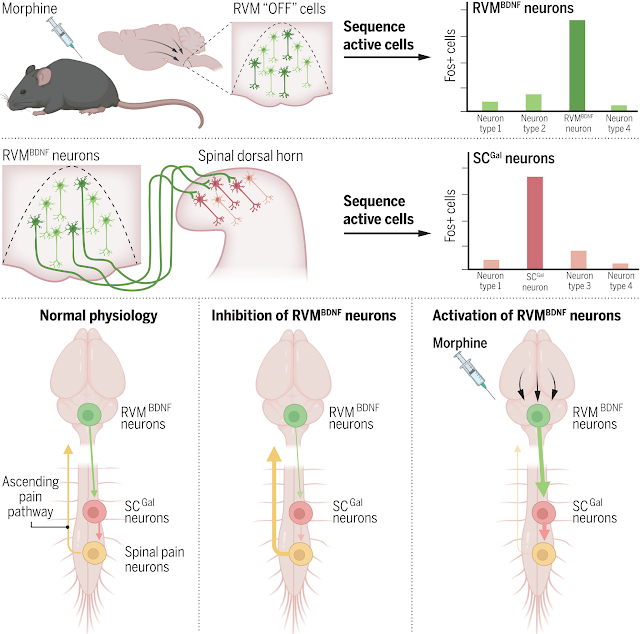
Among the neurons in the ensemble, glutamatergic neurons projecting to the spinal cord called RVMBDNF neurons (BDNF, brain-derived neurotrophic factor) were essential. Within the spinal cord, RVMBDNF neurons were connected to GABAergic inhibitory neurons expressing the neuropeptide galanin (SCGal neurons). Inhibition of SCGal neurons completely prevented pain inhibition after administration of morphine or synthetic activation of the RVMBDNF neurons. Notably, the neurotrophic factor BDNF produced within the RVMBDNF neurons was necessary for morphine to have any effect on the sensitivity to painful stimuli. Conversely, increasing BDNF expression in the RVMBDNF neurons markedly potentiated morphine’s effects, with efficacy at doses where morphine alone was insufficient.
CONCLUSION
We discovered that neural activity alone in the RVM induces the key features of morphine-induced mechanical pain relief, and when this activity is inhibited, morphine has little effect. Pain relief is mediated by glutamatergic RVMBDNF neurons projecting to inhibitory SCGal neurons, which attenuate incoming pain signaling in the spinal cord on the way to the brain. Within this circuit, BDNF is an essential component modulating neurotransmission. Finding the molecular identity of neurons that regulate morphine-induced mechanical antinociception advances the search for alternative therapeutic strategies to provide pain relief across various pain conditions."

ScienceAdvisor

Opioid circuit opens path to pain relief (no public access) "Manipulation of neural circuits targeted by morphine enables pain relief without opioids"


Identification of neurons that regulate morphine antinociception.


Thursday, February 08, 2024

Non-opioid drug proves effective for acute surgical & non-surgical pain

Good news, if confirmed!

It pains me to wonder how do you do placebo tests when pain is involved?

"... the development of non-opioid analgesics has become more urgent. A series of Phase 3 clinical trials into a novel oral, non-opioid painkiller has found that it’s effective in treating acute pain in both surgical and non-surgical settings. ...

Vertex Pharmaceuticals Inc. recently reported the results of Phase 3 clinical trials to test its oral, non-opioid NaV1.8 inhibitor, VX-458. The trials found that the drug effectively treats moderate-to-severe acute pain in surgical and non-surgical conditions. ...
VX-458 was found to be safe and well-tolerated across all three trials. The majority of adverse events were mild-to-moderate, and no serious adverse events were reported. ..."

Non-opioid proves effective for acute surgical & non-surgical pain

Tuesday, April 25, 2023

Chronic pain Patients Hit ‘Sweet Spot’ With Cannabis Inhaler, but it depends on standardized medicinal cannabis

Good news! However, it depends on "Bedrocan is the only company in the world that can supply standardised medicinal cannabis. All our varieties are of consistent composition and quality."

"... Israeli startup Syqe Medical says it’s solved the problem with an inhaler that delivers precisely the same dose of vaporized cannabis every time. ..."

"Raw Plant of Controlled Quality

A genetically stable cannabis inflorescence (Bedrocan®), which is uniform and adherent in each batch,

VaporChips of Uniform Doses

is packed in a metered and uniform amount into 60 VaporChips (60 inhalations),
VaporChips of Uniform Doses
Loaded Cartridge Ready for Inhalation

Syqe Cartridge for SyqeAir Inhaler

loaded into a secured platform which is inserted into the inhaler,
Metered-Dose Medical Cannabis Inhaler

for a fast reduction in the intensity of chronic neuropathic pain with minimum psychoactive side effects." (Source)


Chronic Patients Hit ‘Sweet Spot’ With Cannabis Inhaler More and more patients are turning to medical cannabis for chronic pain relief. But whether they smoke it or ingest it as oil, getting the dose right is always a challenge.

Thursday, May 26, 2022

Early Inflammation Protects Against Chronic Pain, Study Finds

What a surprise!

"Why acute pain sometimes resolves after a few weeks or months, but becomes chronic in other people, is not entirely understood, particularly at the molecular level. A study published yesterday (May 11) in Science Translational Medicine suggests that the initial inflammatory response may be key to avoiding lasting pain.
The study authors report that pain in the lower backs of patients with elevated inflammation was more likely to resolve after three months than that of patients with a more discreet reaction. Thousands of genes, many of them related to the inflammatory response and immune cell activation, changed expression in the blood samples of those who recovered, while none seem to be altered when pain persisted. Based on mouse experiments and a database analysis of drug use and medical conditions, the team found preliminary evidence that blocking the inflammatory response with medication can prolong musculoskeletal pain.
The results challenge two decades of research indicating “that actually a proinflammatory state is accelerating the transition from acute to chronic pain,” ..."

From the abstract:
"The transition from acute to chronic pain is critically important but not well understood. Here, we investigated the pathophysiological mechanisms underlying the transition from acute to chronic low back pain (LBP) and performed transcriptome-wide analysis in peripheral immune cells of 98 participants with acute LBP, followed for 3 months. Transcriptomic changes were compared between patients whose LBP was resolved at 3 months with those whose LBP persisted. We found thousands of dynamic transcriptional changes over 3 months in LBP participants with resolved pain but none in those with persistent pain. Transient neutrophil-driven up-regulation of inflammatory responses was protective against the transition to chronic pain. In mouse pain assays, early treatment with a steroid or nonsteroidal anti-inflammatory drug (NSAID) also led to prolonged pain despite being analgesic in the short term; such a prolongation was not observed with other analgesics. Depletion of neutrophils delayed resolution of pain in mice, whereas peripheral injection of neutrophils themselves, or S100A8/A9 proteins normally released by neutrophils, prevented the development of long-lasting pain induced by an anti-inflammatory drug. Analysis of pain trajectories of human subjects reporting acute back pain in the UK Biobank identified elevated risk of pain persistence for subjects taking NSAIDs. Thus, despite analgesic efficacy at early time points, the management of acute inflammation may be counterproductive for long-term outcomes of LBP sufferers."

Early Inflammation Protects Against Chronic Pain, Study Finds | The Scientist Magazine® Human data and experiments in mice challenge the common use of anti-inflammatory drugs to treat pain.

Sunday, March 13, 2022

Biochemical secrets of tarantula’s painful bite could point to perfect painkillers

Amazing stuff! This is a rather speculative outlook, but who knows ...

"... A team ... has for the first time shown that the venom’s effect is likely due to one peptide attacking several pain receptors at once. ...
‘The real challenge ... will be to redesign the peptide to reverse its activity – blocking sodium channels and opening of potassium channels,’ ... ‘If this can be achieved, that would be a new generation of potential analgesics.’ ... calls a molecule that could perform this opposite function ‘the perfect analgesic’. ...
Despite several decades of research, venoms are still an untapped source of pharmacological treasures ... ‘[Some venoms] have taught us, for example, which targets are important to treat in irritable bowel syndrome ..."

From the abstract:
"The King Baboon spider, Pelinobius muticus, is a burrowing African tarantula. Its impressive size ... Hyperalgesia is the most prominent symptom after bites from P. muticus, but the molecular basis by which the venom induces pain is unknown. Proteotranscriptomic analysis of P. muticus venom uncovered a cysteine-rich peptide, δ/κ-theraphotoxin-Pm1a (δ/κ-TRTX-Pm1a), that elicited nocifensive behavior when injected into mice. In small dorsal root ganglion neurons, synthetic δ/κ-TRTX-Pm1a (sPm1a) induced hyperexcitability by enhancing tetrodotoxin-resistant sodium currents, impairing repolarization and lowering the threshold of action potential firing, consistent with the severe pain associated with envenomation. The molecular mechanism of nociceptor sensitization by sPm1a involves multimodal actions over several ion channel targets, including NaV1.8, KV2.1, and tetrodotoxin-sensitive NaV channels. The promiscuous targeting of peptides like δ/κ-TRTX-Pm1a may be an evolutionary adaptation in pain-inducing defensive venoms."

Biochemical secrets of tarantula’s painful bite could point to perfect painkillers | Research | Chemistry World

Saturday, December 04, 2021

Search for safer pain relief advances with new engineered compounds

Very good news! This new engineered analgesic is almost a wonder drug! Are we finally coming closer to effective pain medication without or with significantly reduced negative side effects of respiratory suppression, toleration, dependence, and addiction!

"Scientists ... have created a collection of new pain-relieving compounds that, like morphine and other drugs, provide relief via activation of opioid receptors, but without inducing many dangerous and unwanted side-effects that have driven opioid-related overdose and deaths. ...
describe a compound called SR-17018, which activates the same pain-relieving receptor as opioid drugs including morphine, oxycodone and fentanyl; however it binds to opioid receptors in a different way from those drugs, leaving the opioid receptor open and available to the body’s own natural pain-relieving substances, apparently augmenting pain relief. In a study published earlier this year ..., the group showed that the compound performed particularly well in mouse studies of chemotherapy-induced neuropathic pain, the scientists write. ...
Importantly for safety, this compound, SR-14968, proved responsive to overdose rescue medication naloxone ...
the new compounds are referred to as “biased agonists,” because they activate the mu opioid receptor in a way that preferentially engages one of its signaling pathways, the one that provides pain relief, over other pathways such as those that lead to suppressed breathing.
“The compound SR-17018 is the first biased agonist of the mu opioid receptor that does not lead to tolerance with chronic use,” ...
The new compounds were engineered to avoid the “beta-arrestin” signaling cascade that leads to opioids’ dangerous and unwanted traits, including respiratory suppression, a cause of overdose, and constipation, he adds. ...
In work spanning more than two decades, ... [the] team have demonstrated the feasibility of untangling the pain-relieving properties of opioids from their negative traits. ...
The compound showed a nice, slow tapering. That, in itself, may help curb some of the dependence problems. A drug like morphine provides a quick rush then a quick clear, and you need the rush again ..."

Search for safer pain relief advances with new engineered compounds | Scripps Research Chronic use of most opioids causes tolerance; the new compounds avoid this and other unwanted qualities.

Friday, December 18, 2020

Schlafmohn-Samen aus dem sechsten Jahrtausend vor Christus in Europa entdeckt

Empfehlenswert! Siehe da, unsere Vorfahren in weiten Teilen Europas schätzten wohl die berauschende Wirkung von Schlafmohn! Man handelte sogar den Schlafmohn über große Distanzen und oder kultivierte ihn!

"... Die Datierung ist jedoch schwierig. Denn Mohnsamen sind so winzig, dass sie von höher gelegenen, jüngeren Gesteinsschichten leicht in tiefer gelegene, ältere rutschen können. Dass sie weniger als einen Millimeter messen und oft nicht einmal zwanzig Mikrogramm wiegen, hat bisher eine direkte Datierung mit der Radiokarbonmethode verhindert. Dank technischer Fortschritte in der Beschleuniger-Massenspektrometrie sind solche Messungen nun möglich geworden. ...
Ähnlich alt wie die jungsteinzeitlichen Mohnsamen aus Südfrankreich und Spanien sind auch Funde aus Belgien und den Niederlanden sowie deutsche aus Vaihingen an der Enz und Nieder-Mörlen. Weil in diesem Siedlungsgebiet der Linearbandkeramiker kein Borsten-Schlafmohn gesammelt werden konnte, muss dort Schlafmohn aus dem Süden importiert worden sein. ...
Schlafmohn erwies sich als derart anpassungsfähig, dass er sich in Mitteleuropa rasch ausbreiten konnte. Dort gedieh er in Lössgebieten offenbar ebenso gut wie im mediterranen Ambiente. ..."

"... We produced the initial set of radiocarbon dates directly from the opium poppy remains of eleven Neolithic sites (5900–3500 cal BCE) in the central and western Mediterranean, northwestern temperate Europe, and the western Alps. ..."

Schlafmohn-Samen aus dem sechsten Jahrtausend vor Christus in Europa entdeckt URSPRÜNGE DES SCHLAFMOHNS. Der Schlafmohn hat seinen Ursprung in Europa. Schon die Menschen der Jungsteinzeit nahmen die Samen in ihren Speiseplan auf und erkannten die schmerzstillende Wirkung des Milchsafts.

Hier ist der Link zum zu Grunde liegenden wissenschaftlichen Artikel: