Showing posts with label simulator. Show all posts

Wednesday, August 07, 2024

Quantum state mimics gravitational waves

Amazing stuff!

"A quantum state in a lab has produced something which is mathematically indistinguishable from a phenomenon only ever witnessed when black holes collide: gravitational waves.
Scientists in Japan have proposed a new method for simulating gravitational waves in labs ..."

"... researchers ... have proposed a method for simulating gravitational waves on the laboratory bench through the quantum condensate of cold atoms."

From the abstract:
"Large-scale gravitational phenomena are famously difficult to observe, making parallels in condensed matter physics a valuable resource. Here we show how spin nematic phases, found in magnets and cold atoms, can provide an analog to linearized gravity. In particular, we show that the Goldstone modes of these systems are massless spin-2 bosons, in one-to-one correspondence with quantized gravitational waves in flat spacetime. We identify a spin-1 model supporting these excitations and, using simulation, outline a procedure for their observation in a 23⁢Na spinor condensate."

Quantum state mimics gravitational waves

Can quantum particles mimic gravitational waves? (original news release) "Researchers have shown how gravitational waves can be simulated in the lab using cold atoms."


FIG. 1.
Quadrupolar nature of gravitational waves, and Goldstone modes of spin-nematic order, visualized through the associated distortions of spacetime, or the spin-nematic ground state.
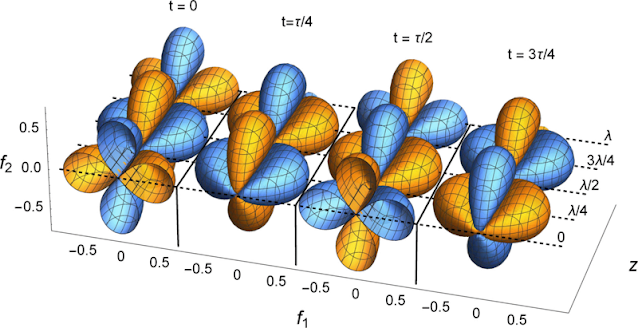

FIG. 3.
Numerical simulation of vortices within a spin-nematic state, showing how quadrupole waves, analogous to gravitational waves, are created when a pair of vortices in-spiral and annihilate.


Wednesday, June 01, 2022

Google open-source version of MuJoCo available on GitHub

Good news! Bravo Google!

"DeepMind, an AI research lab and subsidiary of Alphabet, in October 2021 acquired the MuJoCo physics engine for robotics research and development. The plan was to open-source the simulator and maintain it as a free, open-source, community-driven project. According to DeepMind, the open sourcing is now complete, and the entire codebase is on GitHub.
MuJoCo, which stands for Multi-Joint Dynamics with Contact, is a physics engine that aims to facilitate R&D in robotics, biomechanics, graphics and animation, and other areas where fast and accurate simulation is needed. MuJoCo can be used to implement model-based computations such as control synthesis, state estimation, system identification, mechanism design, data analysis through inverse dynamics, and parallel sampling for machine learning applications. It can also be used as a more traditional simulator, including for gaming and interactive virtual environments. ..."

DeepMind's open-source version of MuJoCo available on GitHub

Monday, June 17, 2019

AI 2019: The Year Of Virtual Reality Environments

Posted: 6/17/2019

Perhaps, 2017 was the year when Generative Adversarial Networks (GANs) took off and became a serious and fast expanding research subject in AI.

Now in the middle of 2019, it appears that new and drastically improved, very realistic simulators or AV/VR environments might well be the highlight of AI for this year. This is a new class of interactive environments for AI research.

It appears that these new software platforms/environments/simulators are coming ever closer to being very realistic environments for AI. These new environments promise a great speed up in training of robots and other advances in AI.

Here are some relevant quotes (emphasis added):
  1. “But researchers believe these systems will learn best if the simulated environments capture the subtle details — like mirror reflections and rug textures — necessary to make them virtually identical to the real thing.” (S1)
  2. ““The Replica data set sets a new standard in the realism and quality of 3-D reconstructions of real spaces,”” (S1)
  3. Replica can be loaded up in AI Habitat, a new open platform for embodied AI research. Facebook AI created AI Habitat to be the most powerful and flexible way for researchers to train and test AI bots in simulated living and working spaces.” (S1)
  4. “But it is also an important research tool for creating next-gen AR experiences that begin to merge the physical and digital worlds” (S1)
  5. “While other simulation engines commonly run at 50 to 100 frames per second, AI Habitat runs at over 10,000 frames per second (multi-process on a single GPU). This enables researchers to test their bots much more quickly and effectively — an experiment that would take months on another simulator would take a few hours on Habitat.”
  6. “For example, Facebook AI researchers will explore ways to build realistic physics modeling into AI Habitat so an AI bot can learn what happens when it knocks a virtual glass off a virtual table” (S1) [Too bad that physics modeling is not yet integrated]
  7. “We present Habitat, a new platform for research in embodied artificial intelligence (AI). Habitat enables training embodied agents (virtual robots) in highly efficient photorealistic 3D simulation, before transferring the learned skills to reality.” (S2)
  8. Replica, a dataset of 18 highly photo-realistic 3D indoor scene reconstructions at room and building scale. Each scene consists of a dense mesh, high-resolution high-dynamic-range (HDR) textures, per-primitive semantic class and instance information, and planar mirror and glass reflectors.” (S3)
  9. “On the other hand, this variety of [previous] simulation environments can cause fragmentation, replication of effort, and difficulty in reproduction and community-wide progress. Moreover, existing simulators exhibit several shortcomings … Most critically, work built on top of any of the [previous] existing platforms is hard to reproduce independently from the platform, and thus hard to evaluate against work based on a different platform, even in cases where the target tasks and datasets are the same.”
  10. “By operating at 10,000 frames per second we shift the bottleneck from simulation to optimization for network training” (S3) [This sounds very desirable!]

Sources (S):