Showing posts with label women in science. Show all posts

Thursday, December 11, 2025

Portrait of Hannah Fry unveiled at Royal Society on Sky Arts Portrait Artist of the Year

Yesterday, I blogged here about Hannah Fry's latest visit to the robotics laboratory of Google Deepmind!

"... Hannah Fry was awarded the Royal Society's David Attenborough Award and Lecture 2024 in recognition of her significant work in public engagement with science and for her prolific role in popularising mathematics

Made by award-winning monoprint artist Chloe Barnes, the portrait is a monotype, printed on Arches Huile paper. Incorporating traditional oil painting techniques, the monotype has been finished with glazing and soft pastel. ..."

Portrait of Hannah Fry unveiled at Royal Society on Sky Arts Portrait Artist of the Year | Royal Society "A portrait of mathematician and broadcaster Professor Hannah Fry commissioned by the Royal Society, the world’s oldest scientific academy, has been unveiled on the final episode of Sky Arts Portrait Artist of the Year 2025, painted by the series winner, Chloe Barnes."


Wednesday, April 02, 2025

Saturday, January 25, 2025

Study uncovers previously unknown bacterial mode of resistance against viruses

Amazing stuff!

"... Without defense mechanisms, Synechococcus would likely have become extinct because of the threats it faces from bacteriophages like Syn9. ... study describes an evolutionary scenario where protection arises from a reduced level of tRNA (transfer RNA), a molecule critical for gene translation.

“Studies on resistance often focus on genes providing active defense against infection,” ... “However, not all defenses stem from active mechanisms; some, like the one we discovered, arise from ‘passive resistance.’ Our findings show that normal tRNA level reduce bacterial resistance to the virus, while low levels increase such resistance. This is a passive mode of resistance where the loss of a certain intracellular function leads to resistance against viral infection.” ...

This phenomenon of passive resistance, the researchers suggest, is likely more widespread than previously thought and not limited to Synechococcus-Syn9 interactions."

"... that this mechanism does not prevent the phage from entering the bacterial cell but halts the formation of new viruses, allowing the bacteria to survive. ..."

From the abstract:
"Synechococcus is a significant primary producer in the oceans, coexisting with cyanophages, which are important agents of mortality. Bacterial resistance against phage infection is a topic of significant interest, yet little is known for ecologically relevant systems.
Here we use exogenous gene expression and gene disruption to investigate mechanisms underlying intracellular resistance of marine Synechococcus WH5701 to the Syn9 cyanophage. The restriction–modification and Gabija defence systems possessed by Synechococcus WH5701 did not contribute to resistance. Instead, resistance was primarily driven by insufficient levels of LeuTAA tRNA, preventing translation of key phage genes in a passive, intracellular mode of resistance.
Restoring cellular tRNA expression rendered the cyanobacterium sensitive to infection. We propose an evolutionary scenario whereby changes in cell codon usage, acquisition of tRNAs by the phage and loss of cell and phage tRNA expression resulted in an effective means of resistance, highlighting the dynamic interplay between bacteria and phages in shaping their co-evolutionary trajectories."

Study uncovers previously unknown bacterial mode of resistance against viruses | News | The Microbiologist

Protection Against Viruses – The Passive Version "Researchers at the Technion Faculty of Biology have discovered a unique mechanism that protects marine bacteria from viruses that attack them"


Fig. 1: The effect of known defence system genes on the sensitivity of Synechococcus WH5701 to the Syn9 phage.


Extended Data Fig. 3: Relevance of tRNA ValTAC for phage sensitivity.


The first author Sofia Zborovsky


The senior author Debbie Lindell


Famous Women Engineers in US History: Willie Hobbs Moore

When meritocracy and not DEI still ruled! This woman earned it!

Just when President John F. Kennedy introduced the so called affirmative action in 1961. Was Ms. Moore an early beneficiary?

"broke barriers in academia, as the first Black woman to earn a Ph.D. in a science (Physics) in the United States."

"... At the University of Michigan, she earned a bachelor of science in electrical engineering in 1958 and a master of science in electrical engineering in 1961. Moore was the first black woman to earn a bachelor of science and master of science in electrical engineering at the University of Michigan. In 1972, she earned a doctorate in physics from the University of Michigan, making her the first [black] American woman to receive a PhD in physics from an American university. ...

After receiving her doctorate, Moore worked at the University of Michigan in the department of physics and the Macromolecular Research Center as a lecturer and research scientist until 1977, continuing spectroscopic work on proteins.[9] In the five years following her dissertation, she published more than thirty papers with Krimm and collaborators, in a variety of journals, including the Journal of Molecular Spectroscopy, The Journal of Chemical Physics, and the Journal of Applied Physics. Additionally, Moore and Yuin Wu published "Quality Engineering" in the American Supplier Institute in 1986. ..." Source

Famous Women Engineers in History - Book 7: Willie Hobbs Moore - You’ve Got To Be Excellent! | IEEE-USA


Friday, January 10, 2025

Image of the day

My kind of fashion model! Caution: satire! 

Source


P.S. Monika Schleier-Smith experimental physicist at Stanford University

Sunday, August 11, 2024

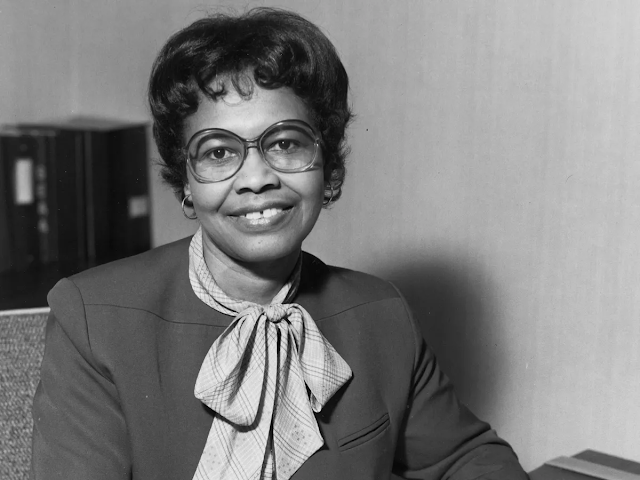
Gladys West (1930-): The Hidden Figure Behind GPS

She is still alive! Let's rename GPS to Glady Position System? 😊

This is another case of systemic racism in America! Caution: Irony!

"While working for four decades as a mathematician and computer programmer at the U.S. Naval Proving Ground (now the Naval Surface Warfare Center) in Dahlgren, Va., she prepared the way for a satellite constellation in the sky that became an indispensable part of modern life: the Global Positioning System, or GPS.

The second Black woman to ever work at the proving ground, West led a group of analysts who used satellite sensor data to calculate the shape of the Earth and the orbital routes around it. Her meticulous calculations and programming work established the flight paths now used by GPS satellites ...

For decades, West’s contributions went unacknowledged. But she has begun receiving overdue recognition. In 2018 she was inducted into the U.S. Air Force Space and Missile Pioneers Hall of Fame. In 2021 the International Academy of Digital Arts and Sciences presented her its Webby Lifetime Achievement Award, while the U.K. Royal Academy of Engineering gave her the Prince Philip Medal, the organization’s highest individual honor.

West was presented the 2024 IEEE President’s Award for “mathematical modeling and development of satellite geodesy models that played a pivotal role in the development of the Global Positioning System.” ..."

Gladys West: The Hidden Figure Behind GPS - IEEE Spectrum Her groundbreaking work changed global navigation

Gladys West in the 1980s during her days as a mathematician and computer programmer at the Naval Surface Warfare Center, in Dahlgren, Va.


Tuesday, June 04, 2024

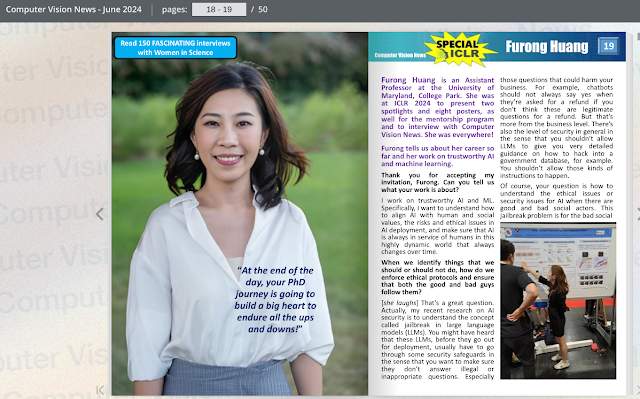
Women in computer vision

Do you write a quote across the chest of a charming looking female scientist despite the mentioning of "a big heart"?
Somebody working at this publications apparently was not paying attention!