Showing posts with label pandemic. Show all posts

Thursday, September 25, 2025

AI model helps boost pandemic preparedness

Good news!

"Scientists ... have developed a novel method that uses artificial intelligence (AI) and advanced imaging techniques to more accurately and efficiently identify therapeutic antibodies to treat infectious diseases.

The breakthrough method ... reduces the time needed to identify protective antibodies from weeks to under a day—while offering a scalable approach that minimizes data bottlenecks and accelerates research. This advancement could transform how researchers develop treatments for influenza, HIV and other infectious diseases, particularly during health emergencies where rapid response is critical.

“This represents a paradigm shift in how we discover antibodies,”  ... “By harnessing AI to analyze the structural details of immune responses, we can now identify the most promising therapeutic candidates in mere hours, with better success rates than traditional methods. This could be game-changing for pandemic preparedness and therapeutic development.” ..."

From the abstract:
"Antibodies are crucial therapeutics, comprising a substantial portion of approved drugs due to their safety and clinical efficacy.
Traditional antibody discovery methods are labor-intensive, limiting scalability and high-throughput analysis.
Here, we improved upon our streamlined approach combining structural analysis and bioinformatics to infer heavy and light chain sequences from cryo-EM (cryo–electron microscopy) maps of serum-derived polyclonal antibodies (pAbs) bound to antigens.
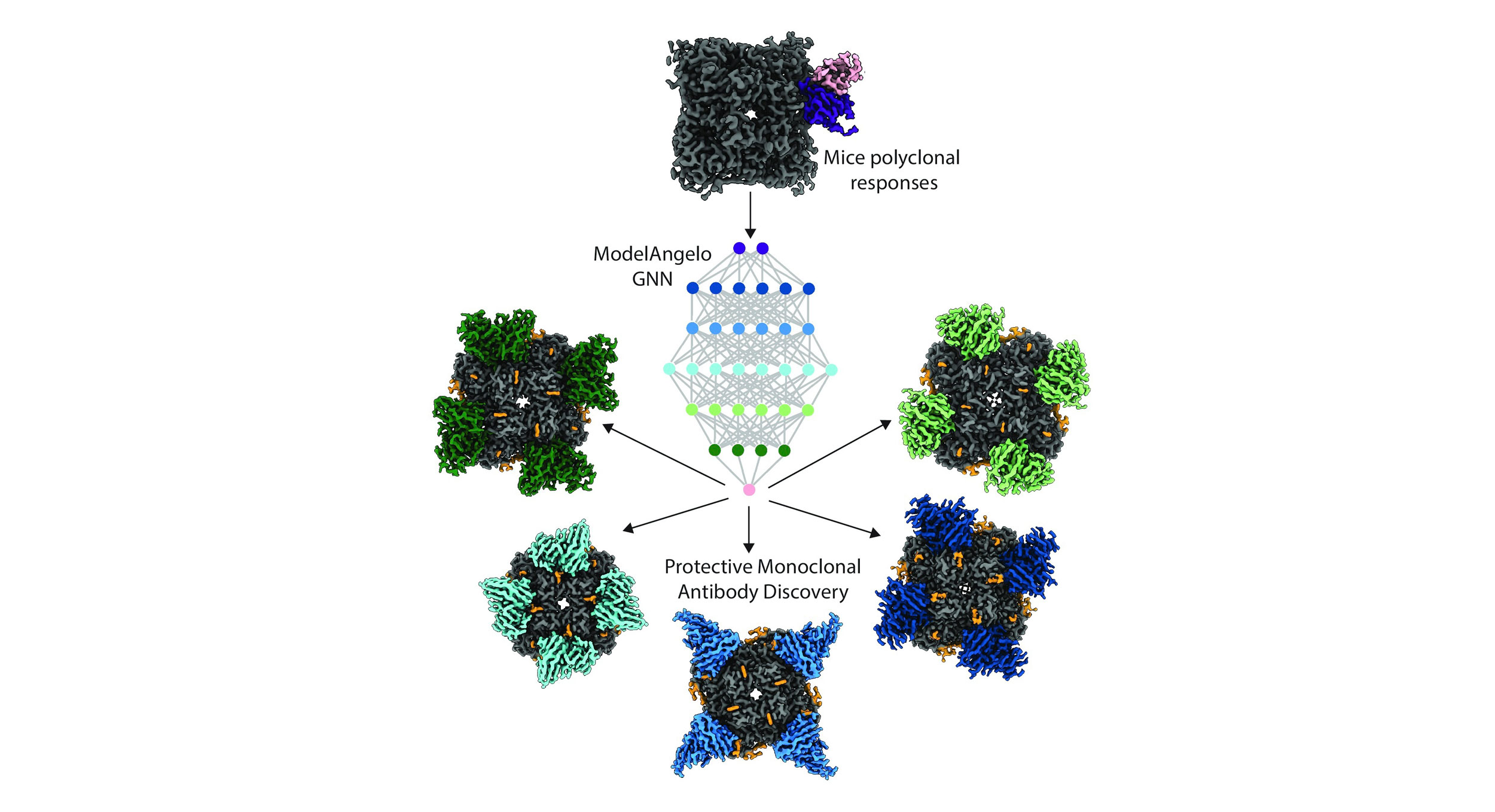
Using ModelAngelo, an automated structure-building tool, we accelerated pAb sequence determination and identified sequence matches in B cell repertoires via ModelAngelo-derived hidden Markov models (HMMs) associated with pAb structures.
Benchmarking against results from a nonhuman primate HIV vaccine trial, our pipeline reduced analysis time from weeks to under a day with higher precision. Validation with murine immune sera from influenza vaccination revealed multiple protective antibodies. This workflow enhances antibody discovery, enabling faster, more accurate mapping of polyclonal responses with broad applications in vaccine development and therapeutic antibody discovery."

AI model helps boost pandemic preparedness | Scripps Research "Scripps Research breakthrough reduces antibody discovery time from weeks to hours, potentially revolutionizing pandemic response and therapeutic development."


Scripps Research scientists used a graphical neural network-based structure building tool, ModelAngelo, to discover monoclonal antibodies (bottom) from polyclonal antibody responses produced after mouse vaccination (top).


Fig. 1. MA integrated STS workflow and benchmarking.


Friday, February 16, 2024

Pandemic preparedness: Testing public transportation stations and vehicles to create a global map of urban microbial strains

Going beyond testing wastewater! Meet the urban microbiome!

"In the subway: Researchers have taken to swabbing and “mapping” the biome of urban transit systems, hospitals, sewage canals, and other public places—creating an atlas of microorganisms found in mass transit systems around the world."

From the highlights and abstract:
"Highlights
• Cities possess a consistent “core” set of non-human microbes
Urban microbiomes echo important features of cities and city-life
• Antimicrobial resistance genes are widespread in cities
• Cities contain many novel bacterial and viral species
Summary
We present a global atlas of 4,728 metagenomic samples from mass-transit systems in 60 cities over 3 years, representing the first systematic, worldwide catalog of the urban microbial ecosystem. This atlas provides an annotated, geospatial profile of microbial strains, functional characteristics, antimicrobial resistance (AMR) markers, and genetic elements, including 10,928 viruses, 1,302 bacteria, 2 archaea, and 838,532 CRISPR arrays not found in reference databases. We identified 4,246 known species of urban microorganisms and a consistent set of 31 species found in 97% of samples that were distinct from human commensal organisms. Profiles of AMR genes varied widely in type and density across cities. Cities showed distinct microbial taxonomic signatures that were driven by climate and geographic differences. These results constitute a high-resolution global metagenomic atlas that enables discovery of organisms and genes, highlights potential public health and forensic applications, and provides a culture-independent view of AMR burden in cities."


MetaSUB Map

Wednesday, January 17, 2024

Chinese lab debuts mutant coronavirus with 100% kill rate in humanized mice

Chinese lab researcher are still creating the most mortal virus possible?

We still do not know very much how SARS-CoV-2/Covid-19 came into existence and was released to the world (e.g zoonotic or lab leak)!

"Chinese scientists in Beijing have crafted a coronavirus variant called GX_P2V that kills humanized mice 100% of the time, largely with late-stage brain infections. The scientists indicated their mutant virus "underscores a spillover risk of GX_P2V into humans."

The study, regarded as pointless and dangerous by Western experts, comes amidst chatter by global elites about "Disease X," a hypothetical pestilence more lethal than COVID-19, and just days after a British report revealed lab leaks of deadly pathogens occurred frequently, even in labs with ostensibly better standards than those observed in China. ..."

From the abstract:
"SARS-CoV-2-related pangolin coronavirus GX_P2V(short_3UTR) can cause 100% mortality in human ACE2-transgenic mice, potentially attributable to late-stage brain infection. This underscores a spillover risk of GX_P2V into humans and provides a unique model for understanding the pathogenic mechanisms of SARS-CoV-2-related viruses."

Amid elites' talk of 'Disease X,' Chinese lab debuts mutant coronavirus with 100% kill rate in humanized mice | Blaze Media Having faced no meaningful repercussions over COVID-19, scientists in China continue to conduct dangerous experiments on coronaviruses.