Showing posts with label locomotion. Show all posts

Wednesday, September 24, 2025

Walking sideways instead of forward may have fueled the True crabs’ success

Amazing stuff!

"True crabs—members of the infraorder Brachyura—are an evolutionary success story. These ten-limbed crustaceans can be found from the darkest depths of the ocean all the way up onto land, and with nearly 8000 described species, they dwarf the diversity of their closest kin, including hermit crabs, lobsters, and crayfish. But what gave them such an evolutionary edge? According to analyses recently published as a preprint, it could be that they gave up on going forward. ..."

From the abstract:
"The evolutionary change in the mode of locomotion is often a major evolutionary event, triggering diversification.
Sideways locomotion is a defining feature of true crabs (Brachyura) and may have contributed to their ecological success. Yet, the evolutionary origin of this unique behavior remains unknown.
Here we show that the prevalence of sideways locomotion in true crabs reflects a single evolutionary origin from a forward-moving ancestor.
Our behavioral analysis of 50 live crab species indicates that crab locomotion can be separated into two distinct types, sideways and forward locomotion, with no intermediates.
The phylogenetic comparative analysis revealed a single origin of sideways locomotion, with multiple independent reversions to forward locomotion in ecologically specialized groups.
The species richness data show that the lineage in which sideways locomotion originated is far more diverse than its nearest outgroups.
These results suggest that sideways locomotion acted as a key innovation, potentially promoting adaptive radiation by enabling true crabs to exploit a wide range of ecological niches. Such a rare but innovative behavioral trait provides a framework for understanding how locomotor modes shape evolutionary diversification in animals."

ScienceAdviser


Wednesday, September 11, 2024

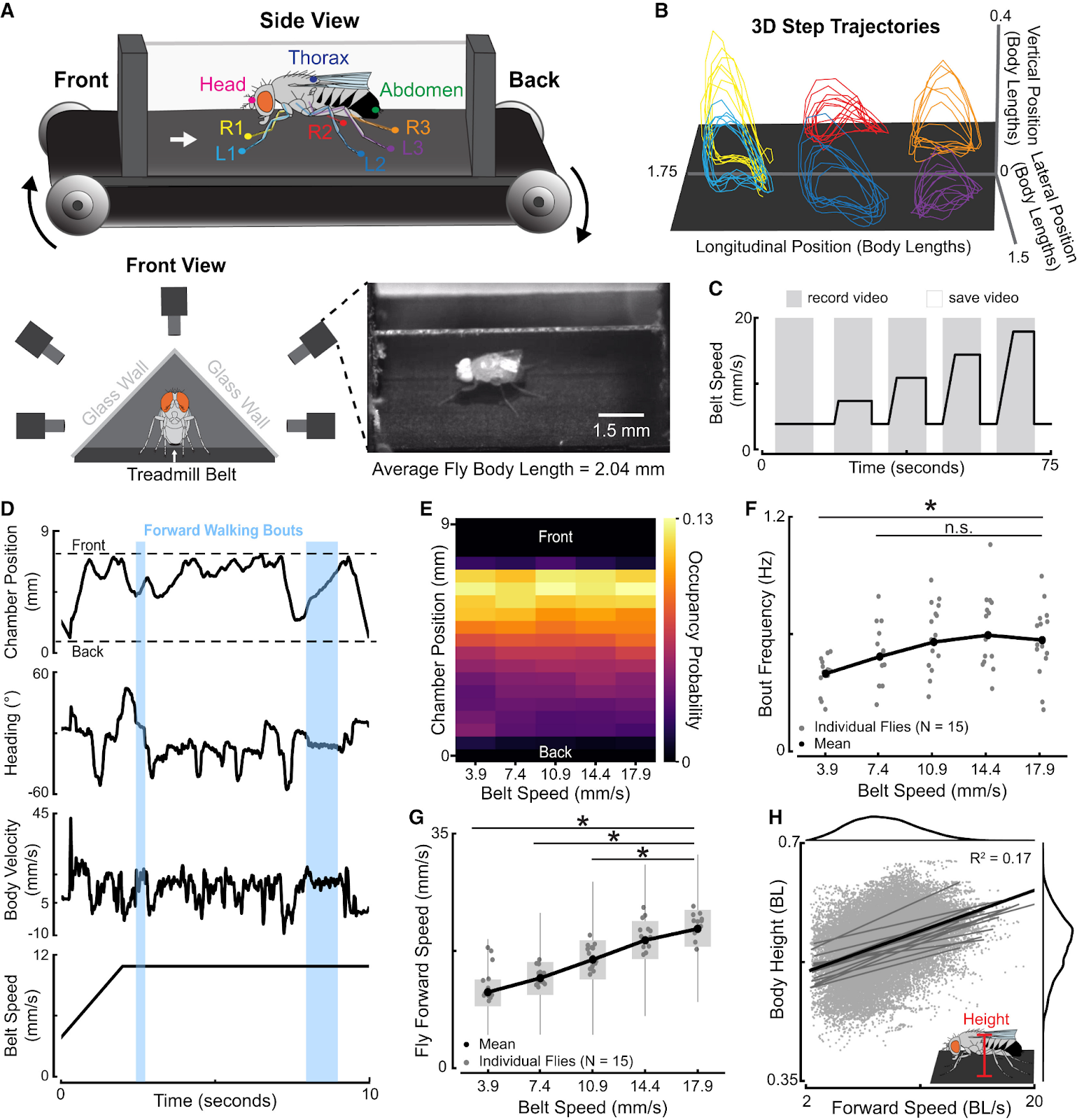
Scientists built mini treadmills for insects – not to keep them fit but to study their walking

Amazing stuff!

Don't laugh! Too bad, humans do not have a middle leg! 😊

"... The researchers were able to track fly walking over long periods of time. Split-belt treadmills were used to investigate how the flies reacted to belts with different speeds on either side of the body. ...

Split-belt treadmills had little effect on the coordination between legs. But the step distances of their middle legs changed a lot. ..."

From the highlights and abstract:
"Highlights
•A new actuated treadmill system captures 3D kinematics of flies compelled to walk
• Flies walking on the treadmill have similar kinematics to freely walking flies
Proprioceptive feedback is important for leg motor control at all walking speeds
• Flies on a split-belt treadmill use their middle legs to counteract perturbations

Summary
To navigate complex environments, walking animals must detect and overcome unexpected perturbations. One technical challenge when investigating adaptive locomotion is measuring behavioral responses to precise perturbations during naturalistic walking; another is that manipulating neural activity in sensorimotor circuits often reduces spontaneous locomotion. To overcome these obstacles, we introduce miniature treadmill systems for coercing locomotion and tracking 3D kinematics of walking Drosophila. By systematically comparing walking in three experimental setups, we show that flies compelled to walk on the linear treadmill have similar stepping kinematics to freely walking flies, while kinematics of tethered walking flies are subtly different. Genetically silencing mechanosensory neurons altered step kinematics of flies walking on the linear treadmill across all speeds. We also discovered that flies can maintain a forward heading on a split-belt treadmill by specifically adapting the step distance of their middle legs. These findings suggest that proprioceptive feedback contributes to leg motor control irrespective of walking speed and that the fly’s middle legs play a specialized role in stabilizing locomotion."

Scientists built mini treadmills for insects – not to keep them fit but to study their walking "Fruit flies on treadmills are giving scientists insights into how insects walk in ways that previous, more invasive techniques could not"


Figure 1. The linear treadmill controls locomotor speed and enables tracking of 3D kinematics in walking Drosophila


Thursday, March 18, 2021

Challenging the lateral-to-sagittal shift in mammalian locomotion

Very recommendable! Just a reminder that science is rarely ever settled! Karl Popper Falsifiability!

"... Nonmammalian synapsids, the extinct forerunners to mammals, like living reptiles, had limbs splayed out to the side instead of beneath like today’s mammals. So scientists believed that they must have also moved in similar ways, with spines more suited to the side-to-side flexing of a sashaying lizard instead of the up-and-down bending typical of a mammal in motion. The transition is known as the lateral-to-sagittal paradigmIt’s an explanation that’s been taught in college textbooks on anatomy and evolution for decades....
The analysis demonstrates that the three lineages differ from one another other when it comes to the morphology, function, and characteristics of their spines, and suggests that mammal backbones didn’t evolve from a reptile-like ancestor. There had to have been a completely different type of backbone function not observed in today’s living vertebrates. ..."

"Highlights
• “Lateral-to-sagittal” paradigm is too simple to explain mammal vertebral evolution
• Extant reptiles are a poor functional model for extinct non-mammalian synapsids
• Non-mammalian synapsid vertebral joints are characterized by high stiffness
• Mammal backbone evolution involved acquisition of multiple vertebral functions"

Challenging the lateral-to-sagittal shift in mammalian locomotion – Harvard Gazette Findings point to the importance of checking the fossil record

Here is the link to the underlying research paper: