Showing posts with label seismology. Show all posts

Thursday, September 10, 2026

Recent research into the deep underground geology of China

Amazing stuff!

Unfortunately, the articles do not contain any charts nor maps!

"... in southwestern China, scientists recently set off 500 kilograms of dynamite to send seismic waves deep into the crust. The experiment is part of SinoProbe II, a $1 billion effort to map China’s deep geology at unprecedented scale.
Early results from the seismic survey have  revealed a structure that researchers interpret as the buried boundary between two ancient continental blocks. If confirmed, the finding could help resolve competing ideas about how South China formed hundreds of millions of years ago. ...

In Tibet, dense networks of seismometers will probe how the Indian plate is being torn and deformed beneath the plateau.

And in northern China, researchers are looking for remnants of a vanished continental root. The work could also guide the search for critical minerals and other resources. ..."

ScienceAdviser

Tuesday, August 25, 2026

Thunderquakes to image the Earth's subsurface

Amazing stuff!

"... the powerful acoustic waves from thunder can ripple the Earth, the resulting seismic signals have long been too difficult to parse. Now, researchers have turned the so-called “thunderquakes” into a useful tool for probing inside Earth.

To interpret thunderquakes, researchers turned to a technique called distributed acoustic sensing. It involved turning a 4-kilometer-long fiber-optic cable, more commonly used for internet and phone services, into a string of more than 2100 sensors that measured vibrations in the ground. In two years, the team identified 458 high-quality thunderquakes.

Since seismic waves travel at different speeds at different depths, the team used the thunderquakes to map the ground below, down as deep as 100 meters. In Pennsylvania, where the cable is located, researchers spotted weak zones and areas where the ground is sinking, both geological features that can cause sinkholes or groundwater contamination if left unaddressed. ..."

"... Using existing fiber-optic telecommunication cables buried just a few feet below the ground under Penn State’s University Park campus, the researchers developed a new way to use distributed acoustic sensing technology, or DAS, to better understand how atmospheric acoustic waves transfer energy into the ground. They also demonstrated how this coupling can be used in seismic imaging. ..."

From the abstract:
"Thunder generates atmospheric acoustic waves that couple into the ground, producing seismic signals called “thunderquakes.” Although widely observed, this atmosphere-solid Earth conversion has rarely been exploited for imaging because the coupled wavefield is complex and its governing physics are poorly constrained.
Here, we show that thunderquakes recorded by preexisting telecommunication fiber-optic cables using distributed acoustic sensing (DAS) contain coherent air-coupled Rayleigh waves that can serve as seismic energy sources for near-surface tomography.
We validate this mechanism using three-dimensional spectral-element simulations and dispersion modeling of thunderquakes.
We analyze 2.5 years of continuous DAS data and a catalog of 458 high-fidelity thunderquakes validated by lightning records.
Cross-correlation virtual-source interferometry and stacking yield dispersed surface waves from which we invert shear-wave velocity structure to ∼100-meter-depth beneath an urban karst setting. The resulting tomographic image reveals several previously undetected weak zones, some coinciding with surface deformation measured by Interferometric Synthetic Aperture Radar.
The tomographic results are further validated by independent borehole logs and engineering surveys.
Our results establish that thunder energy can be converted into dispersive seismic wavefields in the solid Earth and that thunderquakes can act as novel, meteorologically driven sources for seismic imaging in regions with limited access to traditional seismic sources."

ScienceAdviser

Thunderquakes: A new way to image the Earth’s subsurface (original news release) "Thunderstorms detected by underground fiber-optic cables can be a source for seismic imaging, especially in places where earthquakes are uncommon, researchers report"


Fig. 1. Thunderquake raypath diagram.


Fig. 6. Subsurface tomography results.


Tuesday, August 11, 2026

What seismic and accoustic sensors can tell us about hurricanes

What took so long to discover this (i.e. several decades)? This could probably have been already discovered in the last century!

"In brief
  • New research shows sensors used to map Earth’s interior and study earthquakes can pick up ground vibrations caused by hurricane winds.
  • The discovery opens a new path for understanding and predicting storm strength and evolution.
  • Instruments at existing seismic-monitoring stations can serve both geophysics and atmospheric science research.
...

A new study published Aug. 6 in Science demonstrates how specialized microphones and seismometers that detect Earth’s movements can reveal the inner workings of hurricanes. The discovery came after Hurricane Isaac barreled onto the Louisiana coast in 2012, passing over areas where geophysicists had installed sensors for another project.

“We’ve found a new and effective way to gather valuable information about hurricanes from seismic and acoustic sensors,”  ..."

What earthquake sensors can tell us about hurricanes | Stanford Report "A new way to measure hurricanes using earthquake-monitoring equipment could improve storm forecasting, support public safety, and enhance understanding of Earth’s atmosphere."

Monday, July 06, 2026

How Google Phones Alerted over 10 Million people Before earthquakes Shook Venezuela last week

Good news! The total population of Venezuela is about 29 Million.

"Google’s earthquake warning system, which uses accelerometers in Android phones as seismic sensors, sent alerts to 11.4 million people in Venezuela last week, giving them precious seconds to prepare for the tremors. It’s not yet known how many lives the warnings may have saved."

"“Venezuela does not have a national early warning system of its own, but people with Android phones received alerts from Google’s Earthquake Alerts system, which can pull data from more than two billion phones equipped with built-in accelerometers. The same sensor that detects rotation on the screen can also sense vibrations from seismic waves.

Google said the system, which is available in nearly 100 countries, sent warnings that reached 11.4 million people on Wednesday, giving users seconds or up to two minutes notice before back-to-back powerful earthquakes struck …"

Doomslayer: Progress Roundup - by Malcolm Cochran

Sunday, July 20, 2025

Japan completes a new sprawling undersea earthquake-detection system this summer

Good news!

"To help mitigate future seismic disasters, Japan has built a sprawling undersea earthquake-detection system capable of providing up to 20 additional minutes of warning time before tsunamis hit coastal areas. During Fukushima, residents had just 10 minutes of warning."

"... With the final N-net link set up this June, the complete system increases warning times by 20 seconds for earthquakes and a full 20 minutes for tsunamis—enough time to divert incoming flights and close sea gates in busy ports.” ..."

"... Within months of the 2011 [Fukushima] earthquake, the Japanese government began to build S-net (Seafloor Observation Network for Earthquakes and Tsunamis). S-net wired the nation’s earthquake-detection network to the Japan Trench, the seismologically active offshore region where the 2011 earthquake began. Roughly 3,540 miles of cable now zigzag across 116,000 square miles of ocean to connect 150 observatories on the ocean floor. Each contains 14 distinct sensing channels, including seismometers and accelerometers, as well as pressure gauges to measure waves passing overhead.
This network—the first part of the larger network that was completed in June 2025—was finished in 2017. When a magnitude 6.0 quake struck the following year, alerts reached the cities before the first jolt hit—a full 20 seconds before the nearest land seismometer rang its alarm—allowing precious time to slow bullet trains and broadcast warnings. ..."

Japan Wires the Ocean with an Earthquake-Sensing "Nervous System" - Human Progress


Japan Wires the Ocean with an Earthquake-Sensing ‘Nervous System’ (original news) "Japan’s new earthquake-detection network lengthens warning times, and researchers in Wales have harnessed nuclear blast detectors to gauge tsunami risks. But the U.S. lags in monitoring the massive Cascadia megathrust fault"


Monday, January 27, 2025

Starting to understand two strange hot islands of the size of continents deep in the Earth’s lower mantle

Amazing stuff! Plate tectonics and a well flowing mantle are apparently not the whole story!

"Deep inside Earth there are mysterious and fascinating regions the size of continents at the boundary between the core and mantle, and earth scientists have just cracked the mystery of what they’re made of.

Known as “Large Low Seismic Velocity Provinces”, or LLSVPs, the regions cause seismic waves to slow down. ...

One is found under Africa, the other under the Pacific Ocean.

“These 2 large islands are surrounded by a graveyard of tectonic plates which have been transported there by a process called ‘subduction’, where one tectonic plate dives below another plate ...

study looked at whole-Earth oscillations – seismic waves caused by very large earthquakes, which make the planet ring like a bell for weeks or even months – to learn more about LLSVPs. ..."

"... In this type of research, seismologists make good use of oscillations caused by really large earthquakes, preferably quakes that take place at great depths, such as the great Bolivia earthquake of 1994. “It never made it into the newspapers, because it took place at a large depth of 650 km and luckily did not result in any damage or casualties at the Earth’s surface,” ... The whole Earth oscillations, or tones, are mathematically described in such a way that we can easily ‘read’ the damping (i.e. how loud the oscillation is) due to a specific structure and separate it from the wave speed (i.e. how much out of tune it is). “Which is impressive, because the damping of the signal is only one-tenth of the total amount of information that we can unravel from these oscillations.” For this type of research, it is not necessary to wait until another earthquake occurs. The data from previous earthquakes is just as useful. “We can go back to 1975, because from that year onwards, seismometers became good enough to give us data of such high quality that they are useful for our research.” ..."

From the abstract:
"Seismic tomographic models based only on wave velocities have limited ability to distinguish between a thermal or compositional origin for Earth’s 3D structure. Complementing wave velocities with attenuation observations can make that distinction, which is fundamental for understanding mantle convection evolution. However, global 3D attenuation models are only available for the upper mantle at present.
Here we present a 3D global model of attenuation for the whole mantle made using whole-Earth oscillations, constraining even spherical harmonics up to degree four. In the upper mantle, we find that high attenuation correlates with low velocity, indicating a thermal origin, in agreement with previous studies.
In the lower mantle, we find the opposite and observe the highest attenuation in the ‘ring around the Pacific’, which is seismically fast, and the lowest attenuation in the large low-seismic-velocity provinces (LLSVPs). Comparing our model with wave speeds and attenuation predicted by a laboratory-based viscoelastic model suggests that the circum-Pacific is a colder and small-grain-size region, surrounding the warmer and large-grain-size LLSVPs. Viscosities calculated for the inferred variations in grain size and temperature confirm LLSVPs as long-lived, stable features."

Starting to understand strange islands in the Earth’s mantle

Subterranean ‘islands’: strongholds in a potentially less turbulent world (original news release) "Deeply hidden in Earth’s mantle there are two huge ‘islands’ with the size of a continent. New research from Utrecht University, published in Nature, shows that these regions are not only hotter than the surrounding graveyard of cold sunken tectonic plates, but also that they must be ancient: at least half a billion years old, perhaps even older. These observations contradict the idea of a well-mixed and fast flowing Earth’s mantle, a theory that is becoming more and more questioned. “There is less flow in Earth’s mantle than is commonly thought.”"


Location of the LLSVPs and a schematic representation of the Earth's cross-section for speed and damping of the seismic waves.


Schematic representation of the process of subduction of tectonic plates and of a mantle plume rising from an LLSVP. In the latter, the mineral grains are larger than those in the subducted plates.


Saturday, August 10, 2024

Seismic Detectors Measure Soil Moisture Using Traffic Noise

Amazing stuff!

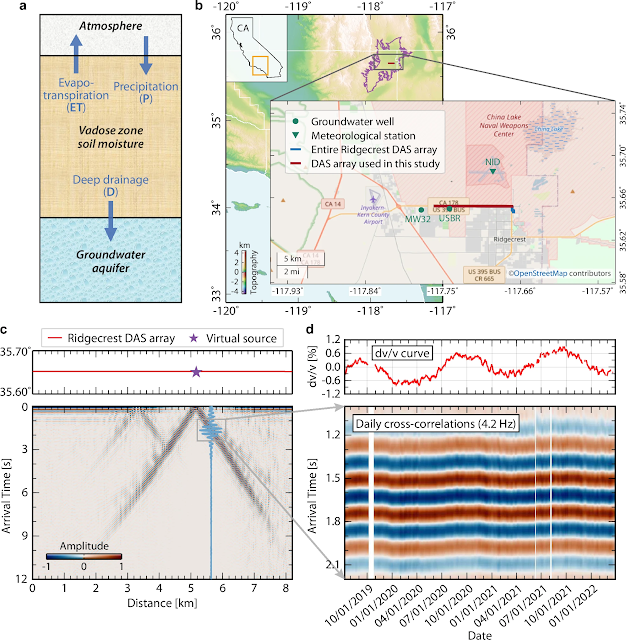
"The new method relies upon seismic technology that normally measures how the ground shakes during earthquakes. However, it can also detect the vibrations of human activity, like traffic. As these vibrations pass through the ground, they are slowed down by the presence of water—the more moisture, the slower the vibration moves. The new study measures the water content in the vadose zone through seismic rumblings from everyday traffic. ...
The new method is based on a technique ... called distributed acoustic sensing (DAS). With this technique, lasers are pointed into unused underground fiber-optic cables (like the kind that provides internet). As a seismic wave, or any kind of vibration, passes through the cable, the laser light bends and refracts. Measuring the wiggles in this laser light gives researchers information about the passing wave, making the 10-kilometer cable equivalent to a line of thousands of conventional seismic sensors. ..."

From the abstract:
"Vadose zone soil moisture is often considered a pivotal intermediary water reservoir between surface and groundwater in semi-arid regions. Understanding its dynamics in response to changes in meteorologic forcing patterns is essential to enhance the climate resiliency of our ecological and agricultural system. However, the inability to observe high-resolution vadose zone soil moisture dynamics over large spatiotemporal scales hinders quantitative characterization. Here, utilizing pre-existing fiber-optic cables as seismic sensors, we demonstrate a fiber-optic seismic sensing principle to robustly capture vadose zone soil moisture dynamics. Our observations in Ridgecrest, California reveal sub-seasonal precipitation replenishments and a prolonged drought in the vadose zone, consistent with a zero-dimensional hydrological model. Our results suggest a significant water loss of 0.25 m/year through evapotranspiration at our field side, validated by nearby eddy-covariance based measurements. Yet, detailed discrepancies between our observations and modeling highlight the necessity for complementary in-situ validations. Given the escalated regional drought risk under climate change, our findings underscore the promise of fiber-optic seismic sensing to facilitate water resource management in semi-arid regions."

Seismic Detectors Measure Soil Moisture Using Traffic Noise - www.caltech.edu "Caltech researchers have developed a new method to measure soil moisture in the shallow subterranean region between the surface and underground aquifers. This region, called the vadose zone, is crucial for plants and crops to obtain water through their roots. However, measuring how this underground moisture fluctuates over time and between geographical regions has traditionally relied on satellite imaging, which only gives low-resolution averages and cannot penetrate below the surface. Additionally, moisture within the vadose zone changes rapidly—a thunderstorm can saturate a region that dries out a few days later."


Fig. 1: Conceptual model for the vadose zone water dynamics and time-lapse seismology example on Ridgecrest DAS array.


Monday, June 17, 2024

Study confirms the rotation of Earth's solid inner core within the outer liquid core has slowed since 2010

Amazing stuff! Or how little we still know about our planet and its climate!

More surprising why is this not linked to Climate Change? There is no CO2 or other so called green house gases involved? Caution: satire

"USC scientists have proven that the Earth’s inner core is backtracking — slowing down — in relation to the planet’s surface, as shown in new research published Wednesday in Nature.
Movement of the inner core has been debated by the scientific community for two decades, with some research indicating that the inner core rotates faster than the planet’s surface. The new USC study provides unambiguous evidence that the inner core began to decrease its speed around 2010, moving slower than the Earth’s surface. ..."

From the abstract:
"The solid inner core, suspended within the liquid outer core and anchored by gravity, has been inferred to rotate relative to the surface of Earth or change over years to decades based on changes in seismograms from repeating earthquakes and explosions. It has a rich inner structure and influences the pattern of outer core convection and therefore Earth’s magnetic field. Here we compile 143 distinct pairs of repeating earthquakes, many within 16 multiplets, built from 121 earthquakes between 1991 and 2023 in the South Sandwich Islands. We analyse their inner-core-penetrating PKIKP waves recorded on the medium-aperture arrays in northern North America. We document that many multiplets exhibit waveforms that change and then revert at later times to match earlier events. The matching waveforms reveal times at which the inner core re-occupies the same position, relative to the mantle, as it did at some time in the past. The pattern of matches, together with previous studies, demonstrates that the inner core gradually super-rotated from 2003 to 2008, and then from 2008 to 2023 sub-rotated two to three times more slowly back through the same path. These matches enable precise and unambiguous tracking of inner core progression and regression. The resolved different rates of forward and backward motion suggest that new models will be necessary for the dynamics between the inner core, outer core and mantle."

Study confirms the rotation of Earth's inner core has slowed

USC study confirms the rotation of Earth’s inner core has slowed (original news  release) A new study provides clear evidence that the inner core began to decrease its speed around 2010.


The inner core began to decrease its speed around 2010, moving slower than the Earth’s surface.


Satellite data reveal anomalies up to 19 days before 2023 Turkey earthquake

Good news! Hopefully, we will find more confirmation and make earthquake prediction a routine.

Let's add an earthquake forecast to the daily news of earthquake prone regions! (just kidding)

"Earthquakes may betray their impending presence much earlier than previously thought through a variety of anomalies present in the ground, atmosphere and ionosphere that can be detected using satellites, a recent study in the Journal of Applied Geodesy suggests. ...
Such anomalies are known as earthquake precursors, and although researchers are aware of them, it has been difficult to definitively identify a pattern of so-called red flags that could indicate an impending earthquake. This is because of the complexity of precursor interactions and their variability in different earthquakes and geographical regions. However, with every earthquake that researchers analyze using increasingly sophisticated satellite technology, these patterns are slowly emerging. ...
Professor Mehdi Akhoondzadeh of the University of Tehran assessed a variety of satellite data from the run up to and aftermath of two earthquakes that occurred on 6 February 2023 near the border between Turkey and Syria. This included data from the Chinese seismo-electromagnetic satellite, CSES-01, and the Swarm satellite mission which consists of three satellites from the European Space Agency. ..."

From the abstract:
"On 6 February 2023, at 01:17:35 and 10:24:49 UTC (LT = UTC + 03:00) two earthquakes with magnitude 7.8 (37.166° N, 37.042° E, depth ∼ 17.9 km) and 7.5 (38.024° N, 37.203° E, depth ∼ 10 km), respectively, heavily struck southern and central Turkey and northern and western Syria. The purpose of this study is to investigate the relation between pre-earthquake anomalies observed in different layers of the earth system and explore the earthquake mechanism of LAIC (Lithospheric Atmospheric Ionospheric Coupling) associated with earthquake precursors. To achieve this goal, electron density and temperature variations obtained from CSES-01 data in the Dobrovolsky’s area the Turkey earthquakes are analyzed in the period from November 1, 2022 to February 10, 2023. Since investigating the LAIC mechanism requires multi-precursor analysis, anomalies obtained from CSES-01 data were compared with the behavior of anomalies obtained from other lithospheric, atmospheric and ionospheric precursors in the same location and time of the study area.
These anomalies that were analyzed in the previous study are:
(1) TEC data obtained from GPS-GIM maps,
(2) electron density and temperature variations obtained from Swarm satellites (Alpha, Bravo and Charlie) measurements,
(3) Atmospheric data including water vapour, methane, ozone, CO and AOD obtained from the measurements of OMI and AIRS satellites, and
(4) Lithospheric data including number of earthquakes obtained from USGS and also surface temperature obtained from the measurements of AIRS satellite. It should be noted that clear anomalies are observed between 1 and 5 days before the earthquake in electron density and temperature variations measured by CSES-01 during the day and night and they are in good agreement with the variations in the Swarm satellites data and GPS-TEC.
The interesting and significant finding is that lithospheric anomalies are detected in the land surface temperature data in the time interval of 19–12 days before the earthquake, and then most of the atmospheric anomalies are observed in the time period of 10–5 days prior to the earthquake and at the end striking ionospheric anomalies are revealed during 5–1 days preceding the earthquake. Therefore, the results of this study confirm the sequence of appearing of earthquake precursors from the lower layers of the lithosphere to the upper layers of the ionosphere during 1–15 days before the earthquake, and finally proving the LAIC mechanism can significantly contribute to the efficiency and lower uncertainty of earthquake early warning systems in the future."

Satellite data reveal anomalies up to 19 days before 2023 Turkey earthquake


Fig. 1 The intensity map and geographic location of the 2023 Turkey earthquake. A black star indicates the earthquake epicenter

Fig 2 Variations of solar-geomagnetic indices of (a) a p, (b) Dst and (c) F10.7, in the time period of 1 November, 2022 to 10 February 2023. The abscissa represents the days relative to the Turkey (06 February 2023) earthquake day. A black asterisk “*” indicates the earthquake origin time. The values of geomagnetic indices (a and b) are displayed in quiet conditions with green color and in non-quiet geomagnetic conditions with red color.


Sunday, April 21, 2024

Thousands of Deaths Averted in Taiwan Earthquake

Recommendable! A short backgrounder! Human ingenuity! How miracles happen!

"Summary: Amidst the recent devastation caused by a significant earthquake in Taiwan on April 3, the nation’s response showcased its progress in earthquake readiness, often overlooked in the headlines. Since the 1999 Jiji earthquake, Taiwan has made substantial strides in fortifying its infrastructure, improving construction standards, and advancing early-warning systems. This can serve as a model for global disaster preparedness."

Thousands of Deaths Averted in Taiwan Earthquake - Human Progress A headline of progress that you might have missed.

Thursday, July 21, 2022

The earthquake that changed history: 1755 in Lisbon

Update of 11/7/2022: Apparently, Lisbon is prone to heavy earthquakes. "Chronologically, it was the third known large scale earthquake to hit the city (following those of 1321 and 1531)". Every about two hundred years? The next one is overdue?
The earthquake of 1755 shaked Christianity! All churches were destroyed on a major holy day of worshiping. Only the brothel survived so they say.


Recommendable! The day the modern age was born!
Why the heck were the Portuguese language speakers not translated by voice???? In this day and age with AI this is as easy as pie!


Friday, May 24, 2019

More Underwater Seismometers Are Finally Coming

Posted: 5/24/2019

Much to my surprise, I learnt today that, after decades of trying, finally submarine seismometers are going to be deployed in larger numbers.

Quotes from the above article (emphasis added):
  1. “Whereas about 1900 seismometers have collected data in the ocean over the past 20 years, the nongovernmental International Seismological Centre lists about 11 500 active sensors on land globally” [Shocking!]
  2. “The engineering of a modern-day ocean-bottom seismometer (OBS) ... “They’re basically like robots that don’t talk to home for a year, ...” [What? For a year?]
  3. “... high-quality OBS costs about $100 000 to build, whereas a land-based seismometer is about one-fifth of that price”
  4. “Over the past several years, …. scientists have shown that it’s feasible to attach seismic sensors to fiber-optic cable with a negligible effect on the cable’s reliability. Seismometers known as SMART sensors would collect seismic data using a small fraction of the cable’s power and bandwidth”
  5. “ It’s a floating network of seismometers known as MERMAID, or Mobile Earthquake Recording in Marine Areas by Independent Divers. The instruments are mobile, are about a third as expensive as OBSs, and can be deployed in remote locations without the need for a return trip to collect data. They drift and float in the water column listening for earthquakes. Each time they sense one, they record the data, move to the surface, and transmit the information to a satellite. ... This map shows the location in the Pacific of the 25 currently deployed MERMAIDs.” [Only 25 deployed?]

Perhaps, these seismometers will shed more light on e.g. sea level rise in some coastal areas of our globe!

This tidbit confirms once more that Global Warming (a.k.a. Climate Change) is the greatest hoax perpetrated on humanity in generations! We still know so little about the sun and the oceans that this constant indoctrination with the climate religion is unbearable!