Showing posts with label optoelectronics. Show all posts

Thursday, August 08, 2024

New type of semiconductor with a previously unknown bright exciton nanocrystals for highly efficient light emitters

Amazing stuff!

"... The lowest energy, or ground-state excitons in nanocrystals are bad at emitting light, hence the name dark exciton. Dark excitons act like a speed bump, slowing down the emission of light and limiting the performance of nanocrystal-based devices. ..."

"  U.S. Naval Research Laboratory (NRL) scientists confirm the identification of a new class of semiconductor nanocrystals with bright ground-state excitons, a significant advancement in the field of optoelectronics ..."

From the abstract:
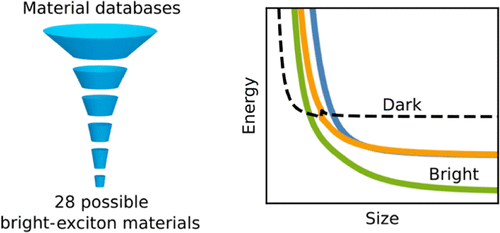
"While semiconductor nanocrystals provide versatile fluorescent materials for light-emitting devices, their brightness suffers from the “dark exciton”─an optically inactive electronic state into which nanocrystals relax before emitting. Recently, a theoretical mechanism, the Rashba effect, was discovered that can overcome this limitation by inverting the lowest-lying levels and creating a bright excitonic ground state. However, no methodology is available to systematically identify materials that exhibit this inversion, hindering the development of superbright nanocrystals and their devices. Here, based on a detailed understanding of the Rashba mechanism, we demonstrate a procedure that reveals previously unknown “bright-exciton” nanocrystals. We first define physical criteria to reduce over 500,000 known solids to 173 targets. Higher-level first-principles calculations then refine this list to 28 candidates. From these, we select five with high oscillator strength and develop effective-mass models to determine the nature of their lowest excitonic state. We confirm that four of the five solids yield bright ground-state excitons in nanocrystals. Thus, our results provide a badly needed roadmap for experimental investigation of bright-exciton nanomaterials."

New type of semiconductor nanocrystal overcomes “dark” exciton for highly efficient light emitters "Newly discovered semiconductor nanocrystals could be used to develop highly efficient light-emitting devices and lasers."

Thursday, February 23, 2023

Optical Transformers: A wave of the future?

Good news!

"... research team from Cornell University performed small-scale optical experiments with a prototype accelerator to demonstrate that Transformer operations can run on optical hardware despite noise and errors. They presented the research results in a paper investigating the energy-efficiency advantage that could be achieved in executing state-of-the-art Transformer models on optical hardware. They conclude that for large enough models, an energy-efficiency advantage of >8,000x versus current electronic hardware (GPUs) should be possible."

[2302.10360] Optical Transformers (open access)

Sunday, February 12, 2023

Chiral logic gates create ultrafast data processors

Exciting research from Finland!

"Light-based optical logic gates operate much faster than their electronic counterparts and could be crucial for meeting the ever-growing demand for more efficient and ultrafast data processing and transfer. A new type of “optical chirality” logic gate developed by researchers at Aalto University works about a million times faster than existing technologies. ...
Optical chirality, which is defined by left-handed and right-handed circularly polarized light, shows great promise for fundamental research and applications such as quantum technologies, chiral nonlinear optics, sensing, imaging and the emerging field of “valleytronics”. ..."

From the abstract:
"The ever-growing demand for faster and more efficient data transfer and processing has brought optical computation strategies to the forefront of research in next-generation computing. Here, we report a universal computing approach with the chirality degree of freedom. By exploiting the crystal symmetry–enabled well-known chiral selection rules, we demonstrate the viability of the concept in bulk silica crystals and atomically thin semiconductors and create ultrafast (<100-fs) all-optical chirality logic gates (XNOR, NOR, AND, XOR, OR, and NAND) and a half adder. We also validate the unique advantages of chirality gates by realizing multiple gates with simultaneous operation in a single device and electrical control. Our first demonstrations of logic gates using chiral selection rules suggest that optical chirality could provide a powerful degree of freedom for future optical computing."

Chiral logic gates create ultrafast data processors – Physics World

Chirality logic gates (open access)


Fig. 1. Illustration of the chirality logic gate and its concept universality in the selection of materials and optical processes.


Friday, March 12, 2021

Fortschritte in der Optoelektronik: Erleuchtung im Computerchip

Empfehlenswert! Sehr ausführliche Darstellung mit Hintergrund!

"... Und tatsächlich zeichnet sich nun eine Lösung in Gestalt einer neuen Form siliciumhaltiger Halbleiterkristalle ab. Sie bestehen aus sechseckigen Kristallsäulen mit einem Durchmesser von bis zu einem Mikrometer (millionstel Meter), die an mikroskopische Basaltsäulen erinnern. ..."

Fortschritte in der Optoelektronik: Erleuchtung im Computerchip Jahrzehnte träumen Computerbauer davon, ihrem Lieblingshalbleiter Silicium beizubringen, Licht und elektrischen Strom direkt ineinander umzuwandeln. Nun scheint das Ziel greifbar.

Hier ist der Link zum zugrunde liegenden Physics World article (Der article hat auch einen link zum Nature PDF file):