Showing posts with label gravity. Show all posts

Thursday, September 03, 2026

Scientists observe Einstein's gravity in the quantum world

Amazing stuff! This could be a breakthrough!

"An international team ... has observed a long-predicted effect of gravity on a falling quantum object for the first time. The result shows that a fundamental principle at the heart of Einstein's theory of gravity remains consistent with the behavior of matter in the quantum world. ...

Now, an international team has performed an experiment that probes the point where they meet. In the study, the researchers observed a distinctive change in the quantum properties of atoms as they fell under gravity. Crucially, the effect they measured is the same one predicted when Einstein's equivalence principle, a cornerstone of his theory of gravity, is applied to a quantum object. 

The equivalence principle states that for an observer in free fall, gravity should locally disappear. ...

At the heart of the experiment is a new apparatus the researchers call the Quantum Galileo Interferometer. It allowed them to do something unusual: effectively split the quantum wave associated with an atom into two paths, hold one in place while allowing the other to fall freely, and then reunite them to see how gravity had changed the falling wave. ...

The experiment ... using clouds of rubidium atoms cooled to just above absolute zero and manipulated close to the surface of a specially designed atom chip. ..."

"... The experimental team ... first used microwave pulses to put the ultracold atoms into a quantum superposition, effectively allowing each atom to travel along two different paths at once. They then used tiny electrical wires on the chip to generate precisely controlled magnetic fields.
One part of the atomic wave responded to this magnetic field, allowing the researchers to apply an upward force that exactly counteracted the downward pull of gravity. In effect, this part was held stationary relative to the laboratory and the Earth. ...

At the end of the fall, the researchers used another precisely controlled magnetic pulse to bring the two parts back together.
When the two waves were reunited, they interfered with each other. That interference allowed the researchers to measure the tiny difference in quantum phase accumulated while one was falling and the other was held still.

The phase measured in the new experiment is the same as the one predicted when Einstein's principle is applied to such a quantum wave. The result therefore provides an experimental connection between quantum physics and Einstein's theory of gravity. ..."

From the abstract:
"The unification of quantum theory and the general theory of relativity, describing gravity, is one of the most important challenges in science.
Einstein’s general theory of relativity is based on the principle of equivalence and has been confirmed to great accuracy for large bodies.
However, in the quantum domain, the equivalence principle has been predicted to take a unique form involving a gauge phase, which is equal, in the context of a measurement on Earth, to the quantum phase of a free-falling wave packet relative to its counterpart wave packet which is static in Earth’s frame.
To measure this phase, we realize a novel cold-atom interferometer in which one wave packet stays static in the laboratory frame while the other is in free fall. The observed relative phase of the wave packets confirms the predicted phase and shows that, in our low energy regime, the equivalence principle may be applied to the quantum domain.
Our observation constitutes a fundamental test of the interface between quantum theory and gravity. The new interferometer also opens the door for further probing of the latter interface, as well as to searches for new physics."

Scientists observe Einstein's gravity in the quantum world

Scientists observe Einstein’s gravity in the quantum world (original news release, Oxford University)

Scientists observe Einstein’s gravity in the quantum world (original news release, Ben Gurion University)


The 2D MOT apparatus which feeds the science chamber with cold atoms.


Fig. 1. The QGI experiment to measure the phase accumulation of a free-falling particle.


Saturday, January 10, 2026

China's new hypergravity centrifuge models extreme forces

Amazing stuff! Can the West keep up with China?

"China has eclipsed its own – and the US – record, building a monster underground hypergravity centrifuge that can model scenarios with 1,900 times the real-world gravitational force of Earth, bending space and time with unprecedented power.

Built by Shanghai Electric Nuclear Power Group as part of China's Centrifugal Hypergravity and Interdisciplinary Experiment Facility (CHIEF), CHIEF1900 will soon function at 1,900 g-tonnes, surpassing the previously most powerful centrifuge the CHIEF1300. ...

The hypergravity facility is reported to have cost around US$285 million to build and is expected to be a beacon of international research, with the Chinese team inviting scientists from around the world to use the technology. ..."

China's new hypergravity centrifuge models extreme forces


China built a 1,900x gravity machine (Source)


This is the older CHIEF1300 centrifuge


Schematic of a geotechnical centrifuge (the older centrifuge, source)


Saturday, January 03, 2026

Cosmic Paradox Reveals the Awful Consequence of an Observer-Free Universe

Amazing stuff!

"When one applies the powerful tools of quantum gravity to an entire universe—not just black holes—a glaring paradox appears: in certain “observer-free” models of a closed cosmos, the universe seems to admit only a single possible quantum state. This conclusion, first raised by Juan Maldacena, Carl P. Feinberg Professor in the School of Natural Sciences, and several collaborators in the School—including Member Ahmed Almheiri; Raghu Mahajan, Member (2019–20) and Visitor (2017–19); and Ying Zhao, Member (2018–21)—challenges one of physics’s deepest ideals: the hope of an objective, observer-independent description of the universe.  ..."

"... But almost 30 years ago, a landmark paper ..., showed that difficult string theory calculations could sometimes be sidestepped and carried out using familiar concepts from particle physics instead. The catch is that this approach only works if the universe has an unusual “anti-de Sitter” geometry. An anti-de Sitter universe has a boundary, often illustrated to resemble a tin can. Remarkably, everything that happens inside the can, from colliding particles to spinning black holes, is revealed by shadows on the can’s outer boundary. It’s as if the 3D universe inside were equivalent to an image on a flat screen, a concept physicists call holography. ...

The problem is that we don’t live in an anti-de Sitter tin-can cosmos. The nature of the universe’s expansion implies that it has no boundary. No matter how far you travel, you will never hit an edge. ...

In 2024, ... began to work on the problem of how to put an observer into a closed universe. ... thought of the observer as introducing a new kind of boundary: not the edge of the universe, but the boundary of the observer themself. When you consider a classical observer inside a closed universe, all the complexity of the world  returns, Zhao and her collaborators showed.

The ... paper came out at the beginning of 2025, around the same time that another group came forward with a similar idea.  ...

If the idea holds up, using the subjective nature of the observer as a way to account for the complexity of the universe would represent a paradigm shift in physics. Physicists typically seek a view from nowhere, a stand-alone description of nature. ..."

Cosmic Paradox Reveals the Awful Consequence of an Observer-Free Universe | In the Media | Institute for Advanced Study

Cosmic Paradox Reveals the Awful Consequence of an Observer-Free Universe "Encouraged by successes in understanding black holes, theoretical physicists are applying what they’ve learned to whole universes. What they’re finding has them questioning fundamental assumptions about how physics ought to be done."


Wednesday, July 23, 2025

Rethinking the Big Bang: Gravity and quantum ripples may explain cosmic origins

Amazing stuff! However, the abstract of the paper is anything but interpretable for a layperson.

I personally think the Big Bang theory is bogus like deus ex machina! E.g. what came before the Big Bang?

That the new theory appears to depend on dark energy may not instill much confidence, as dark energy is another unexplained obscurity.

"A team of scientists ... has presented a revolutionary theory about the origins of the universe. The study ... introduces a radical change in the understanding of the first moments after the Big Bang, without relying on the speculative assumptions that physicists have traditionally assumed.

For decades, cosmologists have worked under the inflationary paradigm, a model that suggests that the universe expanded extremely rapidly, in a fraction of a second, thus paving the way for everything we observe today. But this model includes too many adjustable parameters—the free parameters—which can be modified. Scientifically, this poses a problem, as it makes it difficult to know whether a model is truly predicting or simply adapting to the data.

In a significant breakthrough, the team has proposed a model in which the early universe does not require any of these arbitrary parameters. Instead, it begins with a well-established cosmic state called De Sitter space, which is consistent with current observations of dark energy.

Gravitational Waves: the key to cosmic structure
 
The new model doesn’t rely on hypothetical fields or particles such as the inflaton. Rather, it suggests that natural quantum oscillations of space-time itself, gravitational waves, were enough to seed the tiny differences in density that eventually grew into galaxies, stars, and planets. These gravitational ripples evolve nonlinearly, meaning they interact and build complexity over time, leading to testable predictions that researchers can now compare with real-world data. ..."

From the abstract:
"We propose a novel scenario in which scalar perturbations, which seed the large-scale structure of the universe, are generated without relying on a scalar field (the inflaton).
In this framework, inflation is driven by a de Sitter space time, where tensor metric fluctuations (i.e., gravitational waves) naturally arise from quantum vacuum oscillations, and scalar fluctuations are generated via second-order tensor effects. We compute the power spectrum of such scalar fluctuations and show it to be consistent with near scale invariance. We derive the necessary conditions under which scalar perturbations become significant and much larger than the tensor modes, and we identify a natural mechanism to end inflation via a transition to a radiation-dominated phase. Our proposed mechanism could remove the need for a model-dependent scenario: the choice of a scalar field, as the inflaton, to drive inflation."

Rethinking the Big Bang: Gravity and quantum ripples may explain cosmic origins

A bold leap in understanding the origins of the Universe: Scientists propose a new model for Cosmic Inflation (original news release) "This new simpler, testable model removes speculative elements like the inflaton field and shows that gravitational waves alone could explain how cosmic structures formed, reshaping our understanding of the early Universe."

Inflation without an inflaton (open access, this is a very short paper filled with mathematical formulas)

Saturday, July 12, 2025

Powerful magnets could unlock detection of high-frequency gravitational waves

Amazing stuff!

"New research ... suggests that superconducting magnets used in dark matter detection experiments could function as highly precise gravitational wave detectors, thereby establishing an entirely new frequency band for observing these cosmic ripples.

This concept expands on the initial Weber bar architecture from the 1960s, in which Joseph Weber proposed detecting gravitational waves using massive metal cylinders that would respond through mechanical resonance. ...

This study extends this concept, demonstrating that DC magnets can function as magnetic Weber bars, potentially detecting gravitational waves in the previously challenging kilohertz to megahertz frequency range. ..."

From the abstract:
"When a gravitational wave (GW) passes through a dc magnetic field, it couples to the conducting wires carrying the currents which generate the magnetic field, causing them to oscillate at the GW frequency.
The oscillating currents then generate an ac component through which the GW can be detected—thus forming a resonant mass detector or a magnetic Weber bar.
We quantify this claim and demonstrate that magnets can have exceptional sensitivity to GWs over a frequency range demarcated by the mechanical and electromagnetic resonant frequencies of the system; indeed,
we outline why a magnetic readout strategy can be considered an optimal Weber bar design. The concept is applicable to a broad class of magnets, but can be particularly well exploited by the powerful magnets being deployed in search of axion dark matter, for example, by DMRadio and ADMX-EFR.
Explicitly, we demonstrate that the MRI magnet that is being deployed for ADMX-EFR can achieve a broadband GW strain sensitivity of  ∼10−20/√Hz from a few kHz to about 10 MHz, with a peak sensitivity down to  ∼10−22/√Hz at a kHz exploiting a mechanical resonance."

Powerful magnets could unlock detection of high-frequency gravitational waves

Saturday, March 15, 2025

Gravity from entropy: A radical new approach to unifying quantum mechanics and general relativity

Amazing stuff! Could this be a breakthrough!

What is also very unusual is that this new theory has only one author!

"... For decades, physicists have struggled to reconcile the principles of quantum mechanics with those of general relativity. While quantum mechanics governs the behaviour of particles at the smallest scales, general relativity describes the force of gravity on cosmic scales. Unifying these two frameworks has been one of the most elusive goals in modern science. ...

by treating the metric of spacetime, a key concept in general relativity, as a quantum operator. This innovative approach uses quantum relative entropy, a concept from quantum information theory, to describe the interplay between spacetime geometry and matter. ..."

From the abstract:
"Gravity is derived from an entropic action coupling matter fields with geometry. The fundamental idea is to relate the metric of Lorentzian spacetime to a quantum operator, playing the role of an renormalizable effective density matrix and to describe the matter fields topologically, according to a Dirac-Kähler formalism, as the direct sum of a 0-form, a 1-form and a 2-form. While the geometry of spacetime is defined by its metric, the matter fields can be used to define an alternative metric, the metric induced by the matter fields, which geometrically describes the interplay between spacetime and matter.
The proposed entropic action is the quantum relative entropy between the metric of spacetime and the metric induced by the matter fields. The modified Einstein equations obtained from this action reduce to the Einstein equations with zero cosmological constant in the regime of low coupling.
By introducing the G-field, which acts as a set of Lagrangian multipliers, the proposed entropic action reduces to a dressed Einstein-Hilbert action with an emergent small and positive cosmological constant only dependent on the G-field. The obtained equations of modified gravity remain second order in the metric and in the G-field. A canonical quantization of this field theory could bring new insights into quantum gravity while further research might clarify the role that the G-field could have for dark matter."

From the conclusions:
"This work proposes a modified theory of gravity emerging from statistical mechanics and information theory action. The fundamental idea of this theory is to associate the metric to a quantum operator, playing the role of a renormalizable and effective density matrix. In particular two metrics are discussed: the metric of spacetime that fully defines its geometry and the metric induced by matter fields that are effectively curving the space. The interplay between geometry of spacetime and matter fields is explicitly captured by the proposed action given by the quantum relative entropy between the metric and the metric induced by the matter fields.

Here a Lorentzian theory consistent with this fundamental physical interpretation of gravity is formulated. In order to do this we have built the necessary mathematical background to define the entropy and the cross-entropy of metric tensors in a Lorentzian well defined way. A modified gravity is emerging from this framework when the matter fields are described by topological Dirac-Kähler bosons formed by the direct sum between a 0-form, a 1-form and a 2-form and the induced metric also depends on the curvature of spacetime. The modified Einstein equations reduce to the Einstein equations in the regime of low coupling. By introducing the G-field we obtain the modified Einstein equations and the equations of motion for the matter and the G-field. From this theory it emerges that the proposed entropic action takes the form of a sum between a dressed Einstein-Hilbert action and a matter action. Interestingly, the dressed Einstein-Hilbert action displays an emergent positive cosmological constant that only depends on the G-field. Moreover, thanks to the introduction of the G-field, the equations of modified gravity remain second order in the metric, in the matter and in the G-field. ..."

Gravity from entropy: A radical new approach to unifying quantum mechanics and general relativity

Gravity from entropy: A radical new approach to unifying quantum mechanics and general relativity (original news release) "In a new study ... proposes a groundbreaking new framework that could revolutionise our understanding of gravity and its relationship with quantum mechanics."

Gravity from entropy (open access)


Diagrammatic representation of the entropic quantum gravity action. The action for gravity is given by the quantum relative entropy between the metric of the manifold and the metric induced by the matter field and the geometry.


Friday, January 10, 2025

Brain cells remain healthy after a month on the International Space Station, but mature faster than brain cells on Earth

Is this good or bad news?

Perhaps some immature people may deserve to go and live in space for a while? Caution: satire!

"... Surprisingly, the organoids were still healthy when they returned from orbit a month later, but the cells had matured faster compared to identical organoids grown on Earth—they were closer to becoming adult neurons and were beginning to show signs of specialization. ..."

From the abstract:
"Research conducted on the International Space Station (ISS) in low-Earth orbit (LEO) has shown the effects of microgravity on multiple organs. To investigate the effects of microgravity on the central nervous system, we developed a unique organoid strategy for modeling specific regions of the brain that are affected by neurodegenerative diseases.
We generated 3-dimensional human neural organoids from induced pluripotent stem cells (iPSCs) derived from individuals affected by primary progressive multiple sclerosis (PPMS) or Parkinson’s disease (PD) and non-symptomatic controls, by differentiating them toward cortical and dopaminergic fates, respectively, and combined them with isogenic microglia.
The organoids were cultured for a month using a novel sealed cryovial culture method on the International Space Station (ISS) and a parallel set that remained on Earth. Live samples were returned to Earth for analysis by RNA expression and histology and were attached to culture dishes to enable neurite outgrowth.
Our results show that both cortical and dopaminergic organoids cultured in LEO had lower levels of genes associated with cell proliferation and higher levels of maturation-associated genes, suggesting that the cells matured more quickly in LEO. This study is continuing with several more missions in order to understand the mechanisms underlying accelerated maturation and to investigate other neurological diseases. Our goal is to make use of the opportunity to study neural cells in LEO to better understand and treat neurodegenerative disease on Earth and to help ameliorate potentially adverse neurological effects of space travel."

Brain cells remain healthy after a month on the International Space Station, but mature faster than brain cells on Earth | Scripps Research "Scripps Research scientists reveal microgravity’s effects on brain cells."


Graphical abstract


Sunday, August 18, 2024

Levitating nanodiamonds (750 nm) spin at 1.2 billion rpm in world's smallest disco to observe the Berry phase of electron spins

Amazing stuff! If you got ants in your pants and you need to dance? 😊

"... The tiny diamonds, with an average width of 750 nanometers, are first produced under high pressure and temperature. Then, they’re irradiated with high-energy electrons to create what’s known as a nitrogen-vacancy defect, which can be used to hold quantum information.
To get the nanodiamonds levitating, the team created a surface ion trap by depositing a thin layer of gold onto a sapphire wafer, then etching the gold into an “omega” shape (Ω). When a current is pumped through the gold, it creates an electromagnetic field that can levitate a nanodiamond placed above the surface, in a vacuum chamber. ...
In doing so, the team managed to get the nanodiamonds spinning at speeds of up to 1.2 billion rpm. ... the same team currently holds that record with a nanoscale “dumbbell” that rotated at a blistering 300 billion rpm. ...
When the spinning diamonds are lit up with a green laser they emit red light of their own, which allows scientists to read out the spin states of the electrons inside their defects. At the same time, an infrared laser was shone on the diamonds and the pattern of how they scattered that light tells the team how they’re rotating. Comparing the two measurements allows scientists to infer how the diamonds’ spin affects the quantum information contained in their defects. ...
how gravity could be explained in quantum terms, which remains one of the most pressing problems in physics."

"... explore the mysterious relationship between quantum mechanics and gravity ..."

From the abstract:
"Levitated diamond particles in high vacuum with internal spin qubits have been proposed for exploring macroscopic quantum mechanics, quantum gravity, and precision measurements. The coupling between spins and particle rotation can be utilized to study quantum geometric phase, create gyroscopes and rotational matter-wave interferometers. However, previous efforts in levitated diamonds struggled with vacuum level or spin state readouts. To address these gaps, we fabricate an integrated surface ion trap with multiple stabilization electrodes. This facilitates on-chip levitation and, for the first time, optically detected magnetic resonance measurements of a nanodiamond levitated in high vacuum. The internal temperature of our levitated nanodiamond remains moderate at pressures below 10−5 Torr. We have driven a nanodiamond to rotate up to 20 MHz (1.2 × 109 rpm), surpassing typical nitrogen-vacancy (NV) center electron spin dephasing rates. Using these NV spins, we observe the effect of the Berry phase arising from particle rotation. In addition, we demonstrate quantum control of spins in a rotating nanodiamond. These results mark an important development in interfacing mechanical rotation with spin qubits, expanding our capacity to study quantum phenomena."

Levitating nanodiamonds spin at 1.2 billion rpm in world's smallest disco

Purdue physicists throw world’s smallest disco party "A new milestone has been set for levitated optomechanics as Prof. Tongcang Li’s group observed the Berry phase of electron spins in nano-sized diamonds levitated in vacuum"


Fig. 1: Stable levitation of a nanodiamond in high vacuum.


Wednesday, August 07, 2024

Quantum state mimics gravitational waves

Amazing stuff!

"A quantum state in a lab has produced something which is mathematically indistinguishable from a phenomenon only ever witnessed when black holes collide: gravitational waves.
Scientists in Japan have proposed a new method for simulating gravitational waves in labs ..."

"... researchers ... have proposed a method for simulating gravitational waves on the laboratory bench through the quantum condensate of cold atoms."

From the abstract:
"Large-scale gravitational phenomena are famously difficult to observe, making parallels in condensed matter physics a valuable resource. Here we show how spin nematic phases, found in magnets and cold atoms, can provide an analog to linearized gravity. In particular, we show that the Goldstone modes of these systems are massless spin-2 bosons, in one-to-one correspondence with quantized gravitational waves in flat spacetime. We identify a spin-1 model supporting these excitations and, using simulation, outline a procedure for their observation in a 23⁢Na spinor condensate."

Quantum state mimics gravitational waves

Can quantum particles mimic gravitational waves? (original news release) "Researchers have shown how gravitational waves can be simulated in the lab using cold atoms."


FIG. 1.
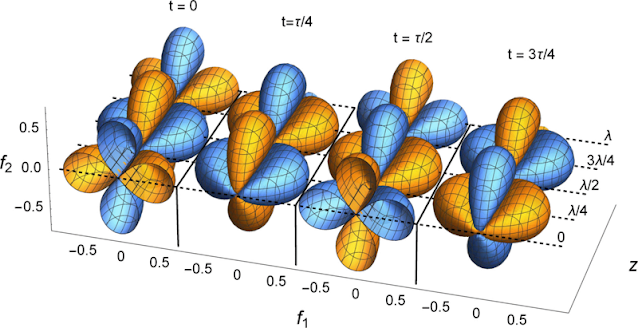
Quadrupolar nature of gravitational waves, and Goldstone modes of spin-nematic order, visualized through the associated distortions of spacetime, or the spin-nematic ground state.


FIG. 3.
Numerical simulation of vortices within a spin-nematic state, showing how quadrupole waves, analogous to gravitational waves, are created when a pair of vortices in-spiral and annihilate.


Sunday, April 07, 2024

Researchers find first experimental evidence for a graviton-like particle in a quantum material

Amazing and exciting stuff! Unfortunately, this stuff is not easy to grasp for a layperson like me.

The scientists themselves call it "exotic physics" and it is about "collective excitations"! 

"A team of scientists ... have presented the first experimental evidence of collective excitations with spin called chiral graviton modes (CGMs) in a semiconducting material. ..."

"Experiments on a quantum material have revealed for the first time what might be a particle similar to the hypothetical graviton particle. This elementary particle could be the missing link between Einstein’s theory of general relativity, which explains gravity, and quantum mechanics. ...
When matter interacts with these fields in particular ways, it causes “excitations” in the force fields which leads to energy being translated in waves through the field. The force carriers are the ‘quantisation’ of this energy, according to quantum mechanics. ..."

From the abstract:
"Exotic physics could emerge from interplay between geometry and correlation. In fractional quantum Hall (FQH) states, novel collective excitations called chiral graviton modes (CGMs) are proposed as quanta of fluctuations of an internal quantum metric under a quantum geometry description. Such modes are condensed-matter analogues of gravitons that are hypothetical spin-2 bosons. They are characterized by polarized states with chirality of +2 or −2, and energy gaps coinciding with the fundamental neutral collective excitations (namely, magnetorotons) in the long-wavelength limit. However, CGMs remain experimentally inaccessible. Here we observe chiral spin-2 long-wavelength magnetorotons using inelastic scattering of circularly polarized lights, providing strong evidence for CGMs in FQH liquids. At filling factor v = 1/3, a gapped mode identified as the long-wavelength magnetoroton emerges under a specific polarization scheme corresponding to angular momentum S = −2, which persists at extremely long wavelength. Remarkably, the mode chirality remains −2 at v = 2/5 but becomes the opposite at v = 2/3 and 3/5. The modes have characteristic energies and sharp peaks with marked temperature and filling-factor dependence, corroborating the assignment of long-wavelength magnetorotons. The observations capture the essentials of CGMs and support the FQH geometrical description, paving the way to unveil rich physics of quantum metric effects in topological correlated systems."

Researchers find first experimental evidence for a graviton-like particle in a quantum material


Graviton modes and inelastic light scattering


Saturday, March 23, 2024

Scientists measure gravity at the smallest mass ever recorded so far

Amazing stuff! What is e.g. the gravity force of an electron?

"... In a recent experiment, researchers ... levitated tiny particles with magnets and measured their gravitational pull at near absolute zero temperatures to minimize external noise. The mass of the particles measures a mere 0.000015 ounce (0.43 milligrams). Much to their surprise, this setup allowed the physicists to detect a faint whisper of gravity.
“We have successfully measured gravitational signals at the smallest mass ever recorded,” ..."

"... They claim it could pave the way to finding the elusive quantum gravity theory. ...
It measured a weak pull, just 30aN, on a tiny particle 0.43mg in size by levitating it in freezing temperatures a hundredth of a degree above absolute zero – about minus-273 degrees Celsius. ..."

From the abstract:
"Gravity differs from all other known fundamental forces because it is best described as a curvature of space-time. For that reason, it remains resistant to unifications with quantum theory. Gravitational interaction is fundamentally weak and becomes prominent only at macroscopic scales. This means, we do not know what happens to gravity in the microscopic regime where quantum effects dominate and whether quantum coherent effects of gravity become apparent. Levitated mechanical systems of mesoscopic size offer a probe of gravity, while still allowing quantum control over their motional state. This regime opens the possibility of table-top testing of quantum superposition and entanglement in gravitating systems. Here, we show gravitational coupling between a levitated submillimeter-scale magnetic particle inside a type I superconducting trap and kilogram source masses, placed approximately half a meter away. Our results extend gravity measurements to low gravitational forces of attonewton and underline the importance of levitated mechanical sensors."

P.S. It is very annoying that popular science articles do not reveal the source of their information as happened again here. I made the effort again to find the official news release! This is clearly bad practice!

Scientists measure gravity of smallest mass so far, chasing Holy Grail of physics

Scientists closer to solving mysteries of universe after measuring gravity in quantum world (official news release) Scientists are a step closer to unravelling the mysterious forces of the universe after working out how to measure gravity on a microscopic level.


Fig. 1. Schematic depiction of the experimental setup.


Saturday, March 16, 2024

Unlocking the secrets of the universe: Preparing for New discoveries in gravitational waves

Seems to be a very interesting survey/review article!

"The review outlines the path from a particle physics model to GWs, which contains many specialized parts, including:
  • building a finite-temperature effective potential in a particle physics model and checking for FOPTs [first-order phase transitions]
  • computing transition rates
  • analyzing the dynamics of bubbles of true vacuum expanding in a thermal plasma
  • characterizing a transition using thermal parameters
  • making predictions for GW spectra using the latest simulations and theoretical results and considering the detectability of predicted spectra at future GW detectors.
..."

From the abstract:
"Gravitational waves (GWs) were recently detected for the first time. This revolutionary discovery opens a new way of learning about particle physics through GWs from first-order phase transitions (FOPTs) in the early Universe. FOPTs could occur when new fundamental symmetries are spontaneously broken down to the Standard Model and are a vital ingredient in solutions of the matter anti-matter asymmetry problem. The purpose of our work is to review the path from a particle physics model to GWs, which contains many specialized parts, so here we provide a timely review of all the required steps, including: (i) building a finite-temperature effective potential in a particle physics model and checking for FOPTs; (ii) computing transition rates; (iii) analyzing the dynamics of bubbles of true vacuum expanding in a thermal plasma; (iv) characterizing a transition using thermal parameters; and, finally, (v) making predictions for GW spectra using the latest simulations and theoretical results and considering the detectability of predicted spectra at future GW detectors. For each step we emphasize the subtleties, advantages and drawbacks of different methods, discuss open questions and review the state-of-art approaches available in the literature. This provides everything a particle physicist needs to begin exploring GW phenomenology."

Unlocking the secrets of the universe: New discoveries in gravitational waves A groundbreaking body of work led by Monash University physicists has opened a new pathway for understanding the universe's fundamental physics.

Tuesday, December 05, 2023

New theory claims to unite Einstein's gravity with quantum mechanics

If confirmed, this would be big news! I don't claim to fully understand this new theory.

"But these two theories are in contradiction with each other and a reconciliation has remained elusive for over a century.

The prevailing assumption has been that Einstein's theory of gravity must be modified, or "quantized," in order to fit within quantum theory. This is the approach of two leading candidates for a quantum theory of gravity, string theory and loop quantum gravity.

But a new theory, developed by Professor Jonathan Oppenheim (UCL Physics & Astronomy) and laid out in a paper in Physical Review X, challenges that consensus and takes an alternative approach by suggesting that spacetime may be classical—that is, not governed by quantum theory at all.

Instead of modifying spacetime, the theory—dubbed a "postquantum theory of classical gravity"—modifies quantum theory and predicts an intrinsic breakdown in predictability that is mediated by spacetime itself. This results in random and violent fluctuations in spacetime that are larger than envisaged under quantum theory, rendering the apparent weight of objects unpredictable if measured precisely enough.
A second paper, published simultaneously in Nature Communications and led by Professor Oppenheim's former Ph.D. students, looks at some of the consequences of the theory, and proposes an experiment to test it: to measure a mass very precisely to see if its weight appears to fluctuate over time. ..."

From the abstract (1):
"The effort to discover a quantum theory of gravity is motivated by the need to reconcile the incompatibility between quantum theory and general relativity. Here, we present an alternative approach by constructing a consistent theory of classical gravity coupled to quantum field theory. The dynamics is linear in the density matrix, completely positive, and trace preserving, and reduces to Einstein’s theory of general relativity in the classical limit. Consequently, the dynamics does not suffer from the pathologies of the semiclassical theory based on expectation values. The assumption that general relativity is classical necessarily modifies the dynamical laws of quantum mechanics; the theory must be fundamentally stochastic in both the metric degrees of freedom and in the quantum matter fields. This breakdown in predictability allows it to evade several no-go theorems purporting to forbid classical quantum interactions. The measurement postulate of quantum mechanics is not needed; the interaction of the quantum degrees of freedom with classical space-time necessarily causes decoherence in the quantum system. We first derive the general form of classical quantum dynamics and consider realizations which have as its limit deterministic classical Hamiltonian evolution. The formalism is then applied to quantum field theory interacting with the classical space-time metric. One can view the classical quantum theory as fundamental or as an effective theory useful for computing the backreaction of quantum fields on geometry. We discuss a number of open questions from the perspective of both viewpoints."

From the abstract (2):
"We consider two interacting systems when one is treated classically while the other system remains quantum. Consistent dynamics of this coupling has been shown to exist, and explored in the context of treating space-time classically. Here, we prove that any such hybrid dynamics necessarily results in decoherence of the quantum system, and a breakdown in predictability in the classical phase space. We further prove that a trade-off between the rate of this decoherence and the degree of diffusion induced in the classical system is a general feature of all classical quantum dynamics; long coherence times require strong diffusion in phase-space relative to the strength of the coupling. Applying the trade-off relation to gravity, we find a relationship between the strength of gravitationally-induced decoherence versus diffusion of the metric and its conjugate momenta. This provides an experimental signature of theories in which gravity is fundamentally classical. Bounds on decoherence rates arising from current interferometry experiments, combined with precision measurements of mass, place significant restrictions on theories where Einstein’s classical theory of gravity interacts with quantum matter. We find that part of the parameter space of such theories are already squeezed out, and provide figures of merit which can be used in future mass measurements and interference experiments."

New theory claims to unite Einstein's gravity with quantum mechanics

A Postquantum Theory of Classical Gravity? (open access, a very long paper with no figures)

Thursday, November 09, 2023

What If Gravity is NOT Quantum?

As usual, very recommendable! Mind boggling. Is the graviton an extremely small black hole?