Showing posts with label anxiety disorder. Show all posts

Friday, September 26, 2025

Inflammation during pregnancy may prime offspring for anxiety

Good news! It has been suspected for decades that events during a woman's pregnancy may cause serious disorders etc. affecting her child possibly for the rest of the child's life. 

"Increased risk for anxiety may begin before birth, shaped by infection or stressful events during pregnancy, according to a new preclinical study ...

While scientists have long known that maternal difficulty during pregnancy may raise a child’s risk for psychiatric illness, the biological pathways between these prenatal experiences and later mental health have been unclear. ..."

From the highlights and abstract:
"Highlights
• Adverse gestational environment is a risk factor for psychiatric disorders
• Gestational adversity has variable neuronal transcriptomic effects
• The most affected hippocampal neurons are activated in a stressful environment
• Higher neuronal activity during transition from safe to threatening environment

Summary
An adverse gestational environment is a risk factor for the development of psychiatric disorders. Although studies have implicated modifications in neuronal DNA and chromatin, how these changes come about and lead to abnormal behaviors is not known.
We sought to identify persistent DNA/chromatin and transcriptomic signatures induced by a proinflammatory gestational environment in the ventral dentate gyrus (vDG), a hippocampal region linked to anxiety. 
A proinflammatory environment shifted DNA methylation of enhancers and promoters and altered synapse-related gene expression, resulting in transcriptional heterogeneity in the vDG.
In animals with prior adversity, exposure to a threatening environment recruited vDG neurons with the greatest transcriptional changes, notably in synapse-relevant genes that also tended to be differentially methylated.
Finally, vDG activity was increased during transition from a safe to a threatening environment in animals with prior adversity but not in controls, suggesting their enhanced perception of a potential threat.
Our data outline a proinflammatory gestational environment-induced neurobiological sequence that leads to anxiety."

Inflammation during pregnancy may prime offspring for anxiety | Cornell Chronicle


Graphical abstract


Figure 2 An adverse gestational environment preferentially alters methylation at intermediately methylated CGs in vDGCs


Monday, September 23, 2024

Scientists Uncover Genetic Predisposition to Anxiety in a study with more than 1.2 million participants from around the world

Good news!

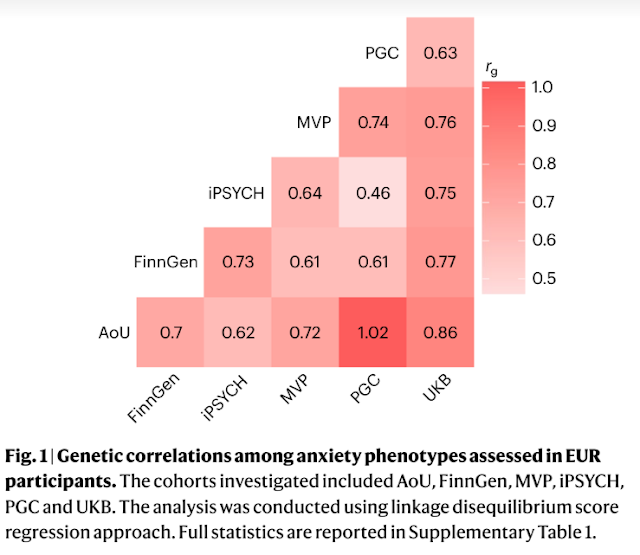
"... investigated the genetic profiles of more than 1 million participants enrolled in multiple cohorts around the world. Leveraging this large dataset, they uncovered more than 100 genes associated with anxiety. ...

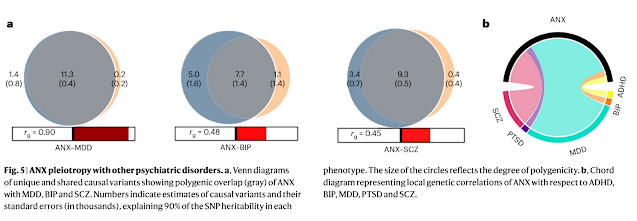
They also observed that some anxiety-associated genes can also predispose to other mental illnesses, including depression, schizophrenia, and bipolar disorder. ...

In line with anxiety comorbidity with physical health, the study also demonstrated that anxiety genetic risk is also correlated with non-psychiatric conditions. In particular, the strongest evidence was observed with gastrointestinal disorders and pain-related outcomes. ..."

From the abstract:
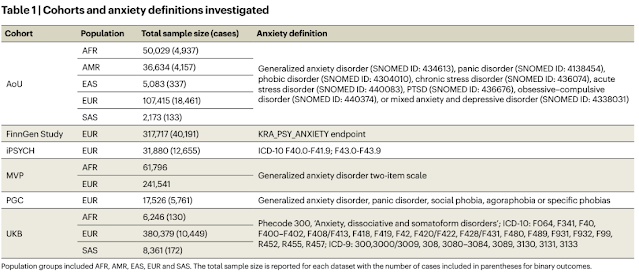
"We leveraged information from more than 1.2 million participants, including 97,383 cases, to investigate the genetics of anxiety disorders across five continental groups. Through ancestry-specific and cross-ancestry genome-wide association studies, we identified 51 anxiety-associated loci, 39 of which were novel. In addition, polygenic risk scores derived from individuals of European descent were associated with anxiety in African, admixed American and East Asian groups. The heritability of anxiety was enriched for genes expressed in the limbic system, cerebral cortex, cerebellum, metencephalon, entorhinal cortex and brain stem. Transcriptome-wide and proteome-wide analyses highlighted 115 genes associated with anxiety through brain-specific and cross-tissue regulation. Anxiety also showed global and local genetic correlations with depression, schizophrenia and bipolar disorder and widespread pleiotropy with several physical health domains. Overall, this study expands our knowledge regarding the genetic risk and pathogenesis of anxiety disorders, highlighting the importance of investigating diverse populations and integrating multi-omics information."

Yale Scientists Uncover Genetic Predisposition to Anxiety < Psychiatry


Gene Discovery and Biological Insights into Anxiety Disorders from a Multi-Ancestry Genome-wide Association Study of >1.2 Million Participants (preprint, open access) Courtesy of personal communication  with the senior author Renato Polimanti.


Wednesday, May 15, 2024

Tweaked psychedelic toad toxin alleviates anxiety in mice

Sometimes the cure is worse than the disease comes to mind! (just kidding) 😊 A toast the toad!

"Psychedelic substances have gained attention in recent years as treatments for depression and other central nervous system disorders. Now, researchers have made an analog of 5-MeO-DMT that appears to relieve anxiety and depression in mice without causing hallucinations."

"To deter predators, the Colorado river toad (Incilius alvarius) exudes the toxin 5-MeO-DMT from glands within its skin. While the substance puts off predators, people who consume 5-MeO-DMT can have a psychedelic experience. ..."

Tweaked psychedelic toad toxin alleviates anxiety in mice Analog of the psychoactive compound 5-MeO-DMT doesn’t induce hallucinations in the rodents


Monday, June 26, 2023

First-of-its-kind noninvasive CRISPR method knocks out anxiety gene

Good news! When are we able to knock out the sneezing gene or the male facial hair gene?

"... Researchers have developed a novel, noninvasive method of delivering CRISPR/Cas9 gene-editing technology into the brain ... to knock out a gene that causes anxiety. While the technique has so far only been used on mice, the findings open the door to developing new therapeutics, especially for people resistant to medication. ... They say it’s the first successful demonstration of noninvasive CRISPR/Cas9 delivery capable of passing the blood-brain barrier to enable genetic modification. ...
In the current study, the researchers experimented with intranasal delivery of the CRISPR/Cas9 system to ... knock out the serotonin receptor (HTR2A) gene, which modulates the availability of serotonin. ...
The researchers administered a viral vector, an inactivated adeno-associated virus (AAV), into the noses of mice to deliver the gRNA to neurons in the brain so that it could bind to the target HTR2A gene, which Cas9 then cut out. ... The researchers used the AAV9 subtype, a highly efficient vector for delivering cargo to neurons throughout the central nervous system. ..."

From the abstract:
"The expanding field of precision gene editing using CRISPR/Cas9 has demonstrated its potential as a transformative technology in the treatment of various diseases. However, whether this genome-editing tool could be used to modify neural circuits in the central nervous system (CNS), which are implicated in complex behavioral traits, remains uncertain. In this study, we demonstrate the feasibility of noninvasive, intranasal delivery of adeno-associated virus serotype 9 (AAV9) vectors containing CRISPR/Cas9 cargo within the CNS resulting in modification of the HTR2A receptor gene. In vitro, exposure to primary mouse cortical neurons to AAV9 vectors targeting the HT2RA gene led to a concentration-dependent decrease in spontaneous electrical activity following multielectrode array (MEA) analysis. In vivo, at 5 weeks postintranasal delivery in mice, analysis of brain samples revealed single base pair deletions and nonsense mutations, leading to an 8.46-fold reduction in mRNA expression and a corresponding 68% decrease in the 5HT-2A receptor staining. Our findings also demonstrate a significant decrease in anxiety-like behavior in treated mice. This study constitutes the first successful demonstration of a noninvasive CRISPR/Cas9 delivery platform, capable of bypassing the blood–brain barrier and enabling modulation of neuronal 5HT-2A receptor pathways. The results of this study targeting the HTR2A gene provide a foundation for the development of innovative therapeutic strategies for a broad range of neurological disorders, including anxiety, depression, attentional deficits, and cognitive dysfunction."

First-of-its-kind noninvasive CRISPR method knocks out anxiety gene


Fig. 3  Intranasal delivery of AAV9 vectors containing Cas9 and gRNA receptor leads to down-regulation of 5HT-2A receptor mRNA.


Sunday, May 07, 2023

Scientists discover “anxiety gene” in the brain - and a natural way to turn it off

Good news! Could this be a breakthrough!

"... This led to the discovery of increased levels of five microRNAs (miRNAs) — small molecules that help determine which genes in a cell are expressed and which aren’t — in the amygdala, the brain region implicated in anxiety.
When the researchers took a closer look at the miRNA that reached the highest levels, miR-483-5p, they saw that it suppressed the expression of the Pgap2 gene — and that this suppression appeared to provide stress relief and reduce anxiety-related behavior. ..."

From the abstract:
"Severe psychological trauma triggers genetic, biochemical and morphological changes in amygdala neurons, which underpin the development of stress-induced behavioural abnormalities, such as high levels of anxiety. miRNAs are small, non-coding RNA fragments that orchestrate complex neuronal responses by simultaneous transcriptional/translational repression of multiple target genes. Here we show that miR-483-5p in the amygdala of male mice counterbalances the structural, functional and behavioural consequences of stress to promote a reduction in anxiety-like behaviour. Upon stress, miR-483-5p is upregulated in the synaptic compartment of amygdala neurons and directly represses three stress-associated genes: Pgap2, Gpx3 and Macf1. Upregulation of miR-483-5p leads to selective contraction of distal parts of the dendritic arbour and conversion of immature filopodia into mature, mushroom-like dendritic spines. Consistent with its role in reducing the stress response, upregulation of miR-483-5p in the basolateral amygdala produces a reduction in anxiety-like behaviour. Stress-induced neuromorphological and behavioural effects of miR-483-5p can be recapitulated by shRNA mediated suppression of Pgap2 and prevented by simultaneous overexpression of miR-483-5p-resistant Pgap2. Our results demonstrate that miR-483-5p is sufficient to confer a reduction in anxiety-like behaviour and point to miR-483-5p-mediated repression of Pgap2 as a critical cellular event offsetting the functional and behavioural consequences of psychological stress."

P.S. Some of those who believe in the Global Warming hoax and Climate Change religion may also suffer from some kind of anxiety disorder. Just speculating! 😊

Scientists discover "anxiety gene" in the brain They see “huge potential” for it to lead to new anti-anxiety meds.


Fig. 1: Regulation of miRNAs in mice by restraint stress in the basolateral amygdala.


Sunday, April 11, 2021

The science of fear

Very recommendable! Fear can be overcome with new treatments!
There is a pill to overcome fear! Fear is not fixed in memory, but refreshed!
How about some immersive virtual reality treatment?
If you have a calcified amygdala you have little fears most of the time. However, it was recently discovered that the amygdala is not the only part of the brain responding to fears.

Monday, February 11, 2019

The Expanding Mental Disorder Profession

Posted: 2/11/2019


Trigger


In this article, we learn that young children were subjected to a few carefully selected and rather narrowly crafted and blunt experiments to determine early onset of anxiety and depression. My hunch is that these few experiments are rather crude to make such far reaching judgments! More longitudinal studies and more observation are called for!


A Few Observations


  1. There is a huge conflict of interest affecting in particular the mental disorder profession (psychologists, psychiatrists, neurologists etc.), but something similar applies to other medical professions as well
  2. The more humans, this profession identifies as having mental disorders, the more money flows their way, the more prestige, fame, and stature they gain, the more such professionals we need and so forth. A nice self feeding, reinforcing process (or a vicious spiral)
  3. I would argue since Sigmund Freud, the mental disorder profession has attempted to declare as many members of society to be suffering from some mental disorder as possible
  4. Do members of the mental disorder profession exploit their authority as trusted specialists? I would say yes! Lay people are kind of left to rely on their pronouncements
  5. If it is to some extent true that a disproportionate number of the members of the mental disorder profession are their own best patients (self treatment), then would these members not feel better if they are not isolated case, but that many humans share their fate?
  6. Like ADHD or autism spectrum disorders, anxiety and depression are very much in the eye of the beholder. All these disorders are difficult to specify and measure. Their diagnosis was expanded dramatically over the past decades. More and more children and adults have been diagnosed as having one of these disorders
  7. To what extent are e.g. anxiety and depression just part of the normal range of human behavior and mental condition? To my knowledge, there are still no hard facts or diagnostic tests to determine if and when a human being (adolescent or adult) has a mental disorder so severe and clinical that requires treatment