Showing posts with label debunking myths. Show all posts

Friday, April 17, 2026

'The Rich Don't Pay Their Fair Share' and 4 Other Tax Myths That Won't Die

Recommendable! 

The argument regarding the Myth No. 5 is flawed. Yes, tax cuts that stimulate economic growth, labor force participation etc. pay for themselves if government exercises restraint on expenditures!

"Myth No. 1: The Rich Don't Pay Their Fair Share ...

Myth No. 2: We'll Fix the Budget Deficit by Taxing the Rich ...

Myth No. 3: If You Can't Tax the Rich, Tax Corporations ...

Myth No. 4: Capital Gains Should Be Taxed Like Ordinary Income ...

Myth No. 5: Tax Cuts Pay for Themselves ..."

'The Rich Don't Pay Their Fair Share' and 4 Other Tax Myths That Won't Die "The United States has the most progressive income-tax system in the developed world"

Sunday, August 31, 2025

Gen Z is, by a large margin, the least criminal American generation in living memory. Really!

Not so fast! 

Why did this not happen already with the video game playing generation before? Were we not saying back then that teenagers and young adults were spending too much time in front of the screen.

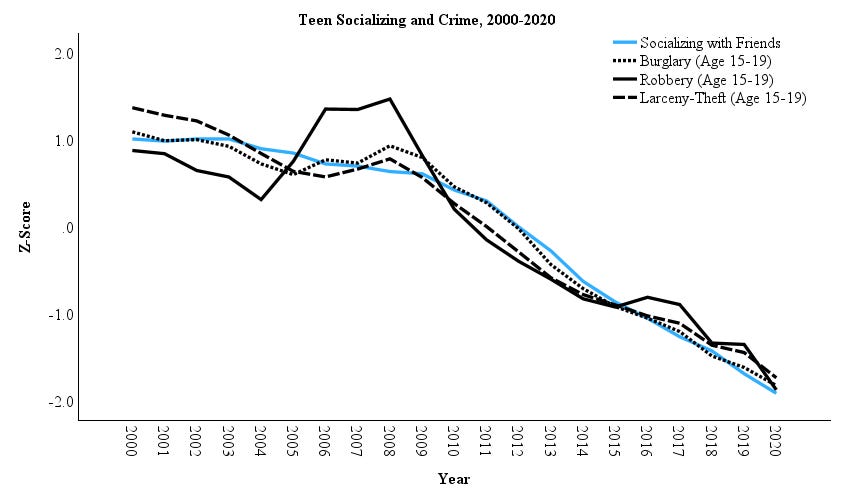
Maybe the new generation is not so much interested in committing old fashioned crimes like burglary, robbery, or larceny-theft as the chart below suggests.

What about cyber crimes

"One silver lining to the worrying decline in teenage socializing is a concurrent drop in the teen crime rate. Data compiled by the sociologist James Tuttle suggests that Gen Z is, by a large margin, the least criminal American generation in living memory."

Doomslayer: Weekly Progress Roundup - by Malcolm Cochran

The Smartphone-Induced Teen Crime Decline "Gen Z made crime rates 'crash out'"


"The correspondence between teenage socializing and crime rates is remarkable."


Sunday, December 01, 2024

The Left is Wrong. There is No Gender Wage Gap - PragerU

Very recommendable! Indeed, the gender pay gap is mostly a myth in Western societies if you compare apples with apples!
Perhaps motherhood and child rearing may affect wages of women more than men and explain some of the differences even today.

Sunday, September 15, 2024

What really happened to the population of Easter Island

I believe, I was taught this theory in school too and my parents told me about it.

"The history of Easter Island has long served as an environmental fable.

"The popular “ecocide” theory claims that, during their escalating obsession with building the famous Moai statues, the native Rapa Nui people deforested their once-verdant island, creating an ecological crisis that led to population collapse, cannibalism, and a complete reordering of Rapa Nui society.

A new study raises serious doubts about this narrative. After analyzing the remains of 15 ancient islanders, researchers found no evidence of the drop in genetic diversity one would expect after a population collapse. In fact, the genomes suggest Easter Island’s population grew steadily until European contact. According to archaeogeneticists Stephan Schiffels and Kathrin Nägele, “the study concludes that there were never more than 3,000 people living on Rapa Nui — a number close to that observed by the first colonizers and far from a previous estimate of 15,000 inhabitants — implying that the hypothesized collapse was always a fantasy.” ..."

From the abstract:
"Rapa Nui (also known as Easter Island) is one of the most isolated inhabited places in the world. It has captured the imagination of many owing to its archaeological record, which includes iconic megalithic statues called moai. Two prominent contentions have arisen from the extensive study of Rapa Nui.
First, the history of the Rapanui has been presented as a warning tale of resource overexploitation that would have culminated in a major population collapse—the ‘ecocide’ theory.
Second, the possibility of trans-Pacific voyages to the Americas pre-dating European contact is still debated.
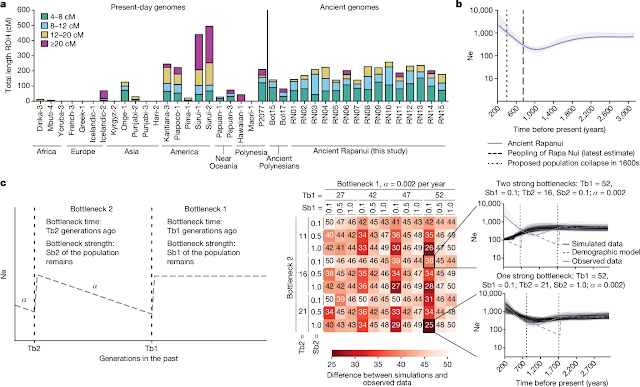
Here, to address these questions, we reconstructed the genomic history of the Rapanui on the basis of 15 ancient Rapanui individuals that we radiocarbon dated (1670–1950 ce) and whole-genome sequenced (0.4–25.6×). We find that these individuals are Polynesian in origin and most closely related to present-day Rapanui, a finding that will contribute to repatriation efforts. Through effective population size reconstructions and extensive population genetics simulations, we reject a scenario involving a severe population bottleneck during the 1600s, as proposed by the ecocide theory. Furthermore, the ancient and present-day Rapanui carry similar proportions of Native American admixture (about 10%). Using a Bayesian approach integrating genetic and radiocarbon dates, we estimate that this admixture event occurred about 1250–1430 ce."

Ancient Rapanui genomes reveal resilience and pre-European contact with the Americas (open access)


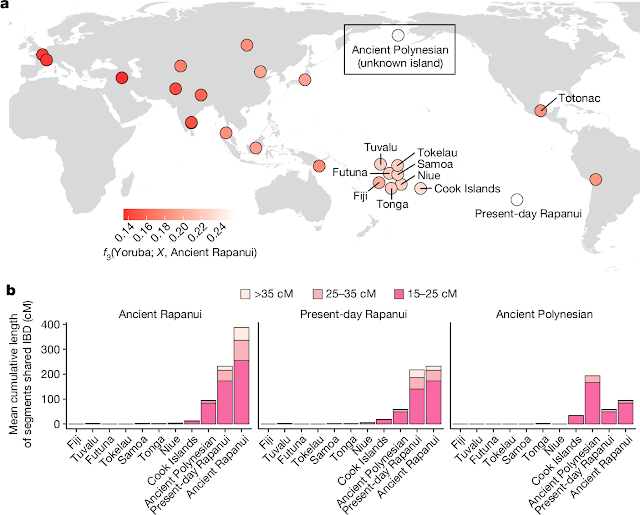
Fig. 1: Shared drift and identity by descent between Ancient Rapanui and present-day populations.


Fig. 2: ROH and Rapanui population size estimates through time.


Wednesday, February 16, 2022

Myth: The rich get richer and the poor get poorer!

One of those widespread, surviving myth that should have been totally debunked a long time ago as far as free market economies are concerned!

Attributed to a English Romantic period poet Percy Bysshe Shelley! What do poets and romantics know about the economy? Often, very little!

I recently encountered the repeated use of this myth in a machine learning related comprehensive survey paper. Even PhDs are not immune to this myth!

Those who are rich and poor do not stay the same over time at least not in free market economies.

The definition of rich and poor people is in the eye of the beholder. E.g. is it the top 5% or 10% etc.

What if the group of the people in the middle gets bigger and richer?

The rich get richer and the poor get poorer - Wikipedia

Wednesday, September 18, 2019

Debunking The Lasting Myth Of Poverty In The Early Industrial Revolution

Posted: 9/18/2019

I have had serious doubts for many years regarding the still predominant narrative about the severe poverty and worker exploitation during the early phase of the Industrial Revolution as it happened in Great Britain. Charles Dickens famous stories and Karl Marx and his sugar daddy Friedrich Engels stoked the narrative early on.

“Were there no poor people before that? (There were, obviously.) There are a number of possible answers – an increase in the concentration of poverty with growing urbanization and industrialization, which made poverty more visible; the rising standard of living, which made poverty seem less “normal”; or ... a more visible contrast between wealthy owners and poorer workers” (S1; emphasis added)

I may add:
  1. Yes, perhaps the contrast between wealthy owners and poor workers became more visible. Perhaps, there were suddenly many more affluent and wealthy citizens around, while in previous centuries wealth was more invisible and highly concentrated with the nobility and upper echelons of clergy. 
  2. Many of the nouveau rich were self made and came from humble beginnings
  3. I would bet there were relatively fewer poor people during this time than in the centuries before if you adjust e.g. for population growth
  4. Above all, poverty is such a strong relative phenomenon depending on time, location, culture and much more. E.g. a person in Western countries, who is in our time considered to be poor, would have been seen as a well off person just a few decades ago. Like beauty, poverty is to some extent more in the eye of the beholder. Greed and envy do the rest!

Sources (S):