Showing posts with label forest management. Show all posts

Monday, August 31, 2026

Japan has begun replacing nearly two million acres of forests to help reduce seasonal allergies.

Planting trees like large forests can be unhealthy! Seems counterintuitive! Wrong trees?

"After World War II, Japan’s government encouraged widespread planting of fast-growing sugi cedar and hinoki cypress trees to supply the country with timber. Unfortunately, the pollen from those trees has since contributed to a national epidemic of hay fever afflicting over 40 percent of the population.
The Japanese government is now accelerating the removal of those forests and replacing them with a variety of local trees, including sugi varieties selectively bred to produce less pollen. The long-term goal is to halve cedar pollen emissions within three decades."

"... In 2023, the Japanese government announced a solution: Fell 750,000 hectares of sugi and hinoki trees in a bid to cut the problem off at the root.
After decades of work, researchers have developed more than 30 strains of low-pollen and no-pollen sugi trees, which will replace some of the trees cut down. ...

The trees were first distributed widely across Japan during the Meiji era, a period of rapid industrialization that ran from 1868 to 1912.
But it was the post-World War II period that accelerated the conversion of natural forests into planted forests dominated by sugi and hinoki. ... explaining that several intersecting shifts in the second half of the 20th century pushed Japan to favor sugi and hinoki trees.

Between 1950 and 1985, Japan’s planted forests grew to account for some 10 million hectares (24.7 million acres) — more than a quarter of the country’s total land area — with much of it converted from natural forests. Deciduous species formerly used for firewood like kunugi (Quercus acutissima) and konara (Quercus serrata) fell out of favor as fossil fuels became widely available. ...

Meanwhile, the construction industry drove demand for timber from sugi and hinoki trees. By the war’s end, aggressive bombing campaigns by the U.S. had left the country in need of some 4.2 million homes, according to a 2021 case study. Japan rebuilt at a staggering pace, spending as much as 40% of the national budget on construction projects. By 2020, the construction industry had built more than 76 million apartments and houses, the study found, with detached single family homes made of wood accounting for the largest share of new housing units. ..."

Doomslayer: Progress Roundup - by Malcolm Cochran


A cloud of tree pollen emanates from a sugi tree


Friday, August 28, 2026

Using airborne sensors for Gamma rays to predict tree die-offs in Australia

Amazing stuff! Good news!

"... In a new study, they present a surprising new tool: gamma rays. Beneath the surface of the parched forests lies thick, granite-rich bedrock, which gradually breaks down and leaves potassium-40-rich minerals in the surrounding soils. Potassium-40 produces gamma rays as it decays—and over millions of years of weathering, the researchers reasoned that the gamma-ray signal should be stronger where soils were shallow and full of potassium-40. Shallow soils in turn mean that tree roots have less room to stretch out for water during drought.

Gamma-ray measurements of three forested areas spanning 400 to 900 square kilometers overlapped neatly with the [conventional] electrical measurements.
In fact, gamma rays were a better predictor of tree mortality than the go-to explanations of the slope of the land or the proximity of trees to streams. The technique could be applied throughout the globe, since one-third of Earth’s ice-free land boasts similar kinds of bedrock and weathered soils. ..."

"... The method revealed that all die-off spots had soils 12 meters deep or less, which made it harder for tree roots to stretch out and access water. But it was incredibly labor intensive, requiring the team to lay electrodes across the forest floor. ...

Still, some applications have already begun: Mining companies operating in the same Western Australian forests have been flying gamma ray sensors to understand the surface geology, but are now considering how much soil should be restored after their operations cease ..."

"... Using airborne sensors, the research team measured gamma rays produced by the natural decay of potassium-40, a naturally occurring radioactive isotope found in rocks and soils. In the highly weathered landscapes of south-west Western Australia, potassium has largely been leached from the soil over millions of years, meaning stronger potassium signals often indicate that bedrock is closer to the surface. ..."

From the abstract:
"Extreme drought and heat are driving forest die-off globally, yet regional-scale mapping of subsurface water storage capacity, governing forest vulnerability, remains a major challenge.
Here, we demonstrate that airborne gamma-ray spectrometry (GRS) of potassium (40K) decay provides a powerful proxy for subsurface constraints on water availability.
In southwestern Australia, we found that spatial patterns of forest die-off during an extreme 2023–2024 drought-heat event were strongly predicted by surficial 40K concentrations.
While GRS measures the upper ∼30 cm of soil
plot-scale electrical resistivity tomography suggests that elevated 40K signals shallow granite or gneiss bedrock, to depths reaching several tens of meters due to leaching of mobile elements, remnant bedrock minerals, erosional thinning of regolith and biological nutrient recycling from K-rich saprolite.
Airborne GRS can map forest vulnerability across highly leached landscapes, which cover one-third of Earth's ice-free land surface. This enables targeted adaptive management of forests for future drought-heat intensification."

ScienceAdviser


Scientists use natural radiation to predict which forests are most vulnerable to drought (original news release) "What do bananas and drought-stressed forests have in common? According to new research led by the Department of Biodiversity, Conservation and Attractions (DBCA) in collaboration with Murdoch University, both contain potassium and a tiny amount of naturally occurring radiation that can reveal important clues about the world around us."


Fig. 1 The forests of southwestern Australia occur on highly leached soils and experienced die-off during a record-breaking drought and heat event in 2023–2024.(a), (b)Study region in southwestern Australia; ...
(c) historical (from 1923) and recent 18-month cumulative rainfall ;
(d) 30-day running mean temperatures; and a 
 (e) global map of strongly leached soils, similar to those in this study, with the potential for gamma rays to signal drought vulnerability.


Tuesday, July 28, 2026

The area burned in the Brazilian Amazon fell to 3.1 million hectares in 2025, the smallest area since at least 1985

Good news! Why do many Western media not report that, but instead of the large burning fires in Canada and Europe?

How much was lack or negligence of proper forest management to blame for the forest fires in Canada and Europe?

Why 1985? When satellite measurements became possible.

"... The amount of land burned in the world's largest rainforest last year covered the smallest area since MapBiomas records began in 1985. ..."

Doomslayer: Progress Roundup - by Malcolm Cochran


Tuesday, February 24, 2026

Forest and tree cover in Uttar Pradesh expanded by roughly 338,000 acres (about 528 square miles) between 2017 and 2023

Good news!

"The scale of this transformation is best seen in the numbers. Between 2017-18 and 2023-24, Uttar Pradesh recorded its highest-ever forest expansion. In the nine years before 2017, only 65.27 crore saplings were planted. Since 2017, that number has jumped to a staggering 242.13 crore saplings.

According to the State of Forest Report 2023, the state’s forest and tree cover increased by 3 lakh 38 thousand acres during this period. The total forest area grew from 1,658 thousand hectares in 2016-17 to 1,772 thousand hectares by 2023-24.” ..."

How Uttar Pradesh Is Leading India’s Environmental Revival - Human Progress

Tuesday, November 25, 2025

Removing dead trees will not save us from fast-moving wildfires. Really!

A very long opinion article totally obsessed with logging dead trees published in the prestigious Proceedings of the National Academy of Sciences of the United States of America (PNAS)! An example of junk science?

Well active forest management to prevent disastrous wildfires is much more than just removing dead trees!

Removing dead trees will not save us from fast-moving wildfires | PNAS

Tuesday, August 19, 2025

Researchers unveil AI-powered tool for near real-time, large-scale wildfire fuel mapping and forecasting for California

Good news! But better forecasting of wildfires is no substitute for better management of forests/wildlands to prevent wildfires!

Not climate change, but failure of proper forest/wildland management, arson, and other human activities are the cause of most wildfires.

"Key takeaways:
  • In validation tests using data from two of California’s most intense recent wildfires — the Dixie and Caldor fires of 2021 — FuelVision’s predictions closely matched actual fuel maps.
  • FuelVision operates autonomously, utilizing commonly available data.
  • Because it draws data from global satellite inputs, FuelVision is readily adaptable to forested areas nationwide.
..."

From the highlights and abstract:
"Highlights
• Near real-time wildland fuels mapping algorithm.
• Leverage satellite remote sensing data and terrain features.
• Overcome challenge posed by imbalanced datasets.
• Leverage General Adversarial Networks for synthetic remote sensing data generation.

Abstract
Accurate assessment of fuel conditions is a prerequisite for fire ignition and behavior prediction, and risk management.
The method proposed herein leverages diverse data sources – including L8 optical imagery, S1 (C-band) Synthetic Aperture Radar (SAR) imagery, PL (L-band) SAR imagery, and terrain features – to capture comprehensive information about fuel types and distributions.
An ensemble model was trained to predict landscape-scale fuels – such as the ’Scott and Burgan 40’ – using the as-received Forest Inventory and Analysis (FIA) field survey plot data obtained from the USDA Forest Service.
However, this basic approach yielded relatively poor results due to the inadequate amount of training data.
Pseudo-labeled and fully synthetic datasets were developed using generative AI approaches to address the limitations of ground truth data availability. These synthetic datasets were used for augmenting the FIA data from California to enhance the robustness and coverage of model training.
The use of an ensemble of methods – including deep learning neural networks, decision trees, and gradient boosting – offered a fuel mapping accuracy of nearly 80%. Through extensive experimentation and evaluation, the effectiveness of the proposed approach was validated for regions of the 2021 Dixie and Caldor fires. Comparative analyses against high-resolution data from the National Agriculture Imagery Program (NAIP) and timber harvest maps affirmed the robustness and reliability of the proposed approach, which is capable of near-real-time fuel mapping."

UCLA researchers unveil AI-powered tool for near real-time, large-scale wildfire fuel mapping | UCLA


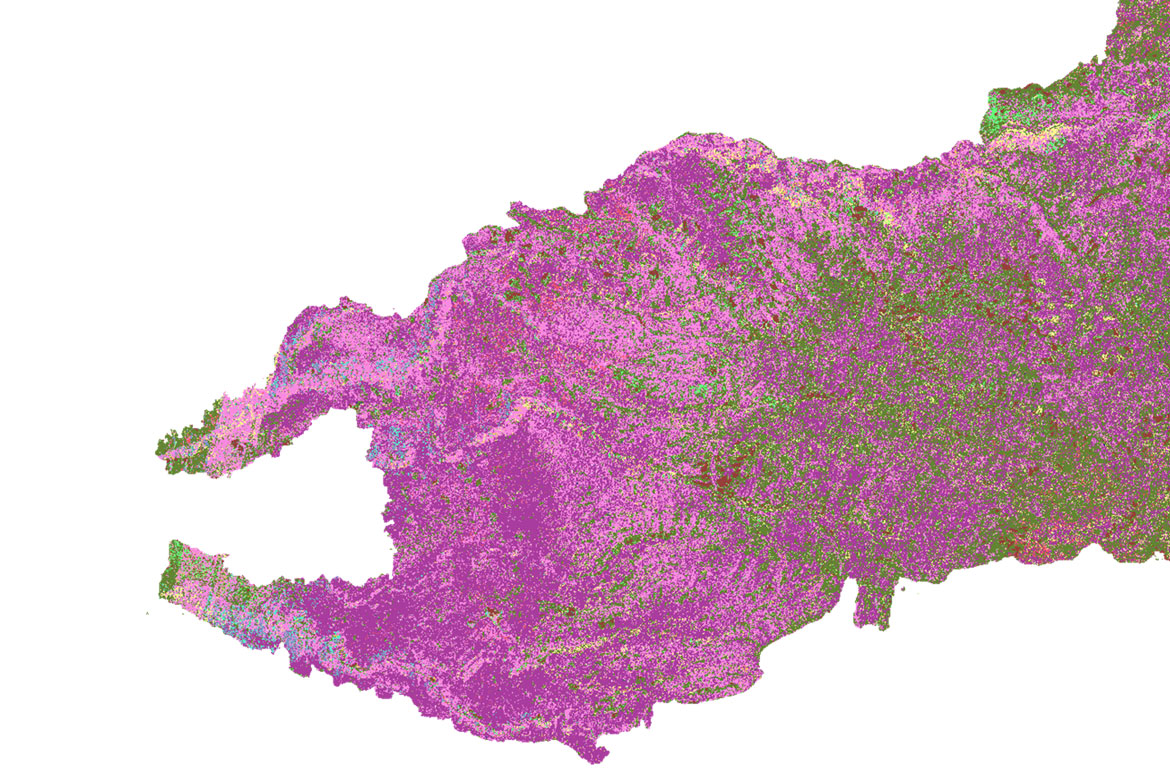
Fuels map of the 2021 Caldor Fire, as predicted by FuelVision


Sunday, July 20, 2025

English Tree Planting Rates Hit Highest Level in over 20 Years with almost 58 square kilometers in 2024/2025

Plant more trees and be done with the Global Warming hoax and Climate Change religion! 😊

"The figures show that over the past year, 5,765 hectares of new woodland were established in England. This means that woodland creation rates over the past year were 27% higher than in 2023/24, and 156% higher than in 2021/22 (when the Tree Planting Programme was in its infancy). In addition, 888,000 trees were planted outside woodland. This is the equivalent to 1,399 hectares, bringing the total area of tree canopy established and numbers of trees planted to 7,164 hectares, or 10.4 million trees. An equivalent to 10,000 football pitches.”"

English Tree Planting Rates Hit Highest Level in over 20 Years - Human Progress


A woodland creation site in England. 


Thursday, February 06, 2025

Beetles boring tunnels in trees may fan wildfire flames

One more good reason why professional, regular and systematic forest management is so important, which was apparently seriously neglected in the Los Angeles area by incompetent politicians and bureaucrats.

Of course, climate change is blamed again!

"Researchers have long known that some voracious wood-eating beetles can make forest fires worse by killing trees. Now, a new study finds beetles might also fan the flames in a more subtle way: by boring tiny tunnels that increase airflow and prolong the smoldering of dead wood.

In the study ... collected 63 wood samples from forests in The Netherlands. They then used an electric drill to mimic the slender, 6 millimeter-wide tubes bored by beetle larvae, which can live in deadwood for long periods.

Wood with radial tunnels that cut across the grain were especially prone to smoldering and releasing more carbon, they report in Ecology. ... a warming climate can increase both wildfire risks and beetle populations. And more wildfires, combined with more beetles, could lead to more carbon being released during fires.

The role of beetle tunnels in wildfires had “gone sort of unnoticed until now,” ..."

ScienceAdviser

Saturday, June 10, 2023

Canada’s forest burning because of bad forest policy and management, not climate change

Here is another blog post on this topic! It is shameful how these latest Canadian forest fires were exploited again by the usual and opportunistic demagoguery of climate change!


Government likes to blame climate change to cover up government failure! As if some Western governments intentionally allow e.g. wildfires to happen in support of the climate change ideology!

What happened in Canada lately is also typical for other Western countries!

"... Here at home, our usual opportunistic climate alarmists including Prime Minister Trudeau, Environment Minister Guilbeault  ...  blame the flames on climate change   ...
As the Royal Society, an independent scientific academy in the United Kingdom, summarizes in a 2020 blog post updating its 2016 research on global wildfire extent, "Fire activity is on the rise in some regions, but when considering the total area burned at the ground level, we are not seeing an increase an overall increase.” The 2016 report was more explicit, finding: “Instead, global area burned appears to have overall declined over past decades, and there is increasing evidence that there is less fire in the global landscape today than centuries ago.” ...
That’s according to a 2020 study in the journal Progress in Disaster Science where authors Tymstra et al. show a fairly sharp declining trend in the number of fires (annually) over time, and a mixed record of areas burned, though the authors note an apparent increase in areas burned over the last two decades.
In fact, as average atmospheric temperatures have risen from 1970 to 2017, Canadian forest fires have declined sharply in number and show little obvious trend in areas burnt.
Crucially, Tymstra’s study also finds that wildfire management policy in Canada comes up short. “A major barrier in Canada… is the inadequate funding to support the vision of an innovative and integrated approach to wildfire management. Mitigation funding has followed wildfire disasters but not at the same level to mitigate flood and earthquake disasters. Despite the increasing occurrence of wildfire disasters in Canada, funding to support wildfire prevention, mitigation and preparedness have not kept pace with the increasing need to mitigate the impacts from wildfires, and be better prepared when they do arrive.”
More specifically, Tymstra et al. find that Canada has failed to fund the proactive management of forest fires sufficiently and is not poised to do better moving forward. “Wildfire management agencies in Canada are at a tipping point. Presuppression [sic] and suppression costs are increasing but program budgets are not.” But clearly, a lack of fire suppression is also a problem: “Wildfire suppression contributes to a wildfire problem but paradoxically it is wildfire use that will help to solve this problem. The wildfire management toolbox must include wildfire use to manage wildfires at the landscape scale because it is not feasible to effectively use prescribed burns and/or fuel management treatments alone to restore expansive wildfire-dependent ecosystems.” ... you need to fight fire with fire ..."

From the abstract:
"Wildfire management agencies in Canada are at a tipping point. Presuppression and suppression costs are increasing but program budgets are not. ... To co-exist with wildfire, agencies in Canada must also strengthen and adjust their wildfire management capacity and capability. This necessitates stronger horizontal collaboration, enhanced resource sharing, investments to develop innovative decision support tools, and an increased focus on prevention and mitigation."

Canada’s burning because of bad forest policy, not climate change | Fraser Institute


Fig. 1. Number of wildfires and area burned in Canada 1970–2017. The red line is a linear trend of the number of wildfires.


Friday, June 09, 2023

Lesson of Canada's Fires: Better forest management, Not Utopian Fantasies and ideological nonsense!

Partially recommendable! However, I bet poor forest management is largely to blame for the devastating effects of the recent forest fires in Canada.

Yes, blame climate change for obvious government failure! Very convenient!

By the way, this article is way too long! The article is unfortunately also very indirect quoting another journalist and no direct evidence is provided about forest mismanagement in Canada! It is very circumstantial!

Actually, the quoted article provides some substantiation for forest mismanagement in Canada!

"The crisis of the day is a series of large-scale forest fires in Canada—at least some apparently started by arson—that caused a huge amount of smoke to descend on the United States. Some areas got hit particularly hard, especially on the East Coast. ...
Have leftists ever considered that sometimes a fire is just a fire? No, we are supposed to believe that every natural disaster is the result of man-made climate change, and if you don’t cede all power over the economy and your way of life over to them and their allies, then you are to blame for all disasters to come. ..
According to the Canadian National Fire Database, the total number of forest fires has dropped in recent decades.
Unfortunately, what’s also been dropping in recent decades is effective forest management. The result has been much larger fires. ...
The New York Post’s Miranda Devine writes that the situation in Canada “is similar to that in Australia, where green ideology and chronic government underfunding mean that the forests currently ablaze have not been managed properly for years.” 
Devine continues:
Instead of dead wood and undergrowth being removed regularly using low-intensity controlled or ‘prescribed’ burns, forests have become overgrown tinderboxes. Fire trails that used to allow first responders easy access to the forest have closed over as vast tracts of land are locked away from humans. Logging and other commercial practices that used to self-interestedly tend to forest health have been phased out.
Poor funding, bureaucratic red tape, and green ideology have suppressed Canada’s ability to manage its forests and clear the fuel that turns an ordinary fire into a towering inferno.
It’s a remarkably similar situation to what we have in large parts of the United States. As I’ve written about the California wildfires, forest management on public land has been lacking for decades. Federal agencies tasked with the job have unlearned what previous generations learned. And, unfortunately, the federal government owns a huge amount of land in the West. Not good. ..."

Lesson of Canada's Fires: Better Forestry, Not Utopian Fantasies

Wednesday, May 03, 2023

Friday, January 20, 2023

Some Utah lawmakers claim overgrown forests suck too much water to save lakes like Lake Powell

That is an interesting concern! It is well known that overgrown or badly managed forests can be prone to wildfires.

"... Claiming “overgrown” forests are guzzling Utah’s water resources dry, rural members are now calling for a major logging initiative as the best hope for saving the shrinking Great Salt Lake and Lake Powell, despite a lack of scientific evidence that tree removal would make a big difference. ...
Utah’s 5 million acres of forests are crowded with 100 to 200 trees per acre, about 10 times the densities in the 1800s, Randy Julander, a retired federal hydrologist, told the caucus gathering. And the trees on about a quarter of this land are standing dead because there isn’t enough water in the ground to sustain them, he added. ..."

Utah lawmakers pitch tree removal as plan to save Great Salt Lake “Yellow Cake” legislators claim logging can save Great Salt Lake, but scientists are doubtful.

Saturday, July 23, 2022

Too many wildfires in the U.S. are caused by government neglect and failure

This well known fact can not be told enough!

"The largest wildfire in New Mexico history was set by the federal government. In April, a prescribed burn carried out by the U.S. Forest Service escaped about four hours after being set. The fire was intended to reduce hazardous fuels and the risk of wildfire, but it became a conflagration that burned more than 340,000 acres.
The Forest Service made many mistakes during the out-of-control burn ...
One recent study lamenting the lack of prescribed [controlled] fire in the West found that between 1998 and 2018, 70 percent of all burning nationwide was carried out in the Southeast. ...
The federal government has aggressively suppressed all fires for decades, an approach that included outlawing "cultural burning" by tribes in the early 20th century. One consequence of curbing the use of fire for so long is that fuels have accumulated in federal forests across the country, most of which are in the West. ...
When the Forest Service wants to remove those built-up fuels, it takes years to even get started, partly due to bureaucratic red tape. Recent research from my organization, the Property and Environment Research Center (PERC), found that once the agency begins the environmental review process, it takes an average of nearly five years to implement a prescribed burn. ..."

California Could Learn From Florida On Fighting Wildfires What Florida gets right about using controlled burns to prevent damaging wildfires, and what California could learn from it.