Showing posts with label forest fires. Show all posts

Tuesday, July 28, 2026

The area burned in the Brazilian Amazon fell to 3.1 million hectares in 2025, the smallest area since at least 1985

Good news! Why do many Western media not report that, but instead of the large burning fires in Canada and Europe?

How much was lack or negligence of proper forest management to blame for the forest fires in Canada and Europe?

Why 1985? When satellite measurements became possible.

"... The amount of land burned in the world's largest rainforest last year covered the smallest area since MapBiomas records began in 1985. ..."

Doomslayer: Progress Roundup - by Malcolm Cochran


Tuesday, August 19, 2025

Researchers unveil AI-powered tool for near real-time, large-scale wildfire fuel mapping and forecasting for California

Good news! But better forecasting of wildfires is no substitute for better management of forests/wildlands to prevent wildfires!

Not climate change, but failure of proper forest/wildland management, arson, and other human activities are the cause of most wildfires.

"Key takeaways:
  • In validation tests using data from two of California’s most intense recent wildfires — the Dixie and Caldor fires of 2021 — FuelVision’s predictions closely matched actual fuel maps.
  • FuelVision operates autonomously, utilizing commonly available data.
  • Because it draws data from global satellite inputs, FuelVision is readily adaptable to forested areas nationwide.
..."

From the highlights and abstract:
"Highlights
• Near real-time wildland fuels mapping algorithm.
• Leverage satellite remote sensing data and terrain features.
• Overcome challenge posed by imbalanced datasets.
• Leverage General Adversarial Networks for synthetic remote sensing data generation.

Abstract
Accurate assessment of fuel conditions is a prerequisite for fire ignition and behavior prediction, and risk management.
The method proposed herein leverages diverse data sources – including L8 optical imagery, S1 (C-band) Synthetic Aperture Radar (SAR) imagery, PL (L-band) SAR imagery, and terrain features – to capture comprehensive information about fuel types and distributions.
An ensemble model was trained to predict landscape-scale fuels – such as the ’Scott and Burgan 40’ – using the as-received Forest Inventory and Analysis (FIA) field survey plot data obtained from the USDA Forest Service.
However, this basic approach yielded relatively poor results due to the inadequate amount of training data.
Pseudo-labeled and fully synthetic datasets were developed using generative AI approaches to address the limitations of ground truth data availability. These synthetic datasets were used for augmenting the FIA data from California to enhance the robustness and coverage of model training.
The use of an ensemble of methods – including deep learning neural networks, decision trees, and gradient boosting – offered a fuel mapping accuracy of nearly 80%. Through extensive experimentation and evaluation, the effectiveness of the proposed approach was validated for regions of the 2021 Dixie and Caldor fires. Comparative analyses against high-resolution data from the National Agriculture Imagery Program (NAIP) and timber harvest maps affirmed the robustness and reliability of the proposed approach, which is capable of near-real-time fuel mapping."

UCLA researchers unveil AI-powered tool for near real-time, large-scale wildfire fuel mapping | UCLA


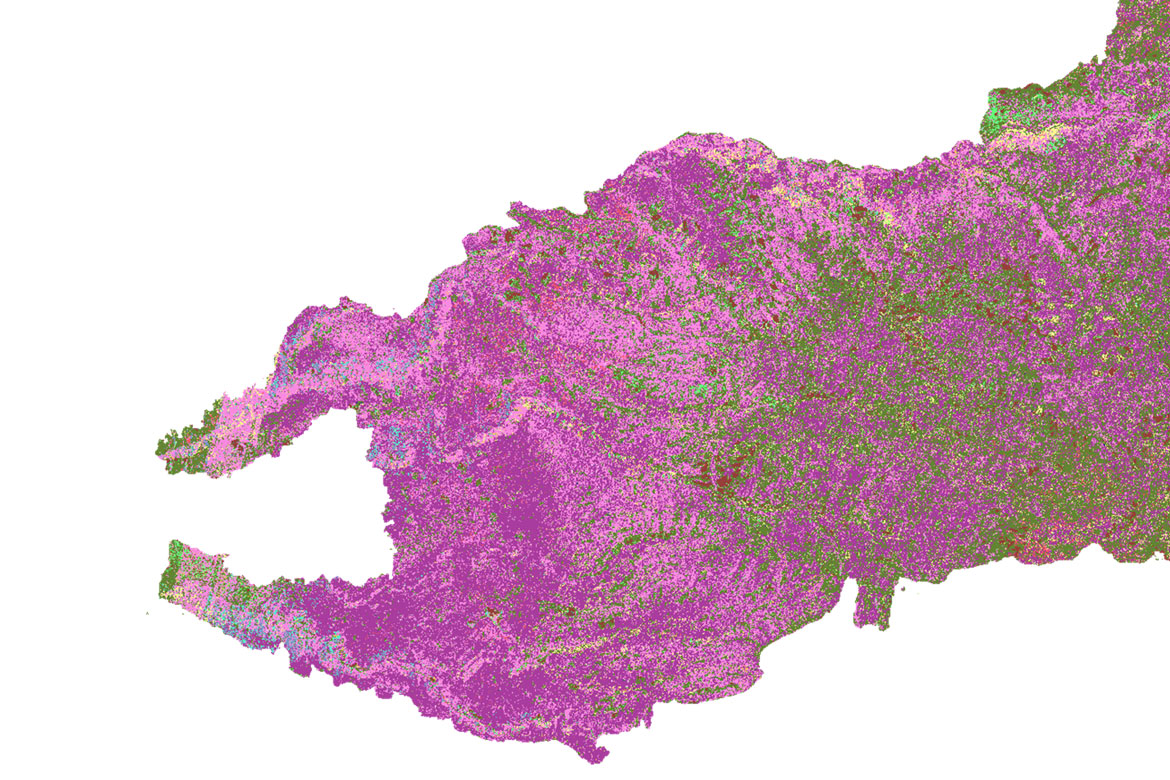
Fuels map of the 2021 Caldor Fire, as predicted by FuelVision


Saturday, June 10, 2023

Canada’s forest burning because of bad forest policy and management, not climate change

Here is another blog post on this topic! It is shameful how these latest Canadian forest fires were exploited again by the usual and opportunistic demagoguery of climate change!


Government likes to blame climate change to cover up government failure! As if some Western governments intentionally allow e.g. wildfires to happen in support of the climate change ideology!

What happened in Canada lately is also typical for other Western countries!

"... Here at home, our usual opportunistic climate alarmists including Prime Minister Trudeau, Environment Minister Guilbeault  ...  blame the flames on climate change   ...
As the Royal Society, an independent scientific academy in the United Kingdom, summarizes in a 2020 blog post updating its 2016 research on global wildfire extent, "Fire activity is on the rise in some regions, but when considering the total area burned at the ground level, we are not seeing an increase an overall increase.” The 2016 report was more explicit, finding: “Instead, global area burned appears to have overall declined over past decades, and there is increasing evidence that there is less fire in the global landscape today than centuries ago.” ...
That’s according to a 2020 study in the journal Progress in Disaster Science where authors Tymstra et al. show a fairly sharp declining trend in the number of fires (annually) over time, and a mixed record of areas burned, though the authors note an apparent increase in areas burned over the last two decades.
In fact, as average atmospheric temperatures have risen from 1970 to 2017, Canadian forest fires have declined sharply in number and show little obvious trend in areas burnt.
Crucially, Tymstra’s study also finds that wildfire management policy in Canada comes up short. “A major barrier in Canada… is the inadequate funding to support the vision of an innovative and integrated approach to wildfire management. Mitigation funding has followed wildfire disasters but not at the same level to mitigate flood and earthquake disasters. Despite the increasing occurrence of wildfire disasters in Canada, funding to support wildfire prevention, mitigation and preparedness have not kept pace with the increasing need to mitigate the impacts from wildfires, and be better prepared when they do arrive.”
More specifically, Tymstra et al. find that Canada has failed to fund the proactive management of forest fires sufficiently and is not poised to do better moving forward. “Wildfire management agencies in Canada are at a tipping point. Presuppression [sic] and suppression costs are increasing but program budgets are not.” But clearly, a lack of fire suppression is also a problem: “Wildfire suppression contributes to a wildfire problem but paradoxically it is wildfire use that will help to solve this problem. The wildfire management toolbox must include wildfire use to manage wildfires at the landscape scale because it is not feasible to effectively use prescribed burns and/or fuel management treatments alone to restore expansive wildfire-dependent ecosystems.” ... you need to fight fire with fire ..."

From the abstract:
"Wildfire management agencies in Canada are at a tipping point. Presuppression and suppression costs are increasing but program budgets are not. ... To co-exist with wildfire, agencies in Canada must also strengthen and adjust their wildfire management capacity and capability. This necessitates stronger horizontal collaboration, enhanced resource sharing, investments to develop innovative decision support tools, and an increased focus on prevention and mitigation."

Canada’s burning because of bad forest policy, not climate change | Fraser Institute


Fig. 1. Number of wildfires and area burned in Canada 1970–2017. The red line is a linear trend of the number of wildfires.


Sunday, September 06, 2015

Devastating Forest Fires Thanks To Federal Government Policies

Posted: 9/6/2015

Trigger

Just read this recommendable summary article about how the federal government has screwed up forest management on federal lands for several decades Devastating Fires Show Forest Management Reforms Are Badly Needed. This is by far not the first article on this subject that I have read.

The Federal Government Built Up A Tinderbox

That the orthodox doctrine of total fire suppression and the prohibition of logging in federal forests have created a formidable tinderbox over the decades has been known for at least several years if not longer. And the federal government, which owns way too much land, has failed to act.

“In 1990, the Fish and Wildlife Service listed the northern spotted owl as “threatened” under the Endangered Species Act. Largely in response to this listing, the Forest Service implemented a new “ecosystem management” policy, which resulted in a further reduction in timber harvests. Then, shortly before he left office President Clinton introduced a rule that severely restricted the use of existing roads and construction of new roads on 49 million acres of National Forest, limiting the ability of the Forest Service to thin the dense thickets of trees that resulted from almost a century of fire suppression – or even remove dead trees.”

“The net result of these changes was a dramatic decline in the amount of timber removed from federal lands. As Figure 7 shows, between 1960 and 1990, an average of 10.3 billion board feet of timber were removed each year from Forest Service land. Removals declined precipitously between 1991 and 2000. From 2000 to 2013, an average of just 2.1 billion board feet of timber were removed from Forest Service land. That represents a near 80 percent decline in removals. Similarly, from 1990 to 2002, timber sales on BLM land fell 74 percent as a direct result of these policy changes and has remained at these suppressed levels since then.f”