Amazing stuff!
Showing posts with label European Space Agency. Show all posts
Showing posts with label European Space Agency. Show all posts
Friday, September 11, 2026

Saturday, July 25, 2026
Saturday, November 01, 2025
In historic shift, ESA poised to take on defense role and capabilities
Blame it on Putin the Terrible and President Trump!
"The Nov. 26-27 meeting of the European Space Agency’s (ESA) Council of Ministers is shaping up to be a watershed moment, with senior space officials from the 23 member states set to vote on a package of projects explicitly designed to bolster Europe’s defense capabilities.
If the proposal from ESA Director Josef Aschbacher is approved, it would be a historic first — since its founding in 1975 the agency has assiduously disavowed any connection to military space activities, instead insisting on a strictly civil mission.
“In a nutshell, there is a general wake-up call in Europe after the war in Ukraine for the need for more autonomy. Countries are investing more in defense (NATO, etc.) and as part of it in space,” one European space official told Breaking Defense. “[T]here is a shift towards security activities triggered by the new U.S. policies and their impact in Europe.” ..."

Friday, September 19, 2025
Sunday, August 10, 2025
The third interstellar flying object observed within our solar system
When one of those objects hits Earth again, then we have a real climate crisis, not the phony climate change!
"The Hubble Space Telescope captured an image of the fastest comet ever observed, moving through our solar system at 130,000 mph, after traveling the universe for hundreds of millions of years.
NASA discovered the 3I/ATLAS comet last month and determined that it was from interstellar space, only the third interstellar object witnessed within our solar system. ..."
"... The NASA-funded ATLAS (Asteroid Terrestrial-impact Last Alert System) survey telescope in Rio Hurtado, Chile, first reported observations to the Minor Planet Center of comet 3I/ATLAS on July 1, 2025.
Hubble’s observations allow astronomers to more accurately estimate the size of the comet’s nucleus. The upper limit on its diameter is 3.5 miles (5.6 kilometers), though it could be as small as 1,000 feet (320 meters) across, researchers report. ..."
Comet 3I/ATLAS (undated article by NASA, very unprofessional)
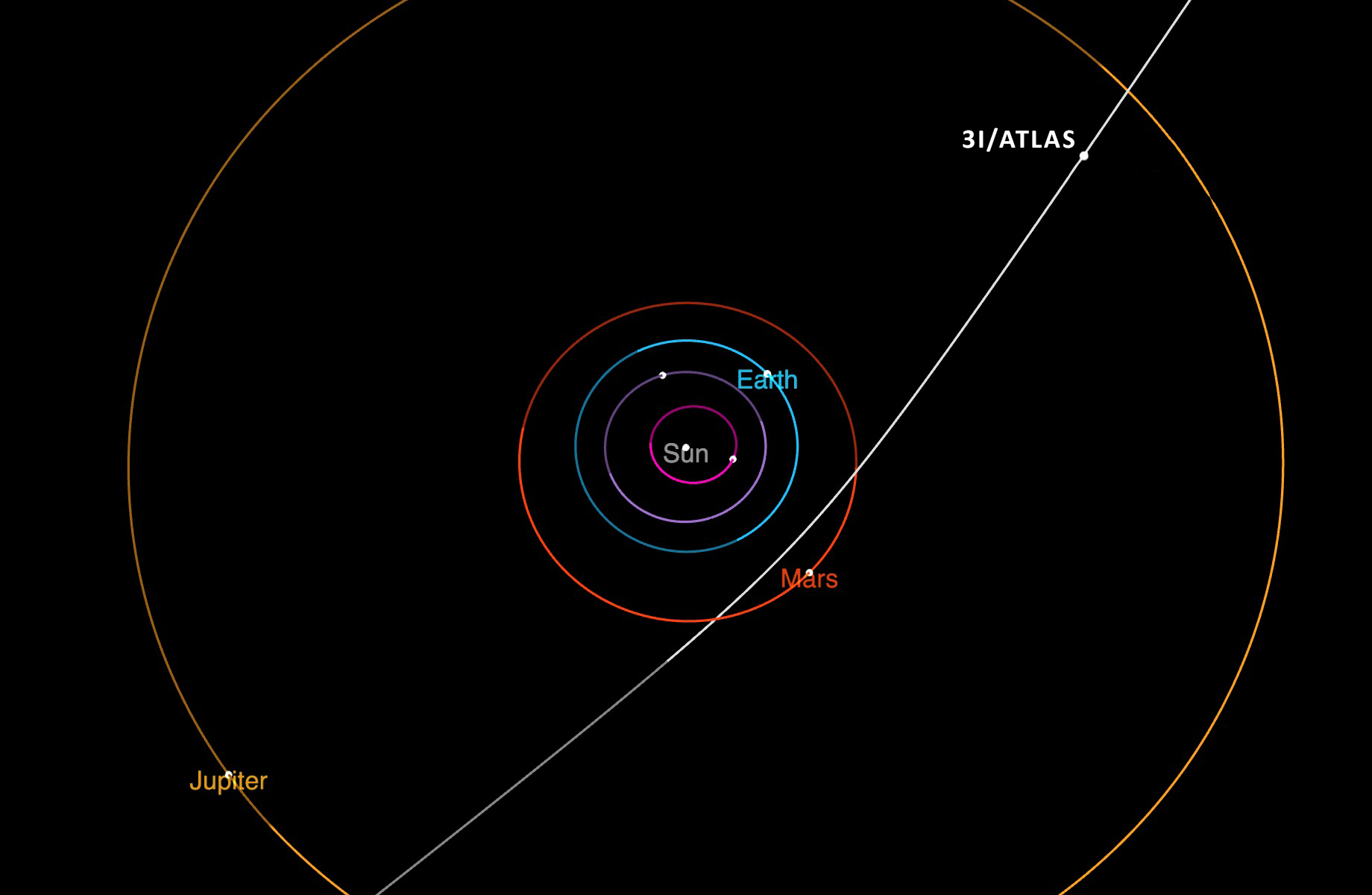
This diagram shows the trajectory of interstellar comet 3I/ATLAS as it passes through the solar system. It will make its closest approach to the Sun in October.
This Hubble Space Telescope image of comet 3I/ATLAS was taken with Hubble's Wide Field Camera 3.

Saturday, August 09, 2025
European Space Agency - spacecraft Proba-3’s first artificial solar eclipse
Amazing stuff! Stunning images. I believe, this important event was little reported about!
We still now so little about our star, the Sun! Global Warming is a hoax and Climate Change is a religion. Just maybe fluctuations in solar activity is warming and cooling our planet.
"Today [6/16/2025], the European Space Agency’s Proba-3 mission unveils its first images of the Sun’s outer atmosphere – the solar corona. The mission’s two satellites, able to fly as a single spacecraft thanks to a suite of onboard positioning technologies, have succeeded in creating their first ‘artificial total solar eclipse’ in orbit. The resulting coronal images demonstrate the potential of formation flying technologies, while delivering invaluable scientific data that will improve our understanding of the Sun and its enigmatic atmosphere. ...
This March, Proba-3 achieved what no other mission has before – its two spacecraft, the Coronagraph and the Occulter, flew 150 metres apart in perfect formation for several hours without any control from the ground. ...
The Sun's fiery corona reaches temperatures above a million degrees Celsius, much hotter than the surface beneath it. This counterintuitive temperature difference has long been a topic in the scientific community.
Proba-3’s ASPIICS is tackling this mystery by studying the corona very close to the Sun’s surface. It can also see more detail, detecting fainter features than traditional coronagraphs thanks to a drastic reduction in how much ‘stray’ light reaches the detector. ..."

Proba-3 Occulter eclipsing Sun for Coronagraph spacecraft

Solar corona viewed by Proba-3’s ASPIICS


Sunday, March 30, 2025
Thursday, May 30, 2024
ESA - EarthCARE launched to study role of clouds and aerosols in Earth's climate
Good news! By the way, we still know very little about many crucial weather/climate related phenomena like cloud formation!
Apparently ESA apparently also worships the Global Warming hoax and Climate Change religion: "With the climate crisis increasingly tightening its grip"
Really! Ridiculous for an agency committed to science! This makes you wonder whether the new satellite will not be biased!
"... the Earth Cloud Aerosol and Radiation Explorer, or EarthCARE for short, will soon be returning crucial information to shed new light on the complex interactions between clouds, aerosols and radiation within Earth’s atmosphere. ..."

Wednesday, January 31, 2024
Hubble Space Telescope Detects Water Vapor in Smallest Exoplanet to Date only 97 light years away
Good news! Amazing stuff!
"At around twice Earth's diameter, planet GJ 9827d orbits a red dwarf star 97 light-years away in the constellation Pisces, NASA and the European Space Agency (ESA) said in statements on Thursday. [1/25/2024] ..."
"... At only approximately twice Earth's diameter, the planet GJ 9827d could be an example of potential planets with water-rich atmospheres elsewhere in our galaxy.
"This would be the first time that we can directly show through an atmospheric detection, that these planets with water-rich atmospheres can actually exist around other stars," ...
Because the planet is as hot as Venus, at 800 degrees Fahrenheit, it definitely would be an inhospitable, steamy world if the atmosphere were predominantly water vapor. ..."
From the abstract:
"Recent work on the characterization of small exoplanets has allowed us to accumulate growing evidence that sub-Neptunes with radii greater than ∼2.5 R⊕ often host H2/He-dominated atmospheres both from measurements of their low bulk densities and from direct detections of their low mean molecular mass atmospheres. However, the smaller sub-Neptunes in the 1.5–2.2 R⊕ size regime are much less understood and often have bulk densities that can be explained either by the H2/He-rich scenario or by a volatile-dominated composition known as the "water world" scenario. Here we report the detection of water vapor in the transmission spectrum of the 1.96 ± 0.08 R⊕ sub-Neptune GJ 9827 d obtained with the Hubble Space Telescope (HST). We observe 11 HST Wide Field Camera 3 transits of GJ 9827 d and find an absorption feature at 1.4 μm in its transit spectrum, which is best explained (at 3.39σ) by the presence of water in GJ 9827 d's atmosphere. We further show that this feature cannot be caused by unocculted starspots during the transits by combining an analysis of the K2 photometry and transit light source effect retrievals. We reveal that the water absorption feature can be similarly well explained by a small amount of water vapor in a cloudy H2/He atmosphere or a water vapor envelope on GJ 9827 d. Given that recent studies have inferred an important mass-loss rate (>0.5 M⊕ Gyr−1) for GJ 9827 d, making it unlikely to retain a H-dominated envelope, our findings highlight GJ 9827 d as a promising water world candidate that could host a volatile-dominated atmosphere. This water detection also makes GJ 9827 d the smallest exoplanet with an atmospheric molecular detection to date."
Water Absorption in the Transmission Spectrum of the Water World Candidate GJ 9827 d (open access, published already in September 2023)
Sunday, January 21, 2024
Mars Express finds evidence of enormous water deposit at the Medusae Fossae Formation
Amazing stuff!
"... Over 15 years ago, Mars Express studied the Medusae Fossae Formation (MFF), revealing massive deposits up to 2.5 km deep. From these early observations, it was unclear what the deposits were made of—but new research now has an answer. ..."
"... “Finding evidence of layering in all the major units of the MFF makes a compelling case that the deposits are similar to the ice-rich polar layered deposits,” ... “An ice-rich MFF deposit has important implications for the paleoclimate of Mars and could be potentially of great value to future human exploration of Mars. The MFF deposits are located at the Martian equator along the boundary between the northern lowlands and the heavily cratered highlands—an ideal landing spot for spacecraft as the lower elevation provides more atmosphere to slow a spacecraft’s decent.” ..."
"... “We’ve explored the MFF again using newer data from Mars Express’s MARSIS radar, and found the deposits to be even thicker than we thought: up to 3.7 km thick,” ...
If melted, the ice locked up in the MFF would cover the entire planet in a layer of water 1.5 to 2.7 m deep: the most water ever found in this part of Mars, and enough to fill Earth’s Red Sea. ..."
New Study Reveals Evidence of an Ice-Rich Layered Deposit on Mars (Smithsonian Institution)
Perspective view of Lucus Planum part of the Medusae Fossae Formation, a series of thick deposits found along the highland-lowland dichotomy boundary on Mars. The deposit shown here in this false color, Context Camera (CTX) mosaic, is several kilometers thick.

Map of suspected ice at Mars’s equator

Saturday, January 06, 2024
ESA - XRISM's first views signal shake-up for X-ray astronomy
Amazing stuff! Patient Universe under x-rays! 😊
This pioneering image is a wide view of a nearby cluster of galaxies called Abell 2319. In purple we see X-ray light from million-degree gas that permeates between the galaxies in the cluster.


Thursday, December 07, 2023
ESA - Understanding climate tipping points. Really!
It is shocking and disturbing that the European Space Agency spreads such propaganda and demagoguery!
This is alarmism and hysteria! It is junk science!
If indeed such tipping points exist, the earth would have been for a very long time as barren as the moon!
"As the planet warms, many parts of the Earth system are undergoing large-scale changes. Ice sheets are shrinking, sea levels are rising and coral reefs are dying off.
While climate records are being continuously broken, the cumulative impact of these changes could also cause fundamental parts of the Earth system to change dramatically. These ‘tipping points’ of climate change are critical thresholds in that, if exceeded, can lead to irreversible consequences [??? laughable!]. ..."

Wednesday, November 15, 2023
ESA - Webb, Hubble space telescopes combine to create most colourful view of Universe
Amazing stuff!
"The NASA/ESA/CSA James Webb Space Telescope and the NASA/ESA Hubble Space Telescope have united to study an expansive galaxy cluster known as MACS0416. The resulting panchromatic image combines visible and infrared light to assemble one of the most comprehensive views of the Universe ever obtained. Located about 4.3 billion light-years from Earth, MACS0416 is a pair of colliding galaxy clusters that will eventually combine to form an even bigger cluster. ..."

Sunday, November 12, 2023
Wednesday, November 08, 2023
European Space Agency - Diversity, Equity and Inclusion
Disgusting! Who is responsible for this demagoguery!
"Diversity, Equity & Inclusion (DE&I) is a vitally important consideration in modern society, as it promotes fairness and equal opportunity. It ensures that everyone, regardless of race, gender, sexual orientation, religion, physical ability, age or any other characteristic, is treated with dignity and respect and can reach their full potential. ...
Diversity, Equity and Inclusion | ESA Business ApplicationsTopics Of Relevance
The scope of this Kick-Start theme is to investigate the technical feasibility and viability of space technologies and applications addressing challenges related to DE&I in society. The following relevant topics were identified for this Kick-Start theme, along with examples of potential applications that could be proposed:
- Inclusive Cities
- Inclusive Corporate Cultures and Business Models
- Inclusive Society for Elderly Citizens "

Saturday, October 14, 2023
ESA - Antarctic ice shelf demise between 1997-2021. Only 42 out of 162 ice shelves lost ice mass
Laughable alarmism and hysteria disseminated by the European Space Agency! Smells like junk science!
It only covers less than 25 years! What a joke! What if there a natural multi decadal fluctuations?
"... The research team... found that 71 ... ice shelves around Antarctica have reduced in volume, releasing almost 67 trillion tonnes of meltwater into the ocean. Apart from the issue of the ice shelves losing mass, this addition of freshwater into the ocean could have implications for ocean circulation patterns. ..."
From the abstract:
"Antarctic ice shelves moderate the contribution of the Antarctic Ice Sheet to global sea level rise; however, ice shelf health remains poorly constrained. Here, we present the annual mass budget of all Antarctic ice shelves from 1997 to 2021. Out of 162 ice shelves, 71 lost mass, 29 gained mass, and 62 did not change mass significantly. Of the shelves that lost mass, 68 had statistically significant negative mass trends, 48 lost more than 30% of their initial mass, and basal melting was the dominant contributor to that mass loss at a majority (68%). At many ice shelves, mass losses due to basal melting or iceberg calving were significantly positively correlated with grounding line discharge anomalies; however, the strength and form of this relationship varied substantially between ice shelves. Our results illustrate the utility of partitioning high-resolution ice shelf mass balance observations into its components to quantify the contributors to ice shelf mass change and the response of grounded ice."
Annual mass budget of Antarctic ice shelves from 1997 to 2021 (open access)


Just look at the ESA image of Antarctica: 99% of the area unaffected. Gains and losses are very roughly balanced.
Fig. 2. Pan-Antarctic ice shelf mass change. Notice again some ice shelves are growing
Saturday, October 07, 2023
ESA - Ozone hole goes large again
The infamous ozone hole of the 1970-1980s that led to the Montreal Protocol in 1987 "to protect the ozone layer by phasing out the production and consumption of these harmful substances".
I suspect, it is e.g. this ozone hole that has contributed to the now so common anthropogenic or manmade accusations e.g. surrounding the Global Warming hoax and Climate Change religion.
I blogged here recently about the much underreported massive eruption of the submarine Hunga-Tonga volcano in January 2022. Almost like a blindspot in our climate crisis obsessed times. We can be lucky it was a submarine volcano.
"Measurements from the Copernicus Sentinel-5P satellite show that this year’s ozone hole over Antarctica is one of the biggest on record. The hole, which is what scientists call an ‘ozone depleting area,’ reached a size of 26 million sq km on 16 September 2023. This is roughly three times the size of Brazil. ...
The size of the ozone hole [naturally] fluctuates on a regular basis. From August to October, the ozone hole increases in size – reaching a maximum between mid-September and mid-October. ...
The size of the ozone hole [naturally] fluctuates on a regular basis. From August to October, the ozone hole increases in size – reaching a maximum between mid-September and mid-October. ...
Although it may be too early to discuss the reasons behind the current ozone concentrations, some researchers speculate that this year’s unusual ozone patterns could be associated with the eruption of the Hunga Tonga-Hunga Ha'apai in January 2022. ... “The eruption of the Hunga Tonga volcano in January 2022 injected a lot of water vapour into the stratosphere which only reached the south polar regions after the end of the 2022 ozone hole. ..."

Saturday, September 16, 2023
ESA - Technology to boost high-speed satellite connectivity
Good news! Take 5G/6G to the skies! Elon Musk can use a little bit more competition for his StarLink.
Are the Europeans trying to catch up? 😊
"... Low Earth orbit constellations are a crucial element of next-generation 5G and 6G converged networks, augmenting communications infrastructure on the ground and ensuring the provision of continuous, instant and ubiquitous connectivity. ...
Filtronic’s technology operates over extremely high frequency bands – or millimetre waves – that deliver wide bandwidths, high data rates, and low latencies over localised areas. ...
The contract is part of ESA’s Space for 5G and 6G Programme, and falls under ESA’s programme of Advanced Research in Telecommunications Systems (ARTES), which promotes commercial innovation to boost European and Canadian leadership in the fiercely competitive global satcom marketplace. ..."
Filtronic win major contract with European Space Agency’s ARTES programme. RF and mm-Wave specialist, Filtronic, has announced the successful contract win from the European Space Agency (“ESA”), supported by the UK Space Agency, as a result of a recent funding call in the area of Space for 5G/6G and Sustainable Connectivity. The €3.7M contract falls under ESA’s Advanced Research and Telecommunications Systems (“ARTES”) programme, which capitalises on a company’s innovative idea and develops it into a successful commercial deployment, keeping Europe at the leading edge of the fiercely competitive global satellite communications market.
Thursday, September 07, 2023
ESA - Camera ‘hack’ lets Solar Orbiter peer deeper into Sun’s atmosphere
We still know so little about the sun! It is actually shocking!
What if the sun is the most important factor influencing climate on earth and not the life essential trace gas CO2? This is not a hypothetical!
"... Even before those new instruments, there is a lot of new science to come from EUI. The occulter mode makes it possible for scientists to see deeper into the Sun’s atmosphere. This is the region that lies beyond the field of view of classical EUV imagers but it is usually obscured by traditional coronagraphs. Now, however, EUI’s occulter can image this little-explored region easily. ..."
Beyond the disk: EUV coronagraphic observations of the Extreme Ultraviolet Imager on board Solar Orbiter⋆ (open access)

Wednesday, August 30, 2023
ESA - Webb captures a cosmic Whirlpool
Awesome!
The Phantom Galaxy, formally known as M74, is a kind of spiral galaxy known as a "grand design spiral." This means that it has well-defined spiral arms, visibly winding out from the center in the newly released images.


Subscribe to:
Posts (Atom)