Showing posts with label economic growth. Show all posts

Wednesday, September 25, 2024

Chart of the day

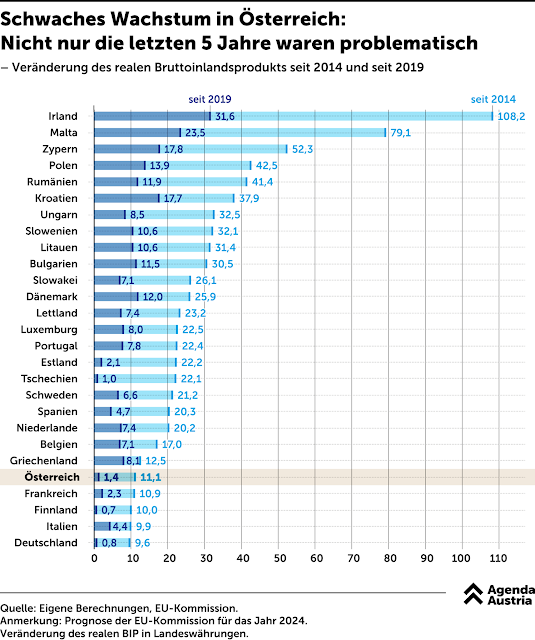
Which EU countries are the most dynamic in terms of economic growth?

France, Germany, Italy, and Spain are the laggards! Germany's growth was very paltry!

GDP growth. Dark blue from 2019, light blue from 2014 onwards


Thursday, April 02, 2020

A Massive Opportunity Exists To Build “Picks And Shovels” For Machine Learning

Recommendable! The AI business needs more raw and intermediate supply as well as consulting businesses to thrive! Many new jobs that AI will probably create, but they may only be temporary!

Full credit for this story to Deeplearning.ai The Batch by Andrew Ng!

A Massive Opportunity Exists To Build “Picks And Shovels” For Machine Learning: The reward for building the next generation of developer tools will be many billions of dollars of enterprise value.

Thursday, June 30, 2016

Importance Of Government For Economic Growth Nonsense

Posted: 6/30/2016

Trigger

Just read this Great inventions are important for growth. So is policy. I pick this article, because I believe their are a lot more economists or intellectuals out there who would argue along similar lines. That such laughable articles are published by the American Enterprise Institute is a bit shocking.

A Critique

The article opens with this paragraph:
“In both research papers and his excellent book “The Rise and Fall of American Growth,” economist Robert Gordon writes about the huge economic impact of some “could only happen once” inventions: the internal combustion engine, running water and indoor toilets, electrification. Newer inventions — the IT revolution today, robotics and AI tomorrow — won’t provide the same transformational oomph to productivity going forward, he argues.” (emphasis added)
This is already highly arguable whether contemporary inventions/innovations are having lesser an impact than the older ones.

Then the article goes on to argue that:
  1. “we present a more optimistic historical narrative in which government policy and institutional design have the power to support technological progress. … And the researchers illustrate this point by comparing the rise of patenting (a measure of innovation) to the establishment of post offices (a measure of government “infrastructural” capacity). The theory here is that having a post office around made it easier to patent because mail service made it easier to obtain new knowledge and information, made it easier to submit patent application, suggested a functioning government ”
    [What a baloney! A measure of innovation, what a joke! Without government there still would have been some kind of private postal service, if customers had found it useful. Patents, or government enforced, temporary monopolies, are actually a considerable impediment to growth and innovation.]
  2. “... We find a significant correlation between a history of state presence–using the number of post offices as a proxy–and patenting in US counties. … This relationship is not only statistically significant, but also economically meaningful. … Taken together–while we do not establish unambiguously that the post office and greater state capacity caused an increase in patenting-–our results highlight an intriguing correlation and suggest that the infrastructural capacity of the US state played an important role in sustaining 19th century innovation and technological change. ”
    [What a baloney again! The typical confusion of correlation and causation!]

Sunday, October 19, 2014

Kenneth Rogoff - A Dismal Economist

Posted: 10/19/2014  Updated: 6/25/2016


Update Of 6/25/2016


Just read his Britain’s Democratic Failure in response to the historic popular vote of the British people to exit the European Union. Kenneth Rogoff did it again, see below. Very revealing how a leading economists actually thinks!


I would now add, Kenneth Rogoff is not only a dismal economist, but a socialist and authoritarian economist. Beware!


It also shows that the economist is basically clueless about British history of individual and entrepreneurial freedom.
Quotes and comments about the above, new paper (Emphasis added):
  1. “The real lunacy of the United Kingdom’s vote to leave the European Union was not that British leaders dared to ask their populace to weigh the benefits of membership against the immigration pressures it presents.” (This is the first, opening sentence of his article)
    [What a lunatic argument by this economist! The British people had several months to discuss the pros and cons. Obviously, Kenneth Rogoff does not trust We the People to make decisions he does not like.]
  2. “... it is Russian roulette for republics ...”
    [Kenneth Rogoff’s arguments are getting more and more desperate and lunatic!]
  3. A decision of enormous consequence … has been made without any appropriate checks and balances.”
    [Kenneth Rogoff appears to know something about the U.S. Constitution! Good that Kenneth Rogoff had no say in what the “appropriate” checks and balances should have been.]
  4. “Did the UK’s population really know what they were voting on? Absolutely not.”
    [As long as the economist Kenneth Rogoff understands what the citizens were voting on!]
  5. “But what, exactly, is a fair, democratic process for making irreversible, nation-defining decisions? Is it really enough to get 52% to vote for breakup on a rainy day?”
    [Rogoff’s desperation continues! Irreversible, that is so laughable! As a student of Rogoff, I would now ask for my money back.]
  6. “In terms of durability and conviction of preferences, most societies place greater hurdles in the way of a couple seeking a divorce than Prime Minister David Cameron’s government did on the decision to leave the EU.”
    [Is this man really a professor at an elite university (Harvard University) in the U.S. to make such foolish comparisons?]
  7. “Modern democracies have evolved systems of checks and balances to protect the interests of minorities and to avoid making uninformed decisions with catastrophic consequences.”
    [Without comment!]
  8. “A country should not be making fundamental, irreversible changes based on a razor-thin minority that might prevail only during a brief window of emotion.”
    [Whether 1 million votes out of about 34 million total votes at 72% participation is “razor-thin” is arguable. Rogoff the rationalist vs. the emotional citizens.]
  9. “There is no universal figure like 60% [for a supermajority], but the general principle is that, at a bare minimum, the majority ought to be demonstrably stable.”
    [Rogoff is arguing here for a quorum of required votes and perhaps for minimum turnout of votes for popular votes on fundamental decisions. Nice try! However, had these rules in place before the referendum, it is quite possible that the result would have been the same.]


Trigger


Just read economic professor Kenneth Rogoff’s piece on project syndicate “Rethinking the Growth Imperative”. The only good thing, I have to say about his article is that it is short, less than four pages and it is not written in economic lingo.


Project Syndicate, I said this here before, has become very annoying. You have to register to see an article.


This is another blog post in a series of blog posts about incompetent, contemporary economists. We have to thank these many incompetent economists for the Great Recession.


What Did He Say?


Salient excerpts and comments (emphasis added):
  1. Modern macroeconomics often seems to treat rapid and stable economic growth as the be-all and end-all of policy.”
    [This is the first sentence and it is already a false premise! Only Keynesians think that way. E.g. Austrian macroeconomists see it differently.]
  2. “But there might be a problem even deeper than statistical narrowness: the failure of modern growth theory to emphasize adequately that people are fundamentally social creatures.”
    [Why is he limiting himself artificially to examining economic growth theory?]
  3. “There is a certain absurdity to the obsession with maximizing long-term average income growth in perpetuity, to the neglect of other risks and considerations. Consider a simple thought experiment. Imagine that per capita national income (or some broader measure of welfare) is set to rise by 1% per year over the next couple of centuries. .... Now suppose that we lived in a much faster-growing economy, with per capita income rising at 2% annually. In that case, per capita income would double after only 35 years, and an eight-fold increase would take only a century. Finally, ask yourself how much you really care if it takes 100, 200, or even 1,000 years for welfare to increase eight-fold.
    [This is a par excellence blunder committed by an what seems to be a Keynesian economist. How did this man manage to become professor? Rogoff never understood that economic growth is an abstraction and to many economists, a meaningless aggregation. What really counts is the underlying economic activity that produces among other things better medical treatments, more life conveniences and so much more. Yes, it matters a lot if there is only sub par economic growth.]
  4. “Wouldn’t it make more sense to worry about the long-term sustainability and durability of global growth? Wouldn’t it make more sense to worry whether conflict or global warming might produce a catastrophe that derails society for centuries or more?”
  5. [Durability of economic growth?? Economic activity goes in business cycles, economic growth is not constant and it can be negative. In essence, this economist buys into the Global Warming hoax.]
  6. “Perhaps a deeper rationale underlying the growth imperative in many countries stems from concerns about national prestige and national security.”
    [Economics is not concerned with national prestige nor national security professor Rogoff!]


Student Beware


I would not spend too much money on studying economics from professor Kenneth Rogoff!

Thursday, June 06, 2013

German Tax Payers’ Money Wasted By Federal Parliament

Trigger

The so called Enquete Kommission “Wachstum, Wohlstand, Lebensqualität - Wege zu nachhaltigem Wirtschaften und gesellschaftlichem Fortschritt in der Sozialen Marktwirtschaft” (a joint federal, parliamentary commission of elected representatives and university professors to investigate economic growth, prosperity, quality of life) just released their final report on 4/6/2013.

What Is In A Title

You would think that the title of this commission entails the research subject. However, if the title already reveals that the agenda is narrowed by bias and ideologically loaded terms, then what do you expect the result of such a commission to be like?

The title of the final report contains a series of questionable terms:

  • “nachaltige[s] Wirtschaften” (sustainable economy): This is a faddish, amorphous term guided by environmentalism.
  • “gesellschaftlichen Fortschritt” (societal progress): What about individual progress, freedom and responsibility?
  • “Soziale Marktwirtschaft” (social market economy): One of those much abused terms of German postwar political discourse. Another name for the so called third way between socialism and free market economy. Whatever that may be?

Just A Short Excerpt

I don’t claim to have read the entire 844 page long report. So I limit myself to a very brief excerpt from this tome to give the reader a flavor. I would bet that the entire report is not much better than this excerpt.

On page 43 of the final report we read (emphasis added):
Ludwig Erhard [father of the German Economic Miracle] hat dies treffend formuliert [an excerpt from his most famous book titled “Wohlstand fuer Alle”]:
„Wohlstand für alle und Wohlstand durch Wettbewerb gehören untrennbar zusammen; das erste Postulat kennzeichnet das Ziel, das zweite den Weg, der zu diesem Ziel führt.“9
Das zentrale Ziel der Politik ist also der Wohlstand aller Bürgerinnen und Bürger. Wirtschaftliches Wachstum dagegen ist kein politisches Ziel. Es ist vielmehr ein guter – wenn auch unvollkommener – Indikator dafür, wie sich die wirtschaftliche Situation und damit der materielle Wohlstand der Arbeitnehmerinnen und Arbeitnehmer sowie der Unternehmerinnen und Unternehmer im Durchschnitt verändert. Unberücksichtigt bleiben dabei insbesondere Verteilungsaspekte, die Entwicklung der nichtmateriellen Lebensqualität sowie die Erfordernisse der Nachhaltigkeit. So kann Wachstum auch bedeuten, dass nur wenige einen materiellen Fortschritt erfahren, während die wirtschaftliche Situation aller anderen stagniert”

For sake of brevity and lack of time I will not attempt her to translate this excerpt, but I intend to interpret it.

The great former federal minister of economics Ludwig Erhard in his seminal book clearly postulated the inseparable duality of economic growth and economic competition, but the authors of this report recognize only economic growth as an economic policy goal and explicitly deny economic competition such a role. One without the other, how foolish is that?

Sustainability like in sustainable economic growth is heralded as an essential requirement, which it is not. Notions of sustainability are born out of irrational fears.


The authors bemoan the possibility that economic growth benefits only a few individuals in their material well being. This kind of outcome is more probable if economic competition is constraint, e.g. by ever busy politicians meddling with the free market economy. This is one reason why economic competition is so fundamental to prevent such undesirable economic outcomes. How many German elected representatives or even professors understand this relationship?