Showing posts with label metrology. Show all posts

Monday, May 11, 2026

The hidden structure behind a widely used class of materials: Relaxor ferroelectrics

Amazing stuff!

"Materials called relaxor ferroelectrics have been used for decades in technologies like ultrasounds, microphones, and sonar systems. Their unique properties come from their atomic structure, but that structure has stubbornly eluded direct measurement.

Now a team of researchers f... has directly characterized the three-dimensional atomic structure of a relaxor ferroelectric for the first time. The findings ... provide a framework for refining models used to design next-generation computing, energy, and sensing devices. ...

In their paper, the researchers describe how they used an emerging technique to reveal the distribution of electric charges in the material, with a surprising result.

“We realized the chemical disorder we observed in our experiments was not fully considered previously,” ... “Working with our collaborators, we were able to merge the experimental observations with simulations to refine the models and better predict what we see in experiments.” ...

Probing disordered materials

Leading simulations of relaxor ferroelectrics suggest that when an electric field is applied, the interactions of positively and negatively charged atoms in different nanoregions of the material help give rise to exceptional energy storage and sensing capabilities. The details of those nanoregions have been impossible to directly measure to date. ...

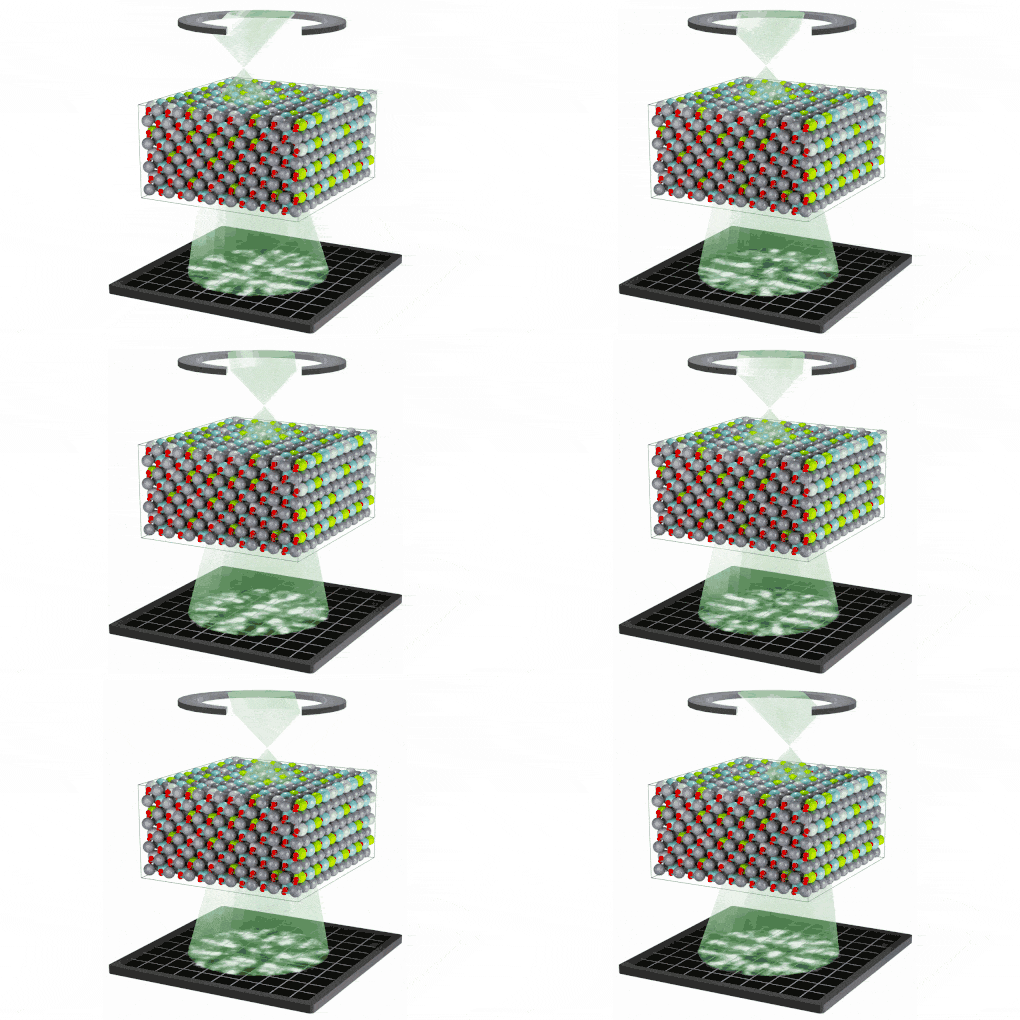
the researchers studied a relaxor ferroelectric material used in sensors, actuators, and defense systems that is a lead magnesium niobate-lead titanate alloy. They used an emerging measurement technique, called multi-slice electron ptychography (MEP), in which researchers move a nanoscale-sized probe of high-energy electrons over a material and measure the resulting electron diffraction patterns. ...

The technique revealed a hierarchy of chemical and polar structures that spanned from atomic to mesoscopic scales. The researchers also found that many regions of differing polarization in the material were much smaller than predicted by the leading simulations. The researchers then fed their new data back into those computer simulations and refined the models to better reflect their findings under different conditions. ..."

From the editor's summary and abstract:
"Editor’s summary
The complexity of lead-based relaxor ferroelectrics makes connecting microscopic characterization with macroscopic properties challenging.
One approach is to compare experimental and theoretical studies, but experiment often averages over material inhomogeneities and theory provides an atomistic view.
To overcome this mismatch, Zhu et al. used multislice electron ptychography, which provided three-dimensional volumetric characterization of the structure and chemistry of a prototypical relaxor material.
Direct comparison with bond valence molecular dynamics simulations revealed that a fully chemically disordered model with residual short-range ordering was necessary to enable agreement with experiment.  ...

Abstract
Introducing structural and/or chemical heterogeneity into otherwise ordered crystals can dramatically alter material properties.
Lead-based relaxor ferroelectrics such as 0.68Pb(Mg1/3Nb2/3)O3-0.32PbTiO3 are prototypical examples.
We performed three-dimensional (3D) volumetric characterization using multislice electron ptychography (MEP) and bond valence molecular dynamics (BVMD) simulations.
Real-space comparisons between the two under varying strain states revealed a coherent 3D view of the “polar slush.” Dipolar correlations from the atomic to domain scales are shown to be jointly modulated by strain and chemical configurations, with the best agreement found in a model accounting for both overall chemical disorder and residual short-range order.
Together, MEP and BVMD provide a framework for linking atomic-scale heterogeneity in complex materials by means of complementary 3D imaging and predictive modeling."

The hidden structure behind a widely used class of materials | MIT News | Massachusetts Institute of Technology "Relaxor ferroelectrics have been used in electronics and sensors for decades, but the source of their unique properties was a mystery until now."


Bridging experiment and theory of relaxor ferroelectrics at the atomic scale with multislice electron ptychography (preprint, open access, published August 2024, could be dated, contains no images)


Using a technique called multi-slice electron ptychography (MEP), researchers move a nanoscale-sized probe of electrons over a material and measure the resulting electron diffraction patterns. Overlapping regions can be used to create a 3-D scan of the material’s atomic structure.


Wednesday, October 01, 2025

Precision sensing experiment bypasses Heisenberg's uncertainty principle

Amazing stuff! This could be a breakthrough!

"The new research has demonstrated how scientists can precisely measure position and momentum of a particle at the same time. The researchers hope this new method could help develop ultra-precise sensor technology which may be used to improve navigation, medicine and astronomy. ...

The approach was first outlined theoretically in 2017, with Tan’s team now performing the first experimental demonstration. The team were able to conduct the experiment using a technological approach they had engineered in a previous study for error-corrected quantum computers. ...

The team used the microscopic vibrational motion of a trapped ion to implement the sensing protocol. These ions were prepared in ‘grid states’, the type of states used in error-corrected quantum computing.

These grid states are then able to measure tiny signals that indicate position and momentum. The measurements were collected with a precision better than the best achieved using only classical sensors. ..."

"... The ability to detect extremely small changes is important across science and technology. Ultra-precise quantum sensors could sharpen navigation in environments where GPS doesn’t work (such as submarines, underground or spaceflight); enhance biological and medical imaging; monitor materials and gravitational systems; or probe fundamental physics. ..."

From the abstract:
"Precise measurements underpin scientific and technological advancements. Quantum mechanics provides an avenue to enhance precision, but it comes with a restriction: Incompatible observables, such as position and momentum, cannot be simultaneously measured to arbitrary accuracy as decreed by Heisenberg’s uncertainty principle
This restriction can be bypassed by instead measuring commuting modular observables, which are counterparts to the naturally incompatible observables. Here, we measure modular observables to estimate small changes in position and momentum with a single-mode multiparameter sensor.
We deterministically prepare grid states in the mechanical motion of a trapped ion and demonstrate uncertainties in position and momentum below the standard quantum limit (SQL).
Further, we examine another pair of incompatible observables—number and phase. We prepare a different resource—number-phase states—and demonstrate a metrological gain over the SQL.
These results introduce previously unidentified measurement capabilities unavailable to classical systems and mark a substantial step in quantum metrology."

Experiment bypasses Heisenberg's uncertainty principle

Scientists sidestep Heisenberg uncertainty principle in precision sensing experiment (original news release) "Foundational research opens pathway for next-generation quantum sensors."


Fig. 1. Multiparameter quantum enhanced sensing.


Sunday, August 24, 2025

Single quantum device that measures amperes, volts and ohms could revolutionize how we measure electricity

Amazing stuff, but a bit aged (first published in July 2023). Precise measurements take time to polish! 😊

"A team of scientists has revealed how a single quantum device can accurately measure the three fundamental units of electricity—the ampere (unit of electrical current), the volt (unit of electrical potential) and the ohm (unit of electrical resistance). This is a significant breakthrough because until now, no single instrument could measure all three primary electrical units in one practical system. It means that making electrical measurements could be more precise and reduce the potential for human error. ...

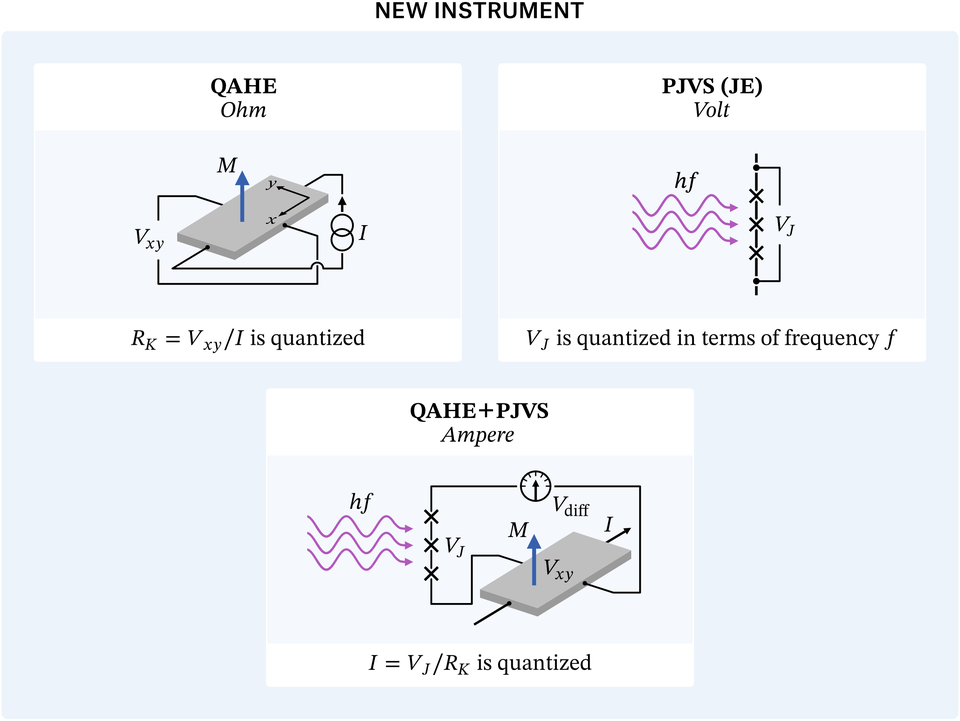
the device is possible by integrating two key quantum systems into a single cryostat. Namely, a special type of resistor called a quantum anomalous Hall resistor (QAHR) and a programmable Josephson voltage standard (PJVS). The cryostat provides the right low-temperature environment for both of them to operate effectively. ...

Using this new technology, the researchers measured voltages from 0.24 millivolts to 6.5 millivolts with very little error. They also made extremely precise measurements of resistance and electrical current. ..."

"Researchers ... have developed one of the first all-in-one instruments for realizing the most up-to-date standards for voltage, resistance, and current. The prototype instrument—a sort of Swiss Army knife for electrical standards—could pave the way for a compact tool that would save both time and money by enabling engineers in their own laboratories to directly calibrate electrical equipment to international standards. ...

The relative accuracy of the new instrument for voltage, resistance, and current is several parts in a million, comparable to the best calibration and measurement capabilities of national metrology institutes across the globe. ..."

From the abstract:
"In the revised International System of Units (SI), the ohm and the volt are realized from the von Klitzing constant and the Josephson constant, and a practical realization of the ampere is possible by applying Ohm’s law directly to the quantum Hall and Josephson effects. As a result, it is possible to create an instrument capable of realizing all three primary electrical units, but the development of such a system remains challenging.
Here we report a unified realization of the volt, ohm and ampere by integrating a quantum anomalous Hall resistor (QAHR) and a programmable Josephson voltage standard (PJVS) in a single cryostat.
Our system has a quantum voltage output that ranges from 0.24 mV to 6.5 mV with combined relative uncertainties down to 3 μV V−1. The QAHR provides a realization of the ohm at zero magnetic field with uncertainties near 1 μΩ Ω−1. We use the QAHR to convert a longitudinal current to a quantized Hall voltage and then directly compare that against the PJVS to realize the ampere.
We determine currents in the range of 9.33–252 nA, and our lowest uncertainty is 4.3 μA A−1 at 83.9 nA. For other current values, a systematic error that ranges from −10 μA A−1 to −30 μA A−1 is present due to the imperfect isolation of the PJVS microwave bias."

Single quantum device that measures amperes, volts and ohms could revolutionize how we measure electricity

All In One: NIST Develops Single Device to Realize Electrical Standards (original news release) "Prototype instrument may enable industry and the military to calibrate electrical equipment to international standards in their own laboratories."


A new instrument developed at NIST realizes the most up-to-date standards for voltage, resistance, and current in a single cryostat.


Saturday, January 18, 2025

Britain deploys quantum clocks for military systems

Good news (right out of Bletchley Park)!

"... The British government has announced that it is deploying a top-secret quantum clock, developed by the Defence Science and Technology Laboratory (Dstl), across the military over the next five years. ...

There are any number of applications for quantum clocks and to achieve these the Dstl has conducted the first British trials outside of the laboratory and is working on ways to miniaturize the technology and integrate it into existing military systems. ...

According to the press release, the new quantum clock can be used to run an alternative to GPS that can provide the same positioning accuracy when the GPS signal is being jammed or spoofed.
It can also be used to secure communications by using highly synchronized timekeeping for high-level encryption.
It can make weapon systems, including missiles, far more accurate too, and it can counter cyberattacks by being able to respond in milliseconds – much faster than the attacker can react. ..."

Britain deploys quantum clocks for military systems

Top secret lab develops atomic clock using quantum technology "A revolutionary UK-built atomic clock will make military operations more secure through experimental quantum technology."

Friday, September 06, 2024

World-first nuclear clock prototype could outperform atomic clocks

Amazing stuff! Exciting! What comes next? Anti matter clocks? (just kidding)

It took only 21 years from proposal to realization!

"... Nuclear clocks work on a similar principle, except instead of measuring the vibrations of a whole atom, they focus in on just the nucleus. ...
The nucleus has a much higher number of “ticks” per second, breaking down the second into even smaller chunks for more accurate timekeeping. As a bonus, it’s more stable against disturbances like electromagnetism that can mess up these measurements. ...
The problem is, a nuclear clock would normally require a much stronger laser than in atomic clocks – except for thorium-229. The nucleus of this atom has two quantum states that are much closer together in energy level, so a smaller kick is needed to jump between them.

Back in April, researchers at JILA finally managed to figure out the exact value of that energy difference, and then actively switched thorium nuclei between them for the first time. Doing so required an ultraviolet laser, instead of the usual infrared light used for atomic clocks. ...
Now the team has built on that work to demonstrate all the components needed to create a nuclear clock. A series of infrared laser pulses are fired at a xenon gas, which produces UV light in a predictable pattern. This UV light is then beamed at thorium nuclei suspended in a tiny crystal, to excite the protons and neutrons in there. An "optical frequency comb" counts the UV wave cycles to make the ultra-precise measurements of time. ..."

"
  • Nuclear clocks would measure time based on changes inside an atom's nucleus, which would make them less sensitive to external disturbances and potentially more accurate than atomic clocks.
  • These clocks could lead to improved timekeeping and navigation, faster internet speeds, and advances in fundamental physics research.
  • Scientists have demonstrated key components of a nuclear clock, such as precise frequency measurements of an energy jump in a thorium-229 nucleus.
..."

"... But it is very hard to create a nuclear clock. To make energy jumps, most atomic nuclei need to be hit by coherent X-rays (a high-frequency form of light) with energies much greater than those that can be produced with current technology. So scientists have focused on thorium-229, an atom whose nucleus has a smaller energy jump than any other known atom, requiring ultraviolet light (which is lower in energy than X-rays).

In 1976, scientists discovered this thorium energy jump, known as a “nuclear transition” in physics language. In 2003, scientists proposed using this transition to create a clock, and but they didn’t directly observe it until 2016. Earlier this year, two different research teams used ultraviolet lasers they created in the lab to flip the nuclear “switch” and measure the wavelength of light needed for it. ..."

From the abstract:
"Optical atomic clocks use electronic energy levels to precisely keep track of time. A clock based on nuclear energy levels promises a next-generation platform for precision metrology and fundamental physics studies. Thorium-229 nuclei exhibit a uniquely low-energy nuclear transition within reach of state-of-the-art vacuum ultraviolet (VUV) laser light sources and have, therefore, been proposed for construction of a nuclear clock. However, quantum-state-resolved spectroscopy of the 229mTh isomer to determine the underlying nuclear structure and establish a direct frequency connection with existing atomic clocks has yet to be performed. Here, we use a VUV frequency comb to directly excite the narrow 229Th nuclear clock transition in a solid-state CaF2 host material and determine the absolute transition frequency. We stabilize the fundamental frequency comb to the JILA 87Sr clock2 and coherently upconvert the fundamental to its seventh harmonic in the VUV range by using a femtosecond enhancement cavity. This VUV comb establishes a frequency link between nuclear and electronic energy levels and allows us to directly measure the frequency ratio of the 229Th nuclear clock transition and the 87Sr atomic clock. We also precisely measure the nuclear quadrupole splittings and extract intrinsic properties of the isomer. These results mark the start of nuclear-based solid-state optical clocks and demonstrate the first comparison, to our knowledge, of nuclear and atomic clocks for fundamental physics studies. This work represents a confluence of precision metrology, ultrafast strong-field physics, nuclear physics and fundamental physics."

World-first nuclear clock prototype could outperform atomic clocks "Atomic clocks are the most accurate timekeepers we have, losing only seconds across billions of years. But apparently that’s not accurate enough – nuclear clocks could steal their thunder, speeding up GPS and the internet, among other things. Now, scientists have built and tested the first prototype nuclear clock."


Progress on nuclear clocks shows the benefits of escaping from scientific silos "Nuclear clocks might soon rival the best atomic ones as supremely accurate timekeepers — a testament to the value of both competition and cooperation in research."


Using an extremely high-powered laser, scientists can excite the thorium-229 nucleus, which is the core of a future nuclear clock.