Amazing stuff!
"Materials called relaxor ferroelectrics have been used for decades in technologies like ultrasounds, microphones, and sonar systems. Their unique properties come from their atomic structure, but that structure has stubbornly eluded direct measurement.
Now a team of researchers f... has directly characterized the three-dimensional atomic structure of a relaxor ferroelectric for the first time. The findings ... provide a framework for refining models used to design next-generation computing, energy, and sensing devices. ...
In their paper, the researchers describe how they used an emerging technique to reveal the distribution of electric charges in the material, with a surprising result.
“We realized the chemical disorder we observed in our experiments was not fully considered previously,” ... “Working with our collaborators, we were able to merge the experimental observations with simulations to refine the models and better predict what we see in experiments.” ...
Probing disordered materials
Leading simulations of relaxor ferroelectrics suggest that when an electric field is applied, the interactions of positively and negatively charged atoms in different nanoregions of the material help give rise to exceptional energy storage and sensing capabilities. The details of those nanoregions have been impossible to directly measure to date. ...
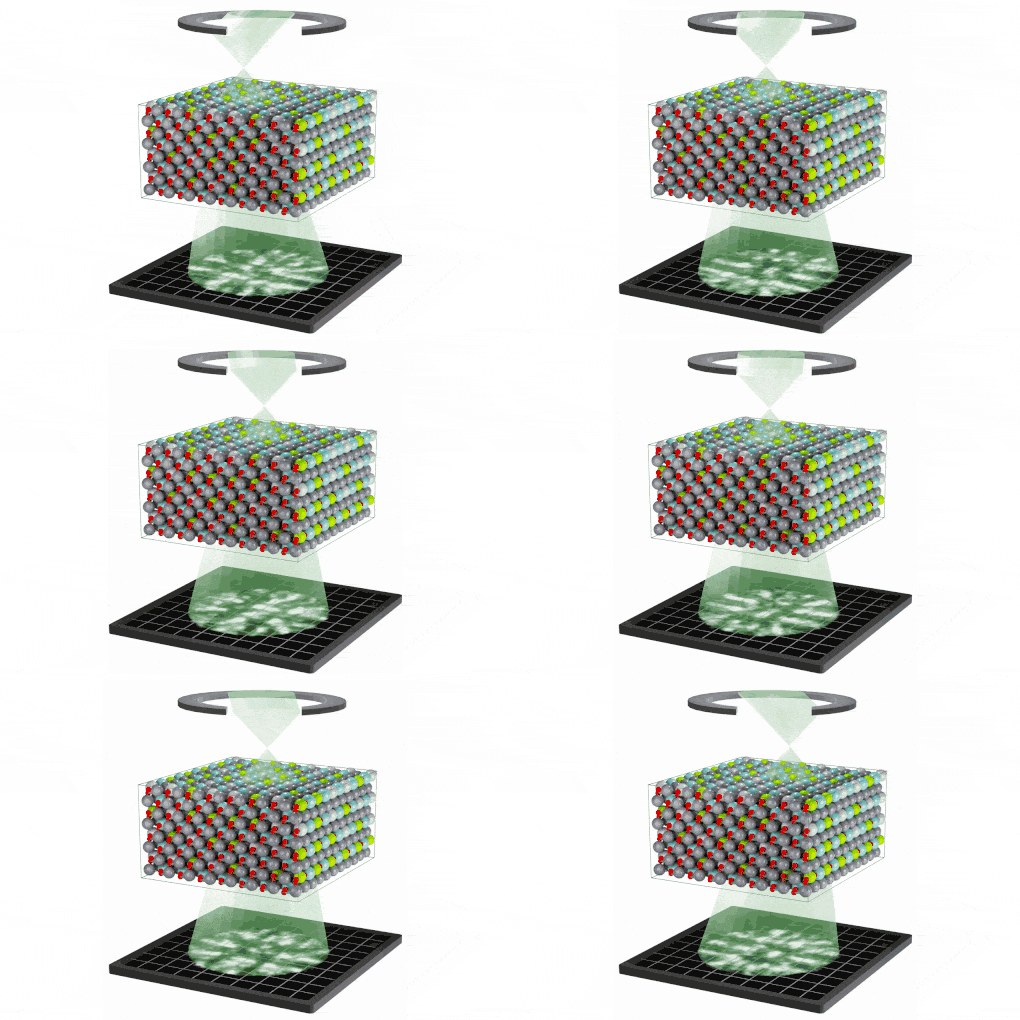
the researchers studied a relaxor ferroelectric material used in sensors, actuators, and defense systems that is a lead magnesium niobate-lead titanate alloy. They used an emerging measurement technique, called multi-slice electron ptychography (MEP), in which researchers move a nanoscale-sized probe of high-energy electrons over a material and measure the resulting electron diffraction patterns. ...
The technique revealed a hierarchy of chemical and polar structures that spanned from atomic to mesoscopic scales. The researchers also found that many regions of differing polarization in the material were much smaller than predicted by the leading simulations. The researchers then fed their new data back into those computer simulations and refined the models to better reflect their findings under different conditions. ..."
From the editor's summary and abstract:
"Editor’s summary
The complexity of lead-based relaxor ferroelectrics makes connecting microscopic characterization with macroscopic properties challenging.
One approach is to compare experimental and theoretical studies, but experiment often averages over material inhomogeneities and theory provides an atomistic view.
To overcome this mismatch, Zhu et al. used multislice electron ptychography, which provided three-dimensional volumetric characterization of the structure and chemistry of a prototypical relaxor material.
Direct comparison with bond valence molecular dynamics simulations revealed that a fully chemically disordered model with residual short-range ordering was necessary to enable agreement with experiment. ...
Abstract
Introducing structural and/or chemical heterogeneity into otherwise ordered crystals can dramatically alter material properties.
Lead-based relaxor ferroelectrics such as 0.68Pb(Mg1/3Nb2/3)O3-0.32PbTiO3 are prototypical examples.
We performed three-dimensional (3D) volumetric characterization using multislice electron ptychography (MEP) and bond valence molecular dynamics (BVMD) simulations.
Real-space comparisons between the two under varying strain states revealed a coherent 3D view of the “polar slush.” Dipolar correlations from the atomic to domain scales are shown to be jointly modulated by strain and chemical configurations, with the best agreement found in a model accounting for both overall chemical disorder and residual short-range order.
Together, MEP and BVMD provide a framework for linking atomic-scale heterogeneity in complex materials by means of complementary 3D imaging and predictive modeling."
Bridging experiment and theory of relaxor ferroelectrics with multislice electron ptychography (no public access)
Bridging experiment and theory of relaxor ferroelectrics at the atomic scale with multislice electron ptychography (preprint, open access, published August 2024, could be dated, contains no images)
Using a technique called multi-slice electron ptychography (MEP), researchers move a nanoscale-sized probe of electrons over a material and measure the resulting electron diffraction patterns. Overlapping regions can be used to create a 3-D scan of the material’s atomic structure.

No comments:
Post a Comment