Showing posts with label graphene. Show all posts

Tuesday, August 18, 2026

Bilayer Graphene’s Magic further Revealed

Recommendable! A nice overview article!

"... Two twisted bilayer graphene (TBG) ...

Is it conventional superconductivity, such as that first identified in mercury more than a century ago, or is it unconventional superconductivity, such as that discovered in the 1980s in high-temperature superconductors? A new study by Julien Barrier of the University of Manchester in the UK and colleagues may help to provide a resolution to this conundrum ...

To help settle this debate, Barrier and colleagues stacked two TBGs, one with a superconductivity-inducing twist close to the magic angle, the other with a smaller (not magic) twist angle (Fig. 1). This second bilayer acted as a normal metal. By gating each bilayer separately, the researchers could induce different amounts of charge in each, allowing the metallic layer to screen electrons in the superconducting layer. To preserve their distinct electronic properties, the two TBGs had to be electronically decoupled so that their electronic states would not mix. In previous experiments, researchers achieved this decoupling using dielectric hexagonal boron nitride (h-BN) spacers, but these several-nanometer-thick layers weakened the screening effect. Instead, Barrier and colleagues introduced a 10° twist between the two TBGs. This ingenious trick decouples the two moiré patterns and suffices to keep their electronic states separate, avoiding the need for physical separation.

Engineering such screening is a good way to probe the pairing mechanism. In the Eliashberg theory of conventional superconductivity—a refinement of BCS theory—electrons experience an effective Coulomb repulsion μ * that must be overcome by an attraction mediated through the exchange of phonons. Increasing the screening between electrons lowers the repulsion μ* while leaving their phonon-mediated attraction unchanged.
If TBG is a conventional superconductor, this screening effect should make phonon-induced electron pairing easier and raise the material’s T c.
But this is exactly the opposite of what Barrier and colleagues observed. They found that increasing the screening between electrons in the superconducting TBG caused the superconducting phase to disappear.
After ruling out trivial explanations, the researchers concluded that this disappearance offers strong evidence that TBG’s superconductivity arises from some type of correlated electron motion that is, at most, very weakly dependent on phonon-mediated attraction. ...

To model the observed behavior, Barrier and colleagues assumed that TBG’s superconductivity arises from an unconventional plasmon-mediated mechanism. Their basic argument is that, for the electronic states involved in superconductivity, screening efficiency decays exponentially on a scale of ∼
2 nm. Because their device uses a large twist angle to decouple the two TBGs instead of a dielectric spacer, the interlayer separation is of subnanometer size, making screening maximally efficient, and much stronger than in earlier experiments with 3–10-nm h-BN spacer layers. Besides explaining the disappearance of the superconducting phase, this plasmon model could also explain an observed disappearance of correlated insulating phases at temperatures below 20 K. ..."

From the abstract:
"The origin of superconductivity in magic-angle twisted bilayer graphene has been a subject of intense debate. While some experimental evidence indicated an unconventional pairing mechanism which should be sensitive to Coulomb screening, experimental attempts to tune the critical temperature by screening Coulomb interactions so far have remained unsuccessful, possibly indicating a conventional phonon-mediated pairing.
Here we study a double-layer electronic system consisting of two twisted graphene bilayers in immediate proximity of each other but remaining electronically decoupled.
By increasing the carrier density in one bilayer, we completely suppressed both the superconductivity and the correlated-insulator state in the adjacent magic-angle graphene. The observation of such an effect from screening offers support for an unconventional mechanism of Cooper pairing in magic-angle twisted bilayer graphene, shedding new light on the underlying physics governing their properties."

Physics - Bilayer Graphene’s Magic Revealed "New experiments suggest that superconductivity in twisted bilayer graphene depends on an unconventional electron-pairing mechanism."


Fig. 1 Characterization of twisted tetralayer graphene device


Monday, July 06, 2026

Graphene can hold multiple states of superconductivity, a new study finds

Good news! More, but incremental progress! 

Superconductivity like nuclear fusion hold huge promises to improve global energy supply!

"In a study appearing ... in the journal Nature, ... researchers report that a certain microscopic structure found in natural graphite can host multiple superconducting states. Superconductivity is an electronic state of matter in which electrons pair up and glide through a material with zero resistance.  ..."

"... In our work, we present a family of three surprising states of superconductivity in 4- or 5-layer rhombohedral graphene, all of which are are able to persist in the presence of strong in-plane magnetic fields up to ~9 T, exceeding the Pauli limit by far more than a factor of 10.
In a further surprise, one state is even enhanced by a perpendicular magnetic field. This is in contract to bernal graphene, which showed only relatively weak in-plane enhancement. The two other states are boosted by the in-plane field, and one of them is only created above ~5 Tesla in-plane field. None of these states could be suppressed with the 9 T magnet of this experiment. 

This establishes a new family of unconventional, magnetic field-boosted superconductors in rhombohedral graphene. It is currently still unclear what the microscopic pairing mechanism is. One possible explanation is that the electrons in these states pair differently than in the paradigmatic simple superconductors — for example, with their spins aligned in the same direction in a triplet state. This could make them less sensitive to magnetic fields. ..."

From the abstract:
"In some unconventional superconductors, time-reversal symmetry can be broken in addition to the gauge symmetry, resulting in superconductivities that can be enhanced or induced by magnetic fields.
However, field-enhanced superconductors are more vulnerable to impurities than Bardeen-Cooper-Schrieffer counterparts.
Crystalline rhombohedral multilayer graphene is a promising platform to explore them due to its superior material quality and gate-tunable strong correlation effects.
Here we report transport measurements of rhombohedral tetralayer and pentalayer graphene, demonstrating a spectrum of clean-limit superconductivities. We found three different types of field-enhanced and field-induced superconductivities in the pentalayer. They are all robust against an in-plane field up to 8.5 Tesla, exceeding the Pauli limit by tens of times.
Compared to Bernal bilayer graphene showing only in-plane field-enhancement, pentalayer graphene features superconductors enhanced by out-of-plane as well as in-plane fields. They also reside at much lower gate electric fields owing to the intrinsically flatter band dispersion—facilitating their study and further engineering.
Additionally, we observed that proximitized spin-orbit coupling (SOC) generates multiple new superconductors without introducing additional disorder effects.
Our work establishes a new family of magnetic field-boosted superconductors in rhombohedral graphene.
Utilizing the high accessibility with moderate gate voltages, this will pave the way for realizing non-Abelian quasiparticles through interfacial engineering in the extreme clean limit, in that proximitized SOC leads to topological states8 and maintains the ultrahigh quality of crystalline graphene."

Graphene can hold multiple states of superconductivity, a new study finds | MIT News | Massachusetts Institute of Technology "What’s more, the superconducting states get stronger under conditions expected to kill them."

Published in Nature: Family of magnetic field-boosted superconductors in rhombohedral graphene (second original news release)


The cartoon sketch shows the family of three different states found in the experiment indicated with three different colors


Monday, April 27, 2026

Graphene oxide targets and destroys bacteria, including drug-resistant strains

Good news! Could this be a breakthrough regarding antibiotics?

"Researchers say graphene oxide targets and destroys bacteria, including drug-resistant strains, by binding to a molecule absent in human cells, offering a durable alternative to antibiotics."

"Scientists have uncovered how graphene oxide pulls off a remarkable trick: it hunts down and destroys harmful bacteria while leaving human cells completely unharmed. By targeting a molecule found only in bacterial membranes, this ultra-thin carbon-based material acts with laser-like precision—offering a powerful new alternative to traditional antibiotics. Even more exciting, it works against drug-resistant “superbugs,” promotes faster wound healing, and keeps its antibacterial strength even after repeated washing."

"...  a joint research team ... has identified the mechanism by which Graphene Oxide (GO) exhibits powerful antibacterial effects against bacteria while remaining harmless to human cells. ...

This study is highly significant as it provides molecular-level proof of graphene's antibacterial action, which had not been clearly understood until now.

The research team confirmed that graphene oxide performs "selective antibacterial action" by attaching to and destroying only the membranes of bacteria ... while leaving human cells untouched. This occurs because the oxygen functional groups on the surface of graphene oxide selectively bind with a specific component (POPG) found only in bacterial cell membranes. ..."

From the abstract:
"Graphene oxide (GO) has attracted research attention as a promising biomedical material principally owing to its biocompatibility as well as excellent antibacterial properties, although the exact mechanism for the apparently conflicting both activities remains controversial yet.
We present controlled physicochemical and biomimetic features of GO that exert antibacterial effects via selective destabilization of the bacterial membrane.
Our model cell study, exploiting artificial vesicular phospholipid assembly along with spectroscopic analyses, finds that surface oxygen functionalities of GO determine antibacterial activity by highly specific interaction with POPG, a phospholipid selectively present in membranes of various bacterial species, including drug-resistant bacteria.
Furthermore, GO-incorporated nanofibers were evaluated in infected wound models in mice and pigs, where they effectively suppressed bacterial growth and accelerated wound healing with minimal inflammation.
These findings highlight the potential use of GO as a safe and sustainable antibacterial to avoid repeated overuse of conventional antibiotics."

Monday, April 27, 2026 - Join The Flyover


Schematic diagram of the selective interaction between graphene oxide and cell membranes


Identification of selective interaction mechanisms at the molecular level through microscopic and chemical analysis of artificial lipid vesicles mimicking cell membranes


Friday, November 07, 2025

Physicists observe key evidence of unconventional superconductivity in magic-angle graphene

Good news! Sounds almost like Voodoo ("unconventional", "magic-angle")! 😊

Are we finally coming closer to room temperature superconductivity?

"... “magic-angle” twisted tri-layer graphene (MATTG) ...

 In particular, the team was able to measure MATTG’s superconducting gap — a property that describes how resilient a material’s superconducting state is at given temperatures. They found that MATTG’s superconducting gap looks very different from that of the typical superconductor, meaning that the mechanism by which the material becomes superconductive must also be different, and unconventional. ...

The researchers made their discovery using a new experimental platform that allows them to essentially “watch” the superconducting gap, as the superconductivity emerges in two-dimensional materials, in real-time. They plan to apply the platform to further probe MATTG, and to map the superconducting gap in other 2D materials — an effort that could reveal promising candidates for future technologies. ..."

From the abstract:
"Understanding the nature of superconductivity in magic-angle graphene remains challenging. A key difficulty lies in discerning the different energy scales in this strongly interacting system, particularly the superconducting gap.
Here, we report simultaneous tunneling spectroscopy and transport measurements of magic-angle twisted trilayer graphene.
This approach allows us to identify two coexisting V-shaped tunneling gaps with different energy scales:
a distinct low-energy superconducting gap that vanishes at the superconducting critical temperature and magnetic field, and
a higher-energy pseudogap.
The superconducting tunneling spectra display a linear gap-filling behavior with temperature and magnetic field and exhibit the Volovik effect, consistent with a nodal order parameter.
Our work suggests an unconventional nature of the superconducting gap and establishes an experimental framework for multidimensional investigation of tunable quantum materials."

MIT physicists observe key evidence of unconventional superconductivity in magic-angle graphene | MIT News | Massachusetts Institute of Technology "The findings could open a route to new forms of higher-temperature superconductors."


Saturday, September 20, 2025

Supercapacitor outperforms batteries in power delivery

Good news!

"Engineers in Australia have created a new carbon-based material which allows supercapacitors to store as much energy as traditional lead-acid batteries and deliver charge much faster.

The new graphene materials are now being made in commercial quantities ..."

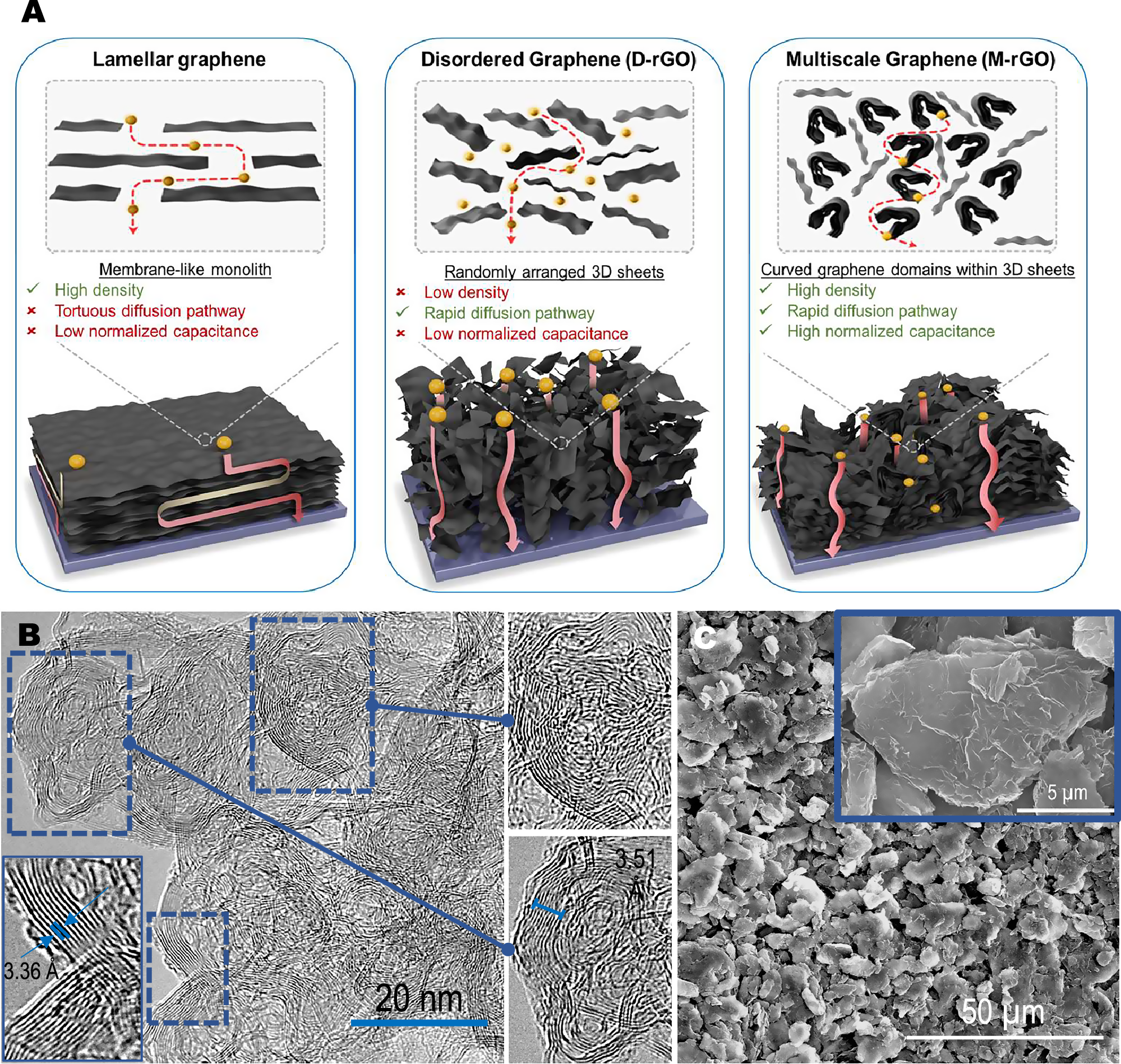
"... The secret lies in a new material architecture developed by the team, called multiscale reduced graphene oxide (M-rGO), which is synthesised from natural graphite – an abundant Australian resource.

Using a rapid thermal annealing process, the researchers created a highly curved graphene structure with precise pathways for ions to move quickly and efficiently. The result is a material that offers both high energy density and high power density – a combination rarely achieved in a single device. ..."

From the abstract:
"Supercapacitors deliver high power but are limited in compact applications by low volumetric energy and power densities.
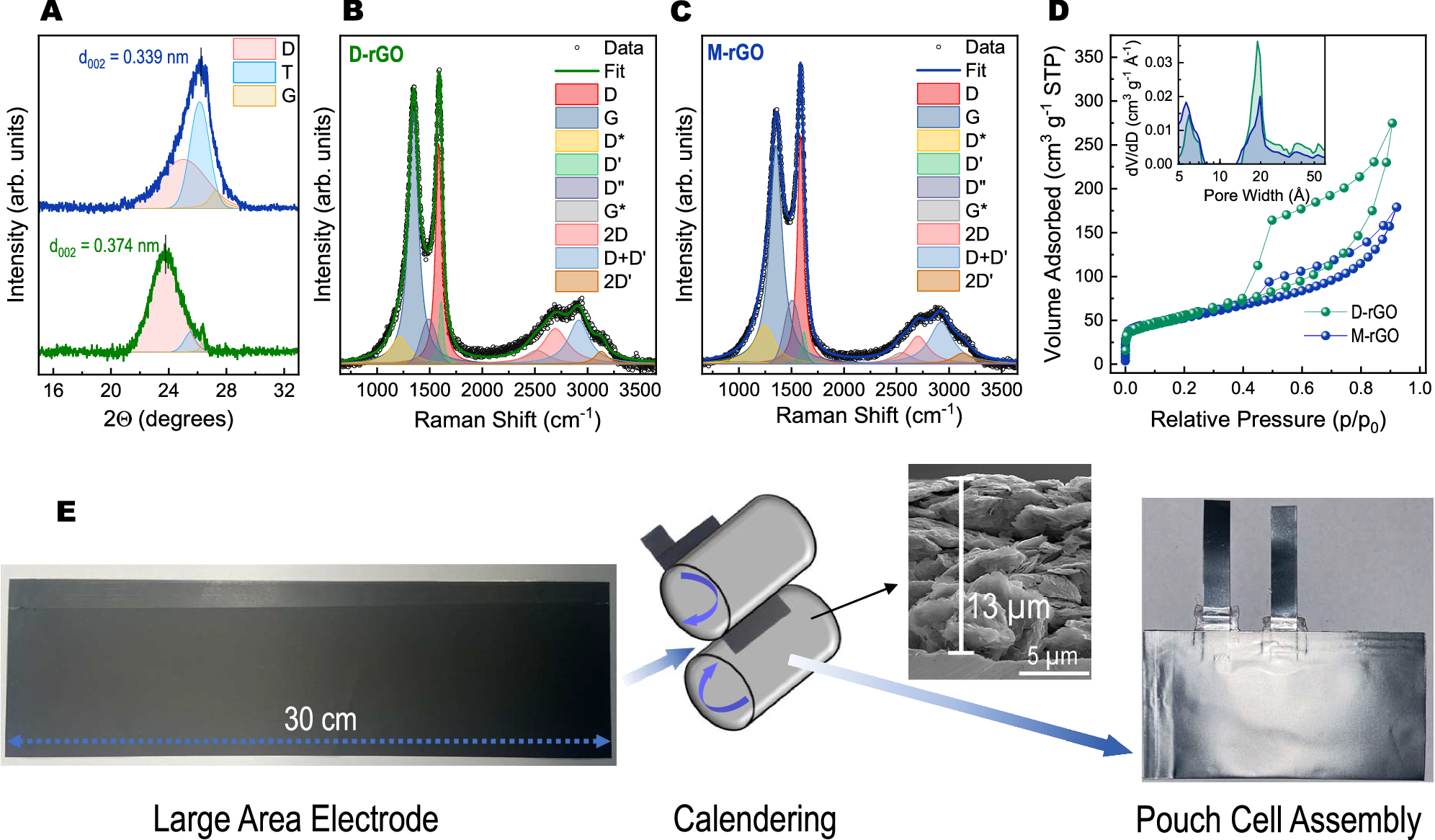
Two-dimensional materials like graphene, despite their high packing density, are hindered by poor ion transport kinetics. A rapid thermal annealing step generates unusually curved turbostratic graphene crystallites, integrated and interwoven within disordered domains in micron-size particles to yield multiscale graphene. Ion insertion into the interlayers enables precise pore-ion matching and partial charge transfer, enabling a high Brunauer-Emmett-Teller surface area-normalized capacitance of 85 µF/cm2.
Here, we show that multiscale graphene exhibits rapid ion transport dynamics within the curved crystallites and disordered domains. When the thin electrodes are assembled into symmetric pouch cell devices, they deliver a stack-level volumetric energy density of 99.5 Wh/L in ionic liquid electrolytes and 49.2 Wh/L in organic electrolyte with a high power density of 69.2 kW/L at 9.6 Wh/L."

Supercapacitor outperforms batteries in power delivery

Lightning-fast power: breakthrough powers supercapacitors that rival batteries (original news release) "Engineers have made a major leap forward in the global race to build energy storage devices that are both fast and powerful – paving the way for next-generation applications in electrified transport, grid stabilisation and consumer electronics."


Fig. 1: Schematic highlighting the differences between lamellar, disordered and multiscale graphene with morphological characterization of M-rGO.


Fig. 2: Physicochemical differences between D-rGO and M-rGO and the fabrication process for the pouch cell prototypes used throughout this study.


Sunday, July 20, 2025

Twisted trilayer graphene shows high kinetic inductance

Amazing stuff! Graphene keeps on giving! See also my other, same day post on trilayer graphene.

"Researchers ... recently set out to better understand the mechanisms behind the unconventional superconductivity observed in twisted graphene moiré heterostructures, material consisting of stacked graphene sheets twisted at an angle of approximately 1.1°.

Their paper ... unveils a large and tunable kinetic inductance (i.e., a resistance to changes in current prompted by the inertia of charge carriers) in twisted trilayer graphene, offering new insight about the underpinnings of superconductivity in moiré materials. ..."

Twisted trilayer graphene shows high kinetic inductance


The first observation of a giant nonlinear Nernst Effect in trilayer graphene

Amazing stuff! Graphene keeps on giving!

"... So far, the Nernst effect has been primarily demonstrated in time-reversal symmetry-breaking systems, either by applying an external magnetic field or by using magnetic materials. Yet recent physics theories have introduced the idea that a nonlinear Nernst effect (NNE) could arise in non-magnetic materials, crucially, under zero external magnetic field.

Researchers ... have now realized this idea in an experimental setting for the first time. Their paper ... reports the observation of a sizable nonlinear Nernst effect in an inversion symmetry-breaking form of trilayer graphene known as ABA trilayer graphene. ...

"The conventional Nernst effect, a thermoelectric phenomenon that generates a transverse voltage from a temperature gradient, typically requires breaking time-reversal symmetry, often with a magnetic field. This requirement poses a significant challenge for the miniaturization and integration of thermoelectric devices. Yet recently, theoretical predictions have suggested a new type of phenomenon called NNE." ..."

From the abstract:
"The Nernst effect, that is, the generation of a transverse voltage in response to a temperature gradient, enables thermoelectric energy conversion. In the absence of an external magnetic field, the linear Nernst effect is forbidden in non-magnetic materials because of time-reversal symmetry constraints, but the recently predicted nonlinear Nernst effect (NNE) is allowed.
Here we report the experimental observation of the NNE in non-magnetic ABA trilayer graphene, even in the absence of an external magnetic field. This effect is detected via electric harmonic measurements under an alternating temperature gradient at temperatures below 12 K.
The NNE exhibits a quadratic dependence on the temperature gradient. It is notably enhanced near the charge neutrality point and reaches a giant effective Nernst coefficient of up to 300 µV K−1 at 2 K, surpassing the linear coefficients of magnetic materials.
Moreover, we establish a scaling law between the NNE and the linear Seebeck effect, confirming the dominance of a skew scattering mechanism in driving the NNE. Our findings demonstrate an alternative approach for thermoelectric energy harvesting and cooling applications via nonlinear thermoelectric responses, which may, in the long run, offer alternative approaches towards the development of advanced thermoelectric devices."

The first observation of a giant nonlinear Nernst Effect in trilayer graphene


a, The schematic diagram of nonlinear Nernst effect in non-magnetic materials at zero magnetic field. b, The Nernst coefficient obtained from nonlinear Nernst effect in trilayer graphene and anomalous Nernst effect in magnetic materials.


Friday, May 23, 2025

Physicists discover a new type of superconductor that’s also a magnet

Amazing stuff! It's the magic graphene again!

"Magnets and superconductors go together like oil and water — or so scientists have thought. ...

In a paper ... the physicists report that they have discovered a “chiral superconductor” — a material that conducts electricity without resistance, and also, paradoxically, is intrinsically magnetic. ... this exotic superconductivity in ... graphite, the primary material in pencil lead. ...

when four or five sheets of graphene are stacked in this “rhombohedral” configuration, the resulting structure can exhibit exceptional electronic properties that are not seen in graphite as a whole. ..."

From the abstract:
"Chiral superconductors are unconventional superconducting states that break time reversal symmetry spontaneously and typically feature Cooper pairing at non-zero angular momentum. Such states may host Majorana fermions and provide an important platform for topological physics research and fault-tolerant quantum computing. Despite intensive search and prolonged studies of several candidate systems, chiral superconductivity has remained elusive so far.
Here we report the discovery of robust unconventional superconductivity in rhombohedral tetra- and penta-layer graphene without moiré superlattice effects. We observed two superconducting states in the gate-induced flat conduction bands with Tc up to 300 mK and charge density ne down to 2.4*1011 cm-2 in five devices.
Spontaneous time-reversal-symmetry-breaking due to electron’s orbital motion is found, and several observations indicate the chiral nature of these superconducting states, including:
1. In the superconducting state, Rxx shows magnetic hysteresis in varying out-of-plane magnetic field B⊥—absent from all other superconductors;
2. the superconducting states are robust against in-plane magnetic field and are developed within a spin- and valley-polarized quarter-metal phase;
3. the normal states show anomalous Hall signals at zero magnetic field and magnetic hysteresis.
We also observed a critical B⊥ of 1.4 Tesla, higher than any graphene superconductivity and indicates a strong-coupling superconductivity close to the BCS-BEC crossover. Our observations establish a pure carbon material for the study of topological superconductivity, with the promise to explore Majorana modes and topological quantum computing."

MIT physicists discover a new type of superconductor that’s also a magnet | MIT News | Massachusetts Institute of Technology "The “one-of-a-kind” phenomenon was observed in ordinary graphite."


Saturday, March 08, 2025

Physicists find unexpected crystals of electrons in new ultrathin material

Amazing stuff!

"... In a paper ... the team describes how electrons in devices made, in part, of the new material can become solid, or form crystals, by changing the voltage applied to the devices when they are kept at a temperature similar to that of outer space. Under the same conditions, they also showed the emergence of two new electronic states that add to work they reported last year showing that electrons can split into fractions of themselves. ..."

".. physicists report the unexpected discovery of electrons forming crystalline structures in a material only billionths of a meter thick. The work adds to a gold mine of discoveries originating from the material, which the same team discovered about three years ago. ...

The team also observed all of these phenomena using two slightly different “versions” of the material, one composed of five layers of atomically thin carbon; the other composed of four layers. ...

They also found another unusual electronic phenomenon: the integer quantum anomalous Hall effect in a wide range of electron densities. The fractional quantum anomalous Hall effect was understood to emerge in an electron “liquid” phase, analogous to water. In contrast, the new state that the team has now observed can be interpreted as an electron “solid” phase — resembling the formation of electronic “ice” — that can also coexist with the fractional quantum anomalous Hall states when the system’s voltage is carefully tuned at ultra-low temperatures. ..."

From the abstract:
"Electrons in topological flat bands can form new topological states driven by correlation effects. The pentalayer rhombohedral graphene/hexagonal boron nitride (hBN) moiré superlattice was shown to host fractional quantum anomalous Hall effect (FQAHE) at approximately 400 mK, triggering discussions around the underlying mechanism and role of moiré effects. In particular, new electron crystal states with non-trivial topology have been proposed. Here we report electrical transport measurements in rhombohedral pentalayer and tetralayer graphene/hBN moiré superlattices at electronic temperatures down to below 40 mK.
We observed two more fractional quantum anomalous Hall (FQAH) states and smaller Rxx values in pentalayer devices than those previously reported.
In the new tetralayer device, we observed FQAHE at moiré filling factors v = 3/5 and 2/3. With a small current at the base temperature, we observed a new extended quantum anomalous Hall (EQAH) state and magnetic hysteresis, where Rxy = h/e2 and vanishing Rxx spans a wide range of v from 0.5 to 1.3. At increased temperature or current, EQAH states disappear and partially transition into the FQAH liquid. Furthermore, we observed displacement field-induced quantum phase transitions from the EQAH states to the Fermi liquid, FQAH liquid and the likely composite Fermi liquid. Our observations established a new topological phase of electrons with quantized Hall resistance at zero magnetic field and enriched the emergent quantum phenomena in materials with topological flat bands. "

Physicists find unexpected crystals of electrons in new ultrathin material

MIT physicists find unexpected crystals of electrons in an ultrathin material (original news release) "Rhombohedral graphene reveals new exotic interacting electron states."

Friday, February 28, 2025

Physicists find unexpected crystals of electrons in pentalayer/tetralayer rhombohedral graphene

Amazing stuff!

"... physicists report the unexpected discovery of electrons forming crystalline structures in a material only billionths of a meter thick. The work adds to a gold mine of discoveries originating from the material, which the same team discovered about three years ago.

In a paper published [2022], the team describes how electrons in devices made, in part, of the material can become solid, or form crystals, by changing the voltage applied to the devices when they are kept at a temperature similar to that of outer space. Under the same conditions, they also showed the emergence of two new electronic states that add to work they reported [2024] showing that electrons can split into fractions of themselves. ...

the material, one composed of five layers of atomically thin carbon; the other composed of four layers. This indicates “that there’s a family of materials  ...

rhombohedral pentalayer graphene  ...

For example, in 2023 they created a sandwich of rhombohedral pentalayer graphene with “buns” made of hexagonal boron nitride. By applying different voltages, or amounts of electricity, to the sandwich, they discovered three important properties never before seen in natural graphite.

[2024] ... reported yet another important and even more surprising phenomenon: Electrons became fractions of themselves upon applying a current to a new device composed of rhombohedral pentalayer graphene and hexagonal boron nitride. This is important because this “fractional quantum Hall effect” has only been seen in a few systems, usually under very high magnetic fields. The Ju work showed that the phenomenon could occur in a fairly simple material without a magnetic field. As a result, it is called the “fractional quantum anomalous Hall effect” (anomalous indicates that no magnetic field is necessary). ...

In the current work, ... reports yet more unexpected phenomena from the general rhombohedral graphene/boron nitride system when it is cooled to 30 millikelvins  ...  discovering two more of these fractional states.

They also found another unusual electronic phenomenon: the integer quantum anomalous Hall effect in a wide range of electron densities. The fractional quantum anomalous Hall effect was understood to emerge in an electron “liquid” phase, analogous to water. In contrast, the new state that the team has now observed can be interpreted as an electron “solid” phase — resembling the formation of electronic “ice” — that can also coexist with the fractional quantum anomalous Hall states when the system’s voltage is carefully tuned at ultra-low temperatures.

One way to think about the relation between the integer and fractional states is to imagine a map created by tuning electric voltages: By tuning the system with different voltages, you can create a “landscape” similar to a river (which represents the liquid-like fractional states) cutting through glaciers (which represent the solid-like integer effect) ...

observed all of these phenomena not only in pentalayer rhombohedral graphene, but also in rhombohedral graphene composed of four layers. This creates a family of materials, and indicates that other “relatives” may exist.

“This work shows how rich this material is in exhibiting exotic phenomena. We’ve just added more flavor to this already very interesting material,”  ..."

From the abstract:
"Electrons in topological flat bands can form new topological states driven by correlation effects. The pentalayer rhombohedral graphene/hexagonal boron nitride (hBN) moiré superlattice was shown to host fractional quantum anomalous Hall effect (FQAHE) at approximately 400 mK, triggering discussions around the underlying mechanism and role of moiré effects.
In particular, new electron crystal states with non-trivial topology have been proposed.
Here we report electrical transport measurements in rhombohedral pentalayer and tetralayer graphene/hBN moiré superlattices at electronic temperatures down to below 40 mK. We observed two more fractional quantum anomalous Hall (FQAH) states and smaller Rxx values in pentalayer devices than those previously reported.
In the new tetralayer device, we observed FQAHE at moiré filling factors v = 3/5 and 2/3. With a small current at the base temperature, we observed a new extended quantum anomalous Hall (EQAH) state and magnetic hysteresis, where Rxy = h/e2 and vanishing Rxx spans a wide range of v from 0.5 to 1.3.
At increased temperature or current, EQAH states disappear and partially transition into the FQAH liquid. Furthermore, we observed displacement field-induced quantum phase transitions from the EQAH states to the Fermi liquid, FQAH liquid and the likely composite Fermi liquid. Our observations established a new topological phase of electrons with quantized Hall resistance at zero magnetic field and enriched the emergent quantum phenomena in materials with topological flat bands. "

MIT physicists find unexpected crystals of electrons in an ultrathin material | MIT News | Massachusetts Institute of Technology "Rhombohedral graphene reveals new exotic interacting electron states."


Sunday, February 09, 2025

Physicists measure a key aspect of superconductivity in 'magic-angle' graphene showing it to be an unconventional superconductor

Amazing stuff!

Why is so much money wasted on windmills and solar panels instead of superconductivity research?

"... Physicists at MIT and Harvard University have now directly measured superfluid stiffness for the first time in "magic-angle" [bilayer] graphene—materials that are made from two or more atomically thin sheets of graphene twisted with respect to each other at just the right angle to enable a host of exceptional properties, including unconventional superconductivity. ...

Since its discovery in 2004, graphene ... In 2018, ... discovered that when two graphene sheets are stacked on top of each other, at a precise, "magic" angle, the twisted structure—known as magic-angle twisted bilayer graphene, or MATBG ..."

From the abstract:
"The physics of superconductivity in magic-angle twisted bilayer graphene (MATBG) is a topic of keen interest in moiré systems research, and it may provide an insight into the pairing mechanism of other strongly correlated materials such as high-critical-temperature superconductors.
Here we use d.c. transport and microwave circuit quantum electrodynamics to directly measure the superfluid stiffness of superconducting MATBG through its kinetic inductance.
We find the superfluid stiffness to be much larger than expected from conventional Fermi liquid theory. Rather, it is comparable to theoretical predictions and recent experimental indications of quantum geometric effects that are dominant at the magic angle.
The temperature dependence of the superfluid stiffness follows a power law, which contraindicates an isotropic Bardeen–Cooper–Schrieffer (BCS) model.
Instead, the extracted power-law exponents indicate an anisotropic superconducting gap, whether interpreted in the Fermi liquid framework or by considering the quantum geometry of flat-band superconductivity.
Moreover, a quadratic dependence of the superfluid stiffness on both d.c. and microwave current is observed, which is consistent with the Ginzburg–Landau theory.
Taken together, our findings show that MATBG is an unconventional superconductor with an anisotropic gap and strongly suggest a connection between quantum geometry, superfluid stiffness and unconventional superconductivity in MATBG. The combined d.c.–microwave measurement platform used here is applicable to the investigation of other atomically thin superconductors."

Physicists measure a key aspect of superconductivity in 'magic-angle' graphene

Physicists measure a key aspect of superconductivity in “magic-angle” graphene (original news release) "By determining how readily electron pairs flow through this material, scientists have taken a big step toward understanding its remarkable properties."

Friday, January 31, 2025

Physicists discover — and explain — unexpected magnetism in an atomically thin material tri-layer graphene

Amazing stuff! Superimposed, hierarchical moire lattices.

"MIT physicists have created a new ultrathin, two-dimensional material with unusual magnetic properties that initially surprised the researchers before they went on to solve the complicated puzzle behind those properties’ emergence. As a result, the work introduces a new platform for studying how materials behave at the most fundamental level — the world of quantum physics. ...

worked with three layers of graphene. Each layer was twisted on top of the next at the same angle, creating a helical structure akin to the DNA helix or a hand of three cards that are fanned apart.

“Helicity is a fundamental concept in science, from basic physics to chemistry and molecular biology. With 2D materials, one can create special helical structures, with novel properties which we are just beginning to understand. This work represents a new twist in the field of twistronics ..." ...

Twistronics can lead to new properties in ultrathin materials because arranging sheets of 2D materials in this way results in a unique pattern called a moiré lattice. And a moiré pattern, in turn, has an impact on the behavior of electrons. ...

In the current work, the helical structure created by the three graphene layers forms two moiré lattices. One is created by the first two overlapping sheets; the other is formed between the second and third sheets.

The two moiré patterns together form a third moiré, a supermoiré, or “moiré of a moiré,” ... “It’s like a moiré hierarchy.” While the first two moiré patterns are only nanometers, or billionths of a meter, in scale, the supermoiré appears at a scale of hundreds of nanometers superimposed over the other two. ..."

From the abstract:
"The intrinsic anomalous Hall effect (AHE) is driven by non-zero Berry curvature and spontaneous time-reversal symmetry breaking. This effect can be realized in two-dimensional moiré systems hosting flat electronic bands but is not usually seen in inversion-symmetric materials.
Here, we show that this physics is manifested in helical trilayer graphene—three graphene layers, each twisted in sequence by the same angle—although the system retains global in-plane inversion symmetry.
We uncover a phase diagram of correlated and magnetic states at a magic twist angle of 1.8∘, which is explained by a lattice relaxation that leads to the formation of large periodic domains where in-plane inversion symmetry is broken on the moiré scale.
Each domain harbours flat topological bands with opposite Chern numbers in the two valleys. We find correlated states at multiple integer and fractional electron fillings per moiré unit cell and an AHE at a subset of them. The AHE disappears above a critical electric displacement field at one electron per unit cell, indicating a topological phase transition. We establish helical trilayer graphene as a platform that presents an opportunity to engineer topology due to its emergent moiré-scale symmetries."

Physicists discover — and explain — unexpected magnetism in an atomically thin material | MIT News | Massachusetts Institute of Technology "The work introduces a new platform for studying quantum materials."

Wednesday, November 20, 2024

How can electrons split into fractions of themselves? An anomalous effect!

Amazing stuff!

"MIT physicists have taken a key step toward solving the puzzle of what leads electrons to split into fractions of themselves. Their solution sheds light on the conditions that give rise to exotic electronic states in graphene and other two-dimensional systems.

The new work is an effort to make sense of a discovery that was reported earlier this year by a different group of physicists ... found that electrons appear to exhibit “fractional charge” in pentalayer graphene — a configuration of five graphene layers that are stacked atop a similarly structured sheet of boron nitride. ...

The phenomenon was coined the “fractional quantum anomalous Hall effect,” and theorists have been keen to find an explanation for how fractional charge can emerge from pentalayer graphene.

The new study ... provides a crucial piece of the answer. Through calculations of quantum mechanical interactions ... show that the electrons form a sort of crystal structure, the properties of which are ideal for fractions of electrons to emerge.

“This is a completely new mechanism, meaning in the decades-long history, people have never had a system go toward these kinds of fractional electron phenomena,” ... “It’s really exciting because it makes possible all kinds of new experiments that previously one could only dream about.” ...

They found that the moiré arrangement of pentalayer graphene, in which each lattice-like layer of carbon atoms is arranged atop the other and on top of the boron-nitride, induces a weak electrical potential. When electrons pass through this potential, they form a sort of crystal, or a periodic formation, that confines the electrons and forces them to interact through their quantum correlations. This electron tug-of-war creates a sort of cloud of possible physical states for each electron, which interacts with every other electron cloud in the crystal, in a wavefunction, or a pattern of quantum correlations, that gives the winding that should set the stage for electrons to split into fractions of themselves. ..."

From the abstract:
"Remarkable recent experiments on the moiré structure formed by pentalayer rhombohedral graphene aligned with a hexagonal boron nitride substrate report the discovery of a zero field fractional quantum Hall effect. These “(fractional) quantum anomalous Hall” [(F)QAH] phases occur for one sign of a perpendicular displacement field, and correspond, experimentally, to full or partial filling of a valley polarized Chern-1 band. Such a band is absent in the noninteracting band structure. Here we show that electron-electron interactions play a crucial role, and present microscopic theoretical calculations demonstrating the emergence of a nearly flat, isolated, Chern-1 band and FQAH phases in this system. We also study the four- and six-layer analogs and identify parameters where a nearly flat isolated Chern-1 band emerges which may be suitable to host FQAH physics."

How can electrons split into fractions of themselves? | MIT News | Massachusetts Institute of Technology "Physicists surprised to discover electrons in pentalayer graphene can exhibit fractional charge. New study suggests how this could work."

Theory of Quantum Anomalous Hall Phases in Pentalayer Rhombohedral Graphene Moiré Structures (no public access, but article above contains a link to request the PDF file)

Sunday, November 10, 2024

Revealing the superconducting limit of ‘magic’ material graphene

Good news!

"... Now ... researchers are making headway into understanding how the material achieves this state by identifying its highest achievable superconducting temperature – 60 Kelvin. The finding is mathematically exact, a rare feat in the field, and is spurring new insights into the factors that fundamentally control superconductivity.  ...

In 2023, ... developed a new theoretical formalism to compute the highest possible superconducting transition temperature in any material obtained by stacking and twisting two-dimensional materials. For the current work, they applied it to twisted bilayer graphene. ...

The theoretical framework the team developed can be applied to other materials in the future ..."

From the abstract:
"Few layers of graphene at small twist angles have emerged as a fascinating platform for studying the problem of strong interactions in regimes with a nearly quenched single-particle kinetic energy and nontrivial band topology. Starting from the strong-coupling limit of twisted bilayer graphene with a vanishing single-electron bandwidth and interlayer tunneling between the same sublattice sites, we present an exact analytical theory of the Coulomb interaction-induced low-energy optical spectral weight at all integer fillings. In this limit, while the interaction-induced single-particle dispersion is finite, the optical spectral weight vanishes identically at integer fillings. We study corrections to the optical spectral weight by systematically including the effects of experimentally relevant strain-induced renormalization of the single-electron bandwidth and interlayer tunnelings between the same sublattice sites. Given the relationship between the optical spectral weight and the diamagnetic response that controls superconducting 𝑇𝑐, our results highlight the relative importance of specific parent insulating phases in enhancing the tendency towards superconductivity when doped away from integer fillings."

Revealing the superconducting limit of ‘magic’ material | Cornell Chronicle


Monday, August 26, 2024

Natural graphene discovered on the Moon

Amazing stuff!

"[China's] Chang’e 5 touched down on the Moon in December 2020, where it scooped up a sample of the lunar regolith and returned it to Earth a few weeks later, marking the first successful lunar retrieval mission since 1976. ...
Now, researchers at the Chinese Academy of Sciences’ Institute of Metal Research have made a new discovery in the lunar sample – graphene. ...
but natural graphene has been detected in interstellar space, meteorites, mines and now, on the Moon. ..."

"Carbon is a fundamental element for understanding the formation and evolution of planetary bodies. The origin of the Moon has aroused intensive interest and debate, from which several hypotheses have been proposed. The prevalent giant impact theory has been strongly supported by the notion of a carbon-depleted Moon that derived from the early analysis of Apollo samples. Recently, this consensus has been significantly challenged by the observation of global carbon ion fluxes from the Moon, suggesting the presence of indigenous carbon on the Moon. This observation is consistent with the presence of graphite in the lunar soil. Therefore, it is highly desirable to unravel the crystalline structure of the indigenous carbon phase by conducting further characterization studies on the young lunar samples. ..."

Natural graphene discovered on the Moon


Fig. 1 Structural and compositional characterization of few-layer graphene in the CE-5 lunar soil sample.


Saturday, June 08, 2024

Oxygen-free conditions are key to making high-quality graphene

Good news!

"An oxygen-free environment is the key to making high-quality graphene. The finding could enable faster, more reproducible production of the 2D carbon allotrope ..."

Oxygen-free conditions are key to high-quality graphene | Research | Chemistry World Chemical vapour deposition in an oxygen-free environment allows fast, reproducible graphene production and minimises defects

Physicists create five-lane superhighway for electrons in a five-layer rhombohedral graphene

Good news! Amazing stuff! Mind boggling!

The MIT seems to be very busy in this research area, see also my previous blog post here from February.

"... The work, reported in the May 10 issue of Science, is one of several important discoveries by the same team over the past year involving a material that is a unique form of graphene. ...
The material behind this work, known as rhombohedral pentalayer graphene, was discovered two years ago ...
In a ... paper last October, ... reported the discovery of three important properties arising from rhombohedral graphene. For example, they showed that it could be topological, or allow the unimpeded movement of electrons around the edge of the material but not through the middle. That resulted in a superhighway, but required the application of a large magnetic field some tens of thousands times stronger than the Earth’s magnetic field.
In the current work, the team reports creating the superhighway without any magnetic field. ...
In the current work, the team tinkered with the original system, adding a layer of tungsten disulfide (WS2). “The interaction between the WS2 and the pentalayer rhombohedral graphene resulted in this five-lane superhighway that operates at zero magnetic field,” . ...
Comparison to superconductivity
The phenomenon ... discovered in rhombohedral graphene that allows electrons to travel with no resistance at zero magnetic field is known as the quantum anomalous Hall effect. Most people are more familiar with superconductivity, a completely different phenomenon that does the same thing but happens in very different materials. ...
Similarly, the rhombohedral graphene superhighway currently operates at about 2 kelvins, or -456 degrees Fahrenheit. ..."

From the editor's summary and abstract:
"Editor’s summary
The quantum anomalous Hall effect has been observed in several materials, including those with a two-dimensional moiré structure. Han et al. observed this effect in a simpler two-dimensional material without a moiré potential: a five-layer rhombohedral graphene. The graphene was placed under a layer of tungsten disulfide, which induced spin-orbital coupling and was encapsulated by hexagonal boron nitride. The Hall resistance of the sample was fully quantized at zero magnetic field at a value corresponding to a high Chern number of 5. ...
Abstract
The quantum anomalous Hall effect (QAHE) is a robust topological phenomenon that features quantized Hall resistance at zero magnetic field. We report the QAHE in a rhombohedral pentalayer graphene-monolayer tungsten disulfide (WS2) heterostructure. Distinct from other experimentally confirmed QAHE systems, this system has neither magnetic element nor moiré superlattice effect. The QAH states emerge at charge neutrality and feature Chern numbers C = ±5 at temperatures of up to about 1.5 kelvin. This large QAHE arises from the synergy of the electron correlation in intrinsic flat bands of pentalayer graphene, the gate-tuning effect, and the proximity-induced Ising spin-orbit coupling. Our experiment demonstrates the potential of crystalline two-dimensional materials for intertwined electron correlation and band topology physics and may enable a route for engineering chiral Majorana edge states."

Physicists create five-lane superhighway for electrons | MIT News | Massachusetts Institute of Technology The work could lead to ultra-efficient electronics and more.


I retrieved the figure below from Google search results


Tuesday, January 30, 2024

Graphene replaces sand to make lighter, stronger concrete

Good news! Amazing stuff! The many uses of graphene!

"... Scientists at Rice University have now shown that substituting graphene can not only save sand, but makes concrete lighter, stronger and tougher. ...
making graphene for years using a technique they developed called flash Joule heating. Essentially, a carbon-rich base material is quickly superheated with a zap of electricity, converting it into graphene flakes. In this case, the base material was metallurgical coke, a fuel source created from coal. ...
While the team says graphene is currently too expensive to make this method commercially viable at scale, it at least shows that there are alternatives that could be pursued."

"The world’s reliance on concrete, the second most consumed material after water, is leading to an environmental and resource crisis, with sand mining rates outstripping natural replenishment.
A study by Rice University researchers found that graphene derived from metallurgical coke, a coal-based product, could serve not only as a reinforcing additive in cement but also as a replacement for sand in concrete. ..."

From the abstract:
"Each year, the growth of cities across developing economies in Asia, Africa, and Latin America drives demand for concrete to house and serve their burgeoning populations. Since 1950, the number of people living in urban areas has quadrupled to 4.2 billion, with another predicted 2.5 billion expected to join them in the next three decades. The largest component of concrete by volume is aggregates, such as sand and rocks, with sand as the most mined material in the world. However, the extraction rate of sand currently exceeds its natural replenishment rate, meaning that a global concrete-suitable sand shortage is extremely likely. As such, replacements for fine aggregates, such as sand, are in demand. Here, flash Joule heating (FJH) is used to convert coal-derived metallurgical coke (MC) into flash graphene aggregate (FGA), a blend of MC-derived flash graphene (MCFG), which mimics a natural aggregate (NA) in size. While graphene and graphene oxide have previously been used as reinforcing additives to concrete, in this contribution, FGA is used as a total aggregate replacement for NA, resulting in 25% lighter concrete with increases in toughness, peak strain, and specific compressive strength of 32, 33, and 21%, respectively, with a small reduction in specific Young’s modulus of 11%. FJH can potentially enable the replacement of fine NA with FGA, resulting in lighter, stronger concrete."

Graphene replaces sand to make lighter, stronger concrete

Rice study shows coal-based product could replace sand in concrete Discovery could be part of a solution to the looming ‘sand crisis’


Saturday, January 27, 2024

Researchers Claim First Functioning Graphene-Based Chip

Good news!

"... The research ... focuses on leveraging epitaxial graphene, a crystal structure of carbon chemically bonded to silicon carbide (SiC). This novel semiconducting material, dubbed semiconducting epitaxial graphene (SEC) —or alternatively, epigraphene—boasts enhanced electron mobility compared with that of traditional silicon, allowing electrons to traverse with significantly less resistance. The outcome is transistors capable of operating at terahertz frequencies, offering speeds 10 times as fast as that of the silicon-based transistors used in current chips. ...
While it has been known since 2008 that it’s possible to make graphene behave like a semiconductor by heating it in a vacuum with SiC, it’s the method ... that makes the difference in the bandgap. ..."

"Researchers at the Georgia Institute of Technology have created the world’s first functional semiconductor made from graphene, a single sheet of carbon atoms held together by the strongest bonds known. ..."

From the abstract:
"Semiconducting graphene plays an important part in graphene nanoelectronics because of the lack of an intrinsic bandgap in graphene. In the past two decades, attempts to modify the bandgap either by quantum confinement or by chemical functionalization failed to produce viable semiconducting graphene. Here we demonstrate that semiconducting epigraphene (SEG) on single-crystal silicon carbide substrates has a band gap of 0.6 eV and room temperature mobilities exceeding 5,000 cm2 V−1 s−1, which is 10 times larger than that of silicon and 20 times larger than that of the other two-dimensional semiconductors. It is well known that when silicon evaporates from silicon carbide crystal surfaces, the carbon-rich surface crystallizes to produce graphene multilayers. The first graphitic layer to form on the silicon-terminated face of SiC is an insulating epigraphene layer that is partially covalently bonded to the SiC surface. Spectroscopic measurements of this buffer layer demonstrated semiconducting signatures, but the mobilities of this layer were limited because of disorder. Here we demonstrate a quasi-equilibrium annealing method that produces SEG (that is, a well-ordered buffer layer) on macroscopic atomically flat terraces. The SEG lattice is aligned with the SiC substrate. It is chemically, mechanically and thermally robust and can be patterned and seamlessly connected to semimetallic epigraphene using conventional semiconductor fabrication techniques. These essential properties make SEG suitable for nanoelectronics."

Researchers Claim First Functioning Graphene-Based Chip - IEEE Spectrum The semiconductor bests silicon alternatives for electron mobility

Researchers Create First Functional Semiconductor Made From Graphene (Georgia Tech) The technology could allow for smaller and faster devices and may have applications for quantum computing.

Ultrahigh-mobility semiconducting epitaxial graphene on silicon carbide (no public access, but article above contains link to PDF)


Thursday, January 11, 2024

Researchers create first functional semiconductor made from graphene

Good news! Possibly a breakthrough!

"... a team of researchers ... to produce a graphene semiconductor that is compatible with conventional microelectronics processing methods—a necessity for any viable alternative to silicon. ..."

"... The researchers used electron beam lithography, a method commonly used in microelectronics, to carve the graphene nanostructures and weld their edges to the silicon carbide chips. This process mechanically stabilizes and seals the graphene’s edges, which would otherwise react with oxygen and other gases that might interfere with the motion of the charges along the edge. ...
They found that the charges traveled for tens of thousands of nanometers along the edge before scattering. Graphene electrons in previous technologies could only travel about 10 nanometers before bumping into small imperfections and scattering in different directions. ...
Rather, the currents were carried by a highly unusual quasiparticle that has no charge and no energy, and yet moves without resistance. The components of the hybrid quasiparticle were observed to travel on opposite sides of the graphene’s edges, despite being a single object.
The unique properties indicate that the quasiparticle might be one that physicists have been hoping to exploit for decades — the elusive Majorana fermion predicted by Italian theoretical physicist Ettore Majorana in 1937. ..."

From the abstract:
"Semiconducting graphene plays an important part in graphene nanoelectronics because of the lack of an intrinsic bandgap in graphene. In the past two decades, attempts to modify the bandgap either by quantum confinement or by chemical functionalization failed to produce viable semiconducting graphene. Here we demonstrate that semiconducting epigraphene (SEG) on single-crystal silicon carbide substrates has a band gap of 0.6 eV and room temperature mobilities exceeding 5,000 cm2 V−1 s−1, which is 10 times larger than that of silicon and 20 times larger than that of the other two-dimensional semiconductors. It is well known that when silicon evaporates from silicon carbide crystal surfaces, the carbon-rich surface crystallizes to produce graphene multilayers. The first graphitic layer to form on the silicon-terminated face of SiC is an insulating epigraphene layer that is partially covalently bonded to the SiC surface. Spectroscopic measurements of this buffer layer demonstrated semiconducting signatures, but the mobilities of this layer were limited because of disorder. Here we demonstrate a quasi-equilibrium annealing method that produces SEG (that is, a well-ordered buffer layer) on macroscopic atomically flat terraces. The SEG lattice is aligned with the SiC substrate. It is chemically, mechanically and thermally robust and can be patterned and seamlessly connected to semimetallic epigraphene using conventional semiconductor fabrication techniques. These essential properties make SEG suitable for nanoelectronics."

Researchers create first functional semiconductor made from graphene

Researchers Create First Functional Semiconductor Made From Graphene (Georgia Institute of Technology news) The technology could allow for smaller and faster devices and may have applications for quantum computing.

At the Edge of Graphene-Based Electronics (Georgia Institute of Technology) 

"Graphene device grown on a silicon carbide substrate chip"