Let this sink in for a moment! This story already came out in March of 2026.
Reminds e.g. of the urban heat island effect that contributed to the corruption of global warming and climate change data!
Alert: Plastophobia is a serious disorder. Please seek immediate medical help! (Caution: satire)
"Particles shed from lab gloves are being misidentified as microplastics, distorting measurements of atmospheric pollution, new research shows. ..."
"The study found that gloves may unintentionally contaminate lab equipment scientists use to measure microplastics in air, water and other samples with nonplastic particles called stearates ... researchers ... suggest cleanroom gloves, which release fewer particulates, be worn instead. ..."
From the abstract:
"To attenuate microplastics pollution, we first must quantify the number and types of microplastics found in the natural environment and identify their sources. Quantifying environmental microplastics requires distinguishing synthetic polymers from other naturally occurring species. Quality assurance and control measures – including wearing gloves when handling laboratory materials and samples – seek to reduce overestimating microplastic abundance.
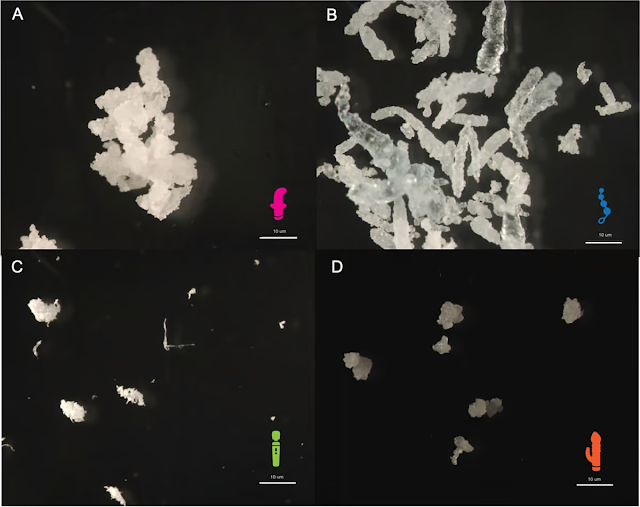
However, commonly used laboratory gloves release non-volatile residues, including stearate salts, that exhibit vibrational spectra similar to microplastics. In this work, we illustrate that dry surface contact with nitrile and latex laboratory gloves can cause overestimations of microplastics (mean 2000 false positives per mm2) when using traditional library matching approaches.
We recommend a nitrile cleanroom glove (mean 100 false positives per mm2) to reduce contamination.
For existing contaminated infrared and Raman spectral datasets, we outline workflows that differentiate between microplastics and stearate contamination from gloves. Applying these workflows to a case study of glove-contaminated environmental data, we illustrate that the proposed solutions reduce MP false positives at the smallest size ranges (<10 µm).
By using this approach in conjunction with our included spectral libraries of stearate standards, researchers can address glove-based contamination in environmental datasets and provide more accurate estimates of environmental microplastic abundance."
Residue from nitrile or latex gloves may unintentionally contaminate lab equipment scientists use to measure microplastics in air, water and other samples with non-plastic particles called stearates. Stearates, a kind of salt, are chemically similar at the structural level to microplastics. They also look similar visually.