Showing posts with label insecticide. Show all posts

Saturday, January 11, 2025

Toxic lover: Genetically engineering males to have venomous semen to kill disease-carrying females

Very clever! Femicide for dangerous insects.

Is there a good reason why not to eradicate bloodsucker from this Earth?

"... Now, researchers have found a way to up the efficiency: Instead of males’ semen lacking viable sperm, it contains lethal toxins from a venomous animal.

When researchers tested the approach on fruit flies, they found that toxins from anemones and Brazilian wandering spiders were most effective, reducing the median lifespans of mated female flies by up to 64%. Additional modeling they performed suggested such mortality would reduce female mosquito populations faster than other approaches and lower blood feeding by as much as 60%. ..."

From the abstract:
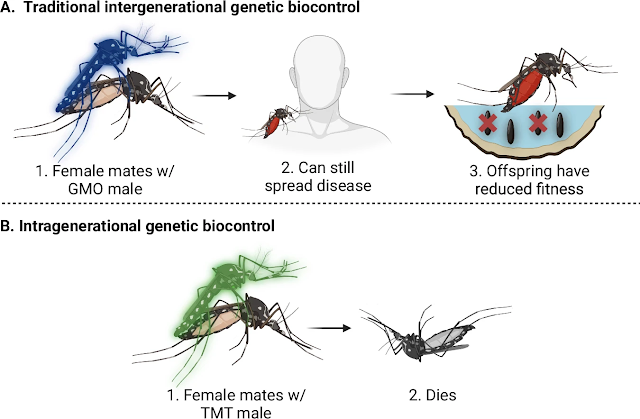
"The emergence of insecticide resistance has increased the need for alternative pest management tools. Numerous genetic biocontrol approaches, which involve the release of genetically modified organisms to control pest populations, are in various stages of development to provide highly targeted pest control. However, all current mating-based genetic biocontrol technologies function by releasing engineered males which skew sex-ratios or reduce offspring viability in subsequent generations which leaves mated females to continue to cause harm (e.g. transmit disease).
Here, we demonstrate intragenerational genetic biocontrol, wherein mating with engineered males reduces female lifespan. The toxic male technique (TMT) involves the heterologous expression of insecticidal proteins within the male reproductive tract that are transferred to females via mating. In this study, we demonstrate TMT in Drosophila melanogaster males, which reduce the median lifespan of mated females by 37 − 64% compared to controls mated to wild type males. Agent-based models of Aedes aegypti predict that TMT could reduce rates of blood feeding by a further 40 – 60% during release periods compared to leading biocontrol technologies like fsRIDL. TMT is a promising approach for combatting outbreaks of disease vectors and agricultural pests."

ScienceAdviser


Fig. 1: Intergenerational vs intragenerational genetic biocontrol of pest insects.


Monday, January 06, 2025

Why are bed bugs virtually unkillable? It might be genes (or atomic bomb blasts?)

Amazing stuff! 

They researched descendants of bed bugs hit by atomic bombs in 1945? How transferable are these results to bed bugs from other regions of the world?

"Bed bugs are notoriously difficult to remove once they’ve moved in – and they’re getting more difficult, thanks to their evolving resistance to insecticides.

A team of researchers has mapped the genomes of bed bug strains, aiming to find out why a “superstrain” has become 20,000 times more resistant to treatment. ...

In this study, researchers collected DNA from 2 bed bug sources.
One population, judged vulnerable to pesticides, had been originally collected from fields in Nagasaki, Japan, but maintained in a lab for 68 years.
The other population was collected from a hotel in Hiroshima, Japan, in 2010. ..."

From the abstract:
"Insecticide resistance in the bed bug Cimex lectularius is poorly understood due to the lack of genome sequences for resistant strains. In Japan, we identified a resistant strain of C. lectularius that exhibits a higher pyrethroid resistance ratio compared to many previously discovered strains.
We sequenced the genomes of the pyrethroid-resistant and susceptible strains using long-read sequencing, resulting in the construction of highly contiguous genomes (N50 of the resistant strain: 2.1 Mb and N50 of the susceptible strain: 1.5 Mb). Gene prediction was performed by BRAKER3, and the functional annotation was performed by the Fanflow4insects workflow.
Next, we compared their amino acid sequences to identify gene mutations, identifying 729 mutated transcripts that were specific to the resistant strain. Among them, those defined previously as resistance genes were included. Additionally, enrichment analysis implicated DNA damage response, cell cycle regulation, insulin metabolism, and lysosomes in the development of pyrethroid resistance. Genome editing of these genes can provide insights into the evolution and mechanisms of insecticide resistance. This study expanded the target genes to monitor allele distribution and frequency changes, which will likely contribute to the assessment of resistance levels. These findings highlight the potential of genome-wide approaches to understand insecticide resistance in bed bugs."

Why are bed bugs virtually unkillable? It might be genes


Figure 2. Transcripts with mutations in the resistant strain. (a) The number of mutation sites per transcript is shown by circles. (b–g) Mutation sites of candidate resistance genes are shown with different amino acids. 


Tuesday, September 10, 2024

Bat Declines Linked to increased Infant Mortality in the U.S. Really!

Seems to be a case of pseudo science! This research seems to be driven by ideological goals and personal preferences of the scientist and not by science!

I have serious doubts that this study would pass scrutiny! We are talking here about 121 infant deaths per year across the entire U.S. between 2006-2017. The author did not explicitly rule out e.g. if there were any serious child disease epidemics during this 11 year period that may have caused excessive deaths etc. On average there were 70 million children total per year during this period. Infant mortality is roughly 20 thousand per year in 2022.

"A “groundbreaking” study showing the connection between bats’ decline in the U.S. and infant mortality is the latest to demonstrate the stark toll of imbalanced ecosystems. 

According to the research, published last week in Science, a decline in bat populations due to a fungal disease led farmers in 245 counties to increase their use of insecticides by 31% to combat an increase in insect activity.
In those same counties, infant mortality rose by ~8%—accounting for 1,334 infant deaths—from 2006 to 2017. ..."

From the editor's summary and abstract:
"Editor’s summary
White-nose syndrome has caused declines in bat species across North America. Because bats typically prey on agricultural insect pests, this decline can be treated as a natural experiment to quantify the costs associated with the loss of an important ecosystem service. Frank used quasi-experimental methods to investigate how insecticide use can compensate for the loss of natural pest control from bats by considering both the economic and health costs of insecticides (see the Policy Forum by Larsen et al.). County-level insecticide use and infant mortality due to internal causes both increased after the emergence of white-nose syndrome, whereas farms’ crop revenue decreased. This study provides an example of how biodiversity loss affects human well-being and presents observational methods for quantifying those costs.
Structured Abstract
INTRODUCTION
...  Specifically, I use the sudden emergence of a deadly wildlife disease in insect-eating bats—known as white-nose syndrome—to quantify the benefits from their provision of biological pest control. I validate previous theoretical predictions that farmers respond by substituting bats with insecticides; however, because those are toxic compounds, by design, this substitution leads to higher human infant mortality rates in the areas affected by the bat die-offs.
RATIONALE
...
RESULTS
I used annual data at the county level on insecticide use and estimated that after the onset of bat die-offs, farmers in the county increase their insecticide use by 31.1%, on average. This demonstrates the substitution between a declining natural input and a human-made input—providing the first empirical validation of a fundamental theoretical prediction in environmental economics. I proceeded to document that infant mortality rates due to internal causes of death (i.e., not due to accidents or homicides) increased by 7.9%, on average, in the affected counties. This result highlights that real-world use levels of insecticides have a detrimental impact on health, even when used within regulatory limits, which highlights the difficulties of assessing the public health impacts of pesticides when regulating them individually.
The staggered expansion of the wildlife disease supports the causal interpretation of the results. Any additional alternative explanation would need to change along the expansion path of the wildlife disease around the same timing of its expansion. In additional analyses, I demonstrate that changes in crop composition, in other types of mortality, or in economic conditions fail to explain the observed results, even when controlling for fine-scaled and flexible time trends.
CONCLUSION
These findings help validate previous theoretical predictions regarding well-functioning ecosystems, where interactions between natural enemies—insect-eating bats and crop pests—allow farmers to use lower amounts of toxic substitutes. Not only are these results informative about natural enemy interactions generally, and biological pest control more specifically, they also highlight the direct agricultural and health benefits that bats provide. ...
Improving our understanding of how changes in biodiversity affect human well-being will be important when designing and implementing conservation policies. These findings inform ongoing efforts, such as pursuing the ambitious goal to place 30% of land and marine areas under protection by 2030, and highlight the importance of continued monitoring of biodiversity levels, as in the assessments released by the Intergovernmental Science-Policy Platform on Biodiversity and Ecosystem Services."

Global Health NOW: Sudan’s Widening ‘Nightmare’; No Known Animal Contact in Missouri Bird Flu Case; and Bat Declines Linked to Infant Mortality


Schematic framework linking the ecosystem and human health as being intermediated by the agricultural system.


Tuesday, October 17, 2023

Field study reveals banned pesticide sulfoxaflor had no effect on pollination by and colonies of bumblebees

Just a reminder how often and how much alarmism and hysteria is applied to insecticides and other chemicals!

"A pesticide banned for outdoor use by the EU could be less harmful to bees than had been thought. This is the conclusion of a study that exposed bumblebee colonies to sulfoxaflor, an insecticide approved in the EU in 2015 but banned for outdoor use in April 2022. ..."

From the abstract:
"Many pollinators, including bumble bees, are in decline. Such declines are known to be driven by a number of interacting factors. Decreases in bee populations may also negatively impact the key ecosystem service, pollination, that they provide. Pesticides and parasites are often cited as two of the drivers of bee declines, particularly as they have previously been found to interact with one another to the detriment of bee health. Here we test the effects of an insecticide, sulfoxaflor, and a highly prevalent bumble bee parasite, Crithidia bombi, on the bumble bee Bombus terrestris. After exposing colonies to realistic doses of either sulfoxaflor and/or Crithidia bombi in a fully crossed experiment, colonies were allowed to forage on field beans in outdoor exclusion cages. Foraging performance was monitored, and the impacts on fruit set were recorded. We found no effect of either stressor, or their interaction, on the pollination services they provide to field beans, either at an individual level or a whole colony level. Further, there was no impact of any treatment, in any metric, on colony development. Our results contrast with prior findings that similar insecticides (neonicotinoids) impact pollination services, and that sulfoxaflor impacts colony development, potentially suggesting that sulfoxaflor is a less harmful compound to bee health than neonicotinoids insecticides."

Field study reveals banned pesticide sulfoxaflor had no effect on pollination by bumblebees | Research | Chemistry World