Showing posts with label plastic recycling. Show all posts

Thursday, July 23, 2026

Chemical recycling plants closing in EU and US

Bad news! More research is certainly needed to find better and cheaper ways to recycle plastics or find better substitutes for plastics!

Is this article possibly spreading alarmism and hysteria?

"The nascent chemical recycling industry – in which plastics are broken down into oils or constituent monomers to be remade into new materials – is contracting across Europe and the US as recyclers call for policy stability to make the industry investable.

Recent closures, postponements or project cancellations ‘reflect the broader structural crisis facing the whole of Europe’s plastics recycling industry (both mechanical and chemical),’ says Maria Vera Duran, policy director at industry body Recycling Europe. ..."

Chemical recycling plants closing in EU and US | Business | Chemistry World (behind paywall) "Firms aiming to break down and re-make plastics are struggling with economic feasibility and environmental impact"

Sunday, February 01, 2026

In 2025 about 2% to 5% of plastic pollution of the oceans was removed

Good news! So much for the hysteria and alarmism about plastic polluting our oceans!

"Boyan Slat claims that his non-profit The Ocean Cleanup removed over 27,000 tons of plastic from the world’s waterways in 2025, which he estimates is 2 to 5 percent of annual plastic pollution. If the operation can maintain its current rate of growth, it could meet its goal “to clean up 90% of floating ocean plastic pollution by 2040.”"

Doomslayer: Progress Roundup - by Malcolm Cochran


Monday, January 12, 2026

Turning polystyrene waste into valuable chemicals like toluene with single-atom catalysts

Good news!

"... Researchers ... recently introduced a new approach to convert polystyrene (PS), a plastic widely used to pack some foods and other products, into toluene, a hydrocarbon that is of value in industrial and manufacturing settings. Their proposed strategy, outlined in a paper ... entails heating polystyrene waste in hydrogen and breaking it down into smaller vapor molecules, a process known as hydro-pyrolysis. ..."

From the abstract:
"Converting plastic waste into valuable products mitigates plastic pollution and lowers the carbon footprint of naphtha-derived aromatics. However, the difficulties of precisely controlling complex multiphase systems and the catalyst inefficiencies hinder process viability.
Here we report a vapour-phase hydrogenolysis strategy catalysed by Ru single atoms on Co3O4 (RuSA/Co3O4), decoupling depolymerization from hydrogenolysis to overcome the toluene yield–selectivity trade-off.
In a pressurized dual-stage fixed-bed reactor, polystyrene undergoes hydropyrolysis at 475 °C, followed by vapour-phase hydrogenolysis at 275 °C (0.4 MPa H2, 2.4 s), yielding toluene with 99% selectivity, 83.5 wt% yield and 1,320 mmol gcat.−1 h−1 rate.
The RuSA/Co3O4 catalyst demonstrates excellent stability, maintaining >99% conversion and selectivity during 100 h continuous operation (turnover number 24,747), and effectively processes diverse real-world polystyrene wastes.
Life-cycle assessment shows a 53% carbon footprint reduction over fossil-based methods, while techno-economic analysis estimates a competitive minimum selling price of US$0.61 kg−1, below the US$1 kg−1 industry benchmark."

Turning plastic waste into valuable chemicals with single-atom catalysts

Sunday, November 02, 2025

Progress in the recycling of polyurethane

Good news! Human ingenuity will take care of plastic trash! 

Alert: Plastophobia is a serious disorder. Please seek immediate medical help! (Caution: satire)

"Polyurethane, which is used in a wide variety of foams and spongy materials, is currently difficult to recycle. Part of the trouble is that it is constructed from two types of building blocks, respectively bearing oxygen- and nitrogen-linking groups, and most breakdown methods tend to cleanly recover just one of them. Hosgor et al. report that heating the foams in diethyl carbonate, which functions as both a reagent and solvent, together with zinc acetate as a catalyst, can deliver both the polyol (oxygen) and dicarbamate (nitrogen) components in 90 and 70% of respective yields."

From the abstract:
"Polyurethane foams (PUFs), a major component of common consumer products such as mattresses, generally end up in landfills because they cannot be properly recycled. As thermoset, PUFs cannot be remolten to new products either.
As condensation polymer, they can be depolymerized to recover one monomer, the polyol, but generally not the diisocyanate co-monomer without using phosgene, a toxic and wasteful reagent.
We show here the possibility to depolymerize PUF in a way that enables a harmless, waste-free and phosgene-free recovery of both diisocyanate and polyol. Accordingly, the PUF is depolymerized with a dialkyl carbonate – providing carbonyl exchange at low concentrations of nucleophile – to deliver a carbonated polyol with 90% yield and aromatic dicarbamates with 70% yield under non-optimized conditions. These precursors are known to be converted to the original polyols and diisocyanates at high yield by alcoholysis and pyrolysis, respectively. We present advanced analytical methods to characterize and quantify the depolymerization products. We also report model reactions to show that the depolymerization proceeds through a thermodynamic equilibration of carbonates, carbamates and ureas."

In Other Journals | Science


Fig. 1 Overview of the full chemical recycling process


Sunday, September 14, 2025

New, cheap catalyst improves mixed plastic waste recycling efficiency with no sorting

Good news! This could be a breakthrough!

"Researchers ... might have a way to largely skip sorting plastic. Their process uses an inexpensive catalyst that selectively breaks down the most common single-use kind of plastics into liquid oils and waxes that can be upcycled into lubricants and fuels. ...

The polyolefins ... are what trash bags, plastic wrap, squeeze bottles, and other disposable single-use packaging are made of. It's estimated that more than 220 million tons of polyolefin products are manufactured annually around the world – but only 1% to 10% of it is recycled globally, in part because this material is awfully hard to break down. ...

With its single-site design, the nickel-based catalyst preferentially cuts carbon-carbon bonds when used in plastic recycling processes. As such, it selectively breaks down only branched polyolefins for easier upcycling. It's especially remarkable because ... "polyolefins don’t have any weak links. Every bond is incredibly strong and chemically unreactive.”

This catalyst also happens to operate at a lower temperature and require less hydrogen gas to act on plastics. It also remains stable when exposed to polyvinyl chloride (PVC), a compound commonly found in pipes and flooring that contaminates plastics in the recycling process to the point where the entire batch becomes unusable and must be discarded. In fact, the inclusion of PVC actually accelerated the catalyst-driven process further. ..."

"... “Compared to other nickel-based catalysts, our process uses a single-site catalyst that operates at a temperature 100 degrees lower and at half the hydrogen gas pressure,” ... “We also use 10 times less catalyst loading, and our activity is 10 times greater. So, we are winning across all categories.” ...

Amazingly, not only did ... catalyst withstand PVC contamination, PVC actually accelerated its activity. Even when the total weight of the waste mixture is made up of 25% PVC, the scientists found their catalyst still worked with improved performance. This unexpected result suggests the team’s method might overcome one of the biggest hurdles in mixed plastic recycling — breaking down waste currently deemed “unrecyclable” due to PVC contamination. ..."

From the abstract:
"Current methods of processing accumulated polyolefin waste typically require harsh conditions, precious metals or high metal loadings to achieve appreciable activities.
Here we examined supported, single-site organonickel catalysts for polyolefin upcycling. Chemisorption of Ni(COD)2 (COD, 1,5-cyclooctadiene) onto Brønsted acidic sulfated alumina (AlS) yields a highly electrophilic Ni(I) precatalyst, AlS/Ni(COD)2, which is converted under H2 to the active AlS/NiIIH catalyst.
This single-site system exhibits unique hydrogenolysis selectivity that favours cleaving branched polyolefin C–C linkages, enabling the hydrogenolytic separation of polyethylene and isotactic polypropylene (iPP) mixtures.
Moreover, AlS/NiIIH remains highly selective and active for hydrogenolysis of iPP admixed with polyvinyl chloride, and the spent catalyst can be repeatedly regenerated by AlEt3 treatment.
Experimental mechanistic analysis and density functional theory modelling reveal a turnover-limiting C–C scission pathway featuring β-alkyl transfer and strong olefin binding. These results highlight the potential of nickel-based systems for the selective upcycling of complex plastic waste streams."

New catalyst improves plastic recycling efficiency

No-sort plastic recycling is near (original news release) "New catalyst could make mixed plastic recycling a reality"

Friday, June 27, 2025

Designer Microbes (E. coli) Make Painkillers (paracetamol) from Plastic Waste like PET

Good news! Amazing stuff! Bacteria can do it all! Next time you pop a painkiller ... 😊

Alert: Plastophobia is a serious disorder. Please seek immediate medical help! (Caution: satire)


"... For the past decade, ... a synthetic biologist at the University of Edinburgh, has been working on engineering microbes to produce diverse chemicals from sustainable sources. He has created bacterial factories that pump out nylon precursors using paper waste and vanilla flavor compounds from discarded plastic. Now, ... his team have designed bacteria that convert plastic waste into the widely used analgesic paracetamol.3 Published in Nature Chemistry, the technique has a negligible carbon footprint and introduces a new potential use for recycled plastic. ..."

"... A team of scientists ... used genetically reprogrammed E. coli, a harmless bacterium, to transform a molecule derived from PET known as terephthalic acid into the active ingredient of paracetamol. Researchers used a fermentation process, similar to the one used in brewing beer, to accelerate the conversion from industrial PET waste into paracetamol in less than 24 hours. The new technique was carried out at room temperature and created virtually no carbon emissions, proving that paracetamol can be produced sustainably. Further development is needed before it can be produced at commercial levels, the team says. Some 90 per cent of the product made from reacting terephthalic acid with genetically reprogrammed E. coli was paracetamol. ..."

From the abstract:
"Nature has evolved an exquisite yet limited set of chemical reactions that underpin the function of all living organisms. By contrast, the field of synthetic organic chemistry can access reactivity not observed in nature, and integration of these abiotic reactions within living systems offers an elegant solution to the sustainable synthesis of many industrial chemicals from renewable feedstocks.
Here we report a biocompatible Lossen rearrangement that is catalysed by phosphate in the bacterium Escherichia coli for the transformation of activated acyl hydroxamates to primary amine-containing metabolites in living cells.
Through auxotroph rescue, we demonstrate how this new-to-nature reaction can be used to control microbial growth and chemistry by generating the essential metabolite para-aminobenzoic acid.
The Lossen rearrangement substrate can also be synthesized from polyethylene terephthalate and applied to whole-cell biocatalytic reactions and fermentations generating industrial small molecules (including the drug paracetamol), paving the way for a general strategy to bioremediate and upcycle plastic waste in native and engineered biological systems."

Designer Microbes Make Painkillers from Plastic Waste | The Scientist "Engineered bacteria turned recycled plastic into paracetamol, a common analgesic, offering a fossil-free route to pharmaceuticals."

Microbes transform plastic waste into paracetamol (original news release) "Paracetamol production could be revolutionised by the discovery that a common bacterium can turn everyday plastic waste into the painkiller, a study reveals."

Everyday painkiller made from plastic — by E. coli "Study highlights potential for sustainable synthesis of paracetamol."


Graphical abstract


Fig. 1: Aniline synthesis from carboxylic acids in vitro and in vivo.


Fig. 3: Substrate synthesis from PET plastic waste for bioremediation.


Monday, June 16, 2025

Sunday, April 20, 2025

Invasive water hyacinth is highly effective at absorbing microplastics

Good news! Microplastics, nanoplastics is mostly alarmism and hysteria!

Alert: Plastophobia is a serious disorder. Please seek immediate medical help! (Caution: satire)


"Researchers in China have found that the water hyacinth—a prolific South American species that has colonized waterways around the world—is highly effective at absorbing microplastics. Within 48 hours, the hyacinths had removed more than half of the plastic particles in highly contaminated water. Remarkably, the plants were still healthy two weeks after the exposure."

"... Despite its reputation as a nuisance, water hyacinth has been shown to clean polluted water, effectively removing agricultural runoff and heavy metals. ..."

From the highlights and abstract:
"Highlights
• Eichhornia crassipes demonstrate significant phytoremediation potential for the removal of microplastics from contaminated water bodies.
• The extensive root cap surface area of E. crassipes (>150,000 mm2 per plant) enhances microplastic adsorption capacity.
Root caps are the primary sites for efficient microplastic entrapment in E. crassipes.
• A stem structure known as a “vascular ring” blocks the movement of microplastics to aerial tissues.

Abstract
Microplastics have emerged as pervasive environmental pollutants, posing significant risks to both terrestrial and aquatic ecosystems worldwide.
Current remediation strategies—including physical, chemical, and microbial methods—are inadequate for large-scale, in situ removal of microplastics, highlighting the urgent need for alternative solutions.
Phytoremediation, an eco-friendly and cost-effective technology, holds promise in addressing these challenges, though its application to microplastic pollution remains underexplored.
Here we show the capacity of Eichhornia crassipes (water hyacinth), a fast-growing, floating aquatic plant, to remove microplastics from contaminated water. Our results show that within 48 h, water hyacinth achieved removal efficiencies of 55.3%, 69.1%, and 68.8% for 0.5, 1, and 2 μm polystyrene particles, respectively, with root adsorption identified as the primary mechanism. Fluorescence microscopy revealed that the extremely large and abundant root caps, featuring a total surface area exceeding 150,000 mm2 per plant, serve as the principal sites for the entrapment of microplastics.
Furthermore, a unique “vascular ring” structure within the stem prevents the translocation of microplastics to aerial tissues, safeguarding leaves for potential downstream applications.
This study offers the first microstructural insight into the mechanisms underpinning water hyacinth's exceptional microplastic adsorption capacity and resilience, providing a promising framework for developing phytoremediation strategies to mitigate microplastic pollution in aquatic ecosystems."

Weekly Progress Roundup - by Malcolm Cochran - Doomslayer


Graphical abstract


Sunday, March 30, 2025

Ball milling breaks PFAS down into industrially useful fluoride source

There are now a several known methods available to breakdown so called PFAS plastics. I blogged here on 3/19/2025 about another method.

Forever chemicals is an ideological misnomer spread by demagogues!

"... In 2023, researchers ... developed a safer method by ball milling the calcium fluoride with a potassium phosphate salt, producing calcium phosphate and solid potassium salts that could be used to build carbon–fluorine bonds.2

The new work arose from a chance observation when the researchers explored the effect of different jar size for this process. ‘When the jar had a seal that was made from PTFE [polytetrafluoroethylene – commonly known as Teflon] instead of rubber, the fluoride recovery was more than what we introduced as fluorspar,’ ...  the researchers worked out that the phosphate acts as a nucleophilic oxyanion, causing cleavage of the carbon–fluorine bond in the PTFE. "

Ball milling breaks PFAS down into industrially useful fluoride source | Research | Chemistry World "Mechanochemistry could deal with ‘forever chemicals’"


Fig. 1: Synthesis of fluorochemicals from PFASs.


Wednesday, March 19, 2025

Piezoelectric Catalyst Destroys "Forever Chemicals"

Good news!

Good bye forever chemicals hysteria and alarmism!

"... But one Swiss startup says it has developed a piezoelectric catalyst that can eliminate 99 percent of these forever chemicals in wastewater streams and prevent them from entering water supplies.

On 30 January, Zurich-based Oxyle announced it had raised US $16 million to scale up its technology and deploy its first commercial units, which aim to eliminate the chemicals from industrial wastewater."

"... The company’s approach electrochemically breaks down PFAS into their chemical constituents such as carbon dioxide and fluorides, which then exit wastewater streams. “Instead of simply filtering PFAS, our solution actively degrades and mineralizes broad-spectra PFAS into harmless byproducts, eliminating the need for polluting, costly, and complex secondary waste management,” ...

To achieve this, Oxyle uses a nanoporous material coated with apiezoelectric catalyst that offers a massive surface area for immobilizing PFAS. When water flows across the material, the piezoelectric effect generates electrical charges. This triggers reduction and oxidation reactions that gradually degrade PFAS into their harmlesscompounds. For example, PFOA (perfluorooctanoic acid), a type of PFAS, gets broken down into fluoride ions (F-), sulfate ions (SO42-), and carbon dioxide (CO2). ..."

Piezoelectric Catalyst Destroys "Forever Chemicals" - Human Progress


Monday, March 17, 2025

Scientists break down various kinds of plastic using a simple, inexpensive catalyst and air

Good news!

I have blogged here several times before that there are multiple ways to process and recycle plastic trash!

Alert: Plastophobia is a serious disorder. Please seek immediate medical help! (Caution: satire)

"Harnessing moisture from air, ... chemists have developed a simple new method for breaking down plastic waste.

The non-toxic, environmentally friendly, solvent-free process first uses an inexpensive catalyst to break apart the bonds in polyethylene terephthalate (PET), the most common plastic in the polyester family. Then, the researchers merely expose the broken pieces to ambient air. Leveraging the trace amounts of moisture in air, the broken-down PET is converted into monomers—the crucial building blocks for plastics. ..."

From the abstract:
"Here, we describe the solventless catalytic deconstruction of polyethylene-terephthalate (PET) under an aerobic atmosphere, mediated by an earth-abundant, low-cost activated carbon (AC)-supported single-site molybdenum-dioxo catalyst (AC/MoO2). Catalytic amounts of AC/MoO2 selectively convert waste PET into its monomer, terephthalic acid (TPA), within 4 h at 265 °C with yields as high as 94% under 1 atm air. Pure crystalline TPA product sublimes from the reaction hot zone, crystallizing on the reactor cold zone, thus avoiding the need for separation and purification steps. This process does not employ any hazardous/toxic reducing agents or solvents, and the catalyst can be recycled multiple times without loss of activity, rendering this process highly atom-efficient. According to computational and experimental mechanistic studies, the AC/MoO2 catalyst mediates a thermoneutral metal-catalyzed β-scission step, followed by an exothermic step that converts the vinyl benzoate intermediate to TPA and acetaldehyde using trace amounts of moisture in the air. The formation of gaseous acetaldehyde makes the isolation of TPA from the reaction mixture facile and industrially favorable, especially since solvents are unnecessary.
The present methodology is also extended to the deconstruction of other frequently used polyester plastics, polybutylene terephthalate (PBT), polyethylene naphthalate (PEN), and polyethylene furanoate (PEF), and operates equally well with post-consumer waste products.
Notably, this process is also compatible with plastic mixtures of polyesters with polyolefins, polyamides, and polycarbonates, leading to the selective conversion of each polyester to the corresponding monomer, leaving the residual polymer unchanged and polyester-free."

Scientists break down plastic using a simple, inexpensive catalyst and air


Saturday, September 07, 2024

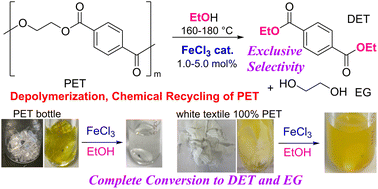
Iron and alcohol makes a common type of plastic (PET) recyclable from cloth waste and plastic waste mixtures

Good news! Human ingenuity beats plastophobia anytime!

Note "from cloth waste and plastic waste mixtures"! Previously, the necessary separation of trash had been a significant issue.

"... Importantly the method is selective, meaning it could recycle the PET in mixtures of plastics and textiles. ...
Chemists have been investigating depolymerisation reactions that can turn the PET back into re-usable monomers, but most known methods require high industrial temperatures and corrosive acids or bases.
These researchers’ new method can be done at under 200°C (low by industrial standards), and uses just alcohol and a cheap iron-based catalyst.
The researchers found that mixing PET with ethanol and ferric chloride (FeCl3) or iron(III) bromide (FeBr3) for a couple of days, at 160-180ºC, yielded an almost-pure mixture of the monomers used to make PET. ..."

"... The research team has now developed a method for acid- and base-free depolymerization of PET bottles using ethanol and either FeCl3 or FeBr3, yielding diethyl terephthalate (DET) and ethylene glycol (EG) with high selectivity (98-99%). Iron trichloride (FeCl3), which is inexpensive and widely available, demonstrated superior catalytic performance at 160-180 ºC, comparable to their previous results using titanium catalyst. Notably, this method enabled the exclusive and selective depolymerization of PET from textile waste, which comprises PET and a mixture of PET and cotton, yielding DET and EG while quantitatively recovering cotton waste. The catalyst also facilitated the selective depolymerization of PET from plastic waste, including polyethylene. ..."

From the abstract:
"Acid-, base-free depolymerization of poly(ethylene terephthalate) (PET) with ethanol catalyzed by FeCl3, FeBr3 (1.0–5.0 mol%) gave diethyl terephthalate (DET) and ethylene glycol (EG) exclusively (98–99%, 160–180 °C), and FeCl3 showed better catalytic performance in terms of activity. The FeCl3 catalyst enabled exclusive, selective depolymerization of PET from textile waste to afford DET (and recovered cotton waste), strongly suggesting the possibility of chemical recycling of cloth waste by the transesterification in this catalysis."

Iron and alcohol makes plastic textiles recyclable

Exclusive chemical recycling of PET from cloth waste and plastic waste mixtures (original news release) "A novel solution to the plastic waste problem: simple, selective depolymerization of polyesters using alcohol and a soluble iron catalyst"


Scheme 3 Acid-, base-free catalytic transesterification (depolymerization) of PET with ethanol catalyzed by FeCl3, FeBr3.


Friday, August 09, 2024

German researchers discovered fungi in a lake that eat plastics

Human ingenuity will sooner or later successfully and effectively deal with the plastic issue! Everything else is mostly hysteria and alarmism!

I bet these fungi are already polluted with microplastics and forever plastics! Caution: irony!

Tuesday, May 21, 2024

Bacterial enzyme found to dissolve styrene based plastics

More and more plastic materials can be biologically recycled! Here is another success story!

Plastophobia is a serious disorder! Please seek immediate medical help!

It appears, these researchers found bacterial enzymes that can dissolve styrene based plastics!

From the abstract (regrettably, this abstract is written for a handful of experts):
"Membrane-bound styrene oxide isomerase (SOI) catalyses the Meinwald rearrangement—a Lewis-acid-catalysed isomerization of an epoxide to a carbonyl compound—and has been used in single and cascade reactions. However, the structural information that explains its reaction mechanism has remained elusive. Here we determine cryo-electron microscopy (cryo-EM) structures of SOI bound to a single-domain antibody with and without the competitive inhibitor benzylamine, and elucidate the catalytic mechanism using electron paramagnetic resonance spectroscopy, functional assays, biophysical methods and docking experiments. We find ferric haem b bound at the subunit interface of the trimeric enzyme through H58, where Fe(III) acts as the Lewis acid by binding to the epoxide oxygen. Y103 and N64 and a hydrophobic pocket binding the oxygen of the epoxide and the aryl group, respectively, position substrates in a manner that explains the high regio-selectivity and stereo-specificity of SOI. Our findings can support extending the range of epoxide substrates and be used to potentially repurpose SOI for the catalysis of new-to-nature Fe-based chemical reactions."

Enzym aus Bakterien macht Polystyrol endlich biologisch abbaubar - ingenieur.de

Allgegenwärtige Kunststoffe biologisch abbaubar machen (original news release) Mit der Aufklärung der Funktion eines bestimmten Bakterien-Enzyms ist der Weg zum biotechnologischen Abbau von Styrol geebnet.


Extended Data Fig. 1: Summary of enzyme cascades involving SOI and the bacterial styrene-degradation pathway.


Friday, May 10, 2024

Microrobots capture bacteria and microplastics out of the water

Amazing stuff! Good news! These microrobots are reusable!

Plastophobia is a serious disease! Please seek medical help immediately!

"Scientists have developed tiny "robots" which appear to be very effective at removing microplastics pollution from water. What's more, the little bots also target the harmful bacteria that often hitch a ride on the plastic particles. ..."

From the abstract:
"The forefront of micro- and nanorobot research involves the development of smart swimming micromachines emulating the complexity of natural systems, such as the swarming and collective behaviors typically observed in animals and microorganisms, for efficient task execution. This study introduces magnetically controlled microrobots that possess polymeric sequestrant “hands” decorating a magnetic core. Under the influence of external magnetic fields, the functionalized magnetic beads dynamically self-assemble from individual microparticles into well-defined rotating planes of diverse dimensions, allowing modulation of their propulsion speed, and exhibiting a collective motion. These mobile microrobotic swarms can actively capture free-swimming bacteria and dispersed microplastics “on-the-fly”, thereby cleaning aquatic environments. Unlike conventional methods, these microrobots can be collected from the complex media and can release the captured contaminants in a second vessel in a controllable manner, that is, using ultrasound, offering a sustainable solution for repeated use in decontamination processes. Additionally, the residual water is subjected to UV irradiation to eliminate any remaining bacteria, providing a comprehensive cleaning solution. In summary, this study shows a swarming microrobot design for water decontamination processes."

Tiny tenacious robots snatch bacteria and microplastics out of the water


Graphical abstract


Sunday, May 05, 2024

This Startup's AI Designs Enzymes That Can Eat Plastic Waste

There are news like this almost every month if not more frequently! Plastic consumption has essentially become a non issue! Plastophobia is a serious disease! Please seek medical help immediately!

Wednesday, April 17, 2024

Plastic Degradation Company, Breaking, Emerges from Stealth with Naturally-Derived Solution to Degrade Multiple Plastics with $10.5M in Seed Funding

Good news! Human ingenuity will eventually handle the recycling of plastic (whether so called and demonized forever PFAS or not)!

From research to application!

Plastophobia has been affecting so many intellectuals and elites for decades! Please see a doctor immediately as plastophobia is a serious health condition!

"Breaking, a plastic degradation and synthetic biology company, gestated at Colossal Biosciences based on a core discovery out of the Wyss Institute for Biologically Inspired Engineering at Harvard University, launches today with the announcement of their discovery, X-32, which they will develop to address the global plastics crisis. In its natural state, X-32 can degrade polyolefins, polyesters, and polyamides leaving behind carbon dioxide, water, and biomass in as little as 22 months. With future synthetic genetic edits, the team is focused on making X-32 faster, more efficient, and more effective with a harmless environmental impact. ..."

Plastic Degradation Company, Breaking, Emerges from Stealth with Naturally-Derived Solution to Degrade Multiple Plastics with $10.5M in Seed Funding | Business Wire

Plastivores: Plastic-Degrading Super-Microbes and Enzymes Plastic-eating microbes and enzymes capable of degrading multiple types of plastics could help reduce global plastic waste and mitigate pollution