Showing posts with label sociology. Show all posts

Wednesday, July 15, 2026

The richer get richer – not just materially, but socially | Cornell Chronicle. Really!

So what! Especially in America, an individual (no matter rich or poor or background) with skills and talent is most likely quickly spotted and given an opportunity.

It also depends very much on the individual him- or herself to make better "social connections" in life!

Is sociology a pseudoscience?

"... This familiar example of elite network influence proves the adage that it’s not what you know but who you know that matters. And such disparities in social connection are far more pervasive throughout daily life than generally recognized, Cornell sociologists argue in a new open-access book, “Friends and Fortunes: Social Capital Inequality in America.”
Inequality in social ties is as stark as income inequality in the United States, the researchers say – and the two are mutually reinforcing. ...

“Why should there be differences in access to valuable social connections? Are they not free?” the authors write. “One would hope so. But the data tell a different story.” ...

explain how social networks subtly feed hidden systems of power, prestige, wealth and, ultimately, life chances. ..."

The richer get richer – not just materially, but socially | Cornell Chronicle


Wednesday, June 03, 2026

Why are white-black marriage rates so low in the US? Really!

This study relies way too much on statistical modeling! 

Notice also the ideological usage of Black v. white! Very annoying and disturbing! How biased is this research?

Spatial exposure seems to be overemphasized and narrowly defined, i.e. childhood neighborhood, but what  e.g. what about military service?.

Some black folks may say white people can't dance and have no rhythm! 😊 Just kidding!

"Americans rarely marry outside of their race or class in a nation where residential segregation is relatively common. It is a dynamic widely viewed as a contributing factor to income inequality and intergenerational social mobility.

A new National Bureau of Economic Research working paper examines whether increased exposure to members of other race and class groups affects marriage rates between Black and white partners, based on an analysis of Census data and federal tax records. The overall rate has grown slowly over the years and currently stands at only 11 percent of intermarried couples. ..."

From the abstract:
"Americans rarely marry outside their race or class group, a pattern with well-documented implications for inequality and intergenerational mobility.
Limited exposure—or interactions with members of other groups—may partly explain these low intergroup marriage rates. We instrument for exposure using variation in childhood neighborhoods based on whether other race and class groups had more opposite-sex children of similar age.
Exposure increases interclass (high- and low-parent-income) marriage but has no detectable effect on interracial (White and Black) marriage.
A spatial marriage market model predicts that residential segregation—one of many forms of exposure—accounts for more than one third of marital sorting by class but less than 5% by race."

Why are white-Black marriage rates so low? — Harvard Gazette "New research suggests increased exposure between groups results in more couplings across class but not racial line."


Friday, April 10, 2026

Resurfacing a Forgotten Icon: Shere Hite

Older folks may remember the Hite Report published in 1976! It was quite a sensation back then.

Feminists sure liked this report when it came out!

Resurfacing a Forgotten Icon | Radcliffe Institute for Advanced Study at Harvard University "There was a time when Shere Hite was everywhere in American media—and then she disappeared. The scholar Rosa Campbell is bringing her groundbreaking lessons to new audiences."


Shere Hite


The Hite Report has sold 50 million copies worldwide, making it the 30th best-selling book of all time.


Tuesday, October 28, 2025

How social norms evolved over time and differ across 90 countries

Recommendable! Who would have guessed that kissing or flirting at a job interview is not a good idea? This seems to be universally accepted.

"When humans interact with each other and engage in everyday activities, they typically follow various undefined rules, also known as social norms. ...

As part of their study, Eriksson, Strimling and their colleagues recruited 25,422 people living in 90 different societies worldwide and asked them to complete an online survey. This survey asked them to rate 150 everyday behaviors based on how acceptable or unacceptable they perceived them to be in specific situations. ...

In addition, they compared the survey responses to those gathered in a similar survey administered 20 years ago, to shed light on how social norms had changed over time. ..."

From the abstract:
"Every social situation that people encounter in their daily lives comes with a set of unwritten rules about what behavior is considered appropriate or inappropriate. These everyday norms can vary across societies: some societies may have more permissive norms in general or for certain behaviors, or for certain behaviors in specific situations.
In a preregistered survey of 25,422 participants across 90 societies, we map societal differences in 150 everyday norms and show that they can be explained by how societies prioritize individualizing moral foundations such as care and liberty versus binding moral foundations such as purity.
Specifically, societies with more individualistic morality tend to have more permissive norms in general (greater liberty) and especially for behaviors deemed vulgar (less purity), but they exhibit less permissive norms for behaviors perceived to have negative consequences in specific situations (greater care).
By comparing our data with available data collected twenty years ago, we find a global pattern of change toward more permissive norms overall but less permissive norms for the most vulgar and inconsiderate behaviors
This study explains how social norms vary across behaviors, situations, societies, and time."

How social norms evolved over time and differ across countries


Behavior-specific and situation-specific global everyday norms. A color-coded matrix illustrating the global appropriateness ratings (averaged over 71 societies) of fifteen behaviors in each of ten situations.


Sunday, August 31, 2025

Gen Z is, by a large margin, the least criminal American generation in living memory. Really!

Not so fast! 

Why did this not happen already with the video game playing generation before? Were we not saying back then that teenagers and young adults were spending too much time in front of the screen.

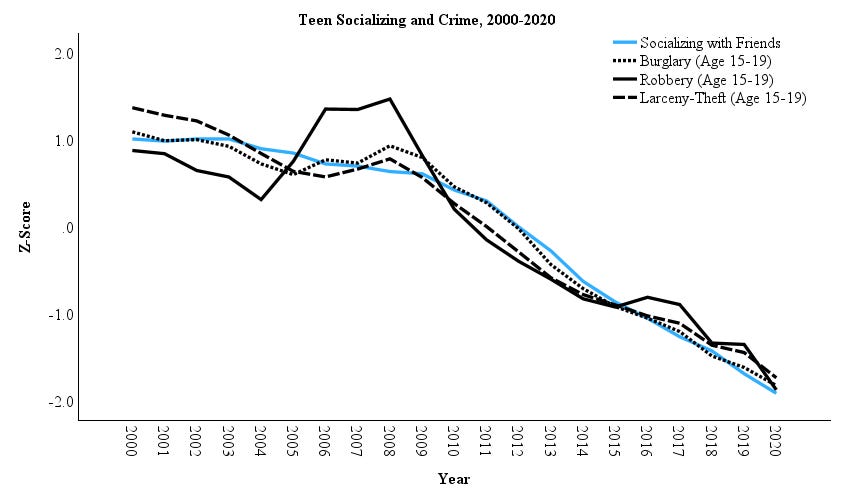
Maybe the new generation is not so much interested in committing old fashioned crimes like burglary, robbery, or larceny-theft as the chart below suggests.

What about cyber crimes

"One silver lining to the worrying decline in teenage socializing is a concurrent drop in the teen crime rate. Data compiled by the sociologist James Tuttle suggests that Gen Z is, by a large margin, the least criminal American generation in living memory."

Doomslayer: Weekly Progress Roundup - by Malcolm Cochran

The Smartphone-Induced Teen Crime Decline "Gen Z made crime rates 'crash out'"


"The correspondence between teenage socializing and crime rates is remarkable."


Saturday, August 09, 2025

On the longitudinal Global Flourishing Study

This seems to be a major endeavor!

Unfortunately, if there were some initial results from this study (as the title of the published study suggests), they were buried somewhere! Not a good sign!

"The Global Flourishing Study (GFS) is a longitudinal research study being carried out in collaboration between scholars at the Human Flourishing Program at Harvard and Baylor’s Institute for Studies of Religion, and in partnership with Gallup and the Center for Open Science.

The study involves data collection for over 200,000 participants, from 22 geographically and culturally diverse countries, with nationally representative samples within each country, and with annual data collection on the same panel of individuals for five waves of data. The survey includes a rich set of questions on well-being along with demographic, social, economic, political, religious, personality, childhood, community, health and character-based questions.

The panel includes individuals from Argentina, Australia, Brazil, China (Hong Kong), Egypt, Germany, India, Indonesia, Israel, Japan, Kenya, Mexico, Nigeria, the Philippines, Poland, Turkey, South Africa, Spain, Sweden, Tanzania, the United Kingdom, and the United States. These countries were selected in consultation with Gallup to maximize coverage of the world’s population, to ensure geographic, cultural, and religious diversity, and in consideration of existing data collection infrastructure and feasibility.

This $43.4 million initiative ... The study has the potential to transform and dramatically expand our understanding of human flourishing. ...

Prior research on flourishing has been severely limited by several factors. Much prior research on the factors that shape flourishing has relied upon cross-sectional samples, with all of the data collected at the same time. Reliance on cross-sectional data makes it difficult to provide evidence concerning causation. Much of the research on well-being has also been restricted to samples in the United States and Europe. ..."

From the abstract:
"The Global Flourishing Study is a longitudinal panel study of over 200,000 participants in 22 geographically and culturally diverse countries, spanning all six populated continents, with nationally representative sampling and intended annual survey data collection for 5 years to assess numerous aspects of flourishing and its possible determinants. The study is intended to expand our knowledge of the distribution and determinants of flourishing around the world. Relations between a composite flourishing index and numerous demographic characteristics are reported.
Participants were also surveyed about their childhood experiences, which were analyzed to determine their associations with subsequent adult flourishing. Analyses are presented both across and within countries, and discussion is given as to how the demographic and childhood relationships vary by country and which patterns appear to be universal versus culturally specific.
Brief comment is also given on the results of a whole series of papers in the Global Flourishing Study Special Collection, employing similar analyses, but with more-specific aspects of well-being. The Global Flourishing Study expands our knowledge of the distribution and determinants of well-being and provides foundational knowledge for the promotion of societal flourishing."


Credits: Is Progress Making Us Miserable? - by Human Progress


Saturday, December 14, 2024

Women with high levels of ‘interoception’ orgasm more often. The secret of the female orgasm may have been revealed . Really!

Why use big latin words to describe a simple, long known fact that frigid women or guilt driven women or women subjected to religious or cultural  orthodoxy may not quite have the pleasure. Or how about old fashioned trust, closeness, intimacy, and love as having some influence!

Unfortunately, the article below and the research article both use the ideological and phony woke term "people who identify as women"! Absolutely terrible! Shame on them! 

Three of the four authors of this study are women themselves or shall we call them people who identify as women!

If my memory serves me well, there were serious struggles in the 1950s and 1960s or so in Western countries to demonstrate and establish that women have intense orgasms too comparable to men and/or different from men. The struggle succeeded back then already!

However, the authors of this new study almost want you to believe that the female orgasm is still a taboo in Western societies!  What a joke!

Since 1950s or so, the upbringing of girls and sex education in Western countries has changed a lot for the better.

5.3% of the 318 respondents of this study were not women, but trans men or non-binary! I guess, these are the signs or manias of our time! Science follows fashion! It would not have crossed my mind to muddy the study by including these individuals! DEI must die!

This study suggests that self stimulation (masturbation?) or "solitary orgasm" without partner seems to be of "greater frequency and satisfaction".

"A new study investigating the female orgasm has found that women have more frequent and satisfying climaxes when they have high levels of “interoception” – the ability to focus on and sense body sensations such as heartbeat and touch. ...
The majority of respondents were cisgender women (94.7%), 2 were trans men (0.6%), and 17 (4.7%) identified as non-binary with female sex assigned at birth. .."

"... Researchers led by the University of Essex found that women climax more frequently if they have high levels of an inward-looking sense known as interoception. ...

discovered women who noticed and attend to internal bodily signals– like heartbeats, breathing, and sensual touch sensations - have more frequent orgasms. ...

“Our study empirically demonstrates that women need to get out of their heads and into their bodies in order to have more frequent and satisfying orgasms. ..."

From the abstract:
"Background:
The female orgasm is a highly understudied phenomenon [??? Really!] that is linked to both wellbeing and relationship satisfaction in women. Although orgasm has been associated with interoception—the sense of the physiological condition of the body—very few studies have directly examined the influence that interoception has on orgasm.
Objectives:
This study investigates how the subjective experience of one’s interoceptive capacities (called interoceptive awareness) is associated with self-reported orgasm frequency and satisfaction in people who identify as women [Grrrr!!!! Cringe!].
Methods:
In a dataset of 318 women, orgasm frequency and satisfaction were both rated significantly higher for solitary as compared to partnered sexual experiences. Results:
Analysis of how dimensions of interoceptive awareness correlated with orgasm frequency and satisfaction showed that
(1) ‘Noticing’ predicted orgasm frequency (but not satisfaction) across both solitary and partnered interactions, 
(2) ‘Attention Regulation’ predicted greater frequency and satisfaction of solitary orgasm (but not partnered interactions), and 
(3) ‘Body Trusting’ predicted orgasm satisfaction (but not frequency) across both solitary and partnered contexts.
Conclusions:
Findings underscore the importance of moving beyond orgasmic dysfunction research by investigating how interoception is associated with healthy—and potentially even optimal—orgasmic functioning in women."

Women with high levels of ‘interoception’ orgasm more often

Secret of the female orgasm uncovered by psychologists (original news release) "The secret of the female orgasm may have been revealed by scientists in a pioneering study."


Figure 1. Multiple regression analyses. Dimensions of interoception as simultaneous predictors of orgasm frequency (top row) and satisfaction (bottom row).


Friday, June 30, 2023

Spouses sharing friends may live longer after widowhood

Unfortunately, it appears the length of marriage and intensity of relationship was not really covered.

"The “widowhood effect” – the tendency for married people to die in close succession – is accelerated when spouses don’t know each other’s friends well, new Cornell sociology research finds.
Analyzing the first longitudinal data detailing older adults’ social networks along with demographic and health measures, the researchers found that over a 10-year study period, the probability of death was five times greater among widows whose friends weren't close to their partner. ...
The data confirmed a “significant” widowhood effect. Controlling for age, gender, race, ethnicity, socioeconomic status, relationship quality and health, the risk of death in the next five years among study participants whose spouses died was nearly twice that of participants who remained married.
Prior research has identified physiological and social factors thought to contribute to the phenomenon. Some cases could involve heart failure resulting from stress hormones flooding the body, known as “broken heart syndrome” or “takotsubo syndrome.” Longer-term effects of grieving and social isolation could also play a role. In addition, couples sharing similar backgrounds and lifestyles may inevitably share similar health trajectories. ..."

From the abstract:
"Research on “the widowhood effect” shows that mortality rates are greater among people who have recently lost a spouse. There are several medical and psychological explanations for this (e.g., “broken heart syndrome”) and sociological explanations that focus on spouses’ shared social-environmental exposures. We expand on sociological perspectives by arguing that couples’ social connections to others play a role in this phenomenon. Using panel data on 1,169 older adults from the National Social Life, Health, and Aging Project, we find that mortality is associated with how well embedded one’s spouse is in one’s own social network. The widowhood effect is greater among those whose spouses were not well connected to one’s other network members. We speculate that the loss of a less highly embedded spouse signals the loss of unique, valuable, nonredundant social resources from one’s network. We discuss theoretical interpretations, alternative explanations, limitations, and directions for future research."

Spouses sharing friends may live longer after widowhood | Cornell Chronicle

Wednesday, September 29, 2021

SOCIOLOGY - Émile Durkheim

This video explains very well why Emile Durkheim and this work has faded away without many people ever having heard of him or it. His views were very one sided and narrow minded!
The video explicitly discusses his book Suicide. Most of it is debunked. It was also not a criticism of capitalism or the new age of industrialization, but contrasting catholics and protestants with respect to their suicide rates. 

Saturday, March 28, 2020

The Much Abused Matthew effect

Posted: 3/28/2020

Recently, I watched episode 2 of Niall Ferguson's Networld documentary. He tried to explain certain network effects with the Matthew effect!

Apparently, sociologists like Robert K. Merton transferred this biblical narrative to describe certain effects in society. Merton is famous for such concepts as self fulfilling prophecy, unintended consequences, and role model. However, with the Matthew effect, he misappropriated and erred!

"The Matthew effect of accumulated advantage, Matthew principle, or Matthew effect for short, is sometimes summarized by the adage "the rich get richer and the poor get poorer""

Some observations regarding the so called Matthew effect:
  1. The references in the Bible refer to spiritual gains not material gains. It is also quite obvious that the usual Bible references are taken out of context (see e.g. S1)
  2. The sociological view of this effect is extremely static and relies on primitive/naive extrapolation, while in reality society (in particular an open and free society) is much more dynamic etc.

Monday, September 24, 2018

On Civil Society And Acts Of Crime

Posted: 9/24/2018

Introduction

This blog post is primarily focused on Western democracies, but, I suspect, my discussion here has some relevance to other parts of the world as well.

Definition Of Crime

Theft, fraud, physical violence resulting in injury or death against humans (includes eg. poisoning), physical violence against or damage to property. Negligence or recklessness which harms others.

A crime committed to (purportedly) correct another crime or a previous crime is still a crime.  

Not every crime defined by law is actually a crime. This is a very important point to keep in mind!

Premise

In a civilized and under the rule of law society there are basically no justifications for crime! There is absolutely not justification for career criminals!

Many Pseudo & Wrong Justifications Of Crime

Plenty of pseudo, but influential justifications for crime were promulgated and steadily promoted over the centuries. Unfortunately, they have gained great popularity and familiarity.

Robin Hood excuse: To steal from the rich and give it to the poor often with the implied or insinuated accusation that the rich themselves are thieves and that is why or how they got rich. Perhaps, there was some truth to this excuse centuries ago or when it comes to uncivilized societies or societies without the rule of law. Most of the times, thieves steal for themselves only and rarely give anything to the poor.
Social or environmental causes of crime excuse: This is a very popular excuse especially among lefties! It is  society or environmental circumstances are at fault why some members of society choose a career of crime. How convenient is that to explain away and to absolve individual responsibility! Once you accept this excuse, its proponents demand a Big Government to take care of it by expanding e.g. the welfare state.

Poverty as excuse: This is a particular lame excuse! There are many non criminal and voluntary ways available in a civil society to overcome or reduce poverty. Many individuals in a civil society are willing to provide voluntary help or relieve to those in poverty. Crime as a means of taking justice into your own hands is not acceptable.

Substance or other addiction excuse: Poor addicts cannot help themselves but to commit crimes to sustain their lives of addiction or so it goes. In prison, addicted criminals could receive medical treatment for their addiction. Whether to legalize drugs is another topic. How to deal with intramural (in prison) drug dealers is another question.

White collar versus blue collar crime excuse: This is another one of the famous, often repeated excuses. The excuse tends to go like this that white collar criminals:
  1. Face much less law enforcement
  2. Rarely go to jail
  3. Can afford to hire much better attorneys for their defense
  4. Evidence against them is much harder to come by
These arguments are flimsy and do not hold up to scrutiny, e.g. the victims of white collar crimes are often very sophisticated themselves and should have better known or the victims do not even choose to indict the criminal for various reasons.

Opportunity makes a thief excuse: Yes, of course, put the blame on the victim of a crime. Good defenses against crime often do not come cheap and these defenses need to be constantly updated and 100% maintained 24 hours year round, while a criminal (like a terrorist) has to succeed only once at a time, manner, and place of his/her choosing. A very asymmetric advantage of a criminal.

The Economic View Of Crime

To summarize:
  1. Criminals are rational, planning, and calculating like other humans.Criminals constantly weigh the benefits and disadvantages of committing a crime versus a law abiding life
  2. Criminals tend to fear or avoid crimes punished with harsh sentences
  3. Criminals tend to avoid strong crime preventative measures
  4. Crimes pays very well for some career criminals. Therefore, many try to become such criminals themselves
  5. The very asymmetric advantage of a criminal, because he exploits human trust and wish to live in peace and harmony. The huge advantage of a criminal of choosing where, when and how to commit a crime

Ultima Ratio Justification

One of the very few acceptable justifications for crime would be the threat of imminent starvation of the person or a loved one of the person. E.g. the person steals food, because the person tried everything humanly possible to obtain food legally, but the person failed due to no fault of his or her own.

Widespread Complacency About Crime

It appears, there is a widespread complacency about crimes in Western democracies:
  1. There will always be some crime committed. Crimes cannot be completely eliminated
  2. Criminals should be given more opportunities to become a law abiding citizen and a valuable member of society
  3. It is society’s fault at large that we have criminals. So let’s treat criminals as human as possible

In a civil society, (not even petty) crimes should never be ignored or taken lightly. Crimes undermine the foundation of a civil society. Crimes encourage further crimes.

Sunday, January 04, 2015

Risk Society Rest In Peace

Posted: 1/4/2015


Trigger


Just read in this article that one of the two major proponents of risk society (german: Risikogesellschaft), german sociologist Ulrich Beck, has passed away.


Risk Society Was A Dead End


I personally never read Beck’s famous book (translated into 35 languages) about risk society, but I was kind of aware of his great influence on politics etc. I genuinely hope that humanity can quickly move on


The coincidence of the Chernobyl nuclear disaster and the publication of this book in 1986 gave this book an enormous, unwarranted prominence and popularity. The Chernobyl nuclear disaster was not much more but a testament to the inhumanity and disregard for human life of the real socialist dictatorship USSR, which was at the time already in its imminent death throes.


I would say, the biggest flaw of the concept of risk society was that it is extremely one sided.  The author used dubious expressions like “Logik der Risikoproduktion” (logic of risk production) “Logik der Risikoverteilung” (logic of risk distribution). The author underrated the opportunities that come with risk taking; the progress of human ingenuity to deal with negative aspects of technological progress and so on.


Risk Society Was An Appeal To Superstition & Apocalypse


Risk society was an excuse for extreme environmentalism and, I suspect, other phenomena (e.g. precautionary principle) of the last 30 years.


To quote from the above Wikipedia article on risk society:
  1. “Beck argued that environmental risks had become the predominant product, not just an unpleasant, manageable side-effect, of industrial society.”
  2. “Modern societies, however, are exposed to risks such as pollution, newly discovered illnesses, crime, that are the result of the modernization process itself. Giddens defines these two types of risks as external risks and manufactured risks. Manufactured risks are marked by a high level of human agency involved in both producing, and mitigating such risks.”


It is not modernization per se, but the increase of the human population to now 7 billion and increasing to 8 billion in about 12 years from now that causes many of the issues. The distinction between ‘external’ and ‘manufactured’ risks is more manufactured than real. Pre-modern societies were exposed to similar risks as modern societies. It is probably also condescending or arrogant to say that pre-modern societies were not as reflexive about their future as modern societies.

It is reported that Beck conjured imaginations of the sorcerers apprentice (Goethe’s Zauberlehrling) or the Jewish golem.