Showing posts with label mosquito eradication. Show all posts

Sunday, November 09, 2025

New highly effective mosquito traps containing a genetically modified fungus

Good news! Eradicate blood suckers!

Apparently, this or similar approaches with Metarhizium have been tried before multiple times in recent years. Thus, this research is not entirely new. My guess is that the combination of attraction and effective killing is new.

"Chinese scientists are using a genetically modified fungus to create highly effective mosquito traps. The engineered Metarhizium constantly releases a scent that draws mosquitoes into fungus-laced traps, where the spores infect and kill them. In lab tests, these traps killed 90 to 100 percent of mosquitoes. The researchers hope their fungus could offer a cheap, scalable alternative to chemical insecticides."

"... Researchers reported last week in the journal Nature Microbiology that Metarhizium — a fungus already used to control pests — can be genetically engineered to produce so much of a sweet-smelling substance that it is virtually irresistible to mosquitoes. When they laced traps with those fungi, 90 percent to 100 percent of mosquitoes were killed in lab experiments. ..."

From the abstract:
"Chemical insecticides have been the primary method of mosquito control, but in recent years, mosquitoes have become resistant to these compounds.
Metarhizium fungi are emerging as promising alternatives and can kill mosquitoes with a small number of spores.
It was previously shown that caterpillars affected by fungal infections can attract mosquitoes. However, the mechanisms and potential applications of this attraction are lacking.
Here we show that Metarhizium-colonized insect cadavers release the volatile longifolene to attract and infect healthy insects, facilitating spore dispersal.
We identified the responsible odorant receptors in Drosophila melanogaster and Aedes albopictus.
The virulent mosquito pathogen Metarhizium pingshaense was engineered to express pine longifolene synthase to produce a large amount of longifolene on media.
The transgenic spores effectively attracted and killed male and female A. albopictus, Anopheles sinensis and Culex pipiens. Attraction of wild-caught mosquitoes was not impacted by human presence, but mosquito-attracting flowering plants competed with transgenic M. pingshaense for attractiveness, although mortality remained over 90%.
This study uncovered an active spore dispersal mechanism in broad-host-range entomopathogenic Metarhizium, enhancing mosquito control efficacy."

"... What also makes this new fungal technology particularly promising is how practical and affordable it is to produce. Other forms of Metarhizium are already commonly cultivated around the world on cheap materials like chicken droppings, rice husks and wheat scraps that are readily available after harvest. The affordability and simplicity of the fungus could be key to reducing mosquito disease-related deaths in many parts of the world, especially in poorer countries in the global south. ..."

Doomslayer: Progress Roundup - by Malcolm Cochran


This Genetically Engineered Fungus Could Help Fix Your Mosquito Problem (original NYT article) "This new strain of fungus mimics flowers to attract and kill mosquitoes, offering a new weapon in the fight against disease-carrying insects."


Wednesday, October 08, 2025

Genomic evolution of major malaria-transmitting mosquito species uncovered

Good news! Can we eradicate bloodsuckers like mosquitos (without great harm)?

"New research into the genetics of Anopheles funestus (An. funestus), one of the most neglected but prolific malaria-transmitting mosquitoes in Africa, has revealed how this species is evolving in response to malaria control efforts. ...

The mosquito species An. funestus is one of the most widespread in Africa. Females of the species are highly anthropophilic, meaning they are attracted to humans as a source of blood, which they need to develop their eggs. They also have a significantly longer lifespan than other malaria-transmitting mosquito species. An. funestus is also extraordinarily adaptive. For example, in some areas, it has evolved from biting indoors in the evening to biting outdoors during the day, likely in response to the use of mosquito nets. Together, these characteristics make them formidable malaria transmitters in the part of the world where malaria remains most devastating. In 2023 the World Health Organisation African Region reported 569,000 malaria-related deaths. ...

To support this, mosquito biologists across Africa together with the team at the Sanger Institute collected and sequenced the whole genomes of 656 modern An. funestus mosquito specimens that were collected from 2014 to 2018.
They also sequenced 45 historic specimens from the Natural History Museum in London and the French National Research Institute for Sustainable Development (IRD) that were collected between 1927 and 1967 to understand the evolutionary patterns and changes in the species across 16 African countries during the last century.

The team found high levels of genetic variation in An. funestus across Africa and discovered that samples originating from equatorial countries shared many genetic similarities despite covering a 4,000-kilometre range. This suggests that they likely belong to one large, interconnected population. However, some samples from this region, such as those from North Ghana and South Benin, were isolated and genetically distinct from the interconnected population. This shows some populations mix widely, while others remain separate. Such population structure has important implications for mosquito control.

By looking at the DNA of the historic samples, the team was able to highlight the fast-evolving nature of An. funestus. One key mutation linked to insecticide resistance, which is widespread among the modern populations, was already present in the mosquitoes from the 1960s. However, other mutations that make mosquitoes resistant to insecticides were absent from the historic mosquitoes, suggesting that these became beneficial for the mosquitoes only later, as different insecticides were used in subsequent decades. ..."

From the editor's summary and abstract:
"Editor’s summary
Mosquitoes serve as vectors for diseases such as dengue and malaria; however, mosquito species are unequally represented in genetics studies. Two groups collected and analyzed extensive genomic data from mosquito disease vector species ... Crawford et al. sequenced 1206 individuals of the dengue and Zika vector Aedes aegypti and found that highly invasive populations split from earlier lineages during the Atlantic slave trade. They identified genomic regions potentially underlying human-specializing behavioral adaptations. Boddé et al. examined 656 modern Anopheles funestus individuals, as well as 45 museum specimens. They found multiple instances of insecticide-resistance variants in this malaria vector, although most of these weren’t shared with museum specimens collected as recently as 1967, suggesting rapid emergence. Such results will help to inform gene drive and insecticide efforts, as well as public health initiatives. ...

Structured Abstract
INTRODUCTION
The mosquito species Anopheles funestus is a major contributor to human malaria transmission across its vast sub-Saharan African range. Vector control of the other three major malaria-transmitting species in the Gambiae Complex has benefited from a deep understanding of genetic diversity, population structure, and the emergence and spread of insecticide resistance through the whole-genome sequencing of hundreds of individuals from many African countries. We completed whole-genome sequencing of 656 modern samples collected since 2014 and 45 historic samples collected between 1927 and 1967 to create a foundational understanding of genomic diversity in An. funestus across the continent.

RATIONALE
Since large scale deployment of insecticides began in the 1950s, An. funestus has rapidly evolved resistance throughout much of its range.
However, it is an open question whether resistance alleles have evolved independently in multiple locations, whether they are shared between different populations through gene flow, or whether resistant populations have entirely replaced historically susceptible populations.
A clearer genomic view on continental population structure is crucial for implementing strategic use of insecticides, taking into account the potential emergence and spread of insecticide resistance alleles. Additionally, with the implementation of gene drive release for vector control likely in the coming years, we need to be able to predict the spread of gene drive under different release scenarios, which is only possible if detailed knowledge of population connectivity across the continent, and how it varies along the genome, is in place.

RESULTS
We found that the 17 geographic regions from which our samples originated form six population clusters with varying degrees of genome-wide differentiation.
One of these populations, the Equatorial cohort, spans more than 4000 km and comprises individuals from seven countries. In close geographic proximity to this cohort, we found two genetically distinct ecotypes that appear to have a restricted range and distinct chromosomal karyotypes.
Using a windowed principal components analysis (PCA) approach, we explored structure across the genome. We used this approach to identify segregating inversions and classify every individual into its specific inversion karyotype. We also identified genomic regions that have exceptional levels of divergence in comparison to other collinear parts of the genome.
Some of these outlier regions are clearly driven by selection for insecticide resistance, as they contain loci with excessive haplotype sharing, often centered on genes known to play a role in insecticide resistance in many insect species. We show that the Gste2 resistance allele has at least two independent origins and that, despite reports of DDT resistance emerging in the 1950s, none of the historic samples in this study carry DDT resistance alleles found in modern-day populations.

CONCLUSION
Variable structure—such as that observed in this work, with some populations readily sharing alleles across the continent, and others clearly geographically proximal but genetically distinct—is a challenge for vector control. Even if the Gambiae Complex disappeared today, malaria would still rage through Africa until An. funestus is also effectively targeted. The greater understanding of the high levels of genetic diversity and the complex population structure of An. funestus presented in this study will underpin smarter surveillance and targeted vector control."

Genomic evolution of major malaria-transmitting mosquito species uncovered "Sequencing hundreds of Anopheles funestus mosquitoes provides new insights into the evolutionary patterns of this important human malaria-transmitting species."


Fig. 1 Population structure of 656 Anopheles funestus specimens collected across Africa.


Wednesday, September 10, 2025

Mass-Producing genetically modified Mosquitoes in Brazil to prevent virus transmission. Really!

Should we perhaps not focus our efforts on eradicating blood suckers like mosquitoes? Extinction please! Caveat: Mosquitoes may have important functions like pollination.

What would be the environmental impact of a successful eradication? I bet, there would be few attempts to reintroduce these bloodsuckers once they are extinct.

"The sprawling Wolbito do Brasil facility in Curitiba is abuzz with innovation—and the drone of millions of mosquitoes. 
 
It is the world’s largest “mosquito factory”—producing 100 million eggs of a modified Aedes aegypti mosquito each week in scaled-up efforts to combat dengue and Zika. 

The modified mosquitoes, dubbed “wolbitos,” are infected with Wolbachia, a bacterium that blocks virus transmission and is passed to offspring.  

Operational hurdles: The facility has had to overcome a range of logistical challenges: fine-tuning climate control, switching blood sourcing, ensuring some insecticide resistance, and cultivating community buy-in in the face of misinformation. 
 
Taking flight: The factory released its first wolbitos last month in Santa Catarina and plans to release more soon in Brasilia."

"... The wolbito strategy, which is being spearheaded by the non-profit World Mosquito Program (WMP), has already shown success in Colombia, Indonesia and at home: in the Brazilian city of Niterói in the southeast, dengue cases dropped by 69% in areas where Wolbachia-carrying mosquitoes were released, compared with areas where they weren’t1. Brazil’s federal government has adopted the approach to fight dengue infections — which surged to a record 6.5 million confirmed cases in the country last year — alongside other preventive measures such as vaccines. ..."

Global Health NOW: Women Denied Aid in Afghanistan; Contraceptive Gaps in Sub-Saharan Africa; and Mass-Producing Mosquitoes in Brazil

This is the world’s largest ‘mosquito factory’: its goal is to stop dengue "Raising millions upon millions of disease-fighting mosquitoes per week is no easy task, Nature learnt during its visit to the facility."


Who needs bloodsuckers?


Tuesday, July 15, 2025

Zap mosquitoes at home with an AI-guided laser system of the size of a smartphone

Amazing stuff! Do you need to wear any eye protection goggles?

"This new AI-powered gadget claims to shoot down up to 30 mosquitoes per second using laser bursts. It retails for $500."

"... It does so using a LiDAR (light detection and ranging) module which determines the locations of objects by emitting laser light pulses, then measuring how long it takes that laser light to be reflected back by whatever it hits.
When a mosquito is detected in this fashion, a second galvanometer-directed laser is instantaneously used to fatally zap the insect. ...

It should be noted that mosquitoes won't be detected if they're flying any faster than 1 meter (3.3 ft) per second. For this reason, the device isn't ideal for use on speedier pest insects such as houseflies.

The Basic Edition model of the Photon Matrix has a 90-degree, 3-meter (9.8-ft) scanning/killing range, which is boosted to 6 meters (19.7 ft) in the Pro Version. Both models are claimed to be capable of dispatching up to 30 mosquitoes per second. And yes, they even work in pitch-black bedrooms. ..."

Tuesday, July 15, 2025 - Join The Flyover

This ‘Iron Dome’ for mosquitoes shoots down bugs with lasers "The Photon Matrix is an AI-guided laser system that claims it can zap up to 30 mosquitoes per second."

Wednesday, June 04, 2025

Mosquitoes could be driven to extinction with gene editing. We finally may be able to rid the world of mosquitoes. But should we?

What a rhetorical and silly question!

Of course, we should get rid of all blood suckers! Don't hesitate, eradicate! Caveat: Mosquitoes may have important functions like pollination.

Hematophagy is an aberration of evolution (or a dead end in the tree of life) in my dim, narrow view! What are they good for other than spreading diseases? Do they help train our immune system this way?

Mosquitoes could be driven to extinction with gene editing - The Washington Post "Gene editing holds the potential of suppressing mosquito species that carry deadly diseases — and raises ethical questions."

Friday, March 28, 2025

Drug in Human Blood toxic to Mosquitos with Palki Sharma

Certainly, an interesting approach and it may contribute, besides other measures, to reduce the mosquito population.

Saturday, February 08, 2025

Zika virus changes human skin to become more attractive for Mosquitoes and why it is so transmissible

Amazing stuff! Why do we not eradicate these bloodsuckers!

"While Zika has gained powerful traction over the last decade, scientists are just beginning to understand why it’s so transmissible. One big reason: It changes human skin to become more mosquito-friendly.
“Zika virus isn’t just passively transmitted, but it actively manipulates human biology to ensure its survival,” said the study’s co-lead author Noushin Emami.
Genetic sabotage: Researchers found that the Zika virus targets dermal fibroblasts—which typically facilitate skin protection and wound repair. But the virus genetically alters the protective barrier, turning it into a “magnet for mosquitoes” to boost transmission. ..."

"Transmission of Zika virus (ZIKV) has been reported in 92 countries and the geographical spread of invasive virus-borne vectors has increased in recent years. Arboviruses naturally survive between vertebrate hosts and arthropod vectors. Transmission success requires the mosquito to feed on viraemic hosts. There is little specific understanding of factors that may promote ZIKV transmission-success. Here we show that mosquito host-seeking behaviour is impacted by viral infection of the vertebrae host and may be essential for the effective transmission of arboviruses like ZIKV.
Human skin fibroblasts produce a variety of metabolites, and we show that ZIKV immediately alters gene/protein expression patterns in infected-dermal fibroblasts, altering their metabolism to increase the release of mosquito-attractive volatile organic compounds (VOCs), which improves its transmission success.
We demonstrate that at the invasion stage, ZIKV differentially altered the emission of VOCs by significantly increasing or decreasing their amounts, while at the transmission stage of the virus, all VOCs are significantly increased.
The findings are complemented by an extensive meta-proteome analysis. Overall, we demonstrate a multifaceted role of virus-host interaction and shed light on how arboviruses may influence the behaviour of their vectors as an evolved means of improving transmission-success."

Global Health NOW: Sudan’s Surgeons Go Underground; Truck Stop Education; and Mosquito Magnetism


Fig. 1: Volatile organic compounds (VOCs) sampled in vitro from fibroblast tissue culture infected with the ZIKV at invasion and transmission stages and their effect on mosquito attraction.


Saturday, January 11, 2025

Toxic lover: Genetically engineering males to have venomous semen to kill disease-carrying females

Very clever! Femicide for dangerous insects.

Is there a good reason why not to eradicate bloodsucker from this Earth?

"... Now, researchers have found a way to up the efficiency: Instead of males’ semen lacking viable sperm, it contains lethal toxins from a venomous animal.

When researchers tested the approach on fruit flies, they found that toxins from anemones and Brazilian wandering spiders were most effective, reducing the median lifespans of mated female flies by up to 64%. Additional modeling they performed suggested such mortality would reduce female mosquito populations faster than other approaches and lower blood feeding by as much as 60%. ..."

From the abstract:
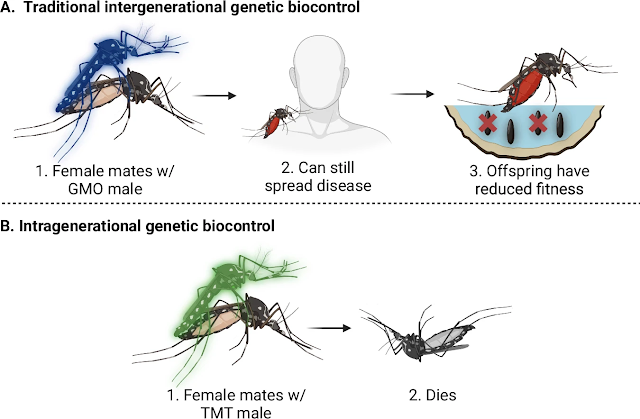
"The emergence of insecticide resistance has increased the need for alternative pest management tools. Numerous genetic biocontrol approaches, which involve the release of genetically modified organisms to control pest populations, are in various stages of development to provide highly targeted pest control. However, all current mating-based genetic biocontrol technologies function by releasing engineered males which skew sex-ratios or reduce offspring viability in subsequent generations which leaves mated females to continue to cause harm (e.g. transmit disease).
Here, we demonstrate intragenerational genetic biocontrol, wherein mating with engineered males reduces female lifespan. The toxic male technique (TMT) involves the heterologous expression of insecticidal proteins within the male reproductive tract that are transferred to females via mating. In this study, we demonstrate TMT in Drosophila melanogaster males, which reduce the median lifespan of mated females by 37 − 64% compared to controls mated to wild type males. Agent-based models of Aedes aegypti predict that TMT could reduce rates of blood feeding by a further 40 – 60% during release periods compared to leading biocontrol technologies like fsRIDL. TMT is a promising approach for combatting outbreaks of disease vectors and agricultural pests."

ScienceAdviser


Fig. 1: Intergenerational vs intragenerational genetic biocontrol of pest insects.


Wednesday, November 20, 2024

Deaf and sterile male mosquitoes are "abolished" to have sex, opening new population control option

Making sure their sex life is no fun anymore! 😊

We seem to have learnt a lot about the sex life of mosquitos!

These researchers also suggested to make the hearing of sterile male mosquitos overactive so they can better compete with non deaf males.

"Genetic studies have revealed that when male mosquitoes lose their hearing, they also lose their sex lives. ...

Scientists have long known that hearing is the main sense used in mosquito mating. ... A few seconds of midair copulation, and the courtship is done. ...

In most species, the act of mating is a multisensory experience, so for the new study, researchers ... Using the CRISPR-Cas9 gene-editing system, the team knocked out a gene called trpVa in the insects.

These mutant mosquitoes showed no reaction to sound whatsoever, and no electrical activity was detected in the neurons known to be associated with hearing. That confirmed that the gene edits had worked.

Next, the researchers placed the deaf mosquitoes in a mixed population, and watched what happened. Deaf females had a harder time than usual attracting mates, but still managed to get the job done. Deaf males, however, didn’t respond at all to the waiting ladies, leaving all the fun to those with unimpaired hearing. That suggests that this is the sole sense males use to find mates. ...

Already, male mosquitoes have been genetically engineered to be sterile, then released in various regions in recent years. The idea is that sterile males will still try to mate, but their partner's eggs won’t hatch. And conveniently, after females mate once, they don’t usually do so again, so the population comes down quickly.

The problem there is that the sterile males have to outcompete natural, virile males for female attention, so populations usually bounce back after a while. But what if the sterile bugs had a female-finding advantage over wild ones?

Rather than knocking out the trpVa gene and making mosquitoes deaf, the team suggests that it could instead be made overactive in these sterile mosquitoes. ..."

From the significance and abstract:
"Significance
The modes of communication required for mating in mosquitoes that transmit pathogens causing malaria, dengue, Zika, and other diseases are poorly understood. ... It is established that Aedes males are attracted to the female wingbeat. However, it was not known whether loss of hearing would just compromise or eradicate mating. We created deaf mosquitoes by eliminating the Transient Receptor Potential Va (TRPVa) channel—a protein required for sound-induced activation of auditory neurons. We found that mating was abolished [???] in deaf males, demonstrating that hearing and TRPVa are essential for male mating behavior. This work reveals a mode of communication that is strictly required for male mating success in a mosquito disease vector.
Abstract
Attraction and mating between male and female animals depend on effective communication between conspecifics. However, in mosquitoes, we have only a rudimentary understanding of the sensory cues and receptors critical for the communication that is essential for reproductive behavior. While it is known that male Aedes aegypti use sound to help them identify females, it is not unclear whether sound detection is absolutely required since other cues such as vision may also participate in mating behavior. To determine the effect of eliminating hearing on mating success, we knocked out the Ae. aegypti TRPVa channel ... Strikingly, mutation of trpVa eliminated mating behavior in males. In contrast, trpVa-null females mated, although this behavior was slightly delayed relative to wild-type females. Males and females produce sounds as they beat their wings at distinct frequencies during flight. Sound mimicking the female wingbeat induced flight, attraction, and copulatory-like behavior in wild-type males without females present, but not in trpVa-null males. Males are known to modulate their wingbeat frequencies before mating in the air, which is a phenomenon referred to as rapid frequency modulation (RFM). We found that RFM was absent in mosquitoes lacking TRPVa. We conclude that the requirement for trpVa and hearing for male reproductive behavior in Aedes is absolute, as mating in the deaf males is eliminated."

Deaf mosquitoes lose their mojo, opening new population control option

Deaf male mosquitoes don’t mate (original news release)


Fig. 3 Mutation of trpVa eliminates male mating behavior and delays female mating.


Thursday, June 27, 2024

CRISPR-based genetic technique eradicates malaria mosquitoes with over 99% efficiency

Good news!

Why don't we try to completely eradicate bloodsuckers? What are bloodsuckers good for?

From the significance and abstract:
"Significance
Controlling the primary African malaria vector, Anopheles gambiae mosquitoes, is crucial for reducing malaria transmission. Conventional methods relying on insecticides are losing effectiveness. The sterile insect technique (SIT) has successfully eradicated pests, but implementing it for A. gambiae is hindered by technological gaps. Our precision-guided SIT (pgSIT) uses CRISPR to induce male sterilization and female elimination for use in SIT. Through engineered Cas9 and gRNA strains, we achieve over 99.5% male sterility and over 99.9% female lethality. Genetically sterilized males display longevity, induce population suppression, and, according to models, can eliminate wild A. gambiae populations. This finding enhances the malaria genetic biocontrol toolkit, allowing scalable, confined suppression in the species.
Abstract
Controlling the principal African malaria vector, the mosquito Anopheles gambiae, is considered essential to curtail malaria transmission. However, existing vector control technologies rely on insecticides, which are becoming increasingly ineffective. Sterile insect technique (SIT) is a powerful suppression approach that has successfully eradicated a number of insect pests, yet the A. gambiae toolkit lacks the requisite technologies for its implementation. SIT relies on iterative mass releases of nonbiting, nondriving, sterile males which seek out and mate with monandrous wild females. Once mated, females are permanently sterilized due to mating-induced refractoriness, which results in population suppression of the subsequent generation. However, sterilization by traditional methods renders males unfit, making the creation of precise genetic sterilization methods imperative. Here, we introduce a vector control technology termed precision-guided sterile insect technique (pgSIT), in A. gambiae for inducible, programmed male sterilization and female elimination for wide-scale use in SIT campaigns. Using a binary CRISPR strategy, we cross separate engineered Cas9 and gRNA strains to disrupt male-fertility and female-essential genes, yielding >99.5% male sterility and >99.9% female lethality in hybrid progeny. We demonstrate that these genetically sterilized males have good longevity, are able to induce sustained population suppression in cage trials, and are predicted to eliminate wild A. gambiae populations using mathematical models, making them ideal candidates for release. This work provides a valuable addition to the malaria genetic biocontrol toolkit, enabling scalable SIT-like confinable, species-specific, and safe suppression in the species."

CRISPR-based genetic technique eradicates malaria mosquitoes with over 99% efficiency Scientists at the University of California, USA, have developed a precision-guided sterile insect technique to eliminate the primary African malaria vector, Anopheles gambiae mosquitoes, and subsequently reduce malaria transmission.


Fig. 1 Homozygous pgSIT gRNA females crossed to Cas9 males produce nearly exclusively sterile male F1 offspring.


Thursday, April 25, 2024

Achieving a malaria-free Rwanda by 2030 is possible

Good news! Bravo! Drones to the rescue!

"Latest data from Rwanda Biomedical Centre, as reported by The New Times in its April 24 edition, indicates that malaria cases in the country dropped by a staggering 88% in 2023.

Rwanda targets to completely eradicate malaria by 2030, and the trend over the last seven years gives hope that it is possible. About five million cases were recorded in 2016, but just over 600,000 were registered last year. ..."

Achieving a malaria-free Rwanda by 2030 is possible - The New Times

Rwanda was the first African country to integrate drone technology in fighting malaria in 2019. Drones are used to target mosquitoes at their breeding sites. 


Thursday, December 14, 2023

Wednesday, December 06, 2023

Thursday, July 06, 2023

Picture of the day

Impressive! Why don't we eradicate mosquitoes and other blood suckers? Are these bloodsuckers essential in any way? Natural evolution made mistakes over billions of years!


Wednesday, May 03, 2023

Study finds AI-based approach cuts mosquito population 75% by managing breeding habitats in urban areas

Good news! Can we eradicate bloodsuckers like mosquitos?

There seems to be also a shift in approach: From indoor treatment to larval source management.

This app should definitely help to better manage the many breeding habitats by e.g. recording and keeping track of all activities. 

"... Malaria kills 400,000 people yearly, most of whom are children under the age of five. ...
The pilot, in cooperation with São Tomé and Príncipe’s Health Ministry, was conducted in three of the country’s six districts. Using Zzapp’s technology, 50 field workers located almost 13,000 water bodies that served as mosquito breeding grounds.
The field workers then treated the identified areas to kill mosquito larvae (larvicide) ...
Managing mosquito larvae at the source was once a mainstay of malaria elimination strategy but was abandoned in Africa in favor of insecticidal nets and indoor residual spraying.
However, the study’s authors write, development of new technologies and mosquitoes’ growing resistance to insecticides has renewed interest in larval source management. ...
Zzapp’s technology has already been deployed in Ghana, Tanzania, Kenya, Ethiopia, Mozambique, and now São Tomé and Príncipe ..."

From the abstract:
"Background
Once a mainstay of malaria elimination operations, larval source management (LSM)—namely, the treatment of mosquito breeding habitats–has been marginalized in Africa in favour of long-lasting insecticidal nets (LLINs) and indoor residual spraying (IRS). However, the development of new technologies, and mosquitoes' growing resistance to insecticides used in LLINs and IRS raise renewed interest in LSM.
Methods
A digitally managed larviciding (DML) operation in three of the seven districts of São Tomé and Príncipe (STP) was launched by the Ministry of Health (MOH) and ZzappMalaria LTD. The operation was guided by the Zzapp system, consisting of a designated GPS-based mobile application and an online dashboard, which facilitates the detection, sampling and treatment of mosquito breeding sites. During the operation, quality assurance (QA) procedures and field management methods were developed and implemented.
Results
12,788 water bodies were located and treated a total of 128,864 times. The reduction impact on mosquito population and on malaria incidence was 74.90% and 52.5%, respectively. The overall cost per person protected (PPP) was US$ 0.86. The cost varied between areas: US$ 0.44 PPP in the urban area, and US$ 1.41 PPP in the rural area. The main cost drivers were labour, transportation and larvicide material.
Conclusion
DML can yield highly cost-effective results, especially in urban areas. Digital tools facilitate standardization of operations, implementation of QA procedures and monitoring of fieldworkers’ performance. Digitally generated spatial data also have the potential to assist integrated vector management (IVM) operations. A randomized controlled trial (RCT) with a larger sample is needed to further substantiate findings."

Study finds AI-based approach cuts mosquito population 75% - ISRAEL21c Pilot project in Africa used Zzapp artificial intelligence to identify and help manage mosquito breeding habitats.


Screenshots from the Zzapp mobile application. Left: Map view during mapping activity showing areas previously visited by the fieldworker highlighted in yellow. The blue circle indicates the current location of the fieldworker, and blue droplet icons indicate water bodies previously reported.


Thursday, February 02, 2023

Ethical dilemma: Should we get rid of mosquitoes?

Recommendable! Who needs these blood suckers? How important are mosquitoes for the ecosystem?
This video tries to make a distinction between mosquitos that carry deadly diseases and those who do not. A bloodsucker is a bloodsucker irrespective of what type of disease it may or may not carry!

Sunday, October 23, 2022

Fatty acids on the skin explain why some people are "mosquito magnets"

Good news! Will we get better repellents? Apparently, we still do not very well understand the complex odor receptors of mosquitoes. The research presented here has taken several years.

Do we need these blood suckers and disease carriers? When will we eradicate these blood suckers? Eradication should be seriously considered!

We should thank the total of 64 human subjects for taking part in this kind of study!

"The team found one target, which they’ve called Subject 33, was much more attractive to the mosquitoes than the others [64 human subjects]. This subject was four times more attractive to the mosquitoes than the next best, and 100 times more attractive than the subject at the bottom of the mosquitoes' hit list. ...
Chemical analysis followed and revealed 50 molecular compounds that were heightened in the skin of the more attractive subjects. One type in particular was produced at much higher levels than less attractive subjects. Called carboxylic acids, these fatty substances help give the skin a distinct odor ..."

"... In the three-year study, eight participants were asked to wear nylon stockings over their forearms for six hours a day. They repeated this process on multiple days. Over the next few years, the researchers tested the nylons against each other in all possible pairings through a round-robin style “tournament.” ...
Humans produce mainly two classes of odors that mosquitoes detect with two different sets of odor receptors: Orco and IR receptors. To see if they could engineer mosquitoes unable to spot humans, the researchers created mutants that were missing one or both of the receptors. Orco mutants remained attracted to humans and able to distinguish between mosquito magnets and low attractors, while IR mutants lost their attraction to humans to a varying degree, but still retained the ability to find us. ...
These results complement [other] recent studies, also published in Cell, which revealed the redundancy of Aedes aegypti’s exquisitely complex olfactory system. ..."

From the abstract:
"Some people are more attractive to mosquitoes than others, but the mechanistic basis of this phenomenon is poorly understood. We tested mosquito attraction to human skin odor and identified people who are exceptionally attractive or unattractive to mosquitoes. These differences were stable over several years. Chemical analysis revealed that highly attractive people produce significantly more carboxylic acids in their skin emanations. Mutant mosquitoes lacking the chemosensory co-receptors Ir8a, Ir25a, or Ir76b were severely impaired in attraction to human scent, but retained the ability to differentiate highly and weakly attractive people. The link between elevated carboxylic acids in “mosquito-magnet” human skin odor and phenotypes of genetic mutations in carboxylic acid receptors suggests that such compounds contribute to differential mosquito attraction. Understanding why some humans are more attractive than others provides insights into what skin odorants are most important to the mosquito and could inform the development of more effective repellents."

Fatty acids on the skin explain why some people are "mosquito magnets"


Graphical abstract


Monday, August 22, 2022

We could kill all mosquitoes (but should we?)

Recommendable! But too much precautionary principle! I hope, some African countries will go ahead with genetically modified mosquitos.

The Neuroscience Behind Why Mosquitoes Always Find You

Do we need mosquitos? Are these bloodsuckers and transmitters of diseases important for biodiversity? If not eradicate or genetically modify! High time for humans to sting back! 😄

Earlier this month, I blogged here about new research how mosquitos hone in on particular odors of humans. 

It appears, we have now a very good understanding why humans are desired by mosquitos and how they find us. So let's finally do something effective about this disease spreading pest!

"... "The olfactory system is a lot more adaptable, a lot more variable than we thought" ...
And they found that, contrary to prior assumptions and their own expectations, OR and IR receptors are frequently coexpressed in the same neurons. Not just that, some groupings of particular receptors were frequently found together, though ... “There may be some logic in this really different olfactory system,” ...
The complexity continues to the brain, the team found. “In mosquitoes, we saw a lot of overlap in the brain,” ... with individual antennal lobe glomeruli receiving olfactory information from multiple types of receptors. This overlap in the glomeruli, as well as the coexpression of receptors, may be why mosquitoes in previous experiments were able to keep smelling humans, even when one receptor type was missing or non-functional. ..."

From the abstract:
"... Mosquitoes are intensely attracted to body odor and carbon dioxide, which they detect using ionotropic chemosensory receptors encoded by three large multi-gene families. Genetic mutations that disrupt the olfactory system have modest effects on human attraction, suggesting redundancy in odor coding. The canonical view is that olfactory sensory neurons each express a single chemosensory receptor that defines its ligand selectivity. We discovered that Ae. aegypti uses a different organizational principle, with many neurons co-expressing multiple chemosensory receptor genes. In vivo electrophysiology demonstrates that the broad ligand-sensitivity of mosquito olfactory neurons depends on this non-canonical co-expression. The redundancy afforded by an olfactory system in which neurons co-express multiple chemosensory receptors may increase the robustness of the mosquito olfactory system and explain our long-standing inability to disrupt the detection of humans by mosquitoes."

The Neuroscience Behind Why Mosquitoes Always Find You | The Scientist Magazine® Neurons in mosquito antennae can express more than one olfactory receptor at a time, a redundancy that likely ensures they don’t lose a potential host’s scent.