More light pollution please! So I can hear more bird singing e.g. in the morning! Caution: satire!
I don't think light pollution in urban areas has become much worse of the past several decades. If so, then birds have adapted to urban light pollution for decades without much fanfare and notice! What is the fuss about?
"If you’re an avid birdwatcher, then you’ll know that most of our feathered friends stick to a fairly predictable schedule: a burst of vocal activity early in the morning, known as the “dawn chorus,” followed by some more singing throughout the day and at dusk. But according to new research, birds living in areas with lots of artificial light are staying awake much longer than usual.
To find out how light pollution—which now affects 23% of the Earth’s surface—impacts avian activity, scientists analyzed millions of bird calls from more than 500 species around the world. The data, collected as part of a global citizen science project called BirdWeather, revealed that birds in light-polluted urban areas are waking earlier and settling down later than their rural counterparts. “We were shocked by our findings,” study co-author Brent ..."
"Birds that are active during the day sing later into the night in places with significant light pollution, according to research by a Southern Illinois University Carbondale professor and his colleague. ..."
From the editor's summary and abstract:
"Editor’s summary
Light pollution has become ubiquitous across much of the planet. This situation has the potential [???] to widely affect a variety of species because most living organisms have evolved to respond, in one way or another, to the circadian light-dark cycle. Pease et al. looked at the influence of light pollution on activity patterns in more than 500 species of birds globally. They found that birds were generally vocal for nearly an hour longer in the presence of light pollution. Furthermore, birds that are more exposed, or entrained, to light were more affected, such as those with large eyes and open nests. ...
Abstract
Light pollution disrupts light–dark cues that organisms use as timetables for life. Although studies—typically focusing on individual species—have documented earlier morning onset of bird vocalization in light-polluted landscapes, a synthesis of light pollution effects across species, space, and season is lacking. We used a global acoustic dataset of more than 60 million detections, representing 583 diurnal bird species, to synthesize effects of light pollution on avian vocalization.
On average, light pollution prolonged vocal activity by 50 min. Light pollution responses were strongest for species with large eyes, open nests, migratory habits, and large ranges and during the breeding season.
Prolonged activity may confer negative, neutral, or positive fitness effects; documenting these fitness effects and curbing light pollution are challenges for 21st-century conservation."
SIU research finds birds in light polluted areas stay up late (original news release)
Light pollution prolongs avian activity (no public access)
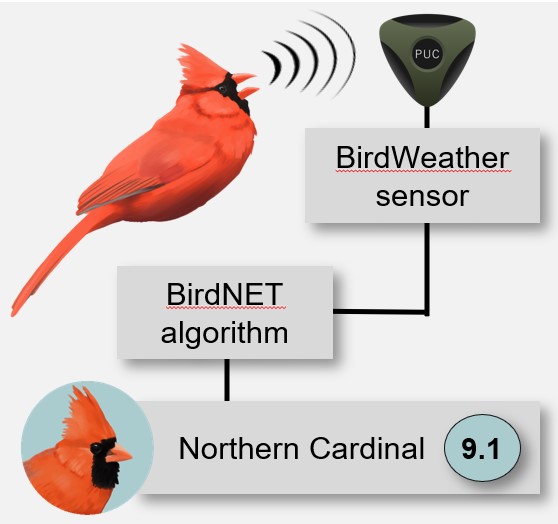
"BirdWeather, which makes sophisticated recording devices with Wi-Fi, GPS and sensors connected to the BirdNET database and its machine learning from the Cornell Lab of Ornithology and the Chemnitz University of Technology. BirdWeather’s dashboard provided a better visualization of what bird species were in the area."

No comments:
Post a Comment