Good news!
"For the last several years, ... bioengineers have been developing a soft, wearable robot that not only provides movement assistance for such individuals but could even augment therapies to help them regain mobility.
But no two people move exactly the same way. Physical motions are highly individualized, especially for the mobility-impaired, making it difficult to design a device that works for many different people.
It turns out advances in machine learning can create a more personal touch. Researchers ... have upgraded their wearable robot to be responsive to an individual user’s exact movements, endowing the device with more personalized assistance that could give users better, more controlled support for daily tasks. ...
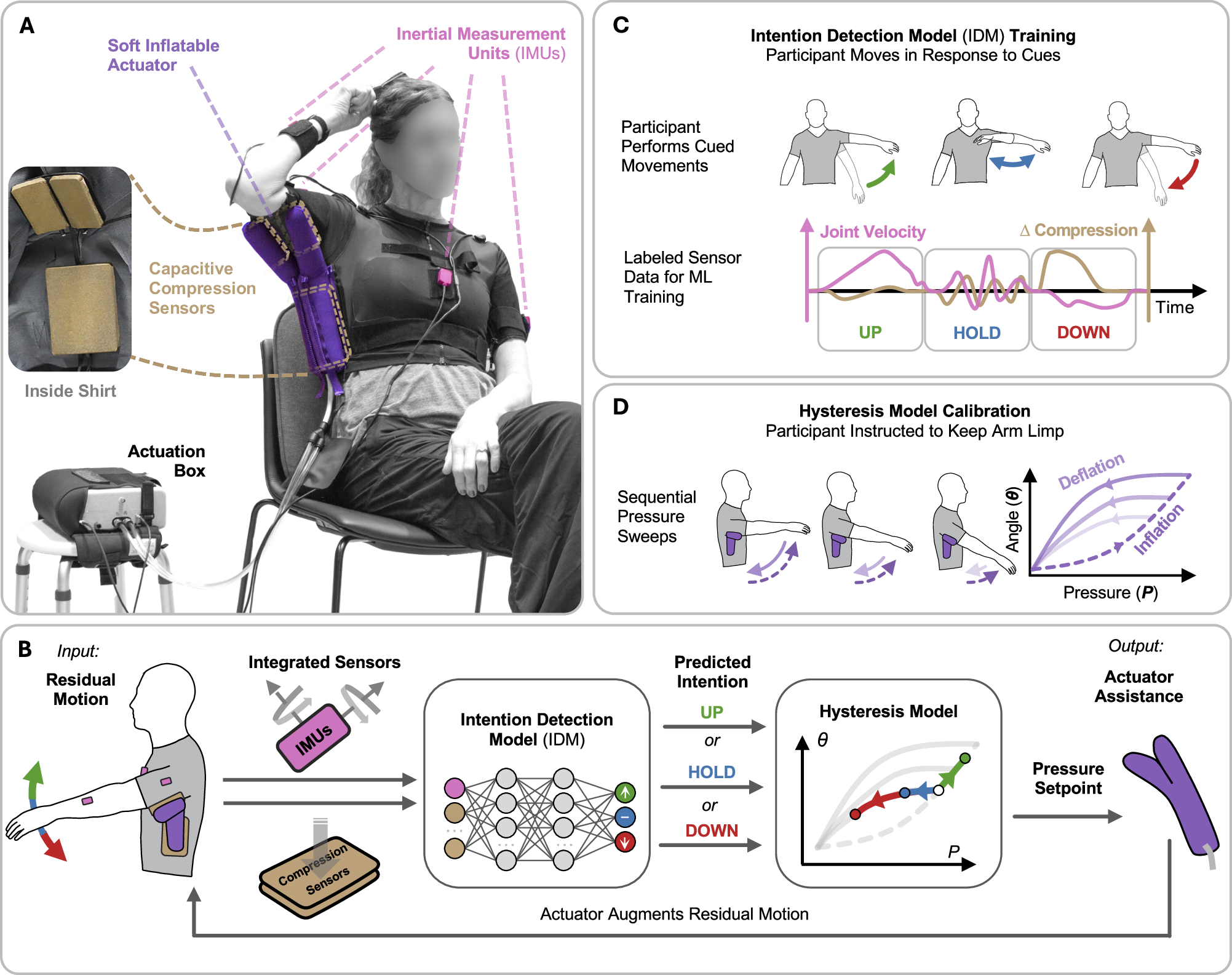
The paper describes a major update to the software powering the device, which consists of a sensor-loaded vest with a balloon attached underneath the arm that inflates and deflates to apply mechanical assistance to a weak or impaired limb.
The researchers used a machine learning model that personalizes assistance levels to the individual user by learning which movements the user is trying to do, via sensors that track both motion and pressure. ..."
From the abstract:
"Portable wearable robots offer promise for assisting people with upper limb disabilities. However, movement variability between individuals and trade-offs between supportiveness and transparency complicate robot control during real-world tasks.
We address these challenges by first developing a personalized ML intention detection model to decode user’s motion intention from IMU and compression sensors.
Second, we leverage a physics-based hysteresis model to enhance control transparency and adapt it for practical use in real-world tasks.
Third, we combine and integrate these two models into a real-time controller to modulate the assistance level based on the user’s intention and kinematic state. Fourth, we evaluate the effectiveness of our control strategy in improving arm function in a multi-day evaluation.
For 5 individuals post-stroke and 4 living with ALS wearing a soft shoulder robot, we demonstrate that the controller identifies shoulder movement with 94.2% accuracy from minimal change in the shoulder angles (elevation: 3.4°, depression: 1.7°) and reduces arm-lowering force by 31.9% compared to a baseline controller. Furthermore, the robot improves movement quality by increasing their shoulder elevation/depression (17.5°), elbow (10.6°) and wrist flexion/extension (7.6°) ROMs; reducing trunk compensation (up to 25.4%); and improving hand-path efficiency (up to 53.8%)."
Fig. 1: Overview of the soft wearable robot and high-level control strategy.

No comments:
Post a Comment