Very impressive, but will it be too cumbersome and heavy (75 grams)?
"Meta revealed new details about its latest Aria eyeglasses, which aim to give AI models a streaming, multisensory, human perspective.
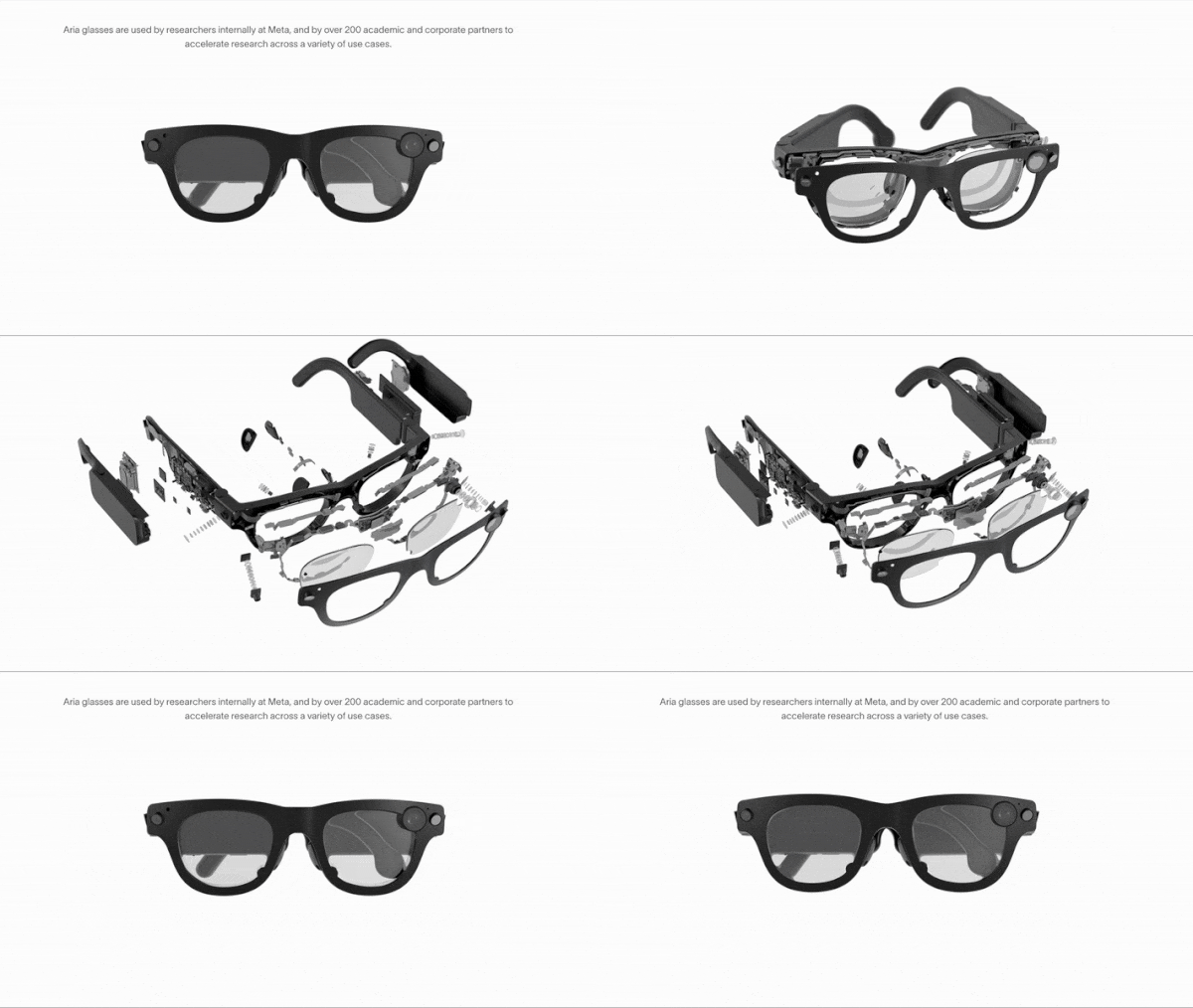
What’s new: Meta described its Aria Gen 2 smart-glasses platform in a blog post that focuses on capabilities relevant to research in augmented reality, “embodied AI” such as robot training, and “contextual AI” for personal use. Units will be available to researchers later this year. Meanwhile, you can apply for access to Aria Generation 1 and download open source datasets, models, tools, 3D objects, and evals.
How it works: Aria Generation 2 packs an impressive variety of technologies into a package the shape of a pair of glasses and the weight of an egg (around 75 grams), with battery life of 6 to 8 hours. A suite of sensors enables the unit, in real time, to interpret user activity (including hand motions), surroundings, location, and interactions with nearby compatible devices. A privacy switch lets users disable data collection.
A Qualcomm SD835 chip with 4GB RAM and 128GB storage processes input and output on the device itself. Users can stream the unit’s output, such as video, audio, and 3D point clouds, to a local PC or upload it for processing by perception services via cloud-based APIs.
The unit includes five cameras: An RGB camera captures the user’s point of view. Two more help track the user’s visual attention based on gaze direction per eye, vergence point, pupil diameters, and blinking. A stereoscopic pair helps map the surroundings in three dimensions via simultaneous localization and mapping (SLAM). In addition, an ambient light sensor helps control camera exposure. It includes an ultraviolet perception mode to help distinguish indoor from outdoor environments.
Seven microphones help to monitor surrounding sounds and their locations. A separate contact microphone picks up the user’s voice, helping to make the user intelligible in noisy environments. A pair of open-ear speakers reproduces sounds.
Other sensors include two motion-sensing inertial measurement units (IMUs), a barometer, and a magnetometer to help track the unit’s motion and orientation; global navigation satellite receiver to help track its location; and a photoplethysmography (PPG) sensor to detect the user’s heart rate. Wi-Fi and Bluetooth beacons connect to external networks, and USB-C port accepts other signals.
A common clock calibrates and time-stamps most sensor readings with nanosecond resolution to synchronize with external devices including nearby Aria units. ..."


No comments:
Post a Comment