Amazing stuff!
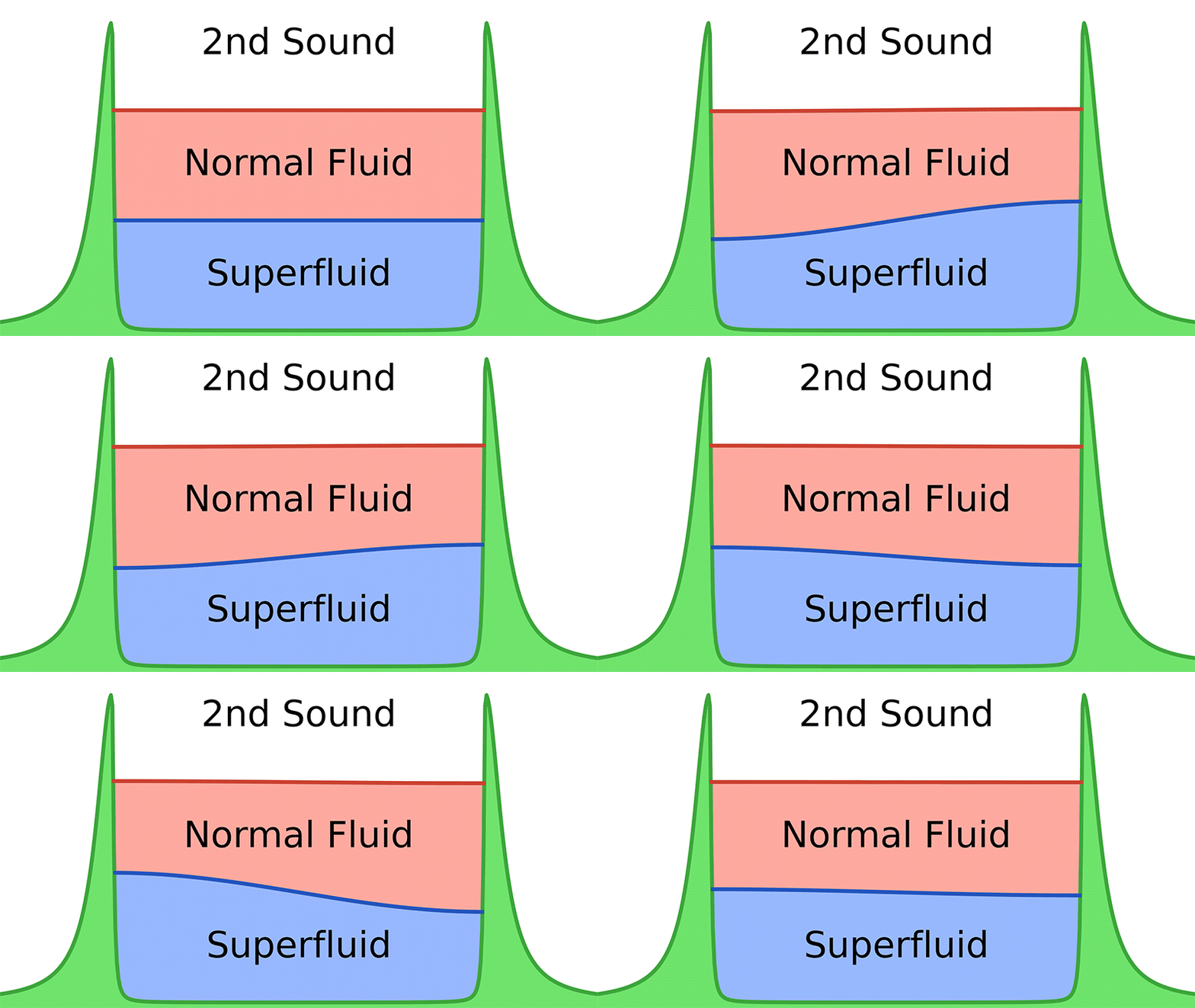
"... But in rare states of matter, heat can behave as a wave, moving back and forth somewhat like a sound wave that bounces from one end of a room to the other. In fact, this wave-like heat is what physicists call “second sound". ...
Under certain conditions, however, fermions can be made to strongly interact and pair up. In this coupled state, fermions can flow in unconventional ways. For their latest experiments, the team employs fermionic lithium-6 atoms, which are trapped and cooled to nanokelvin temperatures. ...
Since a fluid transitions into a superfluid at a certain critical, ultracold temperature, the MIT team reasoned that the two types of fluid should also transport heat differently: In normal fluids, heat should dissipate as usual, whereas in a superfluid, it could move as a wave, similarly to sound.
“Second sound is the hallmark of superfluidity, but in ultracold gases so far you could only see it in this faint reflection of the density ripples that go along with it,” ... “The character of the heat wave could not be proven before.” ..."
From the abstract:
"Heat transport is a fundamental property of all physical systems and can serve as a fingerprint identifying different states of matter. In a normal liquid a hot spot diffuses while in a superfluid heat propagates as a wave called second sound. Despite its importance for understanding quantum materials, direct imaging of heat transport is challenging, and one usually resorts to detecting secondary effects, such as changes in density or pressure. Here we establish thermography of a strongly interacting atomic Fermi gas, a paradigmatic system whose properties relate to strongly correlated electrons, nuclear matter and neutron stars. Just as the color of a glowing metal reveals its temperature, the radiofrequency spectrum of the interacting Fermi gas provides spatially resolved thermometry with sub-nanokelvin resolution. The superfluid phase transition is directly observed as the sudden change from thermal diffusion to second sound propagation, and is accompanied by a peak in the second sound diffusivity. The method yields the full heat and density response of the strongly interacting Fermi gas, and therefore all defining properties of Landau’s two-fluid hydrodynamics. Our measurements serve as a benchmark for theories of transport in strongly interacting fermionic matter."

No comments:
Post a Comment