Good news!
"A newly discovered receptor switch that boosts bone growth could transform how we treat osteoporosis, by stimulating the body’s own bone-building machinery using a targeted drug and even mechanical force. ...
A new study ... has identified a critical regulator of bone formation, the G protein-coupled receptor 133 (GPR133), and a way to stimulate it – opening the door to a new strategy to treat or prevent osteoporosis. ..."
"... The adhesion G protein-coupled receptor GPR133 belongs to a still relatively unexplored group of receptors. In a recent study, scientists ... demonstrated that GPR133 plays a central role in building and maintaining healthy bone.
“If this receptor is impaired by genetic changes, mice show signs of loss of bone density at an early age – similar to osteoporosis in humans. Using the substance AP503, which was only recently identified via a computer-assisted screen as a stimulator of GPR133, we were able to significantly increase bone strength in both healthy and osteoporotic mice,” ..."
From the abstract:
"Osteoporosis represents an increasing health and socioeconomic burden on aging societies. Current therapeutic options often come with potentially severe side effects or lack long-term efficacy, highlighting the urgent need for more effective treatments. Identifying novel drug targets requires a thorough understanding of their physiological roles.
Genome-wide association studies in humans have linked gene variants of the adhesion G protein-coupled receptor 133 (GPR133/ADGRD1) to variations in bone mineral density and body height.
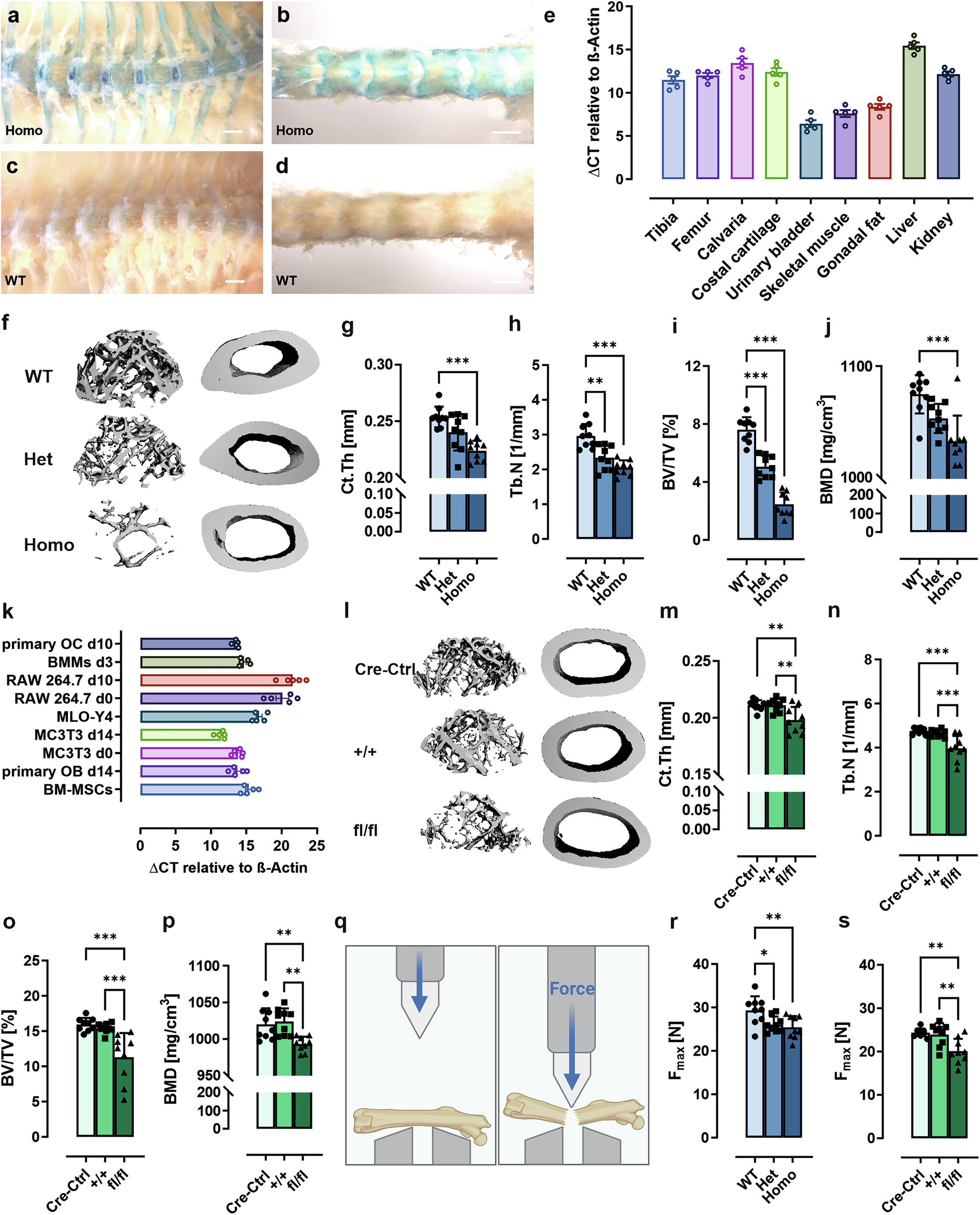
In this study, we explore the impact of GPR133/ADGRD1 on osteoblast differentiation and function. Constitutive and osteoblast-specific knockouts of Gpr133/Adgrd1 in mice lead to reduced cortical bone mass and trabecularization in the femurs and vertebrae — features characteristic of osteoporosis.
This osteopenic phenotype in receptor-deficient mice is caused by impaired osteoblast function, which, in turn, promotes increased osteoclast activity.
At the molecular level, GPR133/ADGRD1 regulates osteoblast function and differentiation through a combined activation mechanism involving interaction with its endogenous ligand, protein tyrosine kinase 7 (PTK7), and mechanical forces. This is demonstrated in vitro through stretch assays and in vivo via a mechanical loading experiment.
Further in vitro analysis shows that GPR133/ADGRD1-mediated osteoblast differentiation is driven by cAMP-dependent activation of the β-catenin signaling pathway.
Activation of GPR133/ADGRD1 with the receptor-specific ligand AP-970/43482503 (AP503) enhances osteoblast function and differentiation, both in vitro and in vivo, significantly alleviating osteoporosis in a mouse ovariectomy model.
These findings position GPR133/ADGRD1 as a promising therapeutic target for osteoporosis and other diseases characterized by reduced bone mass."
Research for stronger bones and muscles in old age (original news release)
The mechanosensitive adhesion G protein-coupled receptor 133 (GPR133/ADGRD1) enhances bone formation (open access)
Fig. 1 Constitutive Gpr133/Adgrd1 deficiency in male mice results in trabecular and cortical bone loss [an example of too much information crammed into one chart]

No comments:
Post a Comment