Recommendable! Food for thought!
The West (in particular Germany) certainly has excessively driven up the cost of nuclear power generation due to largely exaggerated fears of nuclear accidents, radioactivity etc.
On the other hand, communist China may have dangerously risked the life of their citizens by quickly building and operating about 58 nuclear power plants.
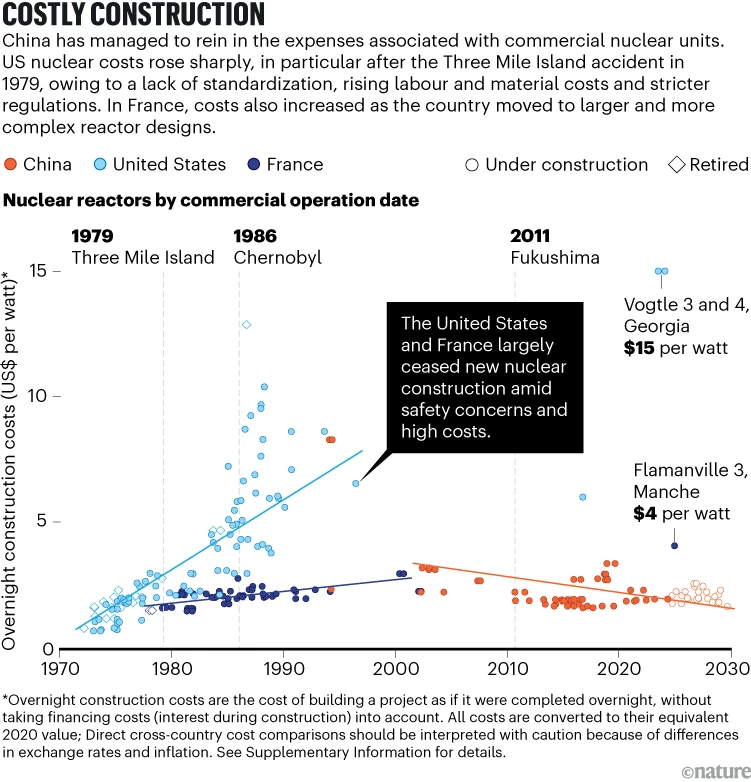
"... While the US and France have seen costs climb for decades thanks to overregulation, bespoke reactor designs, and fragmented supply chains, China has kept costs low by doing the opposite."
"Once again, the world is betting on nuclear power. The United States aims to quadruple its nuclear capacity by 2050, and more than 30 countries have pledged to triple global capacity by mid-century.
China has more than 30 reactors under construction and in planning, and
France has announced plans to build 14 reactors. Technology giants, including Amazon, Google and Microsoft, are also investing in nuclear to power their energy-hungry data centres ...
A central challenge remains: can development be done at a manageable cost? Historically, the industry has faced a ‘cost escalation curse’. Building more nuclear reactors has led to higher, not lower, costs per watt, hampering their economic viability. ...
The cost of building nuclear power plants can soar because of a lack of standardized designs, rising material and labour costs, evolving regulations and technical complexities. ...
China’s success in curbing costs
Over the past two decades, China has been the main country to substantially and consistently expand its nuclear fleet, to 58 operating reactors in 2024.
Since 2022, the government has been approving around ten new reactors each year, putting China on track to surpass the United States and become the world’s largest holder of nuclear power capacity by 2030. ...
Our findings are striking. Whereas construction costs increased substantially between the 1960s and 2000s, by around tenfold in the United States and by nearly twofold in France, they had halved in China by the early 2000s and have remained largely stable since.
Various strategies were used to keep technological costs down, such as building larger plants for scale efficiency and leveraging accumulated experience. ...
The key driver of cost reduction has been China’s deliberate effort to build domestic capacity in civil nuclear power, which unfolded in three stages.
From the 1990s to 2005, China imported foreign reactors to deploy immediately while gradually producing simple, conventional components domestically and using Chinese firms for civil engineering and construction to reduce costs. At the same time, it began researching and developing its own reactor design based on French technology.
Between 2005 and 2010, these efforts to localize production advanced to include more complex, safety-critical components, such as reactor cores. China ramped up capacity, building about 30 reactors using two domestically developed model types. After the Fukushima nuclear disaster in Japan in 2011, China accelerated the adoption of advanced safety features by collaborating with partners from the United States and France, while developing its own advanced reactor models. ..."
China reins in the spiralling construction costs of nuclear power — what can other countries learn? (partial open access) "Strengthening regulations and domestic supply chains could be key to making nuclear power more economically viable."

No comments:
Post a Comment