Amazing stuff!
"Water makes up around 60 percent of the human body. More than half of this water sloshes around inside the cells that make up organs and tissues. Much of the remaining water flows [between cells] ...
Now, MIT engineers have found that this “intercellular” fluid plays a major role in how tissues respond when squeezed, pressed, or physically deformed. Their findings could help scientists understand how cells, tissues, and organs physically adapt to conditions such as aging, cancer, diabetes, and certain neuromuscular diseases. ...
the researchers show that when a tissue is pressed or squeezed, it is more compliant and relaxes more quickly when the fluid between its cells flows easily. When the cells are packed together and there is less room for intercellular flow, the tissue as a whole is stiffer and resists being pressed or squeezed. ...
The findings challenge conventional wisdom, which has assumed that a tissue’s compliance depends mainly on what’s inside, rather than around, a cell. Now that the researchers have shown that intercellular flow determines how tissues will adapt to physical forces, the results can be applied to understand a wide range of physiological conditions, including how muscles withstand exercise and recover from injury, and how a tissue’s physical adaptability may affect the progression of aging, cancer, and other medical conditions. ..."
From the abstract:
"The mechanical characteristics of cells and extracellular matrices—such as elasticity, surface tension and viscosity—can influence diseases such as fibrosis and tumour metastasis.
Multicellular tissues have traditionally been modelled as viscoelastic materials, which overlooked the abundance of intercellular space and intercellular flow within the structure. Although intercellular flow can substantially impact development and disease progression, its role in the mechanical behaviour of tissues remains unclear. Here we show that fluid transport via the intercellular space determines the immediate mechanical response of tissues upon deformation.
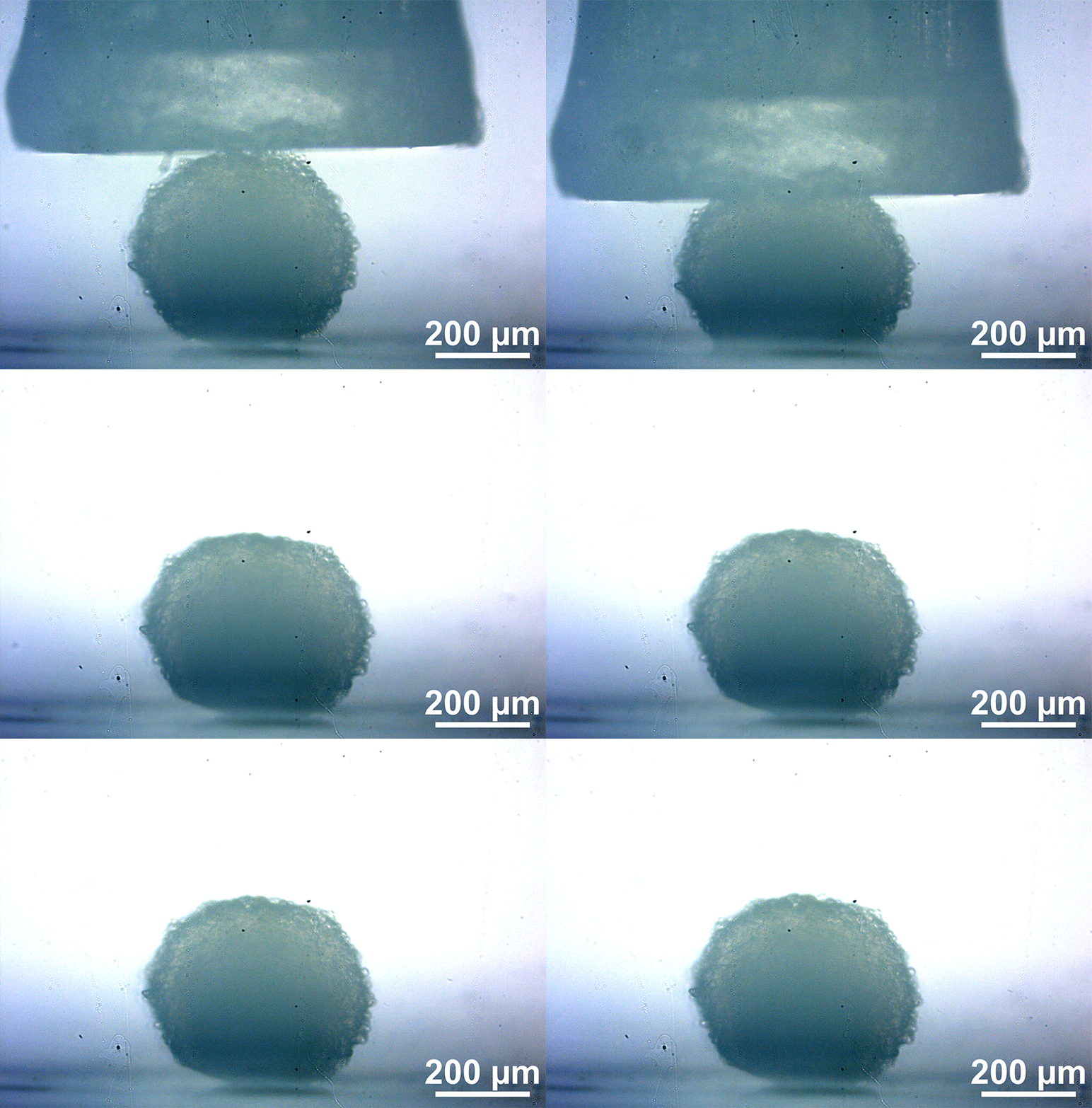
We directly measure the mechanical response of multicellular tissues by applying parallel plate compression via a tailored micro-mechanics platform.
We find that both cultured three-dimensional cell spheroids and native mouse pancreatic islets exhibit apparent poroelastic behaviour over a timescale of up to a minute. These findings highlight the fundamental role of interstitial fluid transport in the mechanics of multicellular systems and could help identify potential physical regulators of development and diseases, as well as strategies for engineering multicellular living systems."
Intercellular flow dominates the poroelasticity of multicellular tissues (no public access)
This image a A549 cell spheroid being gently compressed and released using a specialized platform, allowing researchers to observe how the tissue deforms and relaxes, which reveals important information about its mechanical properties.

No comments:
Post a Comment