Recommendable!
Caveat: I did not read the entire, long article!
"... In recent years researchers have come upon a surprising finding: Some of the machinery that bacteria use to defend against phages exists, almost unchanged, in our own cells. According to dozens of discoveries made over the past decade, the rules of engagement between cells and viruses were written billions of years ago and still largely define how our innate immune system, the first responder to infection, defends us against viruses and bacteria today. ...
Two recent waves of discovery broke this field open.
First, in 2018, researchers reported a variety of novel bacterial defense systems against viruses(opens a new tab), which now number in the hundreds.
The second wave, starting around 2019, showed that some of these bacterial mechanisms exist in plant and animal cells, including our own — and that they still work the same way they did in those distant ancestors. ...
These and other discoveries that followed reveal an unexplored landscape of human innate immunity — one that could lead to new medical treatments and biotechnological tools ...
A few years later, ... team observed that big constellations of immune genes, including restriction-modification enzymes and CRISPR arrays, tended to cluster together in the same region of bacterial genomes. He and other labs observed that genes of unknown function within these “defense islands” or “genomic islands” could potentially represent novel anti-phage mechanisms. ...
In 2018, his team showed that many of the unknown genes in these defense islands did, in fact, function as a variety of anti-phage defense systems. ..."
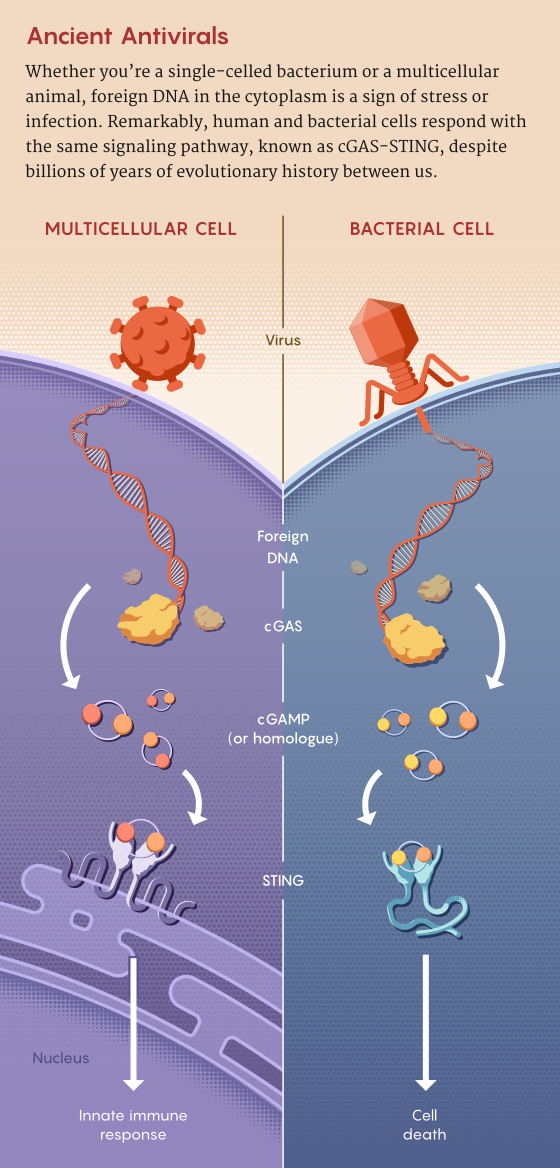
Remarkably, the core machinery of the STING protein (top, protein diagrams) has remained structurally preserved across diverse organisms, although the underlying gene sequence differs widely. Some parts of the protein (bottom, dashed outline) have changed over billions of years.


No comments:
Post a Comment