Food for thought!
What is possibly wrong with this study? The works of both authors are not highly cited. Both authors appear not to be affiliated with a recognized research institution. One of the two authors has published only three papers so far. See Google Scholar.
Keep in mind: We are talking here about global sea level rise in millimeters per year! To measure this accurately is already a tremendous challenge if not impossible! This is analogous to average global atmospheric air temperatures.
"A new first-of-its-kind study by Dutch researchers finds no evidence of a global acceleration in sea level rise because of climate change.
The peer-reviewed paper, “A Global Perspective on Local Sea Level Changes,” published in the Journal of Marine Science and Engineering last month is the first study to be based on local data taken from coastal sites around the world, rather than on models based on extrapolations. ...
While a “small percentage” of the 200 stations showed “notable, sometimes statistically significant, increases or decreases in sea level,” Voortman found those stations were typically located near others that showed no acceleration, “making it unlikely that a global phenomenon like CO2-driven global warming is the cause.” ..."
From the abstract:
"In 2021, the IPCC published new sea level projections. For the first time, the projections gave insight into expected relative sea level rise locally. A prudent designer of coastal infrastructure will want to know how the local projections compare to local observations. That comparison, to date, has not been made.
We compared local projections and observations regarding the rate of rise in 2020. We used two datasets with local sea level information all over the globe. In both datasets, we found approximately 15% of the available sets suitable to establish the rate of rise in 2020.
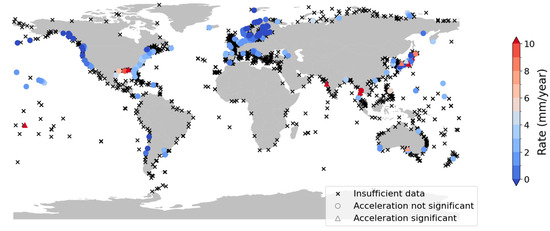
Geographic coverage of the suitable locations is poor, with the majority of suitable locations in the Northern Hemisphere. Latin America and Africa are severely under-represented. Statistical tests were run on all selected datasets, taking acceleration of sea level rise as a hypothesis. In both datasets, approximately 95% of the suitable locations show no statistically significant acceleration of the rate of sea level rise. The investigation suggests that local, non-climatic phenomena are a plausible cause of the accelerated sea level rise observed at the remaining 5% of the suitable locations. On average, the rate of rise projected by the IPCC is biased upward with approximately 2 mm per year in comparison with the observed rate."
Figure 3. PSMSL network with results of this study. Colored symbols indicate locations where the rate of sea level rise in 2020 could be found from the available data, with the color indicating the calculated rate. Upward-pointing triangles indicate statistically significant acceleration of sea level rise. Circles indicate non-significant acceleration. Crosses indicate locations with insufficient data under the criteria of the present study.

No comments:
Post a Comment