Good news!
"Parkinson’s disease causes both movement and cognitive deficits, and for a long time both were thought to be caused by the accumulation of a protein called alpha-synuclein in the brain. But a new ... study has found that the cognitive deficits arise through a different—and unexpected—mechanism.
The new findings suggest that mutations in a gene called GBA—which are a risk factor for developing Parkinson’s disease—drive cognitive decline by disrupting how neurons communicate with each other in the brain. ...
In the study, the researchers analyzed three types of mouse models:
animals that overexpressed a gene called SNCA that encodes the alpha-synuclein protein,
GBA mutants, and
crossbred GBA-SNCA double mutants.
animals that overexpressed a gene called SNCA that encodes the alpha-synuclein protein,
GBA mutants, and
crossbred GBA-SNCA double mutants.
Using these models, the team conducted a series of experiments that tested the animals’ motor and cognitive functions over time between three and 12 months of age.
The experiments showed that motor dysfunction was linked to elevated alpha-synuclein. SNCA and GBA-SNCA mutants—the two models that had elevated alpha-synuclein—experienced motor deficits that worsened over time, but GBA mutants did not develop any motor deficits.
Cognitive deficits, on the other hand, were associated with GBA mutations. GBA and GBA-SNCA mutants developed comparable cognitive deficits as early as three months that persisted at 12 months, while SNCA mutants did not show any dysfunction. ..."
From the abstract:
"GBA is the major risk gene for Parkinson’s disease (PD) and dementia with Lewy bodies (DLB), two common α-synucleinopathies with cognitive deficits.
Here we investigate the role of mutant GBA in cognitive decline by utilizing Gba (L444P) mutant, SNCA transgenic (tg), and Gba-SNCA double mutant mice. Notably, Gba mutant mice show cognitive decline but lack PD-like motor deficits or α-synuclein pathology.
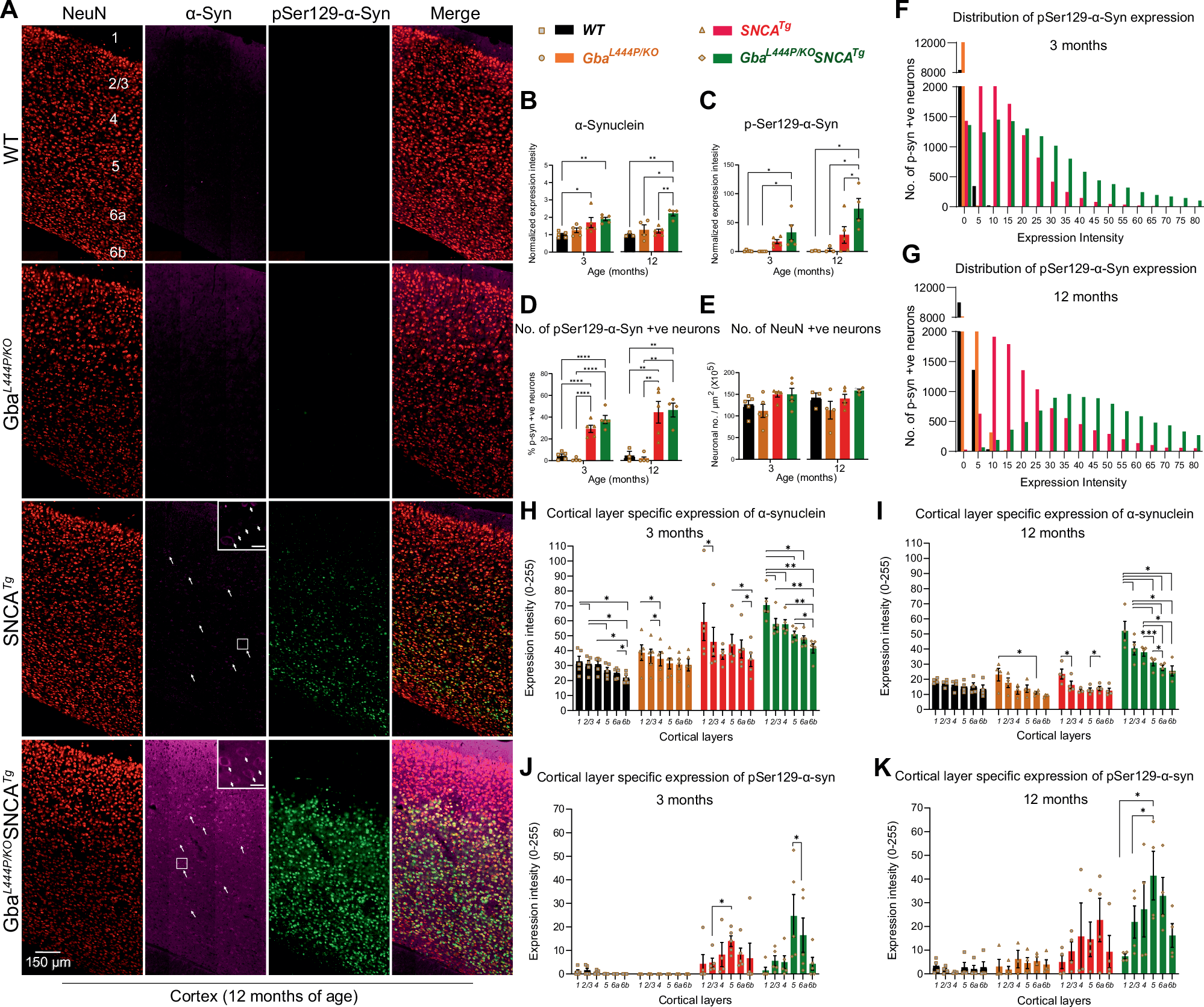
Conversely, SNCA tg mice display age-related motor deficits, without cognitive abnormalities. Gba-SNCA mice exhibit both cognitive decline and exacerbated motor deficits, accompanied by greater cortical phospho-α-synuclein pathology, especially in layer 5 neurons.
Single-nucleus RNA sequencing of the cortex uncovered synaptic vesicle (SV) endocytosis pathway defects in excitatory neurons of Gba mutant and Gba-SNCA mice, via downregulation of genes regulating SV cycle and synapse assembly. Immunohistochemistry and electron microscopy validate these findings.
Our results indicate that Gba mutations, while exacerbating pre-existing α-synuclein aggregation and PD-like motor deficits, contribute to cognitive deficits through α-synuclein-independent mechanisms, involving dysfunction in SV endocytosis."
Fig. 2: Gba mutation exacerbates α-synuclein pathology in the cortices of SNCA tg mice.

No comments:
Post a Comment