Amazing stuff!
"Astronomers ... using the James Webb Space Telescope, have uncovered 300 unusually bright cosmic objects that may be some of the earliest galaxies ever formed. By applying techniques like infrared imaging, dropout analysis, and spectral energy distribution fitting, the team has identified candidates that could force scientists to rethink how galaxies emerged after the Big Bang. ..."
"... In a new study, scientists ... looked deep into the universe and found something unexpected. Using infrared images taken from NASA’s powerful James Webb Space Telescope (JWST), they identified 300 objects that were brighter than they should be. ..."
From the abstract:
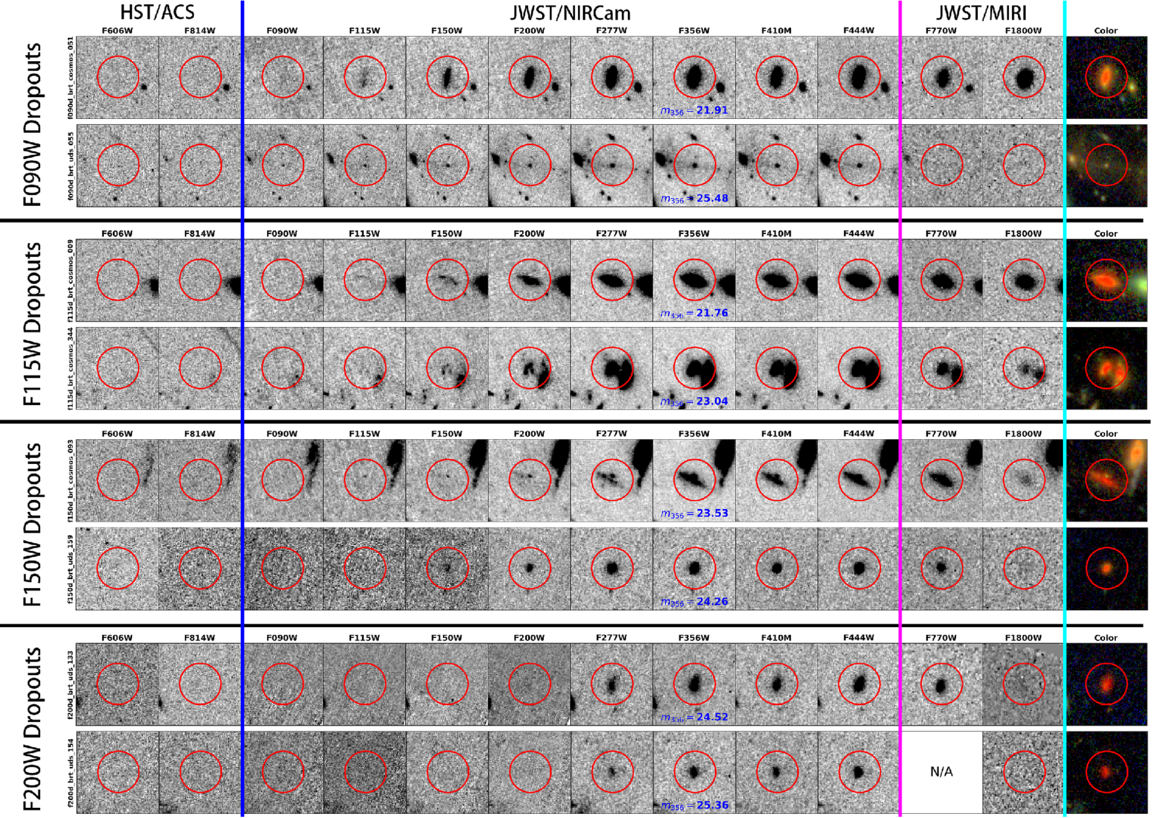
"The selection of candidate high-redshift galaxies using the dropout technique targeting the Lyman-break signature sometimes yields very bright objects that are too luminous to be easily explained if they are indeed at the expected redshifts. Here, we present systematic study of very bright dropouts selected through successive bands of the NIRCam instrument onboard the James Webb Space Telescope (JWST). Using the public NIRCam data in four blank fields over 500 arcmin, 300 such objects were found. They have F356W magnitudes <25.1 mag or <26.0 mag depending on the dropout passband, and the majority of them (>80%) have very red F115W − F356W colors >2.0 mag, qualifying them as “extremely red objects.”
We focus on 137 objects that also have mid-infrared observations from the JWST MIRI instrument. Their spectral energy distribution analysis shows that these objects are dominated by low-redshift (z ∼ 1–4) galaxies (≳67%). However, a non-negligible fraction (≳7%) could be at high redshifts. Seven of our objects have secure spectroscopic redshifts from JWST NIRSpec identifications, and the results confirm this picture: while six are low-redshift galaxies (z ≈ 3), one is a known galaxy at z = 8.679 (with MUV = −22.4 mag and stellar mass M* = 109.1M⊙) recovered in our sample.
In light of recent theoretical models on early galaxy formation, this confirmed high-redshift galaxy does not pose a challenge. However, since our sample contains very luminous high-redshift candidates in the regime still underexplored (MUV ≤ −23 mag and M* > 1010.5M⊙), spectroscopic identifications are necessary to ensure they do not create tension with these new models."
Early galaxies — or something else? Mizzou scientists uncover mysterious objects in the universe (original news) "Using data from NASA’s James Webb Space Telescope, University of Missouri researchers identified 300 unusual early galaxy candidates."
On the Very Bright Dropouts Selected Using the James Webb Space Telescope NIRCam Instrument (open access)
Figure 1. Image stamps of example very bright dropouts in F090W, F115W, F150W, and F200W, arranged from top to bottom. Two example objects are shown for each group.

No comments:
Post a Comment