Good news!
"... the hippocampus, a brain region responsible for regulating learning and memory, and highly vulnerable to the effects of aging. Using a process called neuronal nuclei RNA sequencing they identified ferritin light chain 1 (FTL1), an iron-associated protein, as a pro-aging neuronal factor that impairs cognition.
Using transcriptomics and mass spectrometry, researchers found that older mice had more FTL1 in their hippocampus, the brain's memory HQ. This iron-handling protein wasn't just loitering; it was actively disrupting neural connections and dimming cognitive performance. ..."
"... They looked at how the genes and proteins in the hippocampus changed over time in mice and found just one protein that differed between old and young animals. It’s called FTL1. Old mice had more FTL1, as well as fewer connections between brain cells in the hippocampus and diminished cognitive abilities.
When the researchers artificially increased FTL1 levels in young mice, their brains and behavior began to resemble that of old mice. In experiments in petri dishes, nerve cells engineered to make lots of FTL1 grew simple one-armed neural wires, or neurites, rather than the branching neurites that normal cells create.
But when scientists reduced the amount of FTL1 in the hippocampus of the old mice, they regained their youth. They had more connections between nerve cells, and the mice did better on memory tests. ..."
From the abstract:
"Understanding cellular and molecular drivers of age-related cognitive decline is necessary to identify targets to restore cognition at old age.
Here we identify ferritin light chain 1 (FTL1), an iron-associated protein, as a pro-aging neuronal factor that impairs cognition.
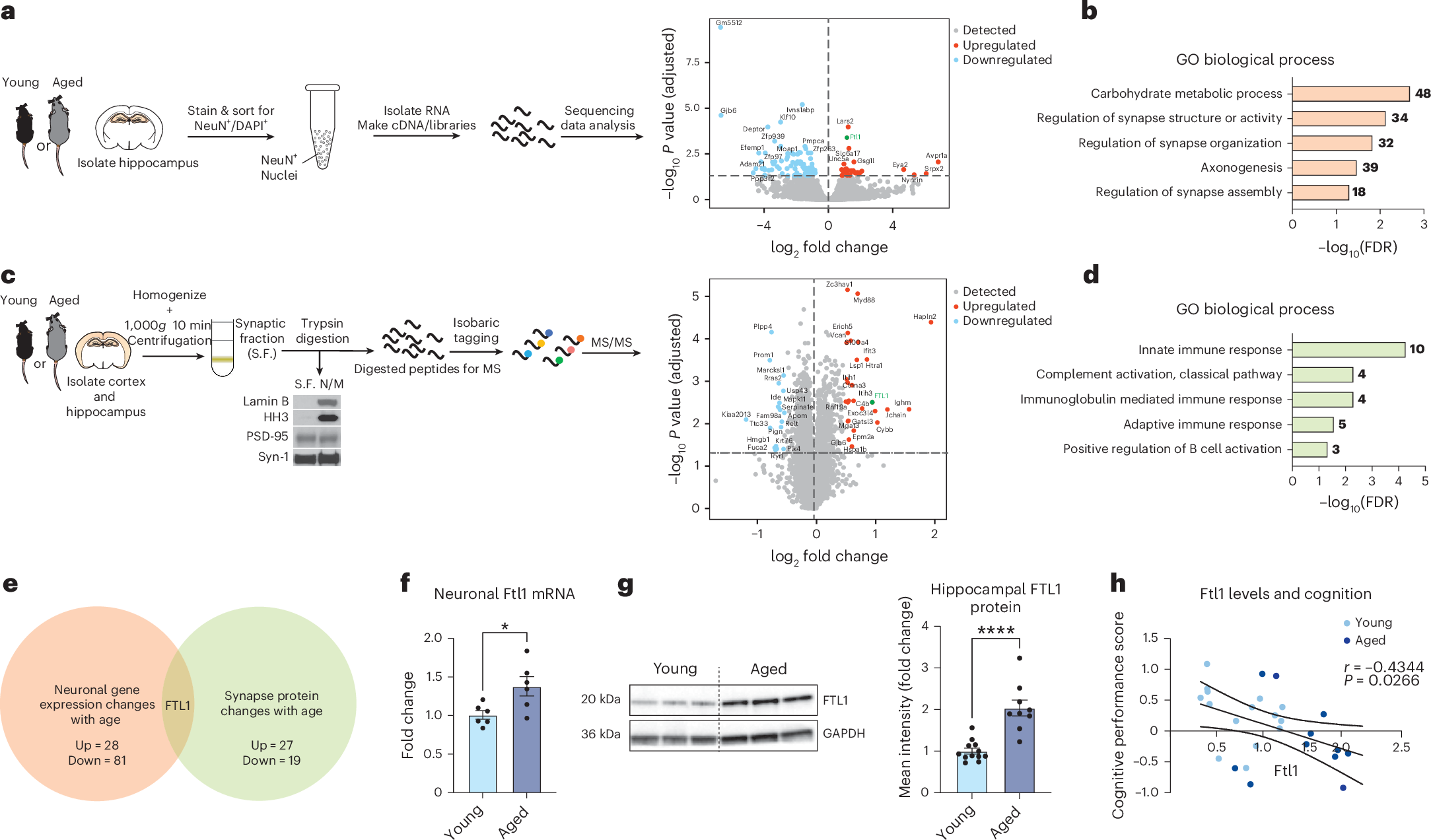
Using transcriptomic and mass spectrometry approaches, we detect an increase in neuronal FTL1 in the hippocampus of aged mice, the levels of which correlate with cognitive decline.
Mimicking an age-related increase in neuronal FTL1 in young mice alters labile iron oxidation states and promotes synaptic and cognitive features of hippocampal aging.
Targeting neuronal FTL1 in the hippocampi of aged mice improves synaptic-related molecular changes and cognitive impairments.
Using neuronal nuclei RNA sequencing, we detect changes in metabolic processes, such as ATP synthesis, and boosting these metabolic functions through NADH supplementation mitigated pro-aging effects of neuronal FTL1 on cognition. Our data identify neuronal FTL1 as a key molecular mediator of cognitive rejuvenation."
This Protein Slows the Aging Brain, and We Know How to Counter It (original news release)
Fig. 1: Neuronal FTL1 increases in the hippocampus with age and negatively correlates with cognitive function.


No comments:
Post a Comment