Good news! Drink modestly!
"Scientists have now discovered how alcohol can switch off an immune "alarm system" in the gut, allowing bad bacteria to escape their natural habitat to flood into the liver, rapidly causing inflammation to the organ. This bacterial invasion is a key driver of the inflammation and injury seen in alcohol-associated liver disease (ALD). ..."
"... Now, scientists ... have found that chronic alcohol use impairs the production of a key cellular signaling protein that helps keep gut bacteria within the gut. Without this guardrail in place, bacteria from the gut can more easily migrate to the liver, exacerbating liver damage caused by alcohol. Targeting this mechanism with existing drugs could provide one approach to minimizing the liver damage from alcohol use and reducing the burden of ALD.
Studying a combination of human liver biopsies and mouse models of ALD, the researchers found:
- Chronic alcohol use reduced the expression of muscarinic acetylcholine receptor M4 (mAChR4), a key cellular communication protein in the gut.
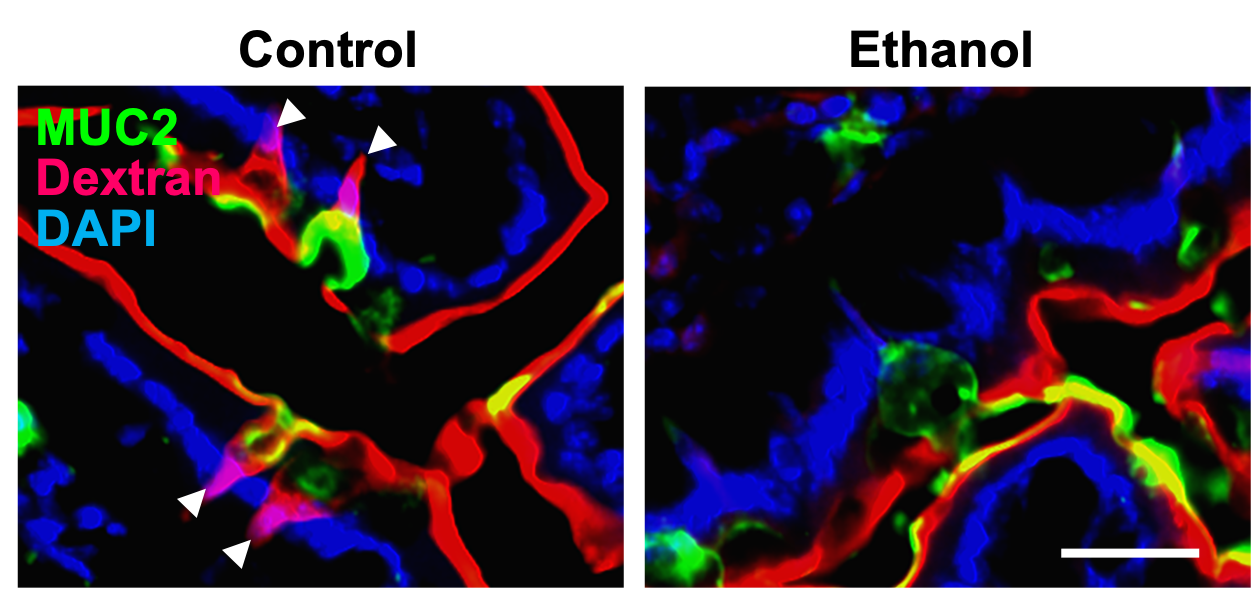
- Reduced mAChR4 expression hindered the formation of goblet cell-associated antigen passages (GAPs), specialized structures that teach the immune system to promote antimicrobial immunity, thereby preventing harmful bacteria from migrating to the liver.
- Restoring mAChR4 function, either by chemically activating mAChR4 or by targeting related signaling pathways allowed GAPs to form and conferred resistance to ALD.
"
From the abstract:
"Alcohol-use disorder and alcohol-associated liver disease (ALD) are major causes of death and liver transplantation. The gut–liver axis has a crucial yet poorly understood role in ALD pathogenesis, which depends on microbial translocation.
Intestinal goblet cells (GCs) educate the immune system by forming GC-associated antigen passages (GAPs) on activation of muscarinic acetylcholine receptor M4 (mAChR4, also known as M4), enabling sampling of luminal antigens by lamina propria antigen-presenting cells.
Here we show that chronic alcohol use in humans and mice downregulates small intestinal mAChR4 and reduces GAP formation, disrupting antimicrobial immunity. This is reversed on activation of intestinal IL-6 signal transducer (IL6ST, also known as glycoprotein 130; gp130), which restores mAChR4 expression and GAP formation, enabling induction of downstream type-3 innate lymphoid cell-derived IL-22 and antimicrobial REG3 proteins. This blunts translocation of enteric bacteria to the liver, thereby conferring ALD resistance. GAP induction by GC-specific mAChR4 activation was essential and sufficient for prevention of ethanol-induced steatohepatitis. These results lay the foundation for a therapeutic approach using mAChR4 or IL6ST agonists to promote GAP formation and prevent ALD by inhibiting microbial translocation."
Alcohol Opens the Floodgates for Bad Bacteria (original news release)
Alcohol Blocks Gut Immune Gatekeepers, Compromising Defense Against Bacteria in ALD "mAChR4 -regulated goblet cell–associated antigen passages (GAPs) train gut immune cells, acting as sentinels, maintaining antimicrobial defense in the gut-liver axis, and positioning mAChR4 agonism and GAP formation as a therapeutic checkpoint for alcohol-associated liver disease (ALD)."
mAChR4 suppresses liver disease via GAP-induced antimicrobial immunity (no public access)
Alcohol reduces mAChR4 and GAP formation. Figure from Llorente et al., Nature, 2025

No comments:
Post a Comment