Good news! Cancer is history (soon)!
"For several years, scientists have been discovering interactions with the nervous system in almost all types of cancer studied, interactions that in many cases promote tumor growth and survival. This also applies to pancreatic cancer, which is interwoven with a dense network of nerves. ...
Pancreatic cancer reprograms nerve cells
In pancreatic tumors, the nerves are extremely well ramified and in contact with most of the tumor cells. Through the detailed molecular analysis of the individual neurons in the tumor, the researchers discovereIn addition to their direct interaction with cancer cells, nerve cells influence in particular the fibroblasts of the tumor (CAF – cancer-associated fibroblasts), which make up a large part of the tumor mass. They are also stimulated to grow and contribute significantly to the suppression of the immune defense in the tumor environment.Nerves cut – tumors shrink
When the sympathetic nerve connections to the pancreas were surgically severed or destroyed with special neurotoxins, tumor growth was significantly inhibited. At the same time, the activity of growth-promoting genes in the cancer cells as well as in the CAFs decreased. In the CAFs, the researchers observed a significant increase in pro-inflammatory gene activity after the nerves were destroyed. d that pancreatic cancer reprograms the gene activity of the nerves for its own benefit. The activity of many genes is increased or attenuated, resulting in a tumor-specific signature. ...
What is more, even after surgical removal of the primary tumor, the tumor nervous system retained its cancer-promoting properties: when the scientists reimplanted pancreatic cancer cells into the animals that had undergone surgery, the resulting secondary tumors were twice as large as those of mice that had been transplanted with pancreatic cancer cells for the first time. ...
In addition to their direct interaction with cancer cells, nerve cells influence in particular the fibroblasts of the tumor (CAF – cancer-associated fibroblasts), which make up a large part of the tumor mass. They are also stimulated to grow and contribute significantly to the suppression of the immune defense in the tumor environment.
Nerves cut – tumors shrink
When the sympathetic nerve connections to the pancreas were surgically severed or destroyed with special neurotoxins, tumor growth was significantly inhibited. At the same time, the activity of growth-promoting genes in the cancer cells as well as in the CAFs decreased. In the CAFs, the researchers observed a significant increase in pro-inflammatory gene activity after the nerves were destroyed. ..."
From the abstract:
"The peripheral nervous system (PNS) orchestrates organ function in health and disease. Most cancers including pancreatic ductal adenocarcinoma (PDAC) are infiltrated by PNS neurons, contributing to the complex tumor microenvironment (TME). However, neuronal cell bodies reside in various PNS ganglia, far from the tumor mass. Thus, cancer or healthy organ-innervating neurons elude current tissue sequencing datasets.
To molecularly characterize pancreas- and PDAC-innervating neurons at single cell resolution, we developed “Trace-n-seq”. This method employs retrograde tracing of axons from tissues to their respective ganglia followed by single-cell isolation and transcriptomic analysis. By characterizing >5.000 individual sympathetic and sensory neurons with about 4.000 innervating PDAC or healthy pancreas we reveal novel neuronal cell types and unique molecular networks distinct to pancreas, pancreatitis, PDAC, or melanoma metastasis. We integrate single-cell datasets of innervating neurons and the TME to establish a neuro-cancer-microenvironment interactome, delineate cancer-driven neuronal reprogramming and generate a pancreatic cancer-nerve signature. Pharmacological denervation induces a proinflammatory TME and increases immune-checkpoint inhibitor effectiveness. Nab-Paclitaxel causes intra-tumor neuropathy which attenuated PDAC growth and in combination with sympathetic denervation results in synergistic tumor regression. Our multi-dimensional data reveal new insights into the networks and functions of PDAC-innervating neurons, supporting inclusion of denervation in future therapies."
Characterization of single neurons reprogrammed by pancreatic cancer (no public access)
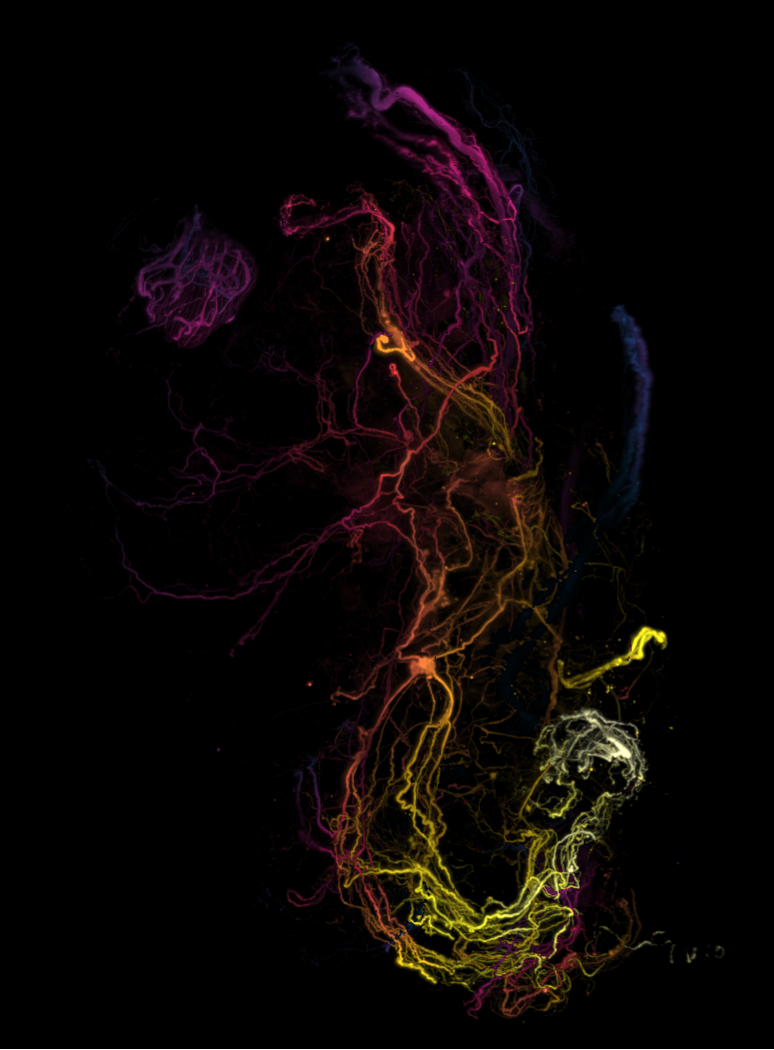
First, the pancreatic tumor of a mouse is made transparent using various chemicals. Then, the dense network of neuronal structures that innervate the tumor and contribute to its growth is visualized using light-sheet fluorescence microscopy.

No comments:
Post a Comment