This question has been posed again and again over the past two decades or more. An empirically confirmed answer to this question would make a huge difference.
It also affects the key question how much of the increase in the life essential trace gas CO2 is caused by humans or by nature.
The climate change alarmists and demagogues claim it is a leading indicator or even the cause of global warming, but without convincing evidence.
Remember and keep in mind, since about 1850 we are coming out of the Little Ice Age! A fact conveniently omitted by the alarmists and demagogues!
Apparently, there is a new study suggesting it is a lagging indicator, warming comes first.
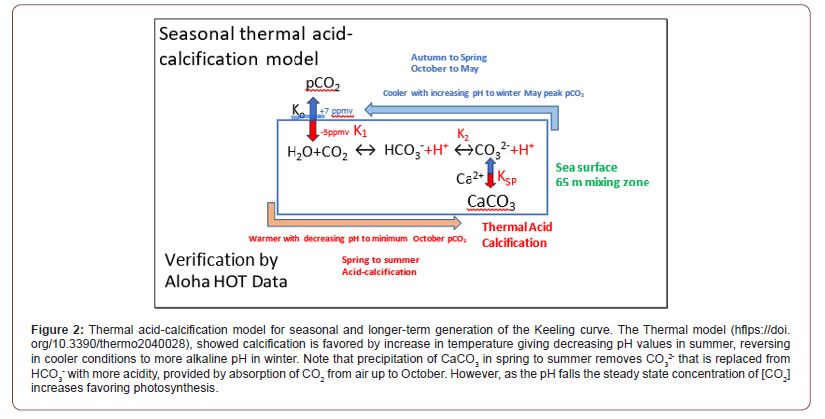
"New research by an international team of public and private sector researchers from Australia and Thailand published in the journal Advances in Oceanography and Marine Biology suggests an alternative explanation for the past half century’s rise in carbon dioxide concentrations: the modest increase in the acidity of the ocean resulting in a release of carbon dioxide.
According to this theory, warming is causing carbon dioxide (CO2) to increase, not the other way around. This hypothesis, which would be consistent with proxy data from the ancient past, suggests past periods of warming have consistently preceded a rise in CO2. Put another way, CO2 is the lagging, not leading, indicator of change. ..."
From the abstract:
"The Keeling Curve documents a steady rise in partial atmospheric pressure of CO₂ (pCO2), conventionally attributed to fossil fuel emissions.
Here, we propose an alternative cause, the thermal acidifying-calcification (TAC) hypothesis, principles of physical chemistry showing that warming will induce calcification in surface seawater, driving seasonal and longer-term increases in atmospheric pCO2. Using thermodynamic modeling and oceanographic data, we estimate that precipitation of ~10 μmol of of CaCO₃ per kg of surface seawater annually could release sufficient CO₂ to equilibrate locally with the recent 2 ppmv annual rise in atmospheric pCO2. Seasonal pH and pCO2 variations at marine stations (e.g., ALOHA, Hawaii) support this mechanism, challenging the dominant terrestrial photosynthesis- respiration explanation for Keeling oscillations. The TAC process can also explain the decreasing trend in 13CO2 in air because of dilution by the same processes that are driving the longer-term increase in atmospheric pCO2. To test this hypothesis, we recommend the following program: 1. field validation of CaCO₃ deposition rates, 2. measures of the CO2 flux and 3. isotopic analysis to test this alternative carbon cycle driver with measures to be taken both in the northern Pacific and in the southern hemisphere on a transect past the Great Barrier Reef."
Credits: The Heartland Institute (The Heartland Institute Climate Change Weekly newsletter)

No comments:
Post a Comment