Amazing stuff!
"... The white blood cells in question are cytotoxic T lymphocytes (CTLs), also known as killer T cells. These “warrior” cells work to kill off infected or cancerous cells in what is both a quick yet incredibly complex process. ...
“It triggers enormous reorganization of all the intracellular organelles that polarize exquisitely and focus on an immune synapse that they form with the cell they’re going to kill. ...”
It’s well established from earlier research ... that the centrosome—the organelle responsible for moving the granules full of killing molecules—orients to the immune synapse during a killing event, but they were shocked to find that the nucleus was moving too, and in fact moved sooner than the centrosomes. ...
From start to finish, it takes a CTL about six minutes to identify its target and deliver a killing blow of granules. While a relatively speedy process compared with other cellular interactions, a lot happens during those six minutes, ... team analyzed using four-dimensional cellular imaging.
“We can use different combinations of markers for the different organelles and combine many observations to draw ourselves a map of events leading to granule delivery ...” ...
The whole six minutes starts with a flux of calcium as T cell signaling starts. However, after only two to three minutes, proteins that control gene activity, called transcription factors, migrate into the nucleus and prompt it to start churning out chemokines and cytokines, molecules that act as extra weapons the CTL can use to help kill its target. Remarkably, at the same time the nucleus starts migrating across the cell to the immune synapse. ...
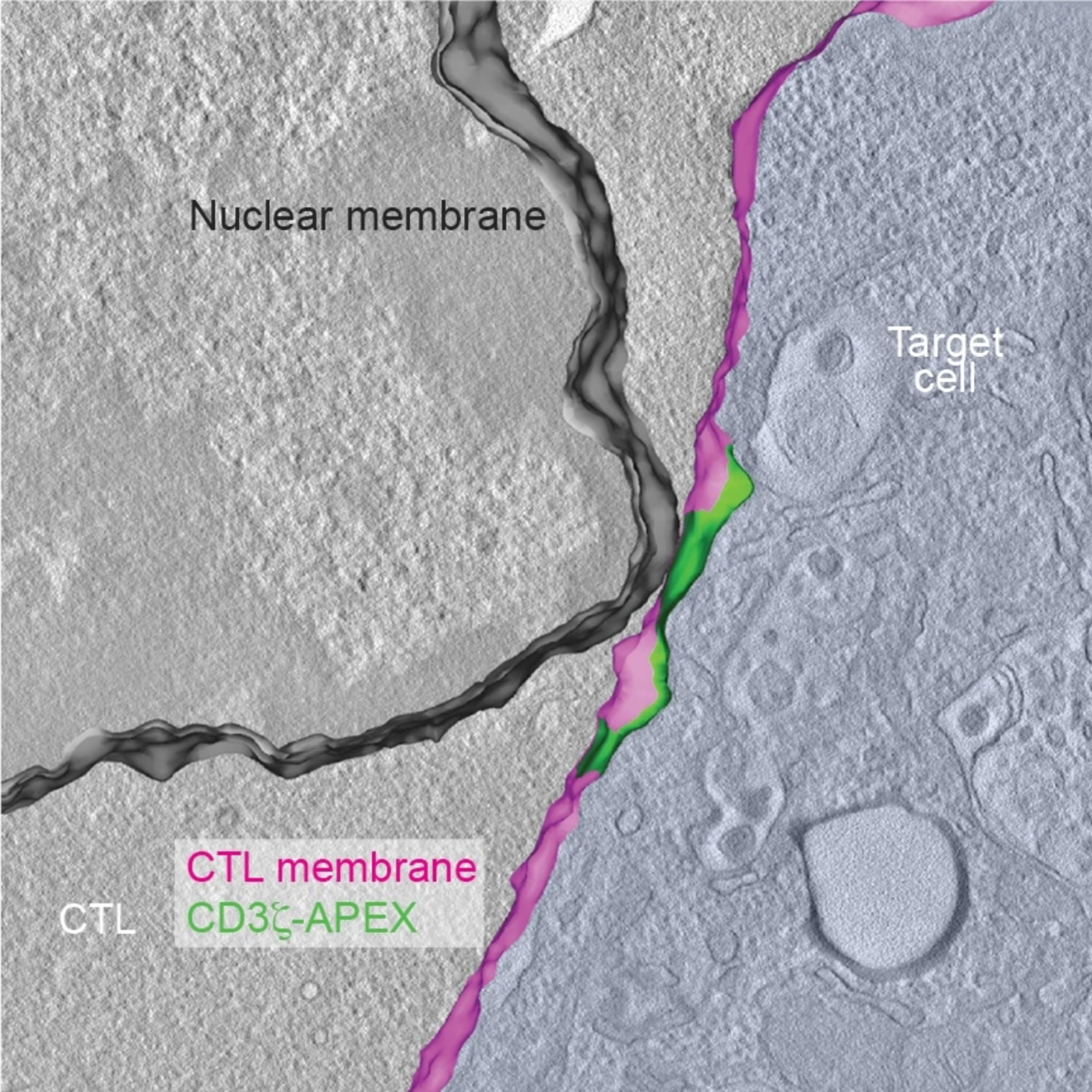
what happens to the nucleus once it reaches its final destination. They found that the nucleus distorts as it moves, puckering the nuclear membrane to focus directly at the immune synapse.
Other organelles like the Golgi apparatus and endoplasmic reticulum localize to the area as well, forming a highly organized pipeline of cellular machinery: the nucleus churns out the instructions to make chemokines and cytokines, where they are immediately made at the endoplasmic reticulum and then shipped off to the target via the Golgi. ...
“Any newly synthesized protein that’s due for secretion will be transported incredibly quickly because you’ve moved the nucleus right there,” ...
While nuclear movement has been identified in other cellular interactions such as wound healing and even in plant cells, the movement isn’t nearly as dramatic ... with the CTLs. ..."
From the editor's summary and abstract:
"Editor’s summary
During cytotoxic T cell (CTL) killing, formation of the immune synapse facilitates the delivery of cytolytic granules, but how CTL intracellular dynamics are coordinated to support target cell killing remains incompletely understood.
Using three-dimensional live-cell imaging, Asano et al. found that the CTL nucleus localizes to the immune synapse and docks at the plasma membrane in a myosin IIA–dependent manner.
Nuclear polarization coincided with transcription factor translocation to the nucleus and facilitated the synthesis of new proteins for delivery to the immune synapse. These findings demonstrate that nuclear polarization represents a key step during CTL-mediated killing. ...
Abstract
Target cell recognition by cytotoxic T lymphocytes (CTLs) triggers rapid delivery of cytolytic granules to the immune synapse directed by the centrosome.
Recent studies have also identified a rapid burst of T cell receptor (TCR)–activated transcription that contributes to CTL-mediated killing.
To determine how de novo transcription might be coordinated with intracellular polarization, we asked when transcription factor translocation to the nucleus occurs relative to TCR activation and centrosome polarization within individual CTLs. Upon target cell recognition, the nucleus polarized to and contacted the immune synapse, preceding centrosome docking. The nucleus distorted as it moved, with transcription factors NFAT and NF-κB accumulating in the nucleus during polarization.
Inhibition or deletion of myosin IIA prevented both nuclear polarization and transcription factor translocation.
Thus, nuclear polarization facilitates an early transcriptional burst that occurs as CTLs encounter targets and the consequent delivery of newly synthesized cytokines to the immune synapse."
The nucleus of a killer T cells orients to the synapse where the T cell meets its target

No comments:
Post a Comment