Amazing stuff!
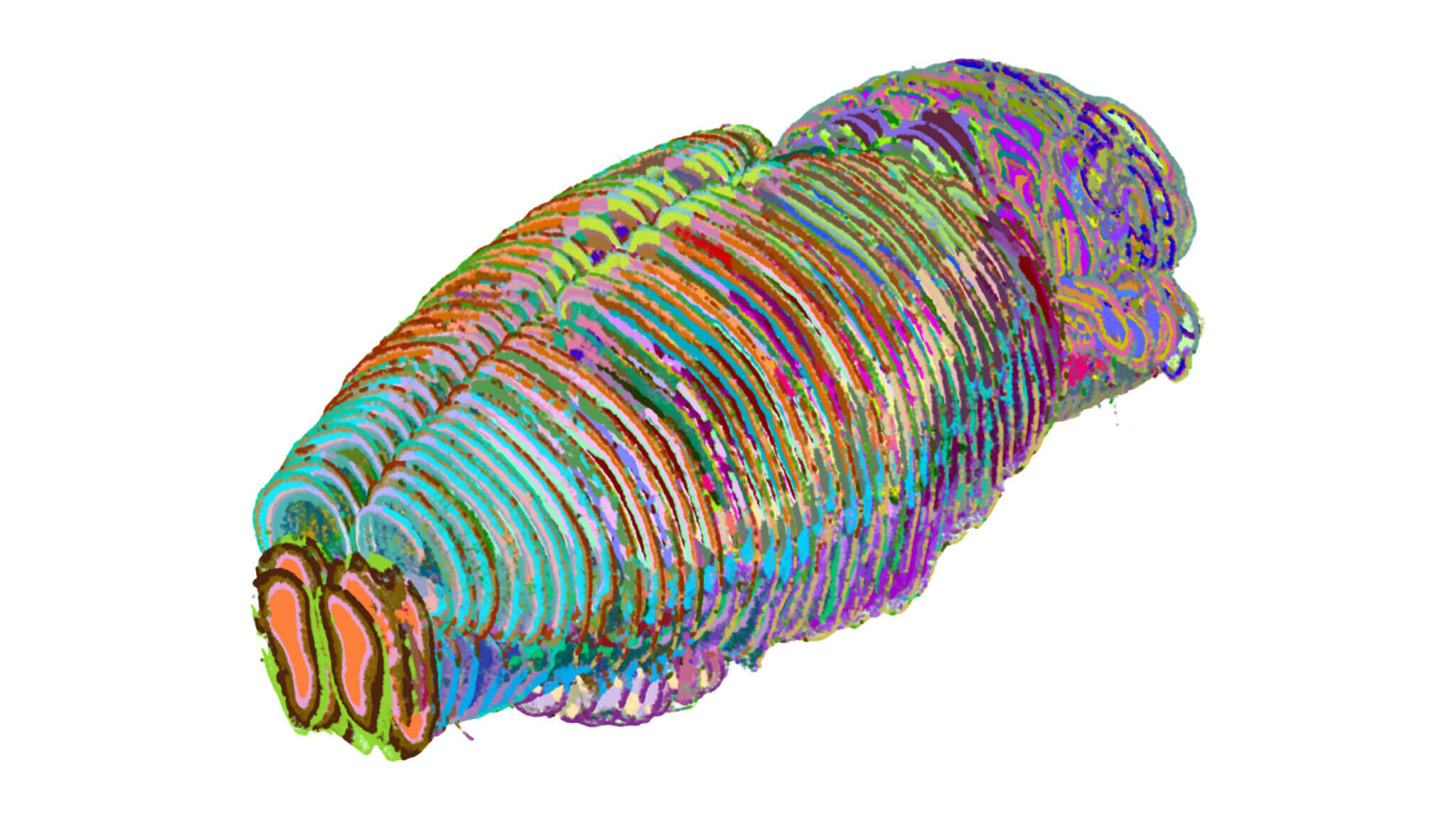
"Unleash artificial intelligence on an atlas that catalogs all cell types in a mouse brain, and—voilà! – you get one of the most granular and complex data-driven brain visualizations of any animal to date: a technicolor dream highlighting 1300 brain regions and subregions, including many that were previously uncharted.
“It’s like going from a map showing only continents and countries to one showing states and cities,” ... She and her colleagues developed a new AI tool called CellTransformer to make sense of vast spatial transcriptomics datasets that record where millions of cells sit and which genes they express. Traditional methods for mapping the brain’s cellular geography rely on hand-drawn, or annotated, atlases; CellTransformer’s algorithms infer from transcription patterns how cells are organized into functional neighborhoods.
When the researchers applied CellTransformer to the Allen Brain Cell Atlas, which encompasses nearly four million cells, it recapitulated known structures in the mouse brain such as the hippocampus but also uncovered hundreds of previously unannotated microregions, the team reported. ..."
"... CellTransformer, a powerful AI model that can automatically identify important subregions of the brain from massive spatial transcriptomics datasets. Spatial transcriptomics reveals where certain brain cell types are positioned in the brain but does not reveal regions of the brain based on their composition. Now, CellTransformer allows scientists to define brain regions and subdivisions based on calculations of shared cellular neighborhoods, much like sketching a city’s borders based on the types of buildings within it. ..."
From the abstract:
"Spatial transcriptomics offers unique opportunities to define the spatial organization of tissues and organs, such as the mouse brain. We address a key bottleneck in the analysis of organ-scale spatial transcriptomic data by establishing a workflow for self-supervised spatial domain detection that is scalable to multimillion-cell datasets.
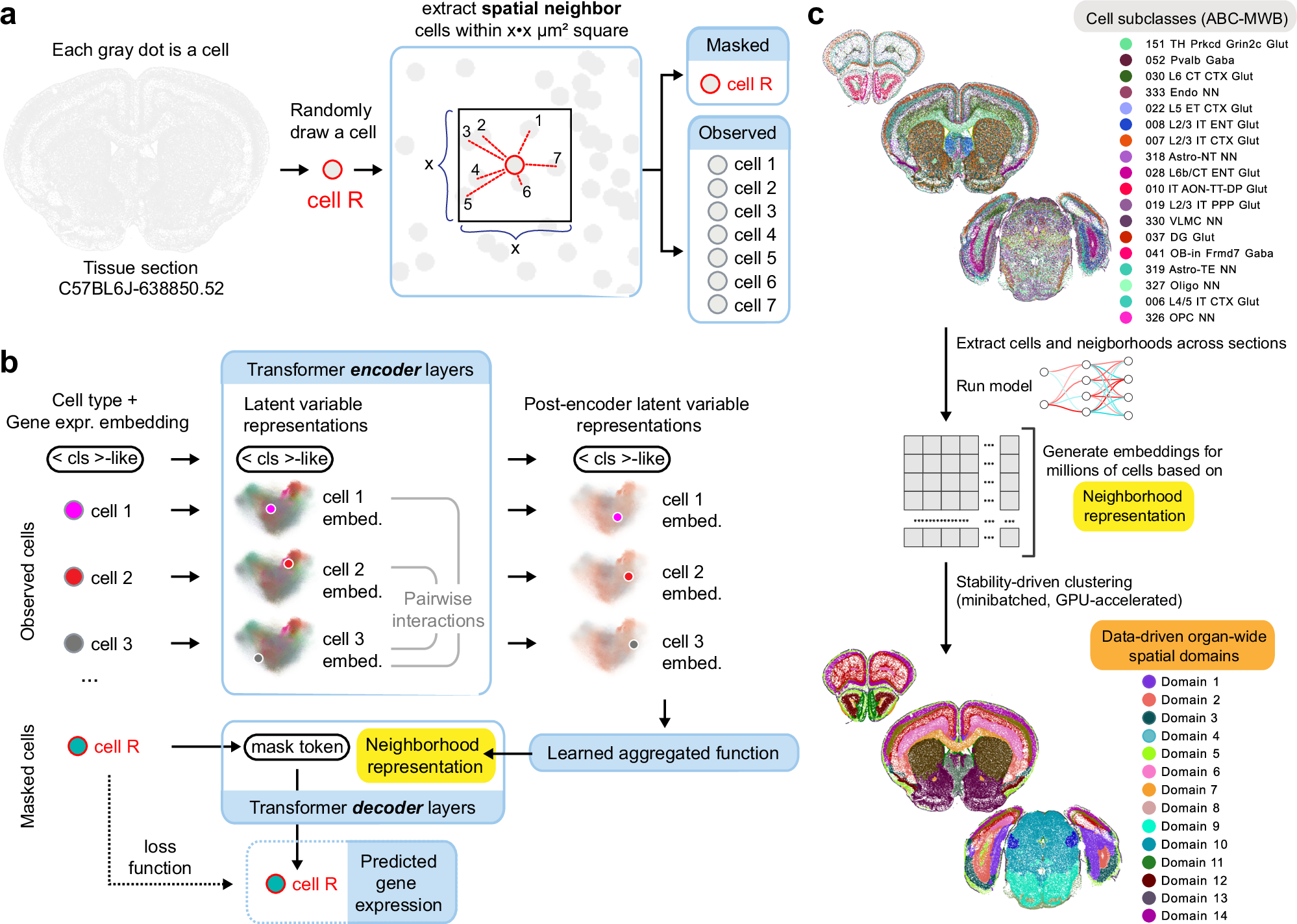
This workflow uses a self-supervised framework for learning latent representations of tissue spatial domains or niches. We use an encoder-decoder architecture, which we named CellTransformer, to hierarchically learn higher-order tissue features from lower-level cellular and molecular statistical patterns.
Coupling our representation learning workflow with minibatched GPU-accelerated clustering algorithms allows us to scale to multi-million cell MERFISH datasets where other methods cannot.
CellTransformer is effective at integrating cells across tissue sections, identifying domains highly similar to ones in existing ontologies such as Allen Mouse Brain Common Coordinate Framework (CCF) while allowing discovery of hundreds of uncataloged areas with minimal loss of domain spatial coherence. CellTransformer domains recapitulate previous neuroanatomical studies of areas in the subiculum and superior colliculus and characterize putatively uncataloged subregions in subcortical areas, which currently lack subregion annotation.
CellTransformer is also capable of domain discovery in whole-brain Slide-seqV2 datasets.
Our workflows enable complex multi-animal analyses, achieving nearly perfect consistency of up to 100 spatial domains in a dataset of four individual mice with nine million cells across more than 200 tissue sections.
CellTransformer advances the state of the art for spatial transcriptomics by providing a performant solution for the detection of fine-grained tissue domains from spatial transcriptomics data."
Scientists create ChatGPT-like AI model for neuroscience to build detailed mouse brain map (original news release) "Artificial intelligence reveals undiscovered regions of the brain from large-scale spatial transcriptomics data"
Fig. 1: Overall training and architectural scheme for CellTransformer.
Three-dimensional representation of regions/subregions in mouse brain map created by CellTransformer. Fewer regions are generated for visual clarity and simplicity.

No comments:
Post a Comment